
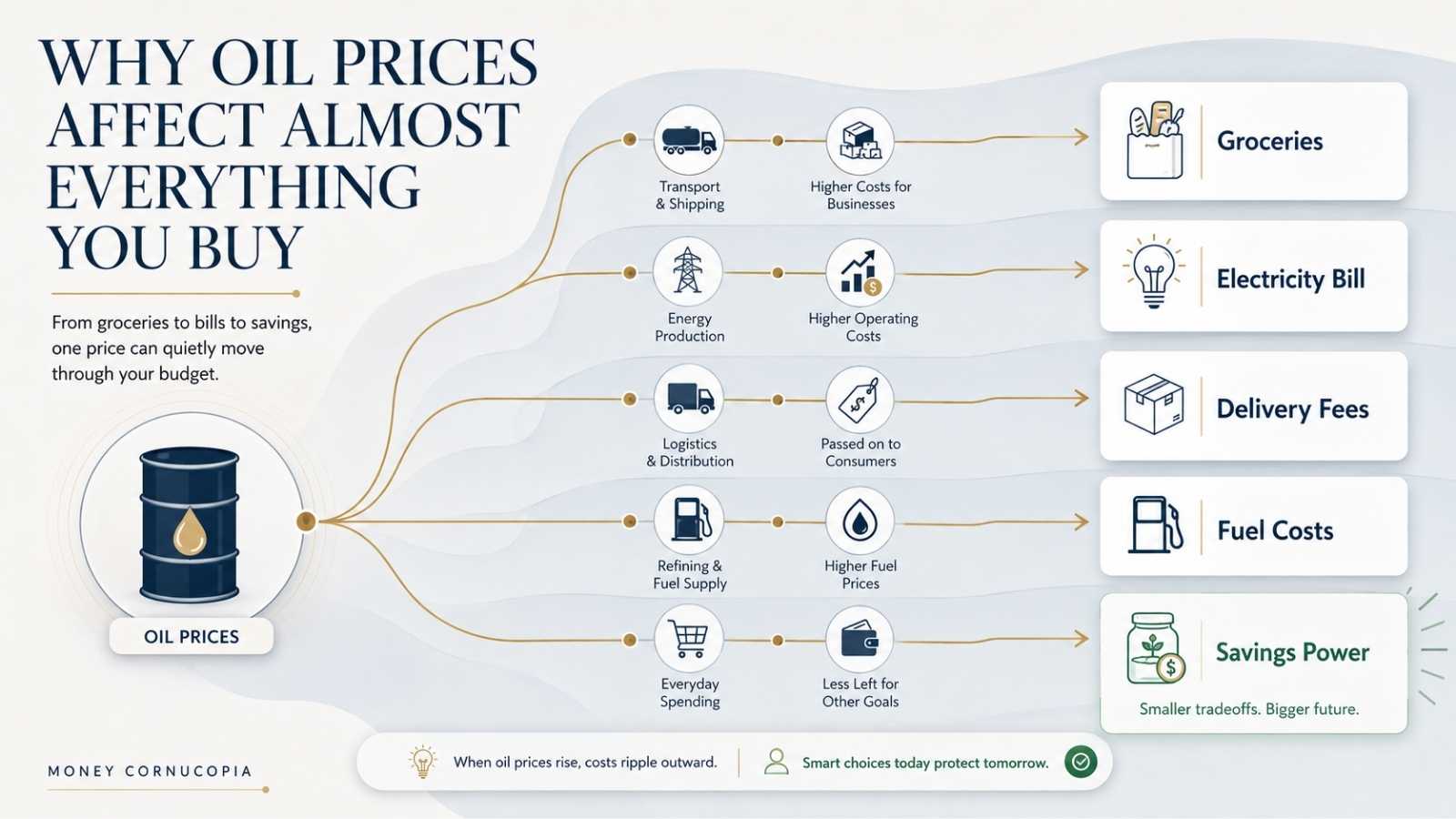
Oil prices rise. You notice it at the petrol station first. Then your grocery bill goes up. Then your electricity bill. Then the delivery fee on your online order.
It feels like everything is connected. Because it is.
Most people understand that expensive oil means expensive petrol. What most people do not understand is everything else. The food. The electricity. The packaging. The fertilizer. The plastics. The shipping. And the savings account that quietly loses value while all of this is happening.
This article explains the full chain reaction in plain language, from a single barrel of crude oil to your monthly budget, and what you can actually do about it.
Quick Answer: Why Do Oil Prices Affect Everything?
Oil affects prices across the economy for two reasons. First, oil is the fuel that powers almost all transportation, meaning everything that moves anywhere costs more when oil is expensive. Second, oil is a physical ingredient in a vast range of products, from the plastic packaging around your groceries to the fertilizer used to grow the food inside.
When oil gets expensive, the cost of moving things goes up. The cost of making things goes up. The cost of growing things goes up. Eventually, all of those costs reach you, the buyer at the end of the chain.
The impact is not immediate. Petrol prices respond within days. Shipping costs follow in weeks. Grocery prices take months. But the connection is real, it is predictable, and understanding it helps you manage your budget before the damage arrives rather than after.
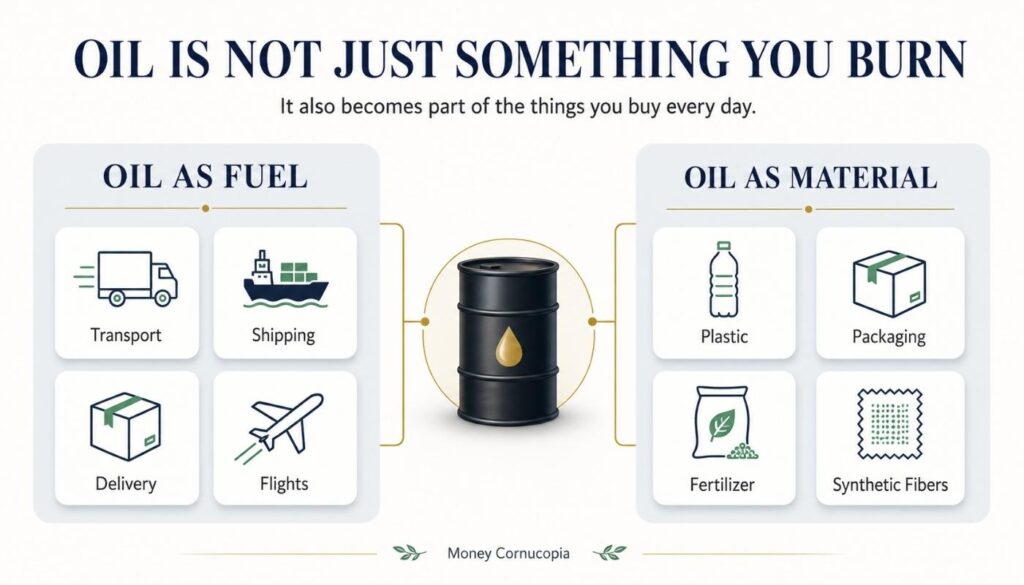
Table of Contents
Why Oil Is More Than Just Petrol
Most petroleum becomes fuel. But a significant share becomes the materials and chemicals that make up everyday life.
According to the US Energy Information Administration, about 71% of all petroleum consumed in the US is used for transportation fuels, including gasoline, diesel, and jet fuel. The rest is used across industrial, commercial, residential, and other uses, including petrochemicals that become plastics, packaging, synthetic fibers, and many everyday materials.
Oil is not only something you burn. It is also something the modern economy builds with. The plastic on your desk. The packaging on your lunch. The fabric in your clothes. Petrochemicals derived from petroleum are used in the manufacture of an enormous range of everyday products.
The quantity of oil-based polyester in clothing has doubled since 2000. Over half of all fibers produced worldwide are now made from petroleum. The cosmetics industry is heavily dependent on petroleum since items such as hand cream, shampoo, and most makeup are made from petrochemicals. S&P Dow Jones Indices
That is why an oil price change does not stay contained at the pump. It moves outward through supply chains into almost every category of spending you have.
How Oil Reaches Your Grocery Bill
Oil does not just deliver your food. It helps grow it.
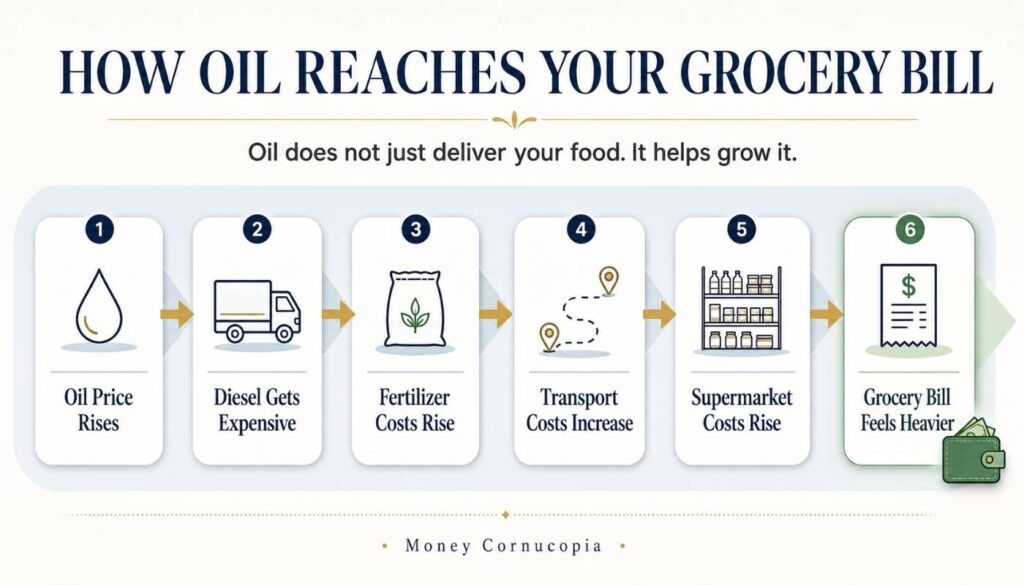
This is the part most people never think about, and it is where the biggest impact on household budgets comes from.
The food industry is especially sensitive to the price of energy, more so than any other sector, because petroleum is a key component of its supply chain at every step of the way, from planting and harvesting through processing and packaging. The biggest use of petroleum in industrial farming is not transportation or fueling machinery but rather fertilizers. Vast amounts of oil and natural gas go into fertilizers and pesticides used to produce and protect grains, vegetables, and fruits. It takes 283 gallons of oil to raise one 1,250-pound steer. S&P Dow Jones Indices
Before a single truck has moved, the food you will buy in three months time is already more expensive to grow.
Then add the transport layer. Fuel prices account for 50% to 60% of the total operating cost of shipping goods by ship. When diesel gets expensive, every truck, train, and ship carrying food charges more. Distributors add surcharges. Wholesalers pass costs to supermarkets. Supermarkets eventually pass costs to you (Swissamerica).
Why Food Prices Often Rise After Oil Prices
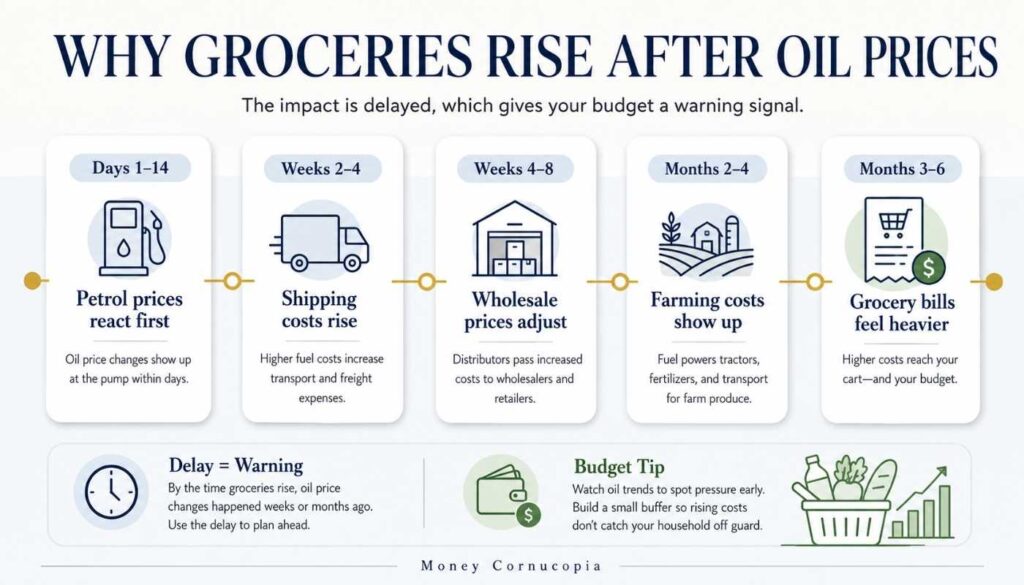
The lag between an oil spike and a higher grocery bill is real. Here is exactly how it works.
The chain spreads in stages, and each stage adds time:
| Timeline | What happens | Where you feel it |
|---|---|---|
| Days 1 to 14 | Crude oil prices rise. Wholesale fuel prices climb. Petrol station prices jump | You notice immediately at the pump |
| Weeks 2 to 4 | Diesel prices follow. Trucking and shipping companies add fuel surcharges. Freight rates rise | Delivery fees and shipping costs |
| Weeks 4 to 8 | Higher transport costs reach distributors and wholesalers. Supermarkets begin seeing higher wholesale prices from suppliers | Supermarket supply chain |
| Months 2 to 4 | Fertilizer costs rise because natural gas is a key ingredient in fertilizer production. Food planted months ago becomes more expensive to harvest and process | Farming input costs |
| Months 3 to 6 | Grocery prices for consumers begin rising noticeably. Fresh produce, meat, and dairy tend to rise first as they are most transport-dependent | Your grocery receipt |
I noticed this in my own shopping. The petrol price spike happened in early spring. My grocery bill started feeling heavier two to three months later, without me buying anything different. The lag is real, and it is also a warning signal. When you see an oil price spike in the news, you have weeks, sometimes months, before the full impact reaches your grocery receipt.
Americans spend roughly 10% of their disposable income on food, which is about twice what they spend on gas. Concerns over grocery prices topped consumer concern polling in 2025, 2024, and 2023. The grocery impact is the oil shock that lasts the longest and hurts the most (Bitget).
Can Oil Prices Affect Electricity Bills?
Yes, but the connection is indirect. Here is how it actually works.
Oil does not directly set most electricity prices. In most countries, electricity prices are more directly affected by natural gas, coal, renewables, grid infrastructure costs, and local utility pricing. But during broader energy shocks, oil and natural gas prices can rise at the same time, which is why an oil price spike may still coincide with higher electricity bills even for households that never buy a drop of petrol.
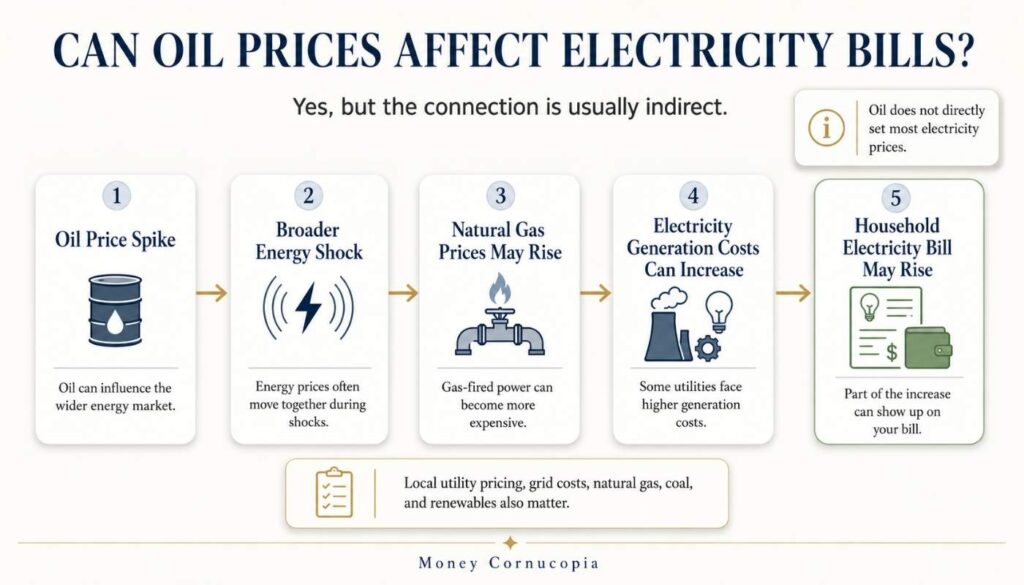
According to the US Energy Information Administration, natural gas accounts for roughly 41% of US electricity generation. When energy markets experience broad supply disruptions, natural gas prices often rise alongside oil, which can push electricity generation costs higher and filter through to household bills.
The second connection is through heating. Homes heated with oil or natural gas see direct cost increases when energy prices rise. Even homes on electricity face higher bills when the electricity itself costs more to generate.
This is why an energy price shock does not only hit drivers. It hits renters, households in cold climates, and anyone who uses electricity, which means everyone.
How Oil Affects Shipping, Packaging, and Online Shopping
Every time you click add to cart, you are buying something that moved through an oil-powered supply chain.
The product you ordered was made in a factory that used energy, packaged in plastic made from petrochemicals, transported from a manufacturer to a warehouse by diesel-powered vehicles, stored in a warehouse that uses electricity, and then loaded onto another vehicle for final delivery.
Every stage uses oil. Every stage passes costs forward. By the time the package arrives at your door, the oil price has been embedded multiple times.
When fuel prices rise, courier companies adjust their surcharges quickly. You may see delivery fees tick up, free delivery thresholds increase, or shipping times lengthen as companies reroute to save fuel. None of it is dramatic on any given day, but across a full month of shopping, it adds up.
How Oil Prices Affect Inflation
Oil-driven inflation is different from other types, and that difference matters for your money.
Oil price increases are generally thought to increase inflation and reduce economic growth. In terms of inflation, oil prices directly affect the prices of goods made with petroleum products and indirectly affect costs such as transportation, manufacturing, and heating. The increase in these costs can, in turn, affect the prices of a variety of goods and services as producers pass production costs on to consumers. Bitget
This type of inflation, driven by rising production costs rather than rising consumer demand, is what economists call cost-push inflation. It is harder to fight than demand-driven inflation because central banks cannot reduce the price of oil by raising interest rates. They can slow spending, but they cannot fix a supply disruption.
That means oil-driven inflation tends to be persistent. It does not disappear when the central bank acts. It fades only when oil prices themselves stabilize or fall. The 1973 oil shock, the 1979 oil shock, and the 2008 commodity spike all followed the same pattern. Prices rose sharply, inflation ran high, and the full economic effect lasted far longer than the initial supply disruption.
How Inflation Quietly Hurts Your Savings
This is the part nobody explains, and it is where the quiet damage happens.
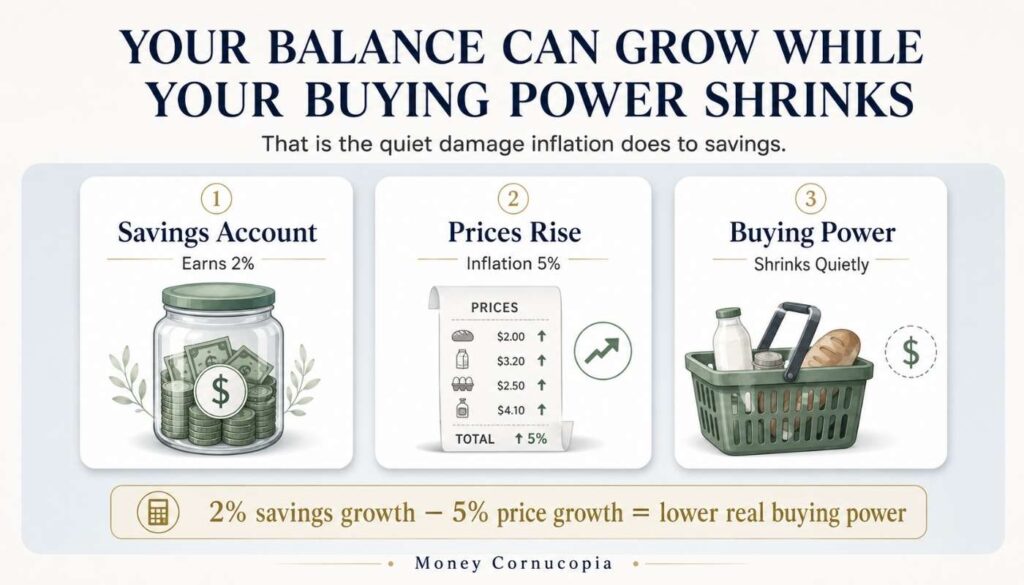
When oil drives inflation, your account balance can go up while your purchasing power goes down. That gap between your savings rate and the inflation rate is where the real cost lives.
This is not about being alarmist. It is about recognizing that your account balance growing does not automatically mean your purchasing power is growing. If your money earns 2% in a savings account while oil-driven prices rise by 5%, your balance is higher, but your real buying power is lower. You can buy less with more money. I covered exactly how this works in my article on what happens when your savings rate is lower than inflation.
There is a very strong correlation between the movement of energy prices and the movement of food prices. Oil topping $100 a barrel has historically coincided with significant food price inflation. Wall Street Survivor
Let me put the household budget impact in concrete terms:
| Budget item | Normal month | Oil shock month |
|---|---|---|
| Petrol and transport | $80 | $110 |
| Groceries | $300 | $340 |
| Electricity bill | $60 | $75 |
| Online shopping delivery | $15 | $22 |
| Total monthly impact | $455 | $547 |
That is roughly $90 extra per month. Over a year, that is more than $1,000 in additional spending that was not in the original budget. The impact is not dramatic enough to feel like an emergency on any given day. It is quiet. Gradual. Cumulative. That is exactly how oil-driven inflation works.
Understanding the time value of money means understanding that money sitting still is money moving backwards when inflation runs above your savings rate. Inflation-resilient assets like broadly diversified index funds have historically outpaced oil-driven inflation over long periods, which is why keeping some portion of your money working outside a savings account matters when energy prices stay elevated.
What You Can Actually Do When Oil Prices Rise
The practical steps that actually help your budget, not just generic advice.
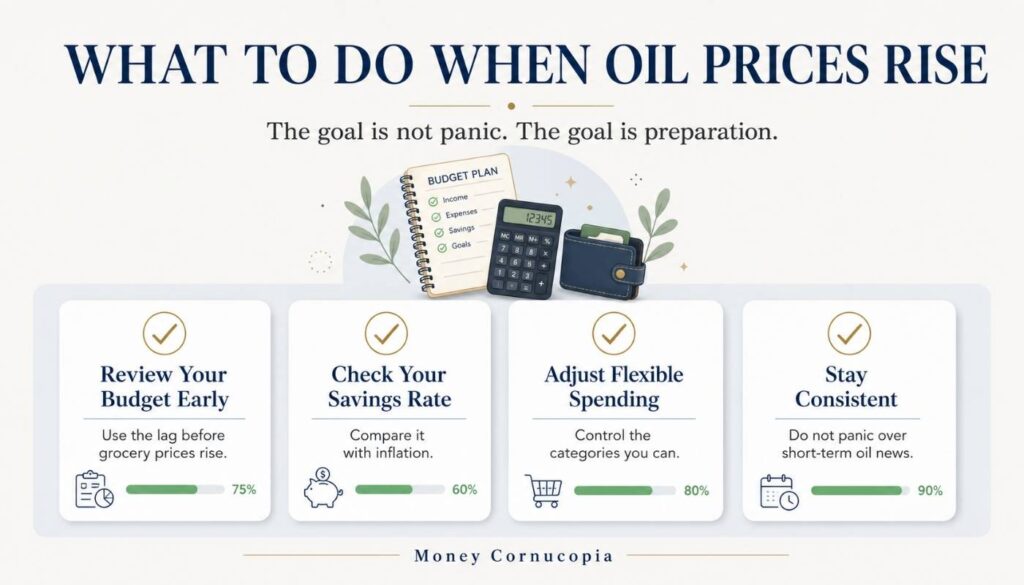
Review Your Budget Before the Prices Arrive
Oil drives prices with a predictable lag. Use that lag. When you see oil prices spiking in the news, review your budget now. Identify where you have flexibility before the increases arrive rather than scrambling to adjust after your grocery bill has already climbed.
Check Your Savings Rate Against Inflation
Go to your bank account and find your savings interest rate. Compare it to the current inflation rate. If your rate is lower than inflation, which it typically is during oil-driven price spikes, your real purchasing power is shrinking even while your balance grows. Emergency funds should stay in cash. But money you will not need for 12 months or more should be working harder. I covered the step-by-step approach in how to start investing with just $100.
Think About Your Asset Allocation
When oil drives inflation, having your money spread across different types of assets matters more than usual. A basic understanding of asset allocation and diversification helps you decide how much of your money should stay in cash, how much in investments, and how much in assets that have historically held value during inflationary periods.
Adjust Your Flexible Spending
Some oil-driven costs are fixed: electricity, gasoline to get to work, and heating. Others are flexible: eating out frequency, brand choices at the supermarket, and timing of discretionary purchases. Identifying which is which gives you real control, even when the broader economy is working against your budget.
Stay the Course With Long-Term Investments
If your investment portfolio dips during an oil shock, that is normal and expected. Markets have absorbed every major oil shock in history. Short-term price drops during energy crises have historically recovered. Making dramatic investment changes in response to oil news is usually a worse outcome than staying the course with a sensible long-term allocation.
Frequently Asked Questions
Why do oil prices affect food prices?
Higher oil prices raise costs across the food supply chain, from fuel used in farming and fertilizer production to transportation and refrigeration, according to the Federal Reserve Bank of St. Louis. Oil is not just used to deliver food. It is used to grow it through fertilizer production that requires oil and natural gas as raw materials. The effect on grocery prices is delayed by one to three months but is real and well-documented by agricultural economists (GoldSilver).
Do oil prices affect electricity bills?
Indirectly, yes. Oil does not directly power most electricity generation. According to the US Energy Information Administration, natural gas accounts for roughly 41% of US electricity generation. During broader energy market disruptions, oil and natural gas prices can rise at the same time, which is why an oil shock may coincide with higher electricity bills even for households that do not own a car.
Why do oil prices cause inflation?
Oil price increases are generally thought to increase inflation and reduce economic growth. Oil prices directly affect the prices of goods made with petroleum products and indirectly affect costs such as transportation, manufacturing, and heating. Producers typically pass these production cost increases on to consumers. Because oil affects so many sectors simultaneously, its price changes create broad, simultaneous cost increases across the economy, which is what drives generalized inflation (Bitget).
What happens to groceries when oil prices rise?
Grocery prices typically rise one to three months after an oil spike. Fresh produce, meat, and dairy tend to rise first because they are most transport-dependent. Fertilizer-related agricultural costs take longer, sometimes six months or more, to work through to food prices. Americans spend roughly 10% of their disposable income on food, about twice what they spend on gas, and grocery prices topped consumer concern polling for three consecutive years (Bitget).
How can I protect my budget from rising oil prices?
The most practical steps are reviewing your budget before grocery and energy prices fully arrive, checking that your savings account rate is not falling significantly behind inflation, considering whether your longer-term savings are appropriately allocated across different asset types, and adjusting flexible spending categories to absorb fixed cost increases. Understanding the lag between oil price spikes and grocery price rises gives you a practical window to prepare rather than react.
How long does it take for oil prices to affect grocery prices?
The full effect typically takes one to three months for most grocery items. Petrol prices react within days. Shipping and transport costs adjust within weeks. Grocery prices for consumers rise noticeably within one to three months. Fertilizer-related agricultural cost increases can take six months or longer to reach supermarket shelves.
Is the connection between oil prices and everyday costs permanent?
The connection exists as long as oil remains central to transportation, manufacturing, and agriculture. According to the EIA, petroleum products account for about one-third of total world energy consumption. Over time, the electrification of transport and renewable energy could reduce the sensitivity of everyday prices to oil. But for now, oil’s role in fuel, fertilizer, and plastic production means its price touches almost everything in the global economy.
Final Thoughts
When oil prices rise, the impact does not stay at the petrol station. It flows quietly through your grocery bill, your electricity bill, your delivery fees, your savings account, and your broader purchasing power.
The chain is long. The lag is real. And that lag is actually useful for anyone who understands it. You have weeks, sometimes months, between the oil price headline and the full impact on your household budget. That is enough time to prepare, adjust, and make decisions rather than react.
Understanding inflation, understanding how your savings rate compares to rising prices, and understanding how to spread your money across different assets does not require a degree in economics. It requires knowing the connection.
Oil touches almost everything you buy. Now you know why. And knowing why is the first step to making decisions that actually protect your money when prices start climbing.
Leave a Reply