
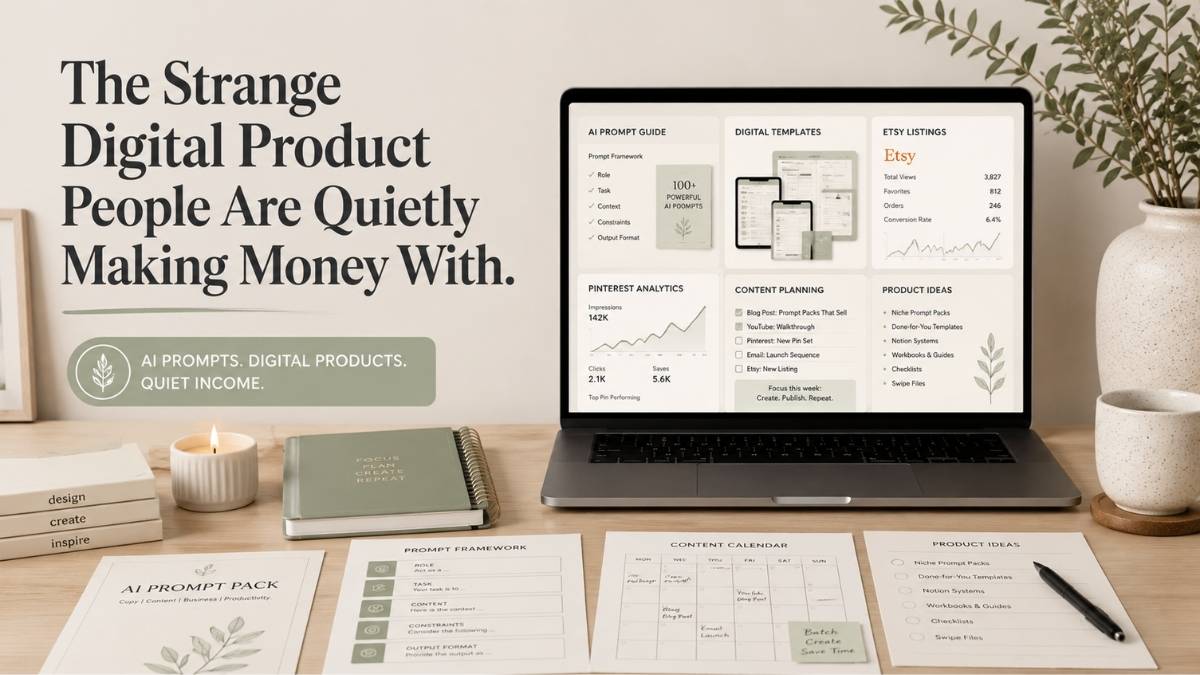
Most people still think digital products mean ebooks, online courses, or printable planners. Those products still work, but over the last few months, I started noticing a quieter trend growing in the background.
Creators were quietly making money selling something much simpler.
Not massive programs. Not expensive software. Just prompt guides and AI prompt templates.
At first, I honestly did not understand why people would pay for prompts when tools like ChatGPT are already available to everyone. But the more I looked into it, the more it started making sense. Most people are not struggling because they lack access to AI tools. They are struggling because they do not know how to use those tools effectively.
That small difference has quietly created an entirely new type of digital product.
Why AI Prompt Guides Are Suddenly Growing So Fast
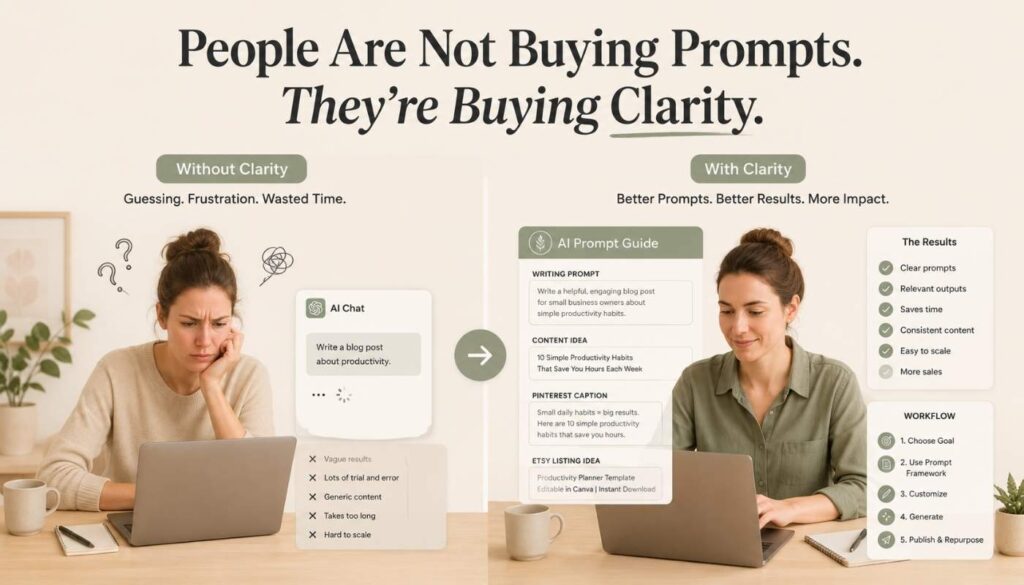
Right now, millions of people are opening AI tools every day hoping to save time, improve their work, or simplify their businesses. The problem is that most of them still stare at a blank screen without knowing what to type.
They know AI can help them:
| ✍️ | Write blog posts |
| 📣 | Improve marketing |
| 📋 | Organize projects |
| 💡 | Create digital products |
| ⚙️ | Automate repetitive work |
But knowing AI is useful and knowing how to use it properly are two completely different things.
That is exactly where prompt guides come in.
Instead of spending hours experimenting with random instructions, people buy collections of prompts that are already organized around a specific result. A creator might sell:
| Prompt guide type | Who it helps |
|---|---|
| Etsy listing prompts | Etsy sellers who want better product titles and descriptions |
| Pinterest marketing prompts | Creators who want more clicks and pin ideas |
| Budgeting prompts | People trying to manage and track personal finances with AI |
| Email writing prompts | Small business owners and creators who write marketing emails |
| Content planning workflows | Bloggers and social media creators planning consistent content |
Platforms like Etsy and Gumroad are already filled with creators quietly selling these products.
The interesting part is that many of these products are surprisingly simple. But simplicity is often what makes digital products valuable in the first place.
People are not paying for words on a screen. They are paying for clarity, convenience, and saved time.
The Real Reason These Products Work
One thing I keep noticing in the digital product space is that practical products usually outperform complicated ones.
A lot of beginners assume they need to create huge courses or extremely polished systems before they can make sales online. In reality, many successful digital products solve one small but frustrating problem in a very simple way.
A budgeting spreadsheet that helps someone organize their monthly finances can become more useful than a 300-page finance ebook they never finish reading. The same principle applies to prompt guides. Buyers are looking for shortcuts that reduce overwhelm and help them get results faster.
That is why these products are quietly growing.
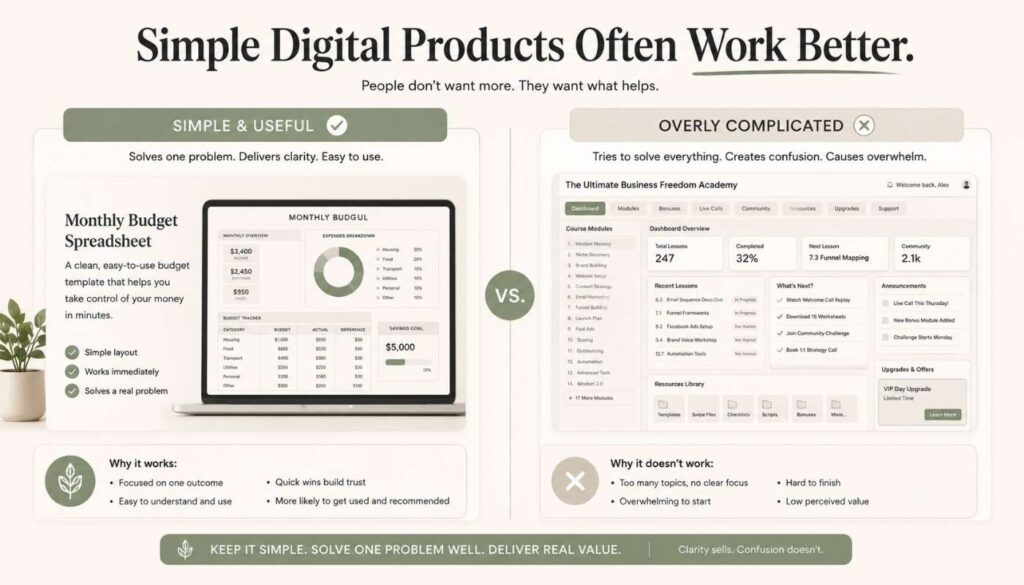
Not because prompts are revolutionary, but because people value tools that remove friction from their workflow.
This also connects closely to something I explained earlier about why most people fail at passive income. Most people focus too much on complexity instead of usefulness.
A Simple Example That Explains the Trend
Imagine a small Etsy seller trying to improve their listings.
They know AI tools could probably help them write better descriptions or titles, but they do not know how to structure prompts properly. They are overwhelmed by SEO advice, confused by AI tutorials, and frustrated because nothing feels consistent.
Now imagine someone sells them a simple guide called
“50 AI Prompts for Etsy Digital Product Sellers.”
Suddenly, the value becomes obvious.
The buyer is not purchasing “prompts.” They are purchasing:
What the buyer is really purchasing
| ⚡ | A faster workflow |
| 😮💨 | Less frustration |
| 🛤️ | A shortcut to better results |
That is why niche-specific prompt guides are starting to perform well. They solve a direct problem for a very specific audience.
Why This Trend Feels Different From Typical Passive Income Advice
A lot of passive income content online still feels disconnected from reality. People talk about building giant businesses before even making their first sale, and beginners end up feeling overwhelmed before they even start.
What makes prompt guides interesting is that they are relatively small and flexible. Someone can create a useful prompt bundle, a workflow template, or a Notion system without needing inventory, employees, or expensive software.
That lower barrier matters.
It allows creators to test ideas quickly without risking huge amounts of money or time. And honestly, I think that is one reason more people are moving toward smaller digital assets instead of chasing massive online businesses immediately.
The internet is slowly shifting toward convenience products. Buyers increasingly want tools that save them time, simplify work, or reduce decision fatigue. Prompt guides fit perfectly into that shift.
This also connects with something I mentioned recently in my article about why many side hustles never grow. Many side hustles stay stuck because people constantly restart instead of building connected systems.
The Biggest Opportunity Is Niching Down
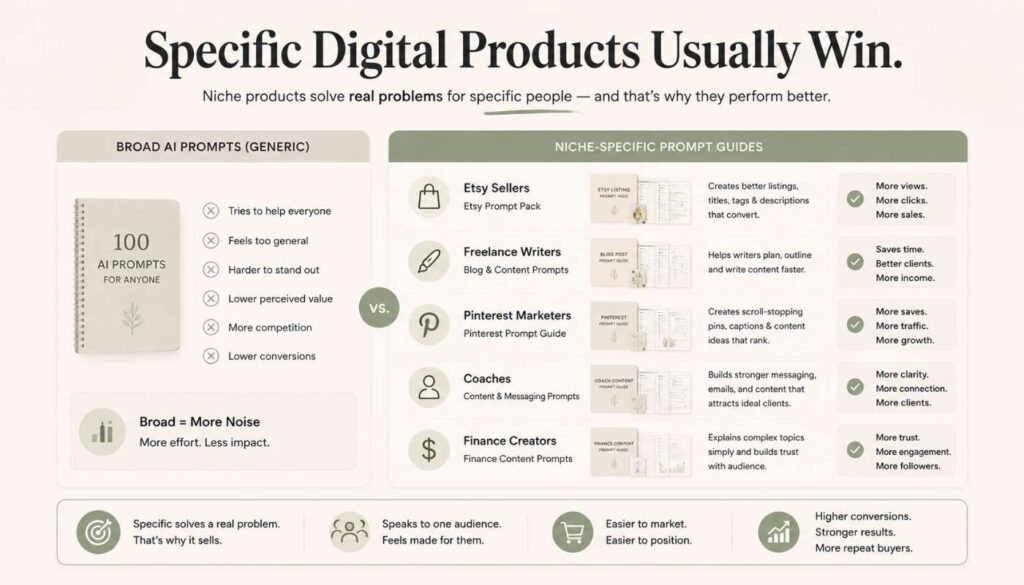
This is the part most people still underestimate.
Generic AI prompts are everywhere now, which means broad prompt collections are becoming less valuable. The stronger opportunity is creating prompt guides for very specific audiences or problems.
For example:
| Niche audience | Product idea |
|---|---|
| Pinterest marketers | AI prompts for writing pin titles, descriptions, and board strategies |
| Freelance writers | AI prompts for outlines, pitches, and client emails |
| Etsy sellers | AI prompts for product listings, tags, and shop descriptions |
| Finance creators | AI prompts for budgeting content, newsletters, and product ideas |
| Coaches | AI prompts for session prep, client onboarding, and social content |
| Small business owners | AI prompts for marketing copy, FAQs, and customer communications |
The more specific the audience, the more useful the product becomes.
That same principle applies to almost every successful digital product category. Specific products usually perform better because they solve very specific frustrations.
A generic “business template” is easy to ignore.
A “Tax Tracker for Etsy Sellers” immediately feels more relevant to the right buyer.
This Trend Also Connects Perfectly With Content
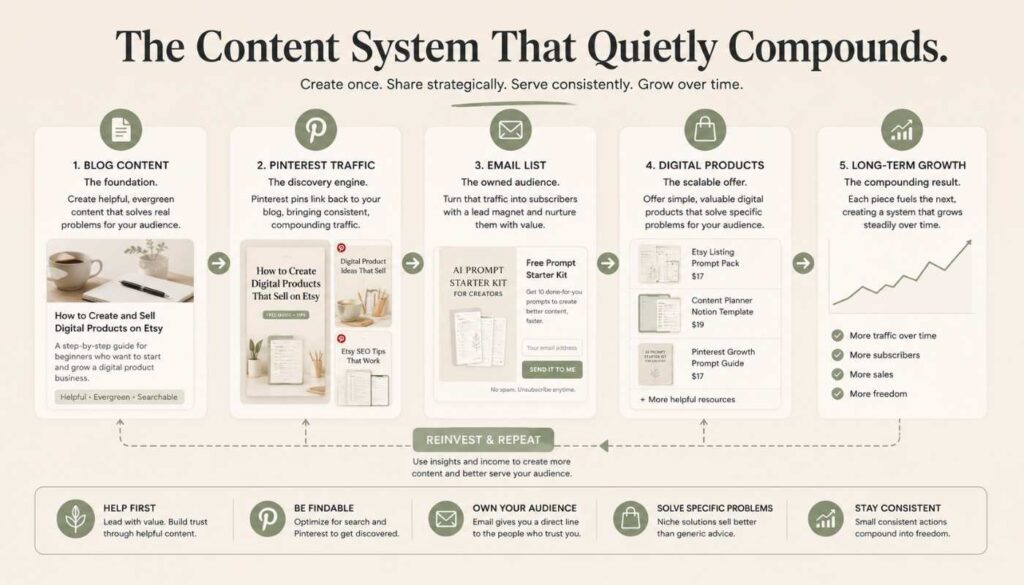
One reason I find this model interesting is that it connects naturally with blogging, Pinterest, and long-term content systems.
A creator can:
The content system that compounds
| 1 | Write articles around specific problems |
| 2 | Create Pinterest content around those articles |
| 3 | Build search traffic slowly over time |
| 4 | Connect that traffic to digital products over time |
That system feels much more sustainable than constantly jumping between random side hustles.
It is also why I have been paying more attention to digital assets lately instead of chasing completely unrelated ideas. When blog content, Pinterest traffic, email lists, and products all support each other, growth starts compounding more naturally.
That is when passive income starts feeling less like an internet fantasy and more like a realistic long-term system.
I recently wrote more deeply about this idea in my guide on building a digital products shop for passive income.
AI prompt guides may still sound strange to some people right now, but that is usually how early trends look before they become overcrowded. And honestly, I think many people are still underestimating how valuable clarity and convenience have become in the AI era.
Leave a Reply