
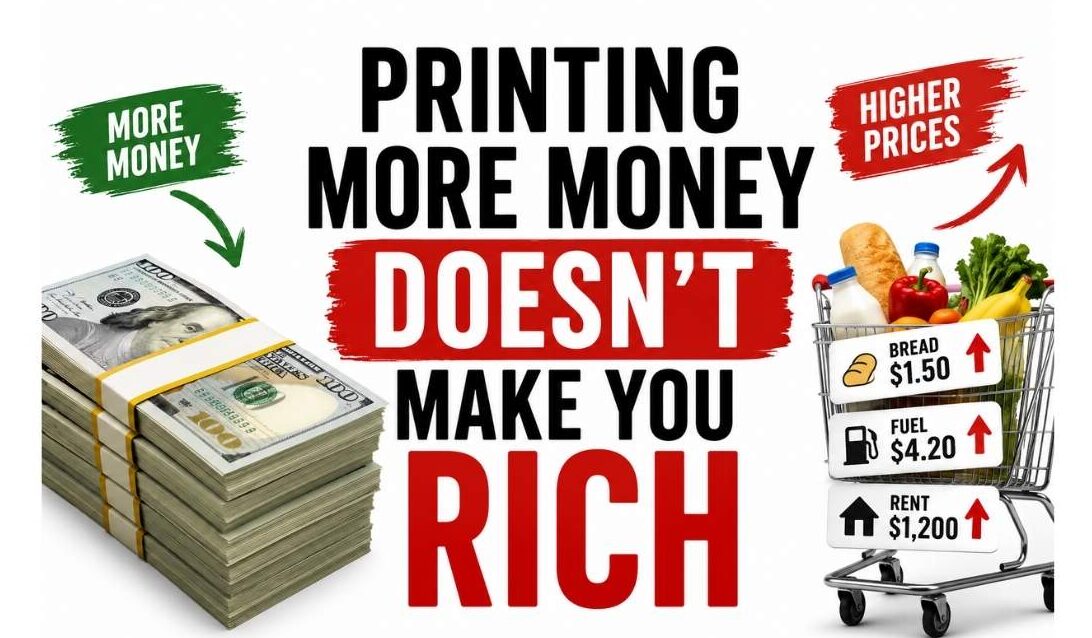
If a country is struggling financially, why can’t it print more money and get rich?
It sounds like the simplest solution in the world.
No taxes. No debt. Just print and fix everything.
But every country that has tried this ended up making things worse. Much worse.
In this post, you’ll learn exactly why printing money doesn’t work, why printing money causes inflation, and what actually happens when governments print money without creating real value.
More Money Doesn’t Mean More Wealth
Here is the mistake most people make:
Money is not wealth.
Money is just a way to measure wealth.
Imagine your entire country is a small village.
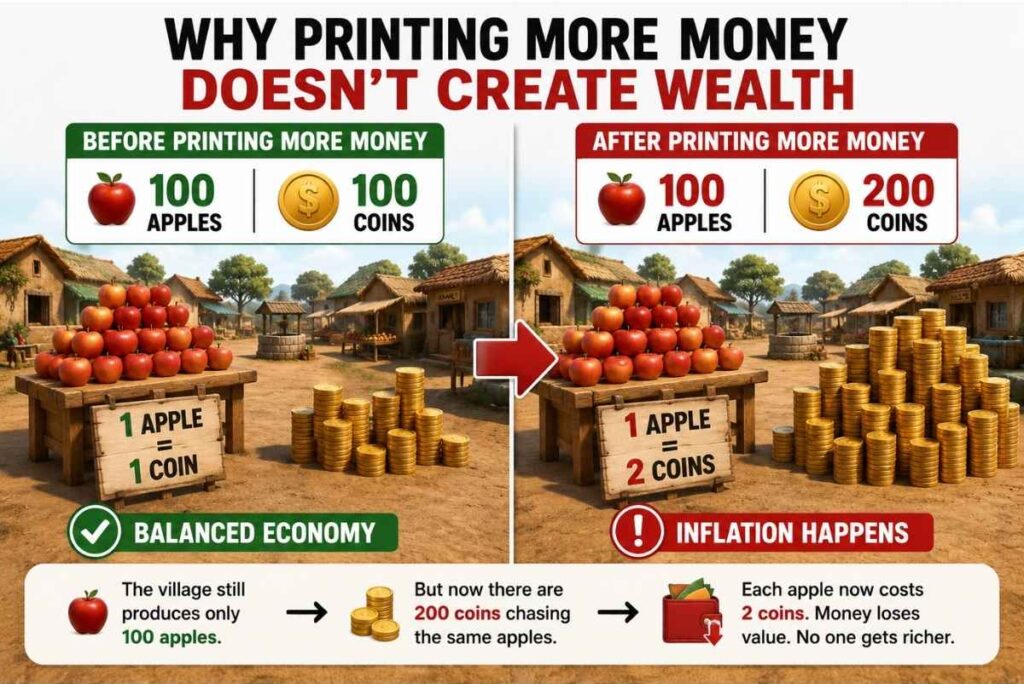
The village produces 100 apples.
There are 100 coins in circulation.
Each apple costs 1 coin.
Everything is balanced.
Now the government prints more money and adds 100 new coins into the system.
Did the village suddenly produce more apples?
No.
There are still only 100 apples.
But now there are 200 coins chasing those same apples.
So what happens?
Each apple now costs 2 coins.
Nobody got richer.
The apples did not increase.
Your money just lost value.
That is exactly why printing money causes inflation.
Printing money does not create wealth.
It just spreads the same wealth across more pieces of paper.
Your Salary Goes Up, but You Are Not Richer
Now let’s make it personal.
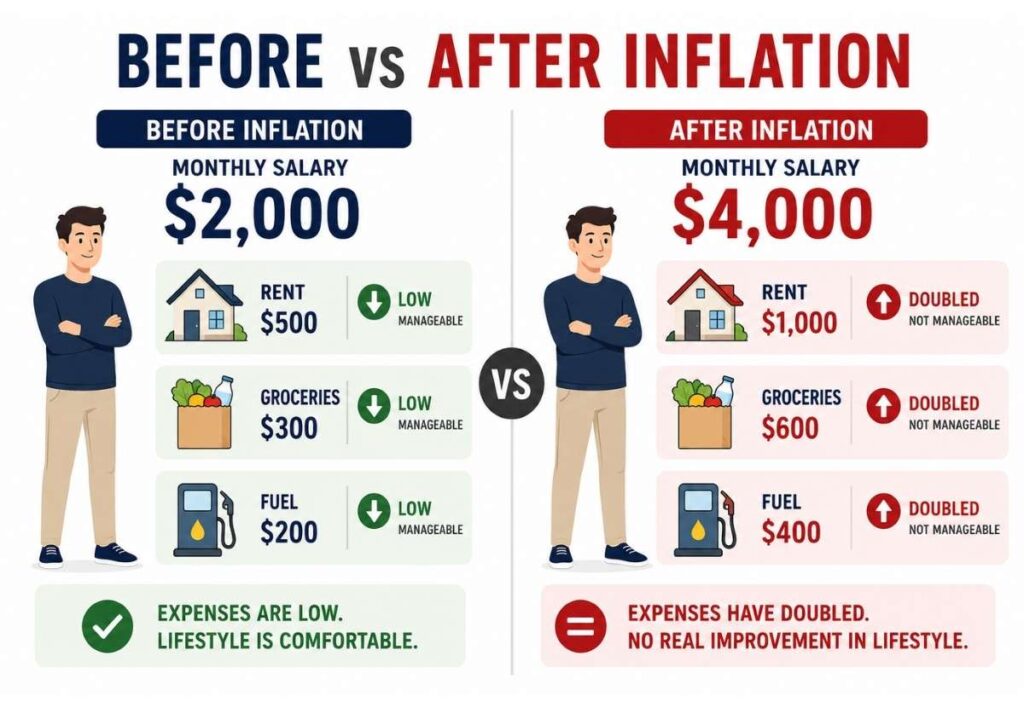
Imagine your salary doubles from 2,000 dollars to 4,000 dollars a month.
Sounds like a win.
But at the same time:
Your rent doubles
Your groceries double
Your fuel costs double
Suddenly, that extra money means nothing.
You are earning more.
But you are not living better.
In reality, you are standing still.
And your savings?
They are quietly losing value while you watch your balance go up.
This is what happens when governments print money without increasing real production.
The Real World Proof: Zimbabwe
There is a real-world example that shows exactly what happens when countries print more money without control.
In the early 2000s, the government started printing money to pay its bills.
At first, it felt like a solution.
Then prices started rising.
So they printed more money.
Prices rose even faster.
They printed even more.
This cycle spiraled out of control.
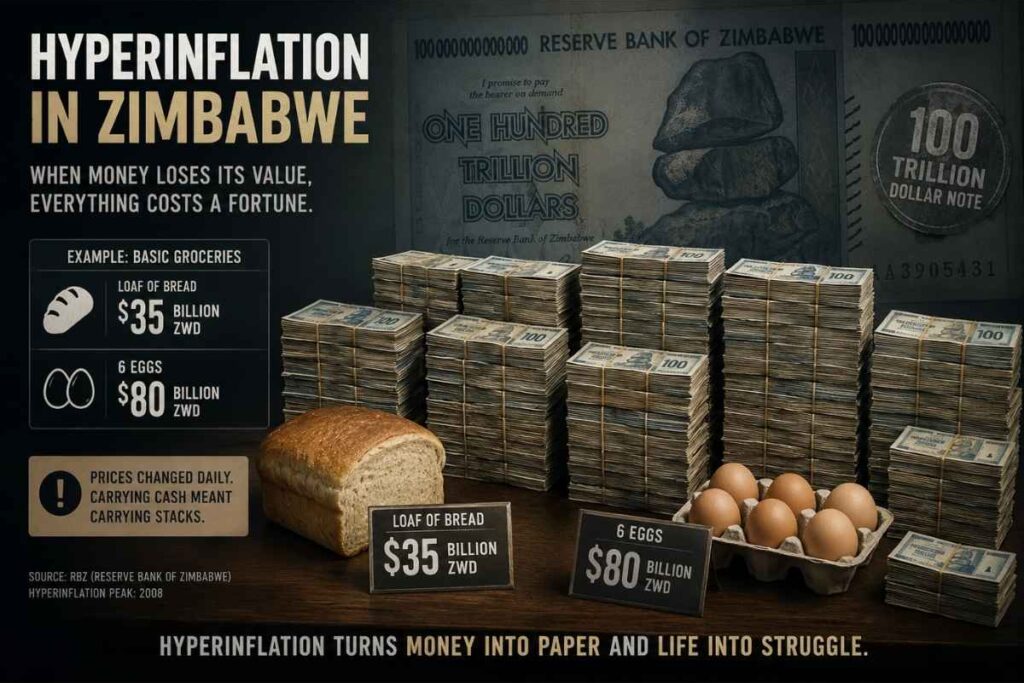
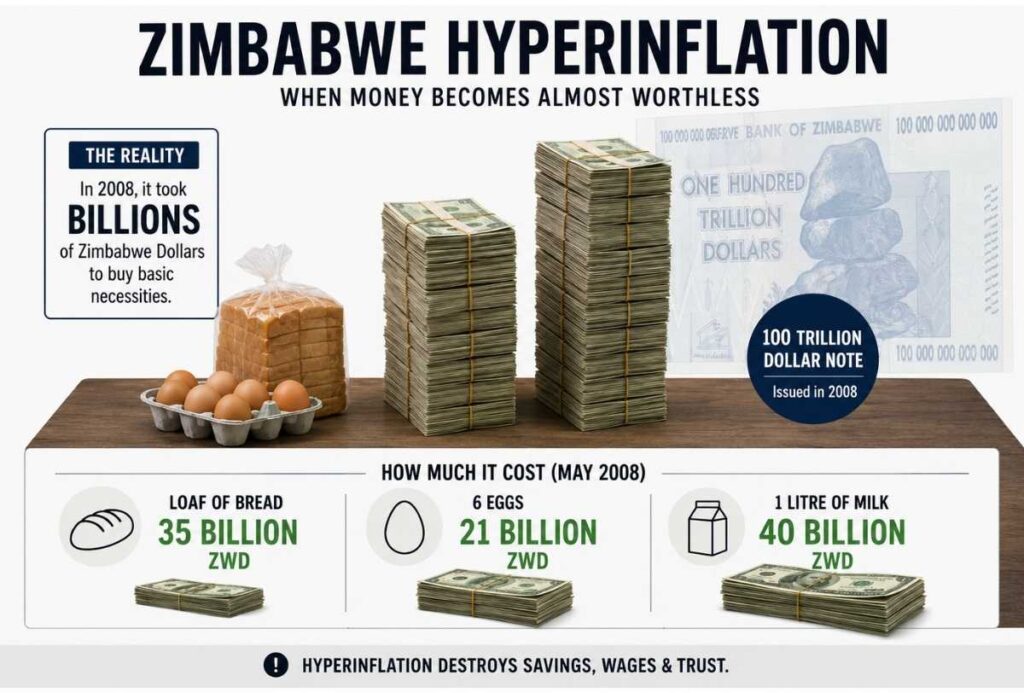
By 2008, inflation reached 89.7 sextillion percent.
A single egg costs billions.
The government printed a 100 trillion dollar note.
And it still was not enough to buy basic groceries.
People needed stacks of cash just to buy bread.
Eventually, the currency became useless.
Zimbabwe had to abandon it completely.
This is what happens when money grows faster than real value.
So How Do Countries Actually Get Richer?
So if printing money doesn’t work, how do countries actually get rich?
There is only one real answer.
Production.
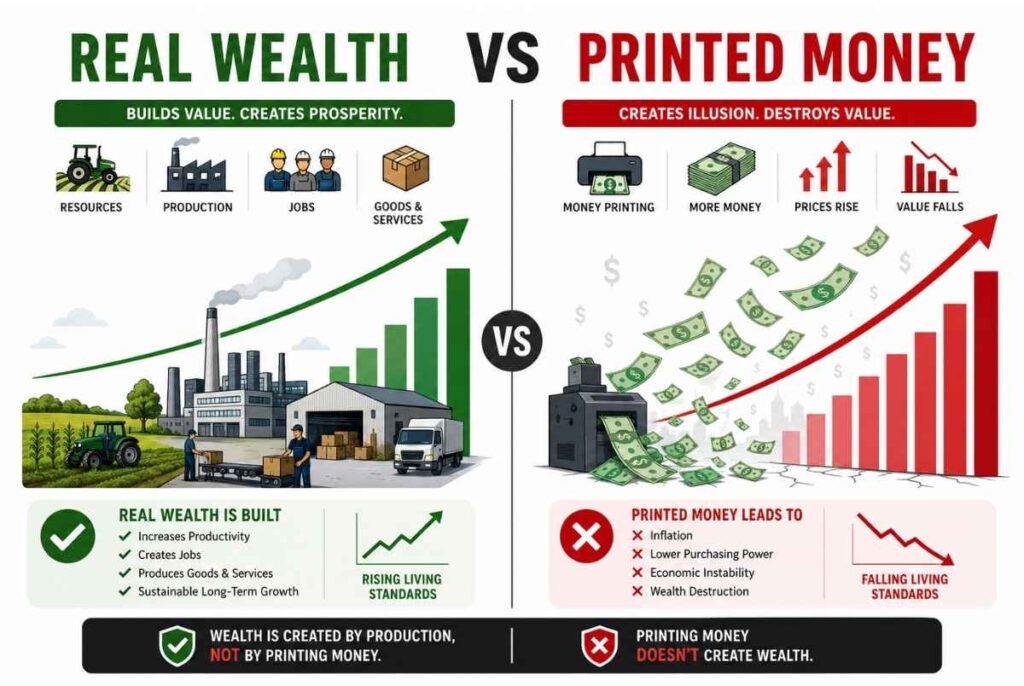
Countries get richer by creating more.
More goods
More services
More businesses
More innovation
When there is more real value in the economy, then adding more money makes sense.
Without that, printing money only leads to inflation.
More money with the same goods leads to inflation
More money with more goods leads to real growth
What This Means for Your Money
So what does this mean for you?
Every time excessive money printing happens, your savings take a hit.
Your balance does not change.
But what it can buy slowly shrinks.
This is exactly why understanding money printing and inflation matters for your personal finances.
It is also why leaving your money sitting still during inflation is one of the most common and costly mistakes.
Understanding this is not just economics.
It is the difference between protecting your money and slowly losing it.
Leave a Reply