
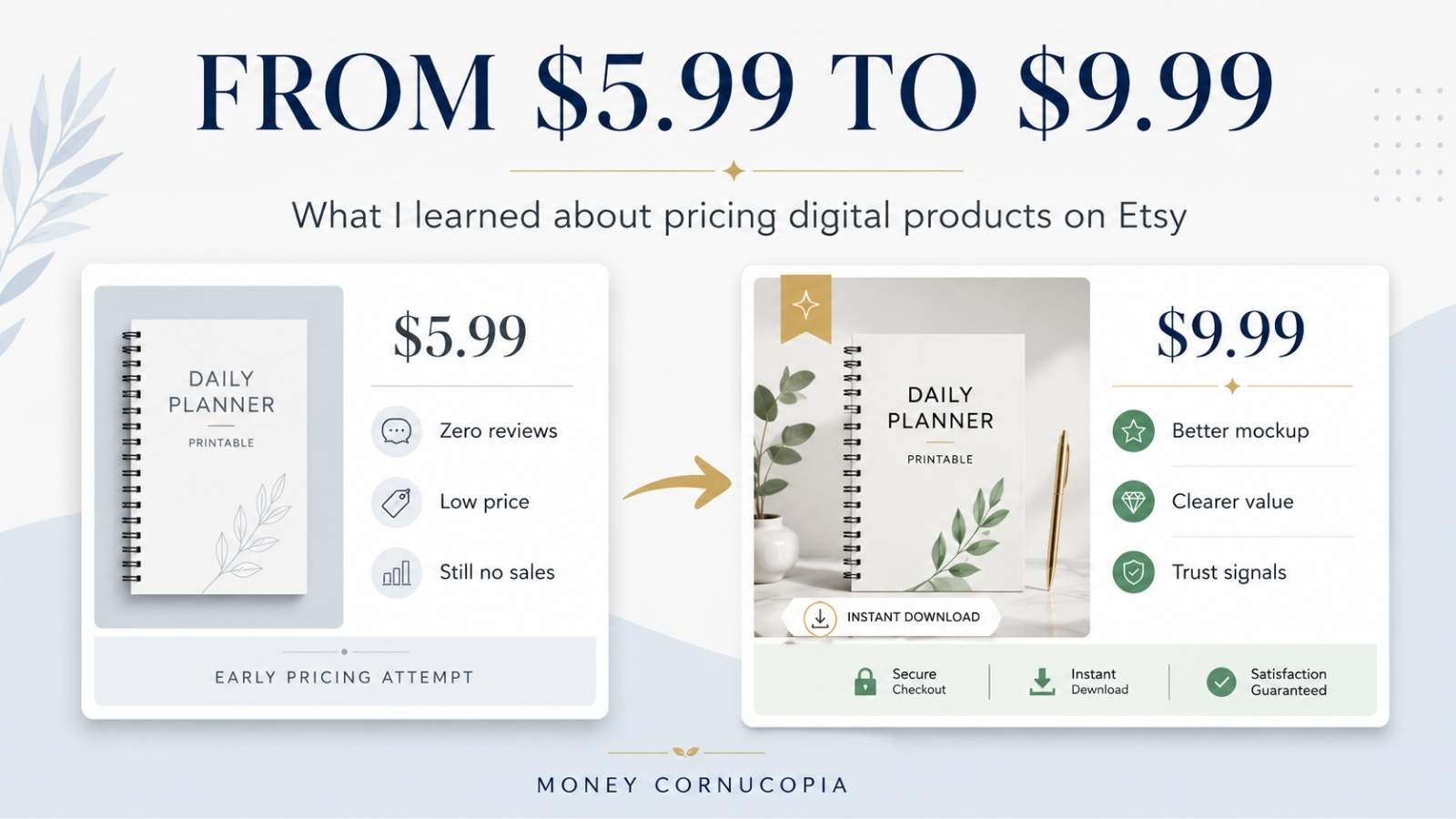
When I listed my first digital products on Etsy, I priced them at $5.99.
My thinking was simple. I had zero reviews. Zero sales history. Zero proof that anyone had ever bought from me. The only lever I thought I could pull to make someone choose my listing over an established seller’s was price. Make it cheap enough, and buyers would take the risk.
Months later, I still had zero sales.
If you are trying to figure out how to price digital products on Etsy, my biggest lesson is this: a low price does not automatically make buyers trust you. Understanding why took me weeks of research and a lot of uncomfortable honesty about what I was actually doing when I typed $5.99 into that listing field.
Quick Summary
I originally priced my Etsy digital products at $5.99 because I thought a lower price would make buyers feel safer. But after getting no sales and studying successful digital product listings, I realized low pricing does not automatically build trust. Reviews, listing quality, mockups, product clarity, and buyer confidence matter more than price alone. I am now moving to $9.99 because I want my price to communicate value, not fear.
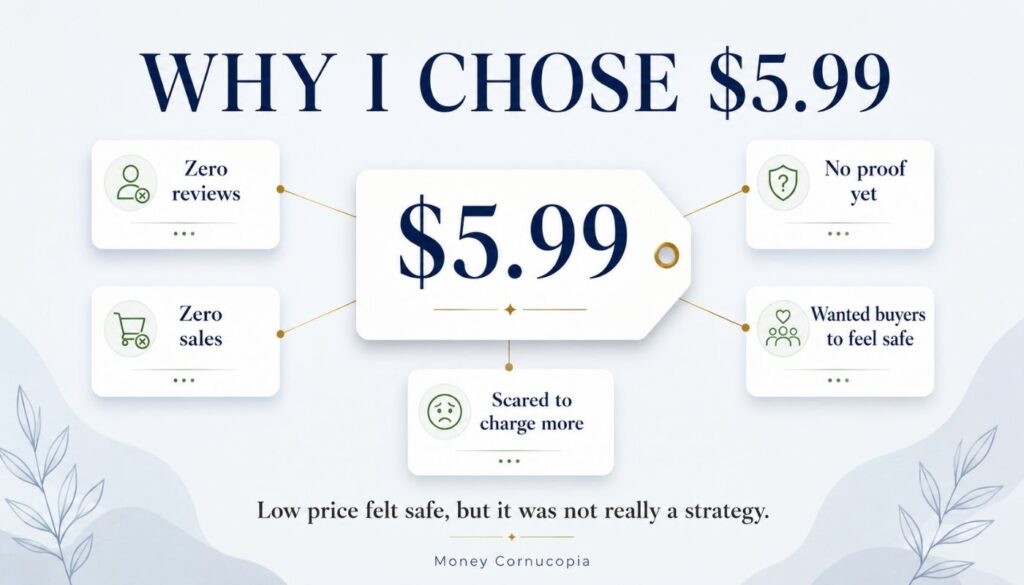
Table of Contents
Why Pricing Digital Products on Etsy Feels So Confusing for New Sellers
The confusion comes from comparing yourself to sellers who are playing a completely different game.
That is why learning how to price digital products on Etsy is not just about choosing a number. It is about understanding what that number communicates to a buyer who knows nothing about you yet.
When you open Etsy and search for digital templates, you see two types of listings. On one end, established shops with hundreds of reviews charge $25, $40, even $80 for their products. On the other end, new shops with no reviews are charging $2.99, $3.99, $4.99, clearly trying to undercut everyone else to get their first sale.
As a new seller, you look at this and think, I cannot charge what the big shops charge. I have no reviews. So I have to be the cheap option.
That logic feels reasonable. It is also wrong. And understanding why it is wrong is the most useful thing I can share about pricing digital products on Etsy.
The Mistake I Made With My First Etsy Prices
I priced it at $5.99 out of fear, not strategy.
My Etsy shop sells finance templates and planners. When I set the price, I did not run any analysis. I did not calculate what the product was worth. I did not study what similar products with similar review counts were charging.
I just picked a number that felt small enough that nobody could complain about paying it. $5.99 seemed safe. Non-threatening. Easy to say yes to.
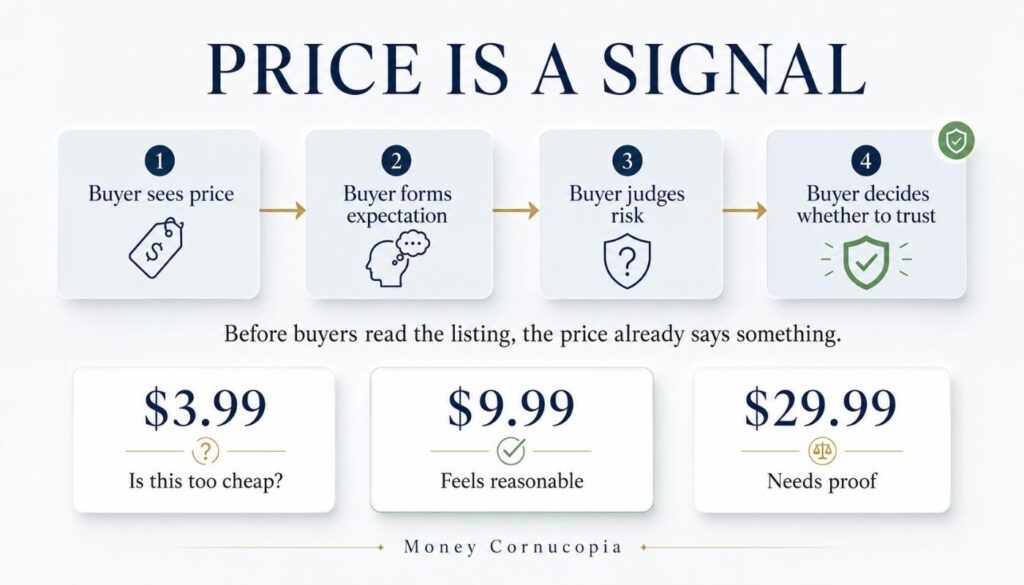
What I did not think about was what $5.99 was communicating to the buyer before they even clicked on my listing.
A price is not just a number. It is a signal. Before a buyer reads your title, before they look at your mockup, before they check your reviews, they see your price. And in a fraction of a second, their brain is already making a judgment about what kind of product this is.
I wrote about this in more detail in my full Etsy listing audit where I discovered that my listing problems went far beyond price. But pricing was the first wrong signal I was sending.
What I Noticed After Studying Successful Digital Product Listings
The shops with the most sales were not the cheapest. They were not even close to the cheapest.
When I looked at the top-performing ADHD Notion template shops on Etsy, the pricing pattern was striking. The shops with 200, 500, or even 1,000 plus reviews were selling templates for $25, $35, $45. Some premium bundles were priced at $60 to $80. And they were selling consistently.
I spent weeks researching successful digital product shops on Etsy, looking at over 20 premium listings in the ADHD Notion template space and the finance template category. I was not just looking at prices. I compared review counts, listing depth, product positioning, mockup quality, and whether higher-priced listings had enough social proof to support the price.
The shops with zero or very few reviews were scattered all over the pricing map. Some were priced very low at $2.99 to $4.99. Some were priced at a mid-range of $12 to $18. A few were priced high at $30 plus. And most of them, regardless of where they sat on the price scale, had very few sales.
I also noticed the shops in the 10 overlooked digital product categories I researched followed the same pattern. Successful sellers were not winning because of low prices. They were winning because buyers trusted them.
The Real Discovery: Price Matters, But Reviews Build Trust
The biggest pattern I kept seeing was not just product quality, design, or price. It was reviews.
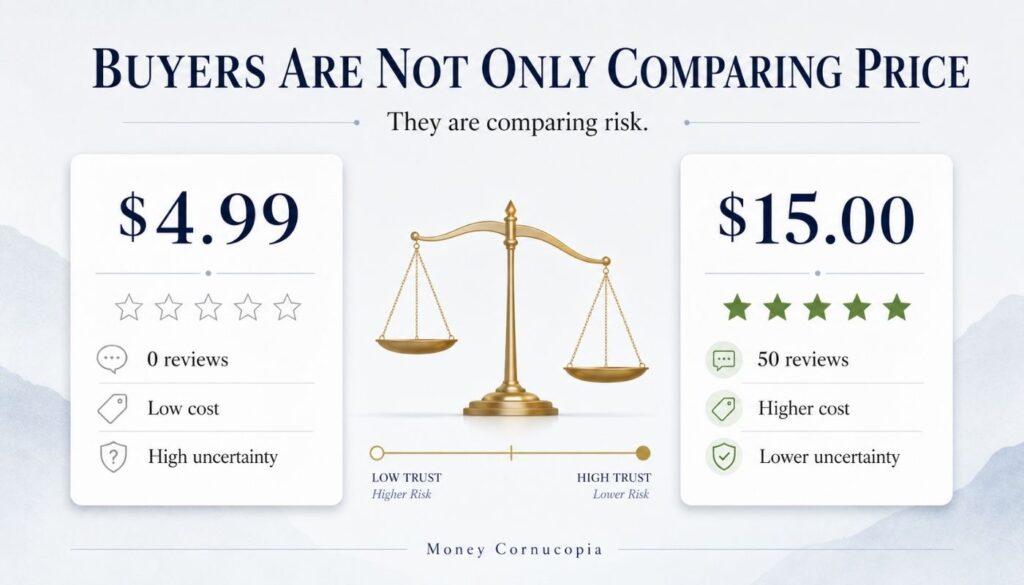
When I looked at why the expensive shops were selling and the cheap shops were not, the answer pointed clearly to social proof. The shops charging $45 for a Notion template had 300 reviews. Each review was a previous buyer saying, “this worked for me.” Each review was proof that real people had purchased this product, used it, and found it valuable enough to leave a rating. That social proof was doing the trust-building work that price alone could not do.
The shops charging $4.99 with no reviews had nothing. No proof. No history. No signal to the buyer that this product was safe to purchase. Just a low price that was supposed to compensate for all of that missing trust.
Price matters. But it cannot replace trust. A low price lowers the financial cost of taking a risk on an unproven seller. But many buyers would rather pay $15 for something from a seller with 50 reviews than $4 for the same thing from a seller with zero. Reviews are what earn the right to charge a premium. Price is what you set while you are still building that right.
Why Low Prices Can Actually Hurt You
Pricing too low does not just fail to solve the trust problem. It can actively make it worse.
When a buyer sees your digital template priced at $3.99, one of several things goes through their mind:
What goes through a buyer’s mind at $3.99
| 1 | “Why is this so cheap?” In a category where the standard is $15 to $40, a $3.99 listing does not feel like a deal. It feels like a question mark. What is wrong with it? |
| 2 | “This must not be very good.” Price communicates quality before the buyer reads a single word. A $3.99 and $15 template can be identical in content, but the price creates a perception gap before the buyer evaluates anything else |
| 3 | “Even if it is bad, I have not lost much.” This attracts the wrong buyer — less invested, less likely to use the product properly, and less likely to leave a thoughtful positive review |
None of these thought processes helps you build the one thing you actually need as a new seller: trust.
But Wait: Can Low Pricing Ever Work for New Etsy Sellers?
Yes. But only when it is a deliberate strategy, not a fear response.
This is the nuance that most pricing guides miss completely, and it is worth being honest about.
Some experienced Etsy sellers recommend a specific low pricing launch strategy. The idea is that you price a new listing deliberately low for a defined period, say 30 to 60 days, to generate initial traction, collect first reviews, and signal to Etsy’s algorithm that your listing converts. Once you have 10 to 20 reviews, you raise the price to your actual target.
This can work. It is used intentionally by sellers who understand exactly what they are doing and have a plan to execute it.
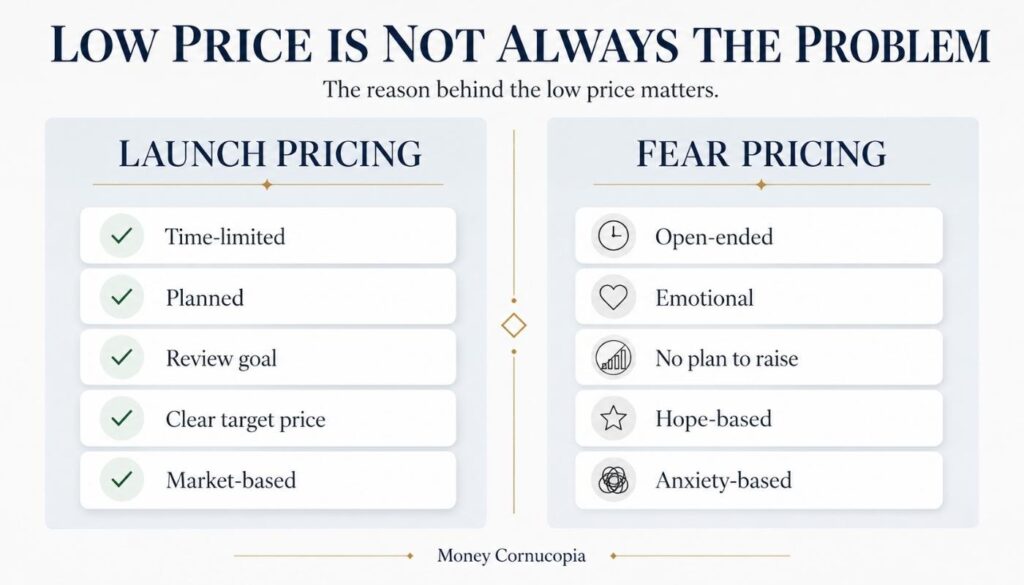
The problem is that most new sellers, including me, are not doing launch pricing. They are doing fear pricing. The difference is significant:
| Launch pricing | Fear pricing |
|---|---|
| Deliberate and time-limited | Indefinite and open-ended |
| Has a specific target price in mind | Has no clear plan to raise the price |
| Designed to collect early reviews | Hopes a low price will magically bring buyers |
| Works like a controlled experiment | Comes from anxiety |
| Based on market research | Based on fear |
I was doing fear pricing. I had no plan to raise the price. I had no timeline. I had no strategy for collecting reviews quickly. I just picked a small number because it felt safer than a bigger one.
That is not a pricing strategy. That is a substitute for confidence, and buyers can sense it.
How to Think About Pricing When You Have Zero Reviews
The goal is not to find the lowest acceptable price. It is to find the highest price your listing can justify without reviews.
When you have zero reviews, your listing needs to earn trust through every other available signal: mockup quality, title clarity, description specificity, and product depth. Your price should reflect the quality of those signals, not compensate for their absence.
According to Etsy’s own seller guidance, sellers should think beyond simple cost and consider profit, positioning, and what buyers are actually willing to pay in their category. Price is part of how your shop presents itself, not just a number you set and forget.
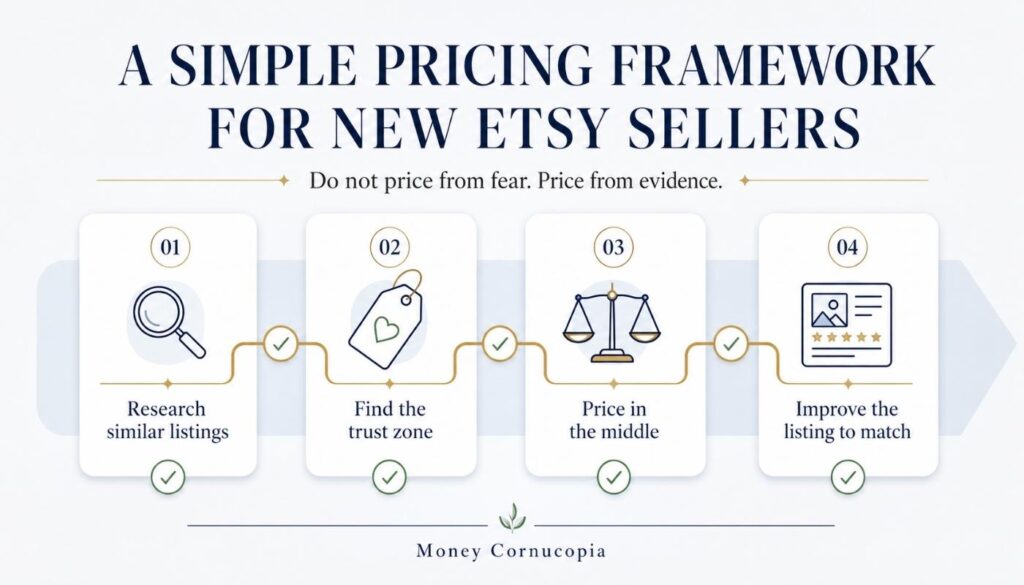
Here is a practical framework for new sellers:
Step 1: Research your category honestly.
Search for your product type on Etsy. Look at listings with 10 to 50 reviews, not the top sellers with thousands. Those are the sellers closest to where you are trying to get to. What are they charging? What does their product look like? How does yours compare in depth, presentation, and specificity?
Step 2: Find the trust zone for your category.
Every product category has a price range that feels normal to buyers. For simple single-page templates, it might be $5 to $12. For comprehensive Notion systems, it might be $15 to $30. For specialty bundles, it might be $25 to $50. Pricing outside the normal range in either direction raises questions.
Step 3: Price in the middle of that zone, not the bottom.
As a new seller without reviews, pricing at the very bottom of the trust zone signals desperation. Pricing in the middle signals confidence while staying accessible. The goal is to look like you belong in the category, not like you are begging for a chance.
Step 4: Make sure your listing quality justifies the price.
A mid-range price on a weak listing is worse than either extreme. If you are going to price at $9.99 instead of $4.99, your mockup, title, description, and product quality need to support that price. The price and the presentation need to tell the same story.
Why I Am Moving My Etsy Digital Products From $5.99 to $9.99
After everything I learned, I landed on $9.99 as my new starting price. Here is the exact reasoning.
$9.99 is not expensive. But it is not apologetically cheap either.
At $5.99, my listing was signalling: “I am not sure this is worth more.” At $9.99, my listing signals: “This is a real product with real value.” That confidence difference is worth more than the $4 price gap.
$9.99 also sits comfortably in what I identified as the trust zone for simple, functional finance templates. It is not so high that a buyer with zero context about me would feel they are taking a significant financial risk. It is not so low that it raises questions about quality.
Most importantly, I am pairing the price change with listing improvements. Better mockup images. A stronger description that opens with the buyer’s problem. Keyword-optimized tags. Because a higher price on a weak listing helps nobody. The goal is to raise both the price and the perceived value simultaneously.
The honest truth is that the price change alone will not get me my first sale. Reviews will. The price change is about making sure my listing looks credible enough for a buyer to take the chance that leads to that first review.
What to Do If Your Etsy Listings Have No Sales and You Think Price Is the Problem
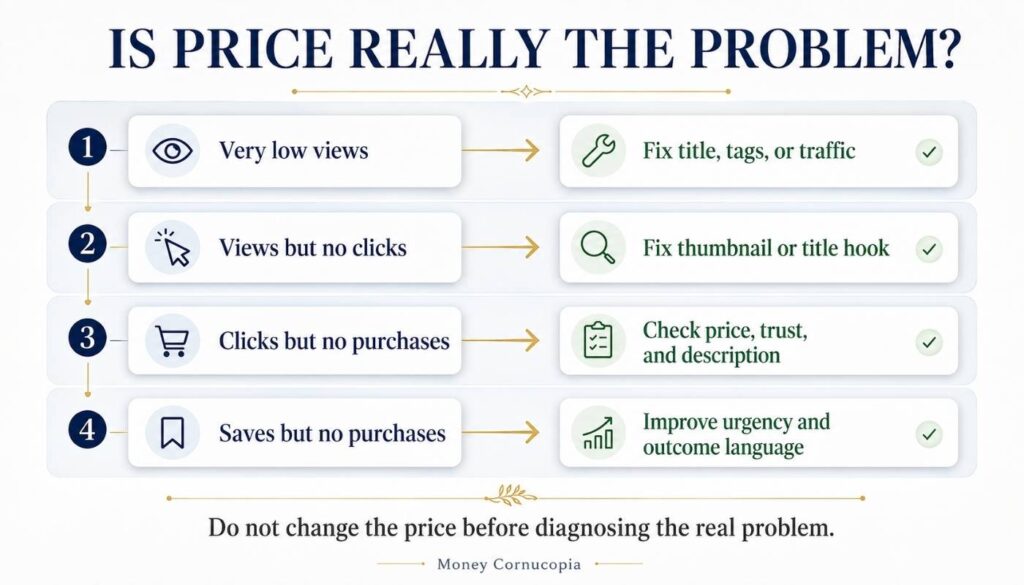
Before you change your price, run this quick diagnostic.
Price is one of many reasons a listing might not convert. Changing the price when the real problem is something else wastes time.
If your listing views are very low: The problem is probably title, tags, or external traffic. Fix your keywords and drive Pinterest traffic before touching the price.
If your views are decent but nobody clicks: The problem is your thumbnail or title hook. Fix the mockup before changing the price.
If you are getting clicks but no purchases: Now price might be a factor, along with description quality, trust signals, and product clarity. This is the stage where the pricing conversation becomes relevant.
If people are saving your listing but not buying: The product is interesting but not urgent enough. Review the outcome language in your description before adjusting the price.
I covered all of these diagnostic signals in detail in my Etsy listing audit article.
Before you change your price, run your actual numbers through this free Etsy Digital Product Pricing Calculator. It shows your profit per sale after fees, your monthly earnings, and how many sales you need to reach your income goal. The numbers will tell you whether a price change actually makes sense before you touch your listing.
Frequently Asked Questions
How much should I charge for digital products on Etsy as a beginner?
For most digital template categories, a trust zone price for new sellers falls between $7 and $18 for individual products. The right price depends on product depth, niche, and what similar products with comparable review counts are charging. Avoid pricing at the very bottom of your category range as a new seller. It signals uncertainty rather than value.
Should I lower my Etsy price if I have no sales?
Not necessarily. Low sales on a new listing are usually caused by low visibility, weak presentation, or insufficient external traffic rather than the price being too high. Run a quick diagnostic first. If views are very low, fix keywords before touching price. If views are decent but conversions are not happening, then consider whether price is contributing alongside other trust factors.
Can low pricing help me get my first Etsy sale?
It can, but only as a deliberate time-limited launch strategy with a plan to raise prices after collecting initial reviews. Random low pricing without a strategy rarely works because price alone does not solve the trust problem that new sellers face. Reviews solve the trust problem.
Why do shops with lots of reviews charge more on Etsy?
Because reviews earn the right to charge more. Every review is a previous buyer confirming that the product delivered value. That social proof reduces the perceived risk of buying, which means buyers are willing to pay a premium. New sellers without reviews cannot replicate that with price alone.
What is the best price for a Notion template on Etsy?
Because reviews earn the right to charge more. Every review is a previous buyer confirming that the product delivered value. That social proof reduces the perceived risk of buying, which means buyers are willing to pay a premium. New sellers without reviews cannot replicate that with price alone.
How do I get my first Etsy review as a new seller?
The most reliable path to first reviews is external traffic. Buyers who find your shop through Pinterest or your blog arrive warmer and more engaged than cold Etsy search traffic. They have already read about your product, understand its value, and are more likely to buy and leave a review.
Final Thoughts
I priced my listings at $5.99 because I was scared. Scared that nobody would pay more. Scared that without reviews I had no right to charge a real price.
What I learned after weeks of research is that the fear did not come from the price. It came from not having reviews yet. And changing the price from $5.99 to $9.99 does not fix that.
But staying at $5.99 was making it worse. Because a price that whispers “I do not really believe in this” does not invite buyers to believe in it either.
So if you are wondering how to price digital products on Etsy, do not start by asking “What is the cheapest price I can charge?” Start by asking “What does my price communicate about my confidence in this product?”
The path to reviews is not a lower price. It is a better listing, external traffic that brings warm buyers, and the patience to survive the quiet months before social proof starts compounding.
I am moving to $9.99. Not because I suddenly have proof that it is the perfect price. But because I have proof that $5.99 was the wrong signal for the wrong reason.
Sometimes, the most important pricing decision is the one that stops communicating fear.
If you are in the same place I was, this article about why your side hustle is not making money yet is worth reading before you change anything. The quiet period before your first sale is real. Understanding it is more valuable than adjusting your price.
Leave a Reply