
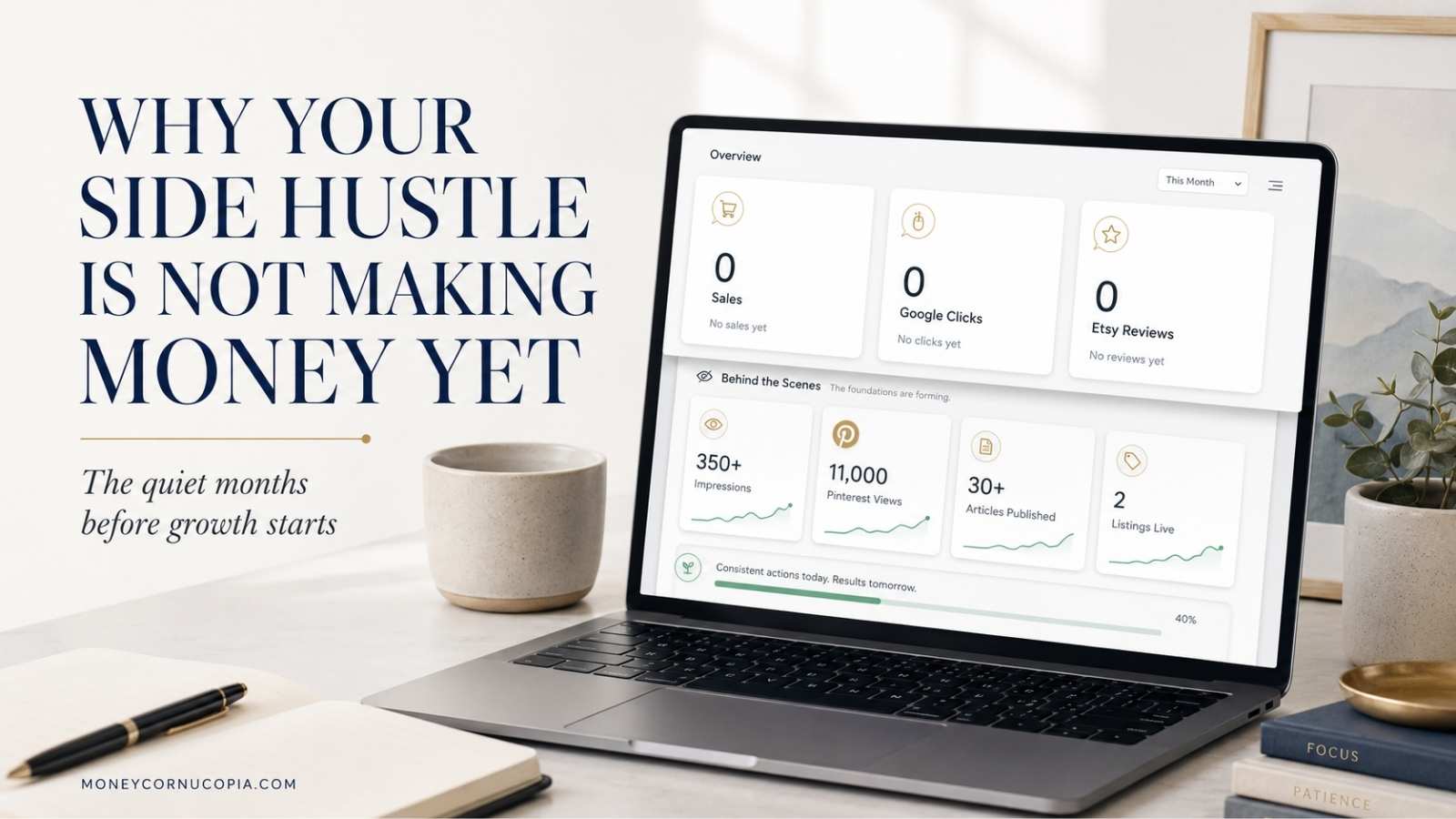
Your side hustle has zero sales. Your blog has zero clicks. Your Etsy shop has zero reviews.
You have been showing up for weeks, maybe months, and the numbers still look embarrassingly quiet. So you start asking the question most beginners eventually ask.
Is this normal, or am I wasting my time?
The honest answer: most side hustles go through a quiet period before they make money. Blogs can take months before Google sends meaningful traffic. Etsy shops can sit with zero sales before the first order appears. Pinterest can feel dead until the platform starts understanding your content.
I know because I quit during my quiet months.
I built this blog in December 2025, published for a month, watched the analytics show nothing, and walked away for five months. I told myself it was not working. The truth is I did not give it enough time to work.
This article is about what I learned when I came back. About what quietly builds underneath the zeros, why the early months feel so discouraging, and how to know whether your side hustle is actually failing or simply too young to judge.
If you are in your quiet months right now, this is the article I wish someone had written for me before I quit the first time.
Quick Answer: Why Your Side Hustle Is Not Making Money Yet
Most side hustles do not make money immediately because the early months are spent building visibility, trust, content, listings, skills, and platform signals that are invisible to you but essential for growth.
A blog may need 3 to 6 months before Google starts sending traffic. An Etsy shop may need more listings, views, and reviews before sales become consistent. Pinterest can move faster, but only when your pins are keyword-focused and published consistently.
The mistake is judging the entire side hustle by the first few weeks of results. The better question is not “Am I making money yet?” It is “Are any signals improving?”
This article is for the beginner who is publishing, pinning, listing, or pitching consistently but still seeing zero sales, zero clicks, or zero traffic. If you have not done anything consistently yet, the problem is not the quiet months. It is the missing system. The quiet months only apply when you have been showing up, and the results have not caught up yet.
Table of Contents
My Side Hustle Still Has Zero Sales and Zero Google Clicks. Here Is What Changed Anyway.
Here are my real numbers. Not a success story. A progress report from the middle of the process.
I started MoneyCornucopia in December 2025. I published a handful of articles about compound interest, inflation, and investing basics. Then I checked my analytics every single day. Every day, the number was the same. Zero.
Zero clicks. Zero visitors. Zero comments. Zero anything.
After about a month, I stopped publishing. I did not make a dramatic decision to quit. I just stopped showing up. The blog sat untouched for five months while I convinced myself it was not going to work.
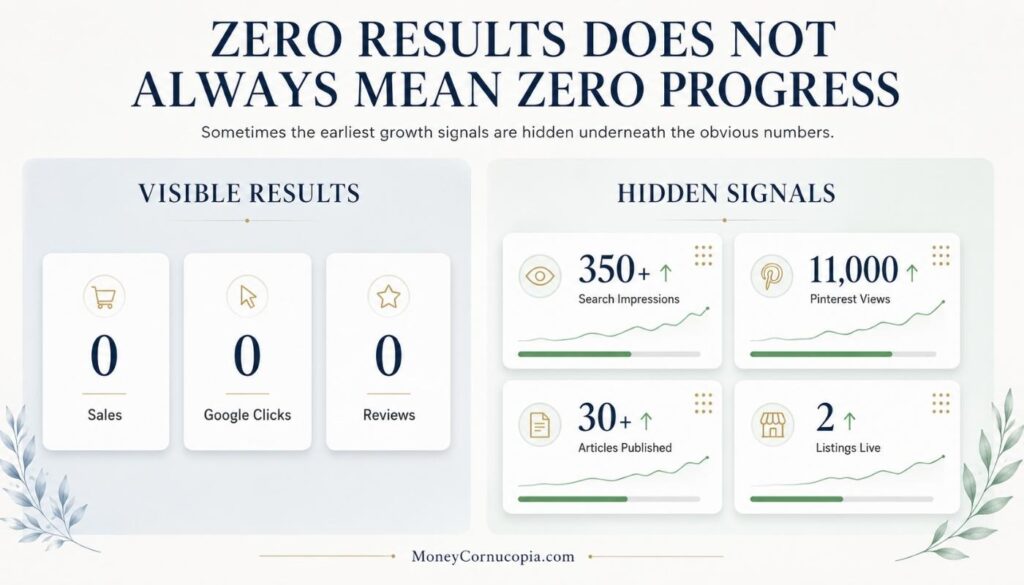
Then, about a month ago, I came back. I started publishing again with a real strategy. Here is what my dashboard looks like now:
| Metric | When I quit (January 2026) | Now (May 2026) |
|---|---|---|
| Published articles | ~10 | 30+ |
| Google clicks | 0 | 0 — but 350+ impressions appearing |
| Etsy shop sales | 0 | 0 — but 2 listings now live |
| Pinterest daily views | 0 | ~11,000 |
| Pinterest followers | 0 | 10 |
| Money spent on ads | $0 | $0 |
Look at that table carefully. The Google clicks column still says zero. The Etsy sales column still says zero. If I were only looking at those two numbers, I would feel like nothing has changed.
But something has changed. Google is now showing my articles in search results 350+ times over the last three months. Pinterest went from dead silence to 11,000 daily views in 20 days. Those are not vanity metrics. Those are signals that the quiet months are doing their work underneath.
How Long Does It Take for a Side Hustle to Make Money?
There is no single timeline, but most beginner side hustles take anywhere from a few weeks to a year before they produce meaningful income.
Service-based side hustles like freelancing can earn faster because you are selling labor directly. Content-based side hustles like blogs, Etsy digital products, and Pinterest-driven systems usually take longer because they depend on search algorithms, trust signals, content volume, and platform distribution.
Here is the realistic timeline most beginners should expect before judging a blog, Etsy shop, Pinterest strategy, or freelance side hustle:
| Side hustle type | Quiet period | First signs of progress | When growth may compound |
|---|---|---|---|
| Blog (SEO content) | 3 to 6+ months | Impressions, indexing, early clicks | 8 to 12+ months |
| Etsy digital products | 1 to 3+ months | Views, favorites, first sale | 6 to 12 months |
| Pinterest marketing | 2 to 6 weeks | Impressions, saves, outbound clicks | 2 to 4 months |
| YouTube channel | 3 to 12 months | Early views, better retention | 12+ months |
| Freelancing | Days to 3 months | Replies, calls, first client | 3 to 6+ months |
| Notion templates on Etsy | 2 to 6 months | Views, favorites, first reviews | 6 to 12 months |
These are rough timelines, not promises. Every side hustle is different. But the common thread is clear: every single one has a quiet period where the numbers show nothing, but the foundation is being built.
The critical insight: different side hustles have different quiet periods. Pinterest rewards consistency within weeks. Google takes months. Etsy sits somewhere in between. If you are comparing your blog’s month 2 results to someone else’s Pinterest month 2 results, you are comparing a marathon to a sprint.
Why the Quiet Months Feel Like Failure
Because your brain measures progress in outcomes, not in process.
When you check your Etsy dashboard and see zero sales, your brain does not think “my listings are being indexed and will start appearing in search results within a few months.” Your brain thinks, “this is not working, and I am wasting my time.”
When you check your blog analytics and see zero clicks, your brain does not think “Google is crawling my content and building topical authority signals that will compound over the next six months.” Your brain thinks, “nobody cares about what I am writing.”
I know exactly how this feels because I have lived it multiple times.
When I saw zeros on my blog after a month of work, I felt like I was not good enough. Like all my effort was going to nothing. Like I was failing at something that everyone else online seemed to be succeeding at effortlessly.
The self-doubt was the worst part. Not the lack of money. Not the lack of recognition. The quiet voice in your head that says, “maybe you are just not cut out for this.”
That voice made me quit for five months. And the cruel irony is that quitting during the quiet months is the one decision that guarantees the quiet months never end.
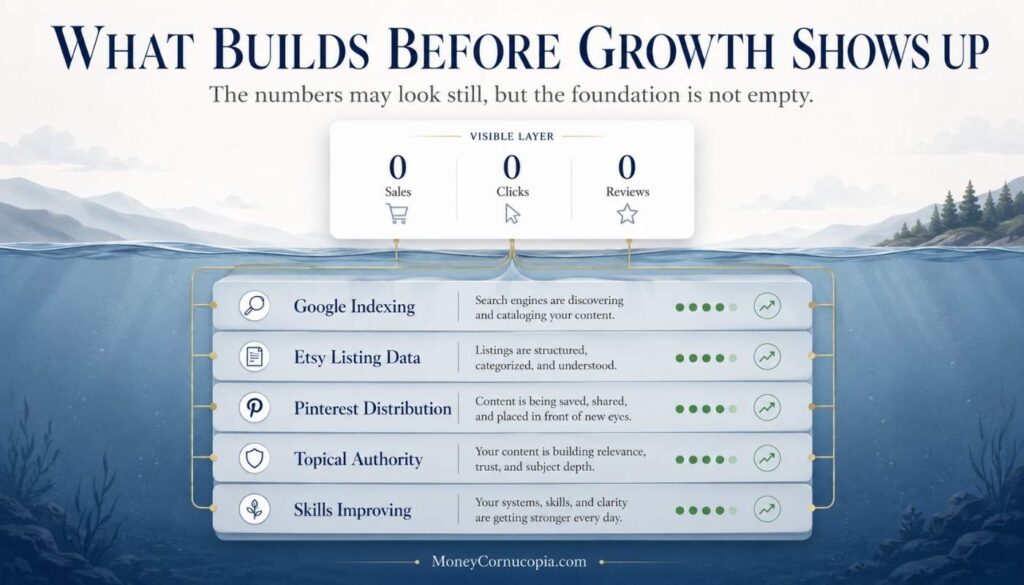
What Is Actually Building Before Your Side Hustle Starts Making Money
The zeros are not empty. They are full of invisible progress.
Google Is Learning Your Blog
Every article you publish gets crawled and indexed by Google. During the first 3 to 6 months of a new site, Google is running a trust evaluation. It asks: does this site publish consistently? Does it cover topics in depth? Does each article connect to a broader knowledge cluster? Google Search Central explains how this crawling and indexing process works.
My blog has zero Google clicks. But when I checked Google Search Console, I found that Google is showing my articles in search results 350+ times. It is testing my content with real searchers. It just has not moved me high enough on the page for anyone to click yet.
Those 350 impressions are not a failure. They are Google saying, “I see you; I am watching; keep going.”
Etsy Is Learning Your Listings
Etsy can feel especially painful in the quiet months because the silence is so visible. You create a product, upload the images, write the description, choose the tags, publish the listing, and then nothing happens. No sales. No reviews. Maybe not even many views.
That does not always mean the product is bad. Sometimes it means the shop is still too thin for Etsy to understand. One or two listings do not give the platform much data. A new shop has no buyer history, no reviews, no conversion signals, and no proven listing performance.
Many experienced Etsy sellers recommend building well beyond one or two listings because a tiny shop gives you very little data to learn from. Etsy’s own Seller Handbook also emphasizes that getting a first sale often requires improving photos, listings, and shop trust signals.
My shop has 2 listings and zero sales. I do not have enough evidence to say the shop failed. I only have enough evidence to say the shop is still too early. The quiet months on Etsy should not only be about waiting. They should be about building enough listings for the shop to become testable.
Pinterest Is Learning Your Content
I created my Pinterest account 6 months ago. Posted a few random pins. Saw nothing. Quit.
When I came back 20 days ago with a real strategy (consistent daily pinning with keyword-focused titles), the results were immediate. 11,000 daily views within three weeks. Zero dollars spent. Zero followers needed. Pinterest distributes content based on keyword relevance, not follower count, which means discovery is available to anyone who pins consistently with searchable titles.
The quiet months on Pinterest lasted exactly as long as my inconsistency lasted. When I showed up consistently, the platform responded within weeks. I wrote about my full approach in the one Pinterest strategy quietly driving free traffic to small Etsy shops.
Your Topical Authority Is Growing
Google ranks individual pages, but a focused cluster of related content can help those pages make more sense within your site’s overall authority. A single article about Notion templates might rank on page 8. But 5 articles about Notion templates, digital products, Etsy selling, and Pinterest marketing all linking to each other? That cluster starts climbing because Google sees a site that genuinely covers the topic.
My site went from 10 articles about random finance topics to 30+ articles across two focused categories. Each new article strengthens every other article in the cluster. That is invisible progress that no dashboard shows you, but Google is counting every single connection.
Your Skills Are Compounding
My first articles were stiff, generic, and forgettable. My recent articles include original research on 20 ADHD Notion templates, real investment data comparing gold to stocks, and personal stories about my own financial decisions. The quality difference between month 1 and month 6 is enormous. That improvement happened during the quiet months, even when nobody was reading.
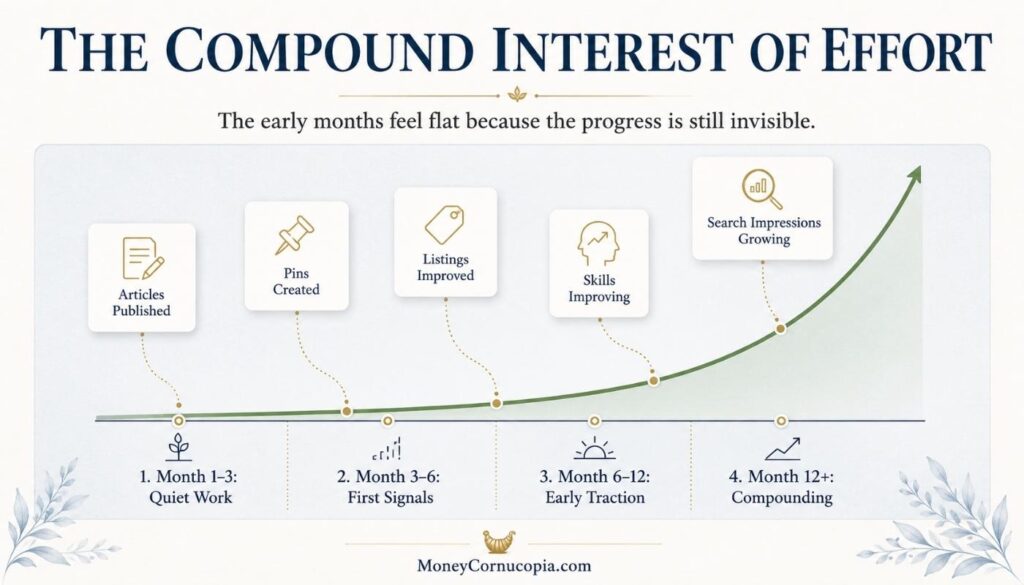
The Compound Interest of Effort
The same math that grows money grows side hustles. You just cannot see it until the curve bends.
In my article on the time value of money, I explained how $100 invested at 7% per year becomes $761 over 30 years. The first 10 years are boring. Your $100 becomes $197. Barely noticeable. Then compounding kicks in, and the growth accelerates.
Side hustles follow the same curve.
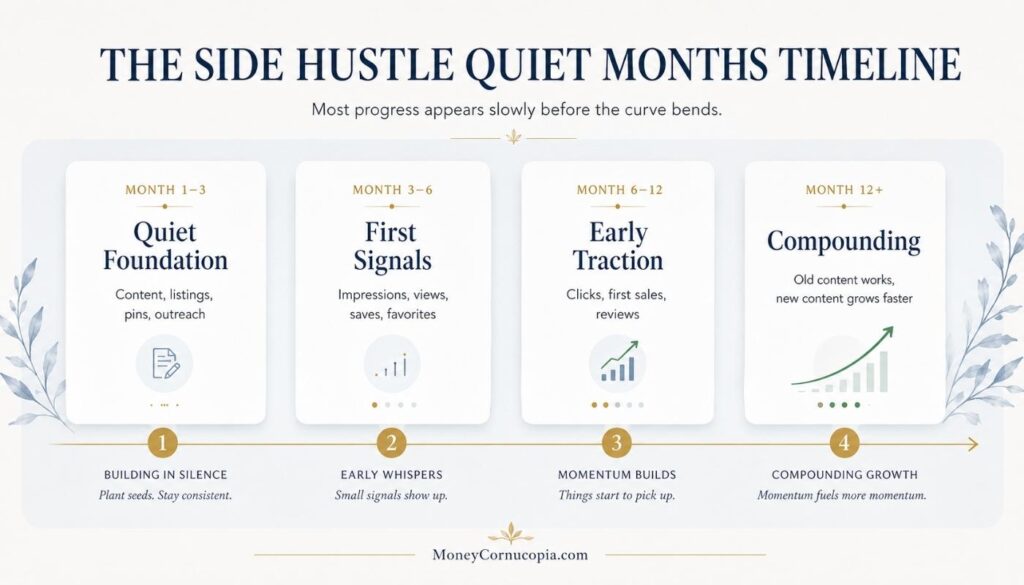
| Stage | What is happening | What it feels like |
|---|---|---|
| Month 1 to 3 | You publish content, create listings, and build pins. Platforms are crawling and learning your content | Throwing effort into a void — nothing appears to be happening |
| Month 3 to 6 | Google starts indexing. Pinterest starts distributing. A few impressions appear. Maybe a first sale | Still feels slow — but the first real signals appear if you look closely |
| Month 6 to 12 | Articles move from page 5 to page 2. Pinterest pins from month 2 start getting traction. One sale becomes two | The curve starts bending — small wins become more visible and more frequent |
| Month 12 and beyond | Old content keeps driving traffic. New content ranks faster. Reviews build on reviews. The system feeds itself | Compounding takes over — growth accelerates without proportional extra effort |
The quiet months are months 1 to 6. They are the flat part of the compound interest curve. They feel like nothing is happening because the numbers are too small to see. But the compounding has already started. You just have to stay long enough to see the curve bend.
How to Know If Your Side Hustle Is Failing or Just in the Quiet Months
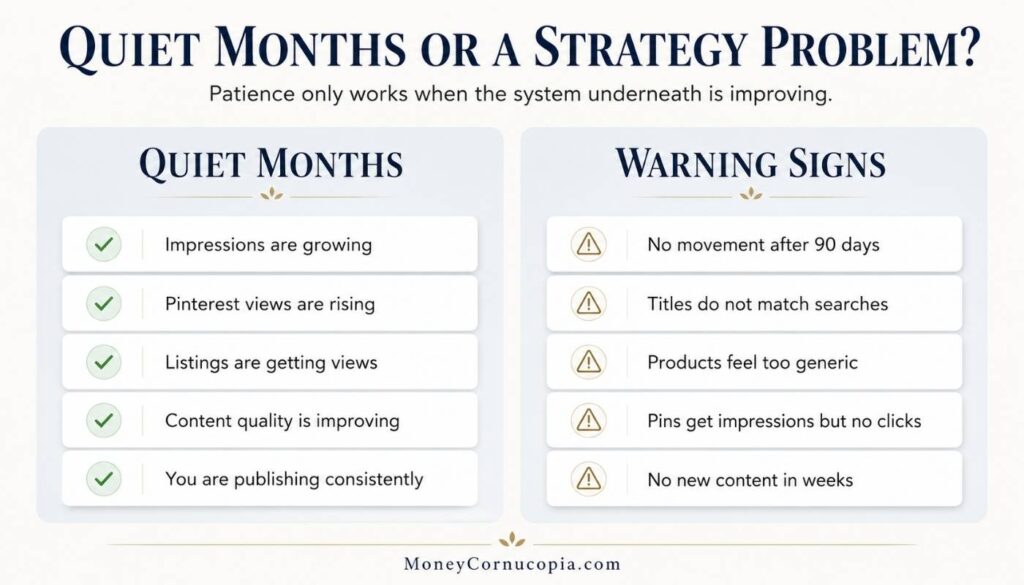
The quiet months are normal. But they should not become an excuse to ignore bad strategy.
Sometimes your side hustle is not quiet because it is young. It is quiet because something needs adjusting. Patience matters, but patience only works when the system underneath is improving.
You Are Probably in the Quiet Months If
You are probably in the quiet months if
| 1 | Your Google impressions are growing, even without clicks yet |
| 2 | Your Pinterest views are rising, even without much outbound traffic |
| 3 | Your Etsy listings are getting views or favorites, even without sales |
| 4 | Your content quality is visibly improving from your first post to your latest |
| 5 | You are publishing consistently and learning what gets ignored and what gets attention |
| 6 | The trend lines are moving upward, even if the absolute numbers are still small |
You May Need to Adjust Your Strategy If
| Warning signal | What to adjust |
|---|---|
| Nothing has moved after 90 days of consistent daily effort | Audit your strategy from the beginning — the problem is usually positioning, keywords, or product specificity, not effort |
| Your article titles do not match what people actually search for | Research keywords before writing — write to answer real searches, not just topics you find interesting |
| Your products are too generic to stand out in a crowded market | Niche down further — a specific buyer with a specific problem converts far better than a broad product |
| Your pins are getting impressions but zero outbound clicks | Rewrite your pin titles to be more specific and benefit-driven — the text overlay needs to promise a clear result |
| Your articles are indexed but not targeting clear keywords | Check Google Search Console for what queries are triggering impressions and rewrite your content around those |
| You have not added new listings, articles, or pins in weeks | Inconsistency is the most common reason the quiet months never end — rebuild the daily habit before anything else |
If the signals are slowly improving, you are in the quiet months. Stay the course.
If nothing is improving despite consistent effort, do not quit. Adjust. In 3 reasons your side hustle still isn’t growing, I covered the most common strategic mistakes that keep side hustles stuck even when the creator is working hard.
The Pattern I Keep Seeing in My Own Life
Every good thing I have built followed the same pattern: try, see nothing, doubt everything, come back with a plan, and then watch things slowly start working.
When I left my stable job to pursue a professional exam, I was terrified. When I could not clear the exam, I felt like a complete failure. But stumbling into freelancing after that failure turned out to be one of the best decisions of my life. The “failure” was actually a redirect.
When I put $1,000 into gold jewelry for my wife in 2020, the decision felt impulsive. Six years later, that gold more than doubled. When I lost $1,000 on an insurance investment I did not understand, the lesson felt expensive and pointless. But it taught me about risk in a way no textbook ever could.
When I quit my blog for five months, I thought I was admitting defeat. But those five months gave me clarity about what I was doing wrong. Coming back with a focused strategy produced more results in one month than my unfocused first month ever did.
The pattern is always the same. The quiet months feel like the end. They are actually the setup for the beginning.
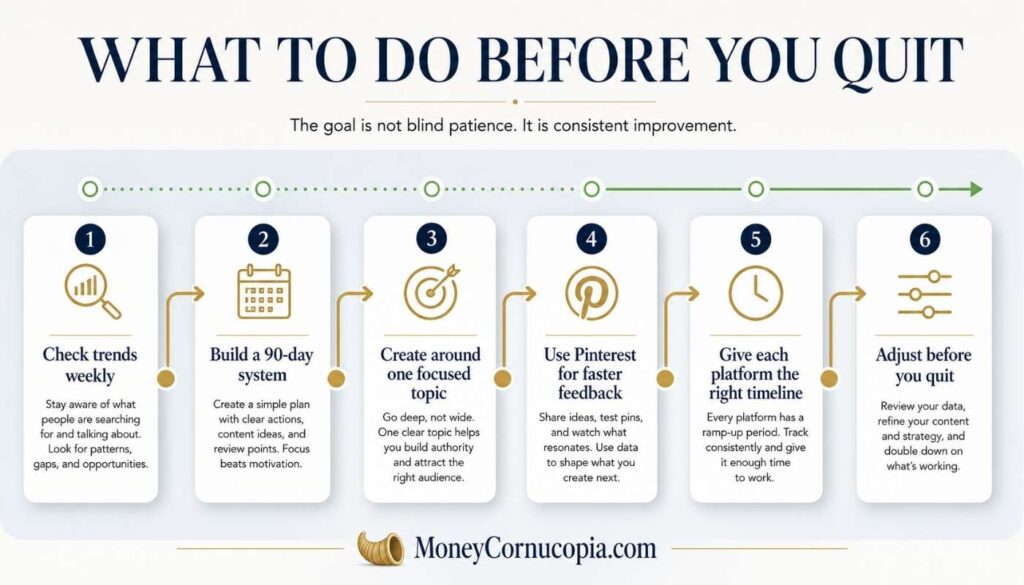
What to Do When Your Side Hustle Is Not Making Money Yet
Stop Checking Analytics Every Day
When I was checking daily, every zero felt personal. It was like stepping on a scale every hour and being surprised that you have not lost weight since breakfast.
Switch to weekly or monthly check-ins. Instead of “zero today, zero yesterday,” you start seeing 350 impressions this quarter that did not exist last quarter. Same data. Different timeframe. Completely different emotional experience.
Build a 90-Day System Instead of Chasing Daily Results
“I want to make $1,000 this month” is a goal. “I will publish 2 articles per week and create 6 Pinterest pins per article” is a system.
Goals depend on outcomes you cannot control. Systems depend on the effort you can control. During my five months away, I had no system. When I came back, I built one: write consistently, pin daily, optimize old content, and publish new content. The system does not guarantee results on any given day. It guarantees that I am building the conditions for results to eventually appear.
Create More Content Around One Focused Topic
Five articles on five different topics tell Google nothing. Five articles on one topic tell Google you are an authority. I covered this principle in how to build a digital products shop for passive income. The creators who succeed are the ones who go deep on one topic before going wide.
Use Pinterest to Speed Up the Feedback Loop
If Google takes 6 months to give you feedback, Pinterest can give you feedback in 2 weeks. My Pinterest account went from dead to 11,000 daily views in 20 days simply by pinning consistently with keyword-focused titles. That feedback told me which topics resonate, which titles get attention, and which content is worth expanding.
If you are waiting for Google and feeling stuck, start pinning. Pinterest is the fastest free way to learn what your audience actually cares about.
Give Each Platform the Right Timeline
Do not judge your blog by week 2 standards. Do not judge your Etsy shop by its first listing. Do not judge Pinterest by your first 5 pins.
Each platform has its own quiet period. Expecting Google speed from Pinterest or Pinterest speed from Google will make you feel like a failure on both when you are actually progressing normally on each.
Embrace Being Bad at It
I recently came across an idea that changed how I think about this entire process. You have to be willing to be genuinely bad at something before you can become good at it. Not just tolerate being bad. Actually embrace it. Stop being ashamed of the zeros. Stop feeling embarrassed about the empty dashboard. Start treating every zero as proof that you showed up.
I decided to start being bad at this on purpose. To publish articles that might not rank. To create pins that might not get clicks. To list products that might not sell. Because the alternative, not publishing anything to avoid the zeros, guarantees that nothing ever improves.
The quiet months end faster when you stop protecting yourself from failure and start accumulating it.
Frequently Asked Questions
Why is my side hustle not making money yet?
Because most side hustles need time to build visibility, trust, skill, and distribution. If your impressions, views, listings, content quality, or audience signals are improving, the side hustle is likely not failing. It is simply too early to judge. The better question to ask is whether any signals are moving upward, not whether the final results have arrived yet.
How long should I give a side hustle before quitting?
Give one focused strategy at least 90 days of consistent effort before judging it seriously. For SEO driven blogs, give it closer to 6 to 12 months because Google traffic usually takes longer than social or service-based side hustles. The keyword is “consistent.” Sporadic effort over 6 months does not count as giving it time.
Is zero traffic normal for a new blog?
Yes. Zero or very low traffic is completely normal for a new blog in the first 3 to 6 months. Google needs time to crawl, index, and trust your content before ranking it. The better early signal is not traffic but whether Google is indexing your pages and showing impressions in Search Console. If impressions are appearing, your content is being tested even if nobody is clicking yet.
Is zero sales normal for a new Etsy shop?
Yes, especially if the shop has only a few listings, no reviews, and no external traffic. Most successful Etsy sellers report very few or zero sales for the first 1 to 3 months. If your listings are getting no views after consistent optimization and building out your catalog, you may need better keywords, mockups, product positioning, or external traffic from Pinterest.
What is the fastest way to get feedback on a new side hustle?
Pinterest, short-form social content, freelancing outreach, and direct audience feedback usually provide faster signals than Google SEO. Pinterest gave me 11,000 daily views within 20 days of consistent pinning. Google has given me zero clicks after 6 months. Both are working, but Pinterest provides feedback much faster.
How do I know if my side hustle is failing or just slow?
Check for invisible growth signals. Are Google impressions increasing? Are Pinterest views rising? Are Etsy listing views growing? Are your skills improving? If trend lines are moving up, you are in the quiet months. If every metric has been completely flat for 90+ days of consistent effort, it may be time to adjust strategy, not quit entirely.
Can I speed up the quiet months?
You can shorten them, but not eliminate them. The fastest accelerators are consistent publishing, Pinterest distribution, and focused topic clustering. You cannot skip the quiet months entirely because platforms need time to evaluate and trust your content. But you can make sure you are not accidentally extending them through inconsistency.
What is the biggest mistake people make during the quiet months?
Quitting. The second biggest mistake is changing strategy every week. Jumping from blogging to YouTube to dropshipping to freelancing every time something does not produce immediate results means you never give any single approach enough time to compound. Pick one strategy, execute it consistently for at least 90 days, and then evaluate.
Final Thoughts
Six months ago, I published my first article on this blog. One month later, I quit because the numbers showed nothing. Five months after that, I came back with a plan and started publishing consistently.
My Google clicks are still zero. My Etsy sales are still zero. And for the first time, I am not panicking about it.
Because I can see what is building underneath. The 350 Google impressions that did not exist before. The 11,000 daily Pinterest views that came from nothing. The 30+ articles forming a content cluster that Google is slowly learning to trust. The skills that have improved dramatically from article 1 to article 30.
None of this shows up in the numbers that most people check. It is all happening in the quiet months, underneath the zeros, in the gap between “this is not working” and “this is starting to work.”
If you are in your quiet months right now, here is what I want you to know.
The zeros do not mean you are failing. They mean you have not been at it long enough for compounding to kick in.
Self-doubt is normal. Every creator who eventually succeeded felt exactly what you are feeling right now. The ones who made it are the ones who did not quit during the silence.
And the most important thing I have learned in this entire process: you do not have to be good at something to start. You just have to be willing to be bad at it long enough to get better.
I am still in my quiet months. I am still seeing zeros in places that matter. But I am also seeing the first signs that the foundation is real.
The compound interest of effort is working. I just have to stay long enough to see the curve bend.
So will you.
Leave a Reply