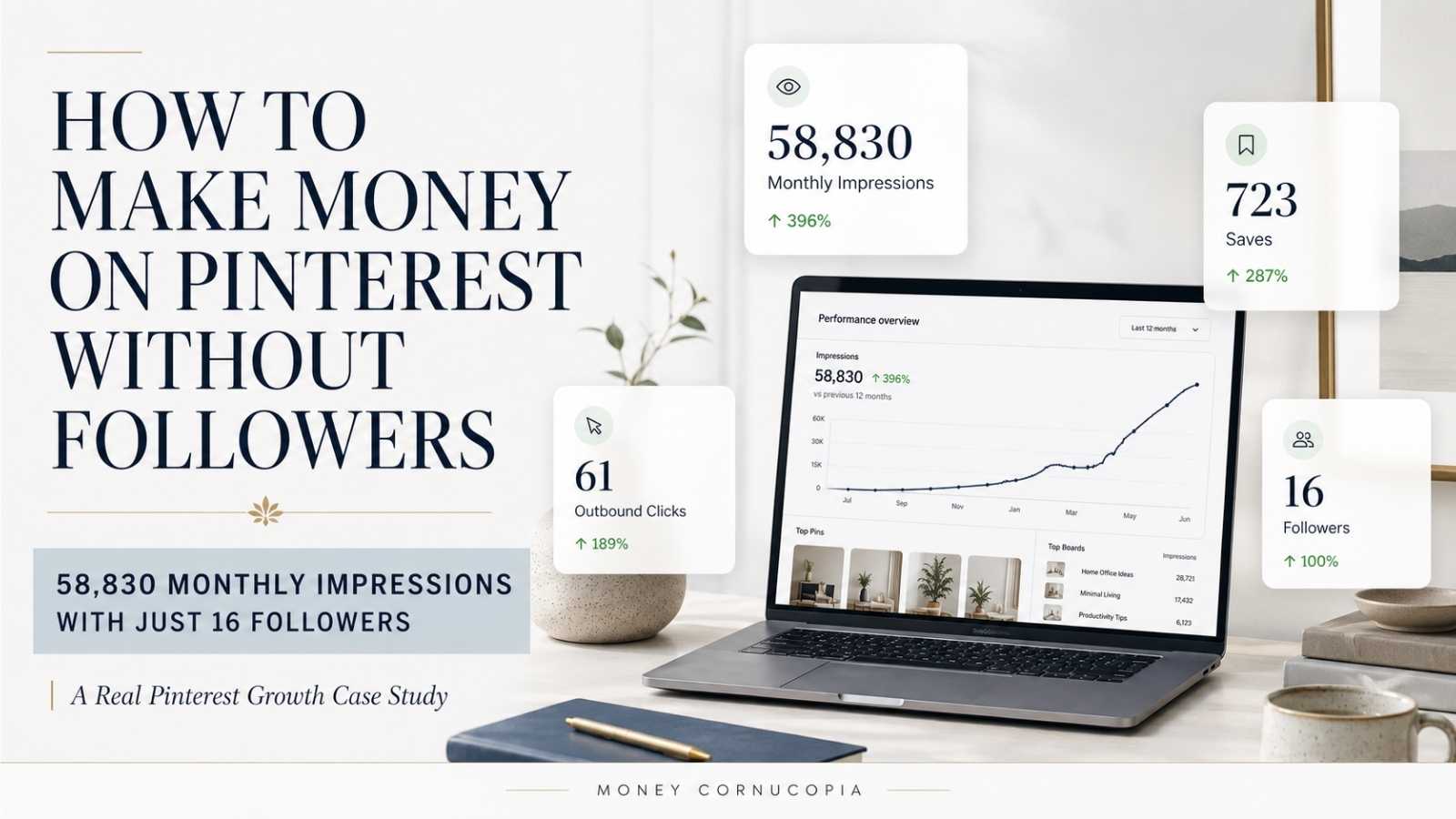
I have 16 Pinterest followers.
Not 16,000. Not 1,600. Sixteen.
If you are wondering how to make money on Pinterest without followers, this case study shows exactly what happened when I grew a Pinterest account to nearly 59,000 monthly impressions with only 16 followers, zero ad spend, and 5 to 6 weeks of consistent effort.
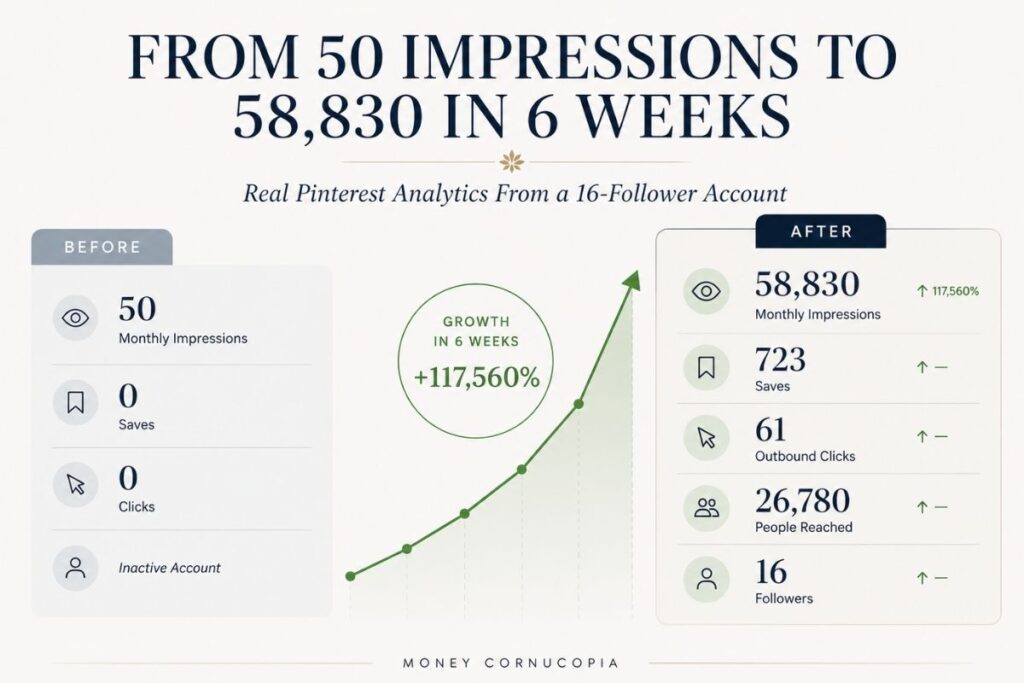
Six weeks ago, that number was around 50 impressions. I had roughly 20 pins published and almost zero activity. I was not growing. I was not even trying.
This article is the honest story of what changed, what I actually did, and whether Pinterest can make you money without a large following. I am not writing this from the other side of success. I am writing it from the middle of the process, with real numbers, real mistakes, and zero income earned yet.
If that sounds more useful than another “7 ways to make money on Pinterest” list, keep reading.
Table of Contents
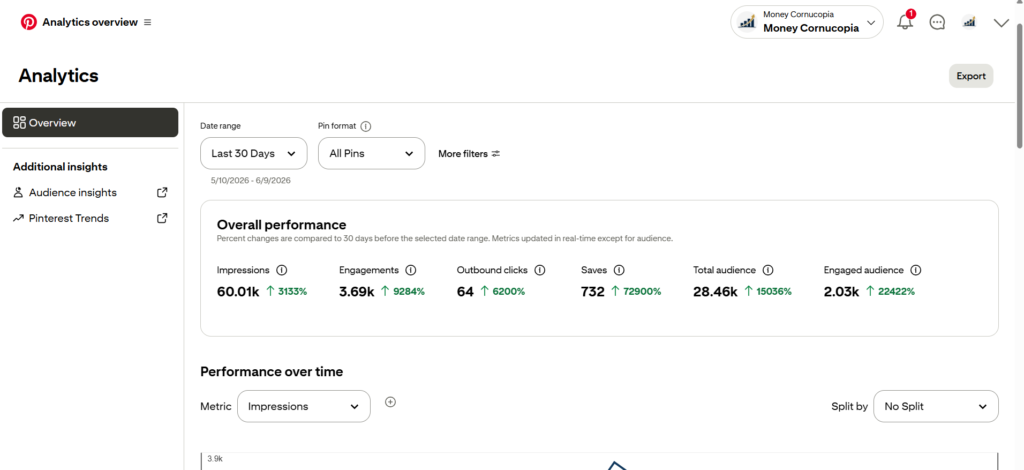
My Pinterest Results: Before and After
| Metric | Before (6 weeks ago) | Now (last 30 days) |
|---|---|---|
| Monthly impressions | ~50 | 58,830 |
| Saves | ~0 | 723 |
| Outbound clicks | 0 | 61 |
| Total audience reached | Minimal | 26,780 |
| Engaged audience | ~0 | 1,890 |
| Followers | 0 | 16 |
That is roughly a 1,170 times increase in impressions in under two months. From 50 to 58,830. With 16 followers.
I created my Pinterest account in December 2025 when I launched this blog. I worked on it inconsistently for about a month, published around 20 to 30 pins, saw almost nothing happen, and stopped. Then I stopped working on the blog too. Both sat untouched for several months.
In May 2026, I decided I wanted to actually build something. Not just start things and abandon them. I came back to the blog and came back to Pinterest at the same time, and I committed to showing up every single day.
Direct Pinterest income so far: zero. My Etsy shop has received one click from Pinterest. My blog has received 61 visits. No affiliate commissions yet. I am telling you this at the very beginning of this article because I want you to trust everything else I say in it.
Can You Make Money on Pinterest Without Followers?
Yes. But the path is different from what most articles describe.
Pinterest is not Instagram. On Instagram, your follower count largely controls your reach. On Pinterest, it does not. Pinterest functions as a visual search engine. When someone searches “budget planner for freelancers” or “how to start investing with $100” or “Notion template for ADHD,” the platform shows them pins based on keyword relevance and engagement signals, not based on how many people follow the creator.
This is why I can have 16 followers and reach 26,780 people in a month. Those people were not following me. They were searching for topics I had created pins about, and Pinterest decided my content was relevant enough to show them.
How Pinterest Traffic Actually Becomes Income
Most articles skip this explanation. Here is the honest funnel.
Getting impressions is not the same as making money. Understanding the path between them is the most important thing to understand before you commit to Pinterest as an income strategy.
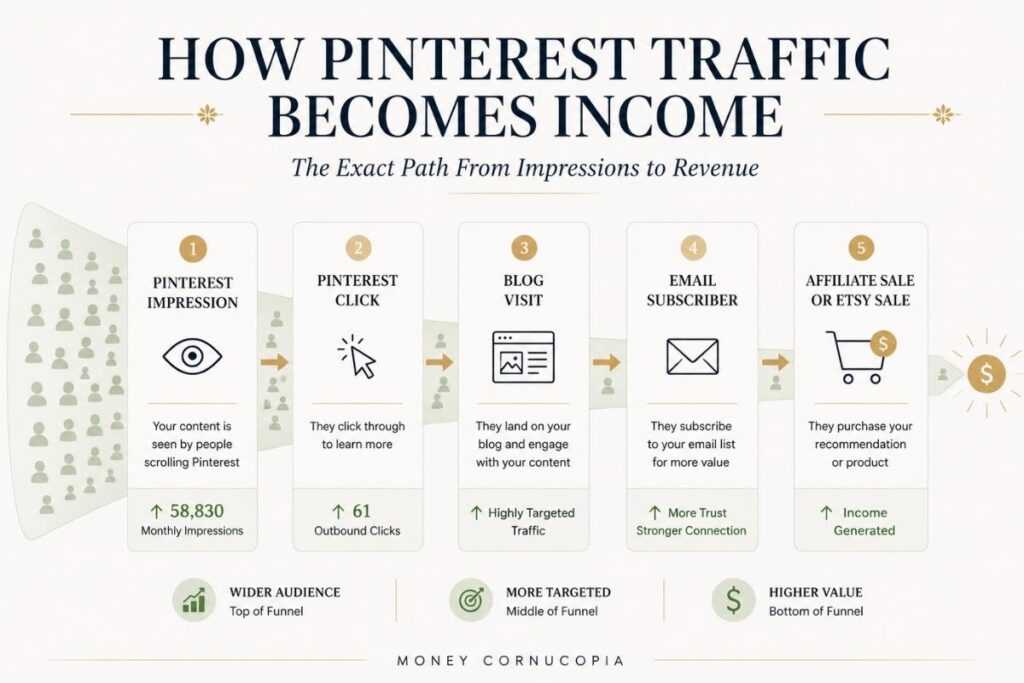
The journey looks like this:
The path from Pinterest impression to income
| 1 | Pinterest impression. Someone searching a relevant topic sees your pin in their feed or search results |
| 2 | Pinterest click. Your pin title and design create enough curiosity that they click through to your blog or Etsy shop |
| 3 | Blog visit or product view. The visitor reads your article or looks at your product listing |
| 4 | Conversion. They click an affiliate link, buy a product, sign up for a newsletter, or return later as a reader who eventually buys |
Right now I am at the top of this funnel. I have impressions. I have a growing number of clicks. The conversions are not significant yet because the volume of clicks is still small. But the funnel is real, and the direction is right.
Here is how I am planning to monetize each step:
How each step of the funnel converts to income
| 1 | Blog traffic will eventually qualify for a display advertising network once monthly pageviews reach the required threshold. Pinterest is building that traffic now |
| 2 | Etsy traffic from Pinterest means buyers who arrive already warm rather than cold Etsy search traffic competing against thousands of established sellers |
| 3 | Affiliate commissions will convert Pinterest readers who click through to relevant blog articles — currently building toward programs like Canva after publishing the Canva Free vs Pro breakdown |
The compounding advantage is that Pinterest pins do not disappear after 24 hours like Instagram posts. A pin I published three weeks ago is still circulating today. Every pin I publish now becomes part of a growing asset base that keeps driving traffic long after I have stopped thinking about it.
Why Pinterest Works Without Followers
Most platforms make starting from zero nearly impossible. Pinterest is the exception.
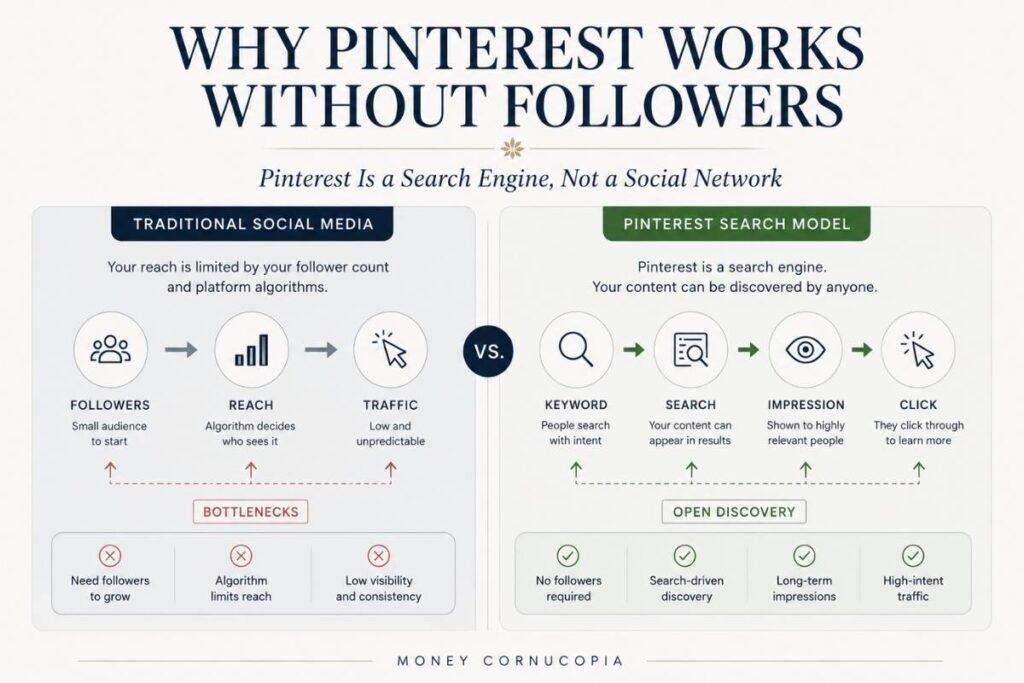
When I was building this blog, the hardest part of every other platform was the same problem. You need followers to get reach. You need reach to get followers. Starting from zero means being invisible for months or years.
Pinterest broke that pattern immediately. The reason is simple. People on Pinterest are not scrolling to see what their friends are doing. They arrive with a specific question or need. They are in search mode. A pin about compound interest does not need 10,000 followers behind it to reach someone who just searched “what is compound interest.” It needs to be relevant, readable, and keyword-focused.
That is a set of skills anyone can develop regardless of their audience size.
The Strategy That Got Me to 58,000 Impressions
Here is exactly what I did. No tool recommendations. No course upsells.
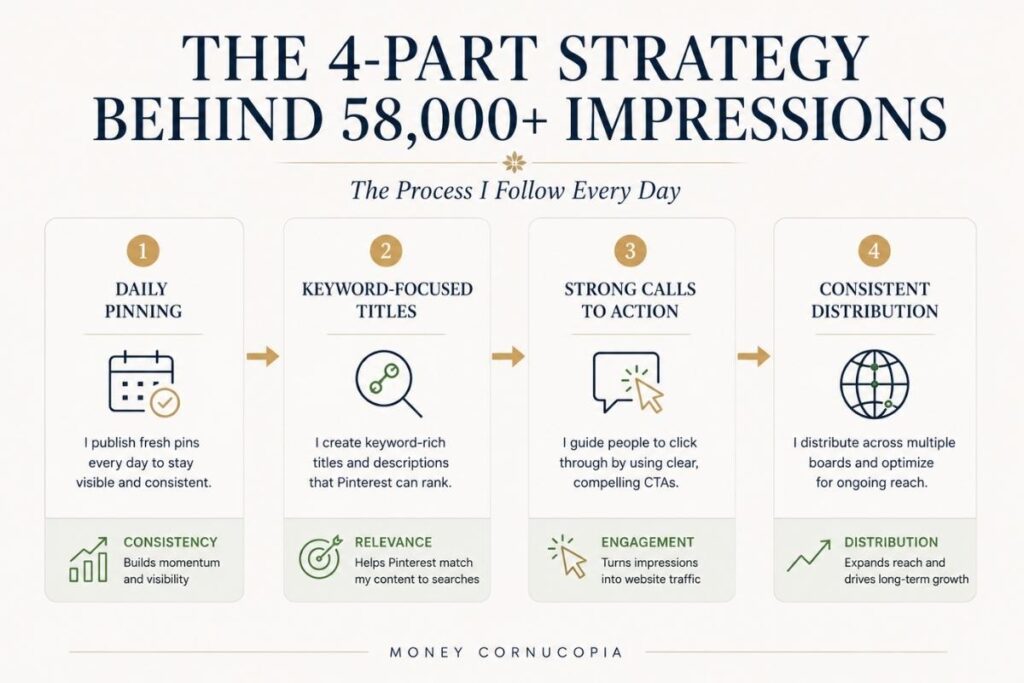
Daily pinning without exception
I pin every day. Sometimes three to five pins, sometimes more, sometimes fewer, but every single day without exception. I also repin content from other accounts in my niche daily to stay active on the platform.
Each pinning session takes about one hour. I design new pins, schedule them in advance using Pinterest’s built-in scheduler, and repin a handful of relevant pins from other creators. The scheduler is the most important tool I use because it means I can batch work and still maintain daily consistency.
For each article I publish on my blog, I create multiple pins spread across several days. Different titles, different designs, different angles on the same content. This gives each piece I write extended distribution rather than a single appearance.
Design and tools
I use a mix of Canva and AI image generators for visuals. I almost always start from scratch rather than using someone else’s template, though I have built my own templates in Canva to speed up the process. One pin takes me between five and ten minutes.
I prefer infographic-style pins. Clean, informative, structured like a quick visual answer rather than an advertisement. They get saved more than any other format I have tried because people find them useful enough to want to return to later.
The title lesson
I learned through watching videos and trial and error that the title of a pin determines almost everything. A beautiful design with a weak title gets almost no traction. A simple design with a strong title can reach thousands of people.
I treat every pin title the way I treat an article headline: it must answer a question, create curiosity, or solve a specific problem. Before writing a pin title, I type my topic into Pinterest’s search bar and look at the autocomplete suggestions. Those are real searches happening right now. I build my titles around those phrases.
The CTA lesson that changed my outbound clicks
For weeks, my saves were growing, but my outbound clicks stayed frustratingly low. I had hundreds of saves and only a handful of blog visits. People were saving my content but not clicking through.
The problem was simple. I was either not including a call to action or using generic language like “Read more.” When I switched to specific, direct CTAs like “Read the full breakdown at the link” or “See the exact numbers in this article” my outbound clicks started improving. Pinterest users are browsers by nature. A clear, specific CTA is what converts a browser into a visitor.
Boards matter from the start
I have four boards: Side Hustle Tips, Money Basics, Digital Products, and Passive Income Ideas. Each has a keyword-rich name that reflects what people actually search on Pinterest.
If I were starting over today, this is the first thing I would get right. When I first created my account in December, I only set up two boards with names that were not optimized for search. I had to rename and restructure them later, and that caused my impressions to drop temporarily because Pinterest had to relearn the context of my boards. Name your boards correctly from the beginning. Do not rename them.
The Pinterest Reality Nobody Talks About
The days that test you are not general. They are very specific.
There is the day you publish a pin you spent 20 minutes designing and it gets four impressions. You check again an hour later. Still four. You wonder if the algorithm has stopped caring about your account entirely.
There is the week where your saves are climbing, but your outbound clicks are flatlining. Seven hundred saves. Sixty-one blog visits. You realize that people are bookmarking your content to never return to it. You start questioning whether your CTAs are working or whether your content is actually worth clicking on.
There is the specific frustration of seeing an old pin from three weeks ago suddenly get fifty saves in one day, while your newest pin sits at zero impressions. Pinterest is not linear. It does not reward recency the way other platforms do. Old content resurfaces randomly, and new content sometimes sits untouched for days.
These are the moments that test consistency. Not the broad fear of failure. The specific small failures of individual pins, specific weeks of stalled clicks, specific mornings of checking analytics and seeing nothing new.
But I do not take a day off.
That is the only thing I have figured out that actually works. You do not need to make your best pin every day. You just need to make something. The platform rewards accounts that show up. Accounts that disappear get deprioritized. I have seen this directly when I compare my current growth to the months I was inactive.
I wrote about this pattern in my article about the quiet months before a side hustle starts working. Every platform has a version of it. Pinterest is no different.
What I Would Do Differently Starting Over
Three specific things I wish I had known before my first pin:
Set up boards correctly from day one. Name them with searchable keyword phrases. Do not rename them after the fact. Every rename resets the algorithm’s understanding of your content and causes a temporary drop in impressions that takes weeks to recover from.
Start with strong CTAs from the very first pin. Do not wait until your saves are high before worrying about outbound clicks. The CTA habit is easier to build at the beginning than to retrofit into an established pinning routine.
Treat every title as a search query. Type your topic into Pinterest’s search bar and read the autocomplete suggestions before writing a single word of your pin title. Those suggestions are real searches happening right now. Build your titles around those phrases, not around what sounds clever to you.
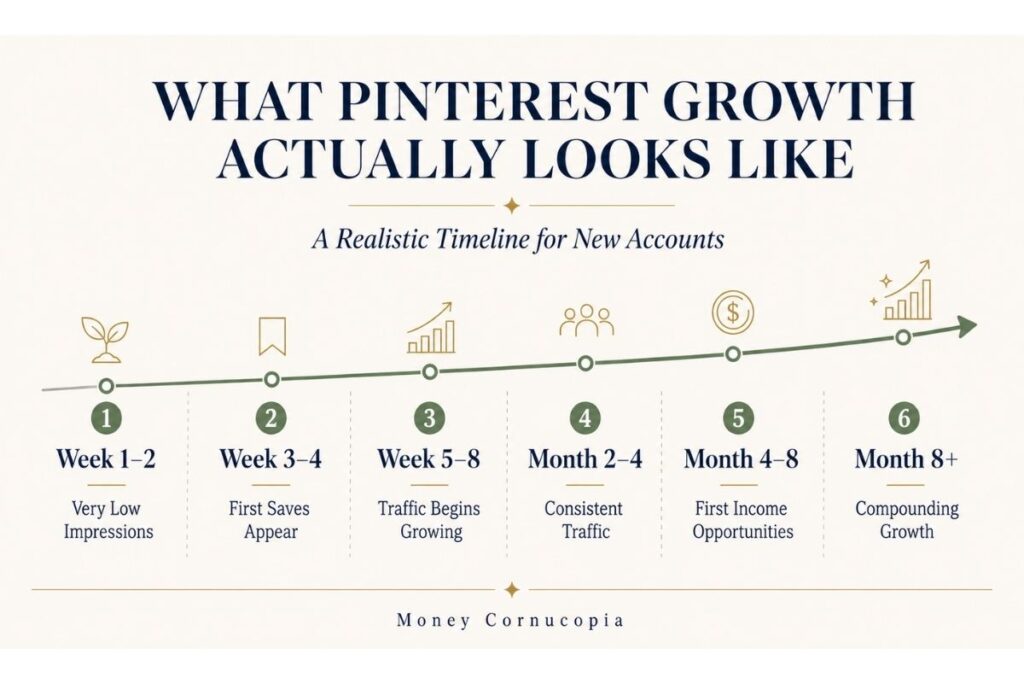
Realistic Expectations: What Actually Happens Week by Week
| Timeline | What realistically happens |
|---|---|
| Week 1 to 2 | Very low impressions — algorithm is still learning your content and boards |
| Week 3 to 4 | First saves appearing, impressions starting to grow noticeably |
| Week 5 to 8 | Meaningful impression growth, first outbound clicks improving as CTAs strengthen |
| Month 2 to 4 | Consistent blog or Etsy traffic beginning, saves compounding from older pins |
| Month 4 to 8 | First income possible if monetisation is already in place |
| Month 8 and beyond | Older pins keep circulating passively, compounding traffic builds without proportional extra effort |
I am currently at week 5 to 6. My impressions are growing, my saves are compounding, and my outbound clicks are improving as my CTAs get stronger. Income is not here yet. That is the honest position, and I have no reason to pretend otherwise.
Next Update
This is a living case study, not a finished success story.
When my Pinterest-driven income changes, when my outbound clicks cross a meaningful threshold, or when my strategy shifts based on what the analytics show, I will update this article with the real new numbers.
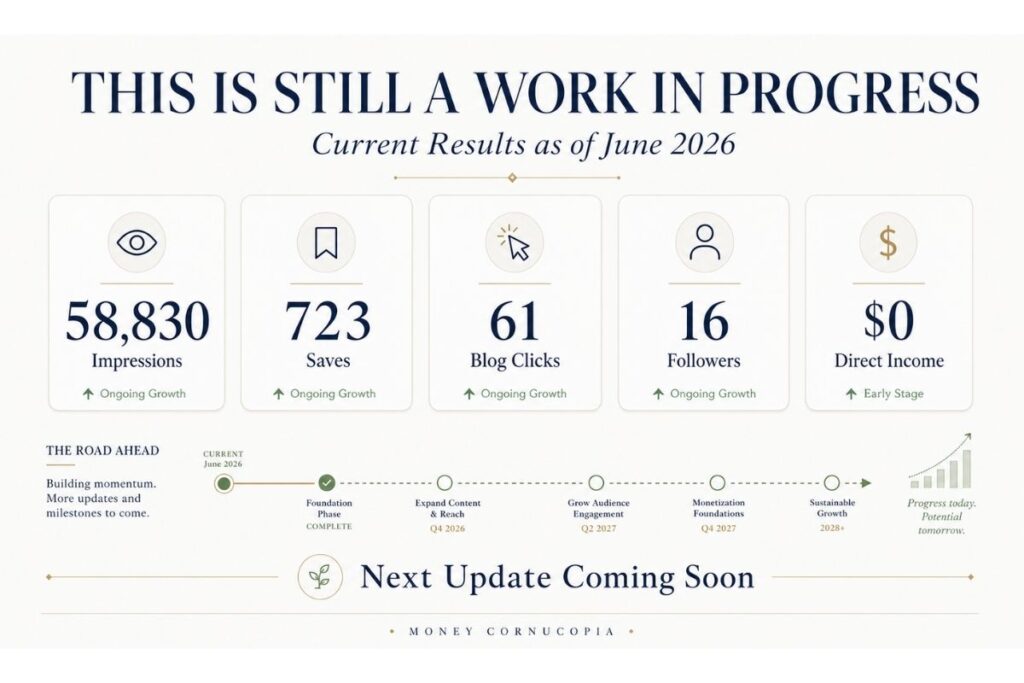
June 2026: 58,830 monthly impressions, 16 followers, 61 blog clicks, 1 Etsy click, $0 direct income. Building consistently every day.
Frequently Asked Questions
Can you really grow Pinterest without followers?
Yes. Pinterest is a visual search engine, not a social network. Your reach is determined by keyword relevance and content quality rather than follower count. My account reaches over 26,000 people monthly with 16 followers because my pins appear in search results for topics people are actively looking for.
How long does it take to see Pinterest results?
In my experience, meaningful impression growth started in weeks 3 to 4 of consistent daily pinning. Outbound clicks took longer because I needed to improve my CTAs. Most creators report seeing real traction after 4 to 8 weeks of consistent effort.
How many pins should a beginner post per day?
I post between three and five pins per day, sometimes more, sometimes fewer. The most important thing is consistency. One pin every single day for two months outperforms ten pins daily for two weeks, then nothing. The algorithm rewards accounts that show up regularly.
Do you need a blog to make money on Pinterest?
No, but having a blog helps significantly. Without a blog, you can link pins directly to an Etsy shop, Gumroad store, or affiliate product pages. With a blog, you can build a deeper relationship with visitors and create content that naturally promotes multiple income streams. I cover how a blog fits into the full picture in my digital products shop guide.
Why are my Pinterest saves high but outbound clicks low?
This was my exact problem for weeks. The most common cause is weak or missing calls to action. Pinterest users are browsers by nature. A specific, direct CTA like “Read the full breakdown at the link” gives them a clear reason to click now rather than save for later.
What type of pins get the most saves?
Infographic-style pins that provide immediate visual value perform best for saves. A pin that teaches something or answers a question clearly gets saved because people want to return to the information. Curiosity-driven titles that promise a specific insight also accumulate saves consistently.
Is Pinterest still worth starting in 2026?
Yes. Pinterest had over 570 million monthly active users in early 2026. Unlike Instagram or TikTok content that disappears within 24 to 48 hours, Pinterest pins continue driving traffic for months or years after publication. For personal finance, digital products, and side hustle content, Pinterest users are actively searching for solutions rather than passively scrolling, which makes them far more engaged visitors.
Can you make money on Pinterest without a blog?
Yes. You can link pins directly to affiliate products, Etsy listings, or digital product storefronts like Gumroad. Having a blog amplifies the income potential because it gives you a destination to warm up visitors before they buy, but it is not a requirement to start.
Does Pinterest pay you for views?
No. Pinterest does not pay creators directly for impressions or views the way YouTube pays for video views. Pinterest income comes indirectly through what you do with the traffic. Views become blog visits, blog visits become ad revenue or affiliate clicks, and affiliate clicks become commissions. The platform drives traffic. You monetise the traffic through your own products, affiliate programs, or display advertising on your blog.
How many Pinterest views do you need to make money?
There is no fixed number because it depends entirely on your monetization method. For blog display ads, the threshold varies by network, but most require thousands of monthly pageviews rather than Pinterest impressions. For Etsy or digital product sales, even a small number of highly targeted clicks can convert to sales. For affiliate marketing, one well-placed link in a high-traffic article can earn commissions regardless of total view count. The more useful question is not how many views, but what happens after those views.
Can you make money on Pinterest as a beginner?
Yes, though not immediately. As a beginner, the first 4 to 8 weeks are typically spent building impression volume and learning what content resonates with your audience. Income usually follows traffic, and traffic takes time to compound. My account reached 58,000 monthly impressions in 5 to 6 weeks as a beginner with no prior Pinterest experience. The income from that traffic is still being built. Starting as a beginner is not a disadvantage on Pinterest, the way it is on follower-dependent platforms.
Final Thoughts
Six weeks ago, I had 50 monthly impressions and zero followers on a Pinterest account I had abandoned for months.
Today I have 58,830 impressions, 723 saves, and 26,780 people who have seen my content without a single penny spent on advertising.
I still have not earned any direct income from Pinterest. I still face doubt on the days where pins get three impressions and analytics look flat. But I do not take a day off.
If you are reading this and thinking you cannot get these results because you do not know enough or do not have enough followers, I want to say one thing clearly.
Six weeks ago, I did not know anything either. I learned everything through trial and error, watching videos, and showing up the next day regardless of what happened the day before.
The only thing I have now that you do not have is that I started.
And you have not started yet.
Leave a Reply