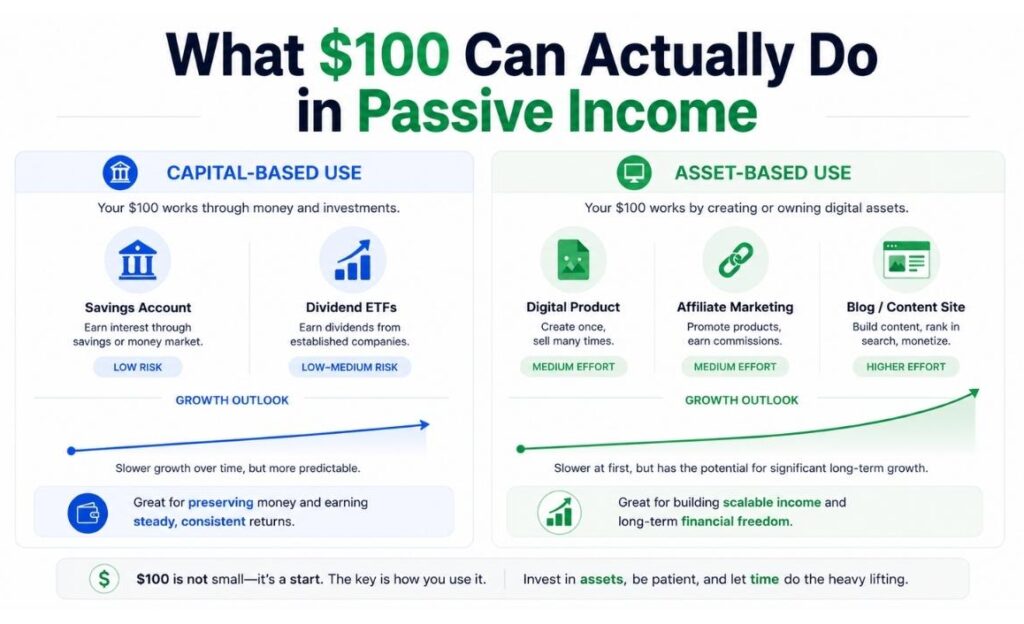
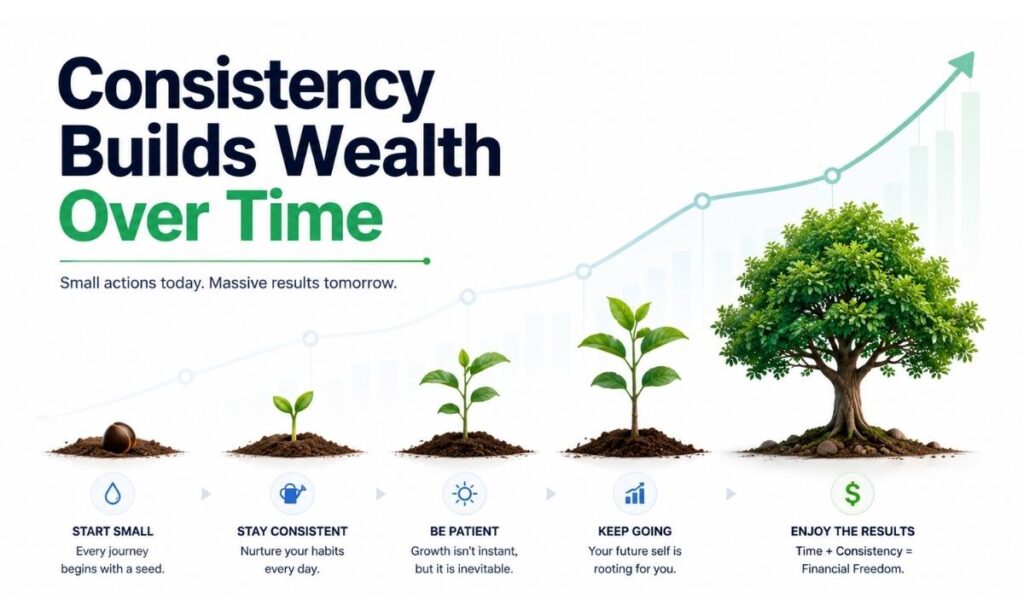
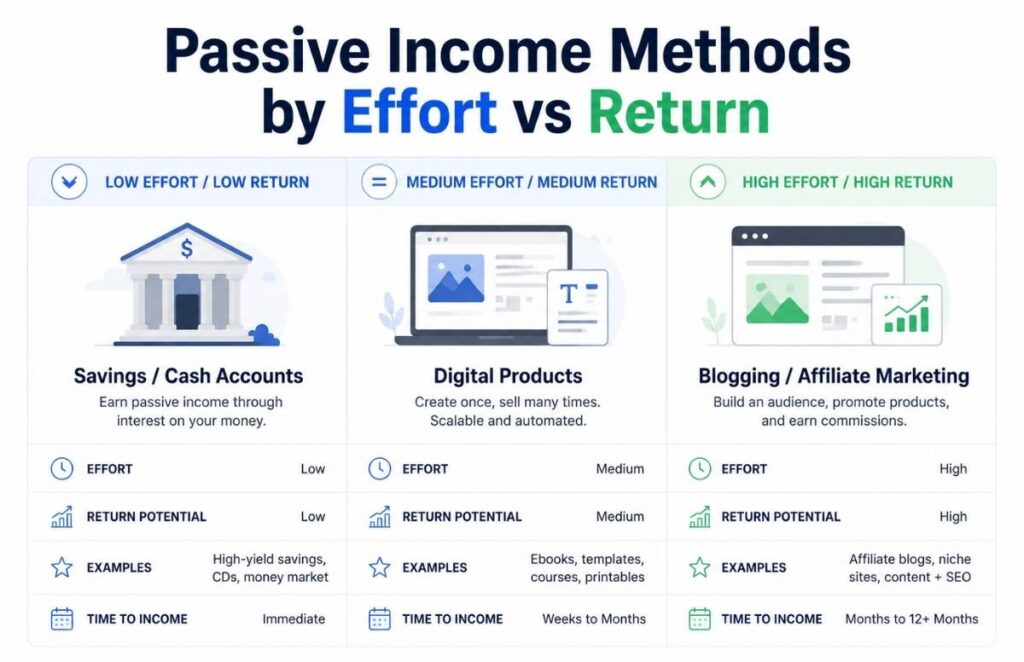
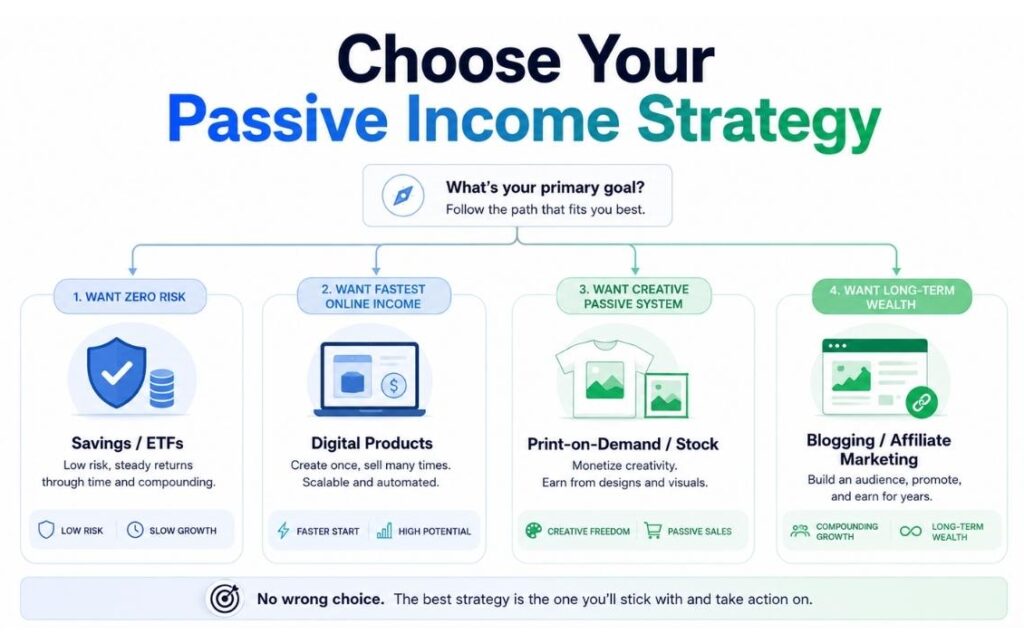
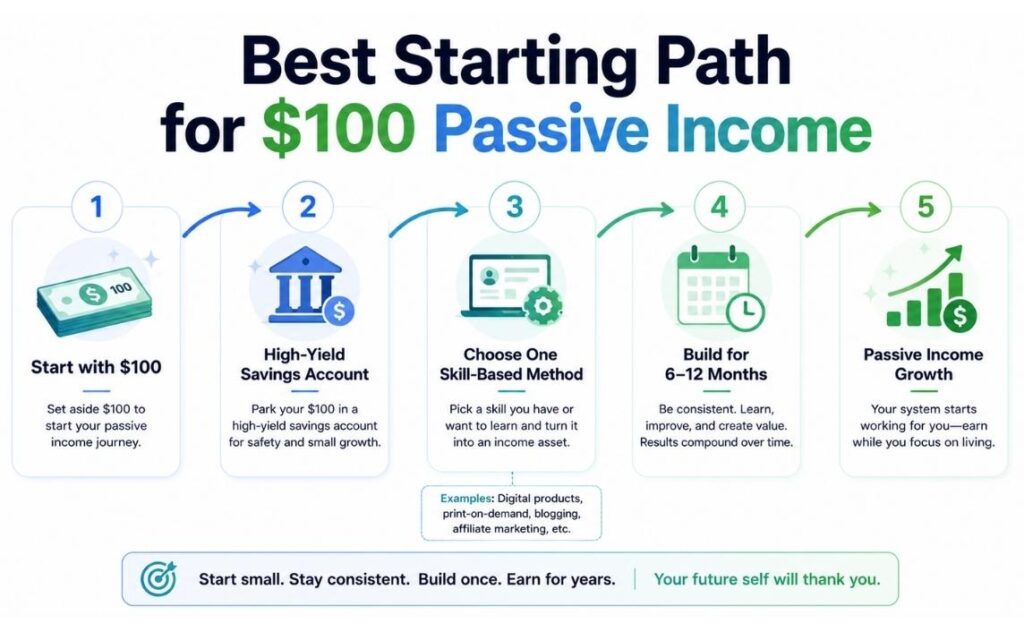
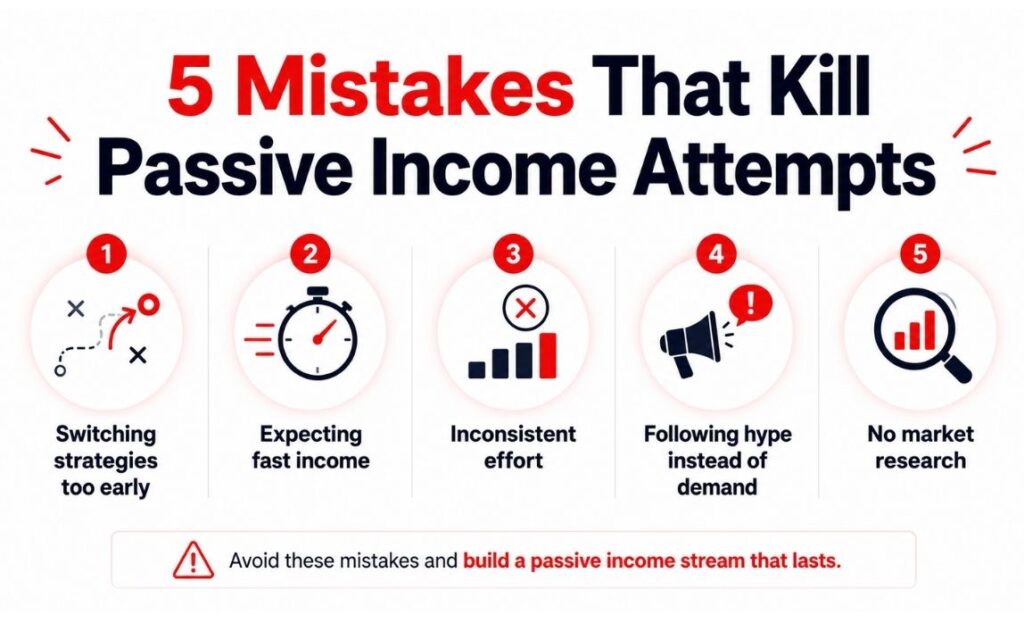
Honest strategies for growing an online side hustle or passive income stream without fake overnight success claims. Covers common mistakes, realistic expectations, and the slow path from zero to consistent online income.
If you are trying to figure out how to start a side hustle with no money, you will usually run into two types of advice, and both of them are misleading.
The first says it is completely free. Just start a blog, post on Pinterest, open an Etsy shop, and watch the money appear. No mention of any cost at all.
The second says it is secretly expensive. You need premium tools, paid courses, ads, and a budget before you can earn a single dollar.
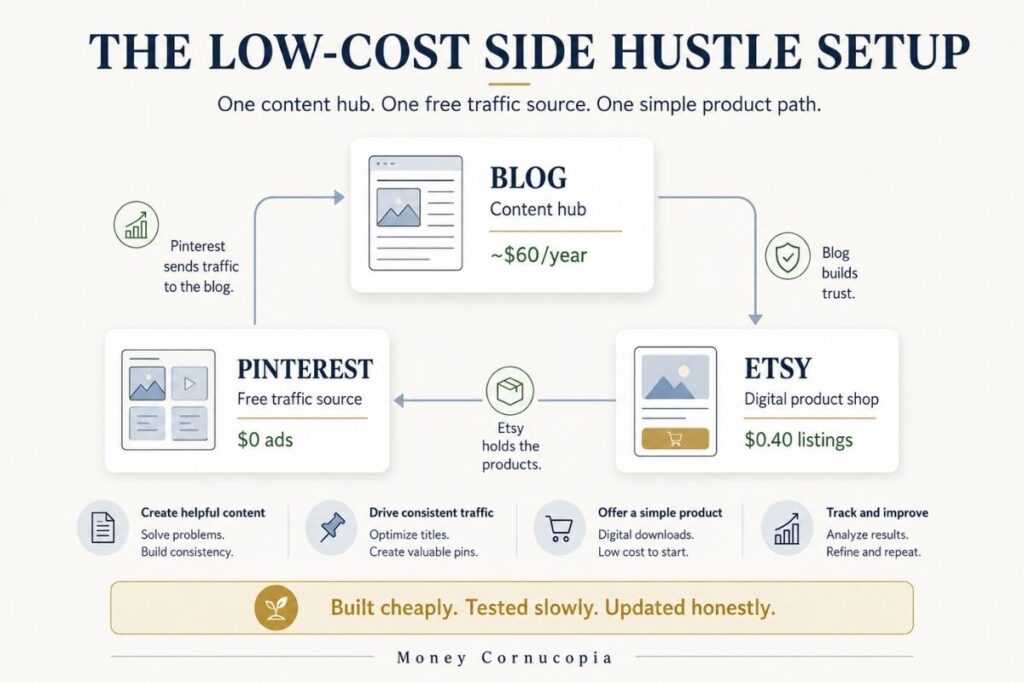
The truth, based on what I actually spent, sits in between. I started a blog, a Pinterest account, and an Etsy shop for roughly $60 in essential costs. That number is neither free nor expensive, and being honest about it matters more than any headline.
But before you get excited about the low number, here is the part most articles skip: starting cheap is not the same as earning quickly. I spent very little, my visibility has grown a lot, and I have still made $0 so far. This article is the honest breakdown of exactly what it costs to start, what I spent it on, what I deliberately skipped, and what actually happened.
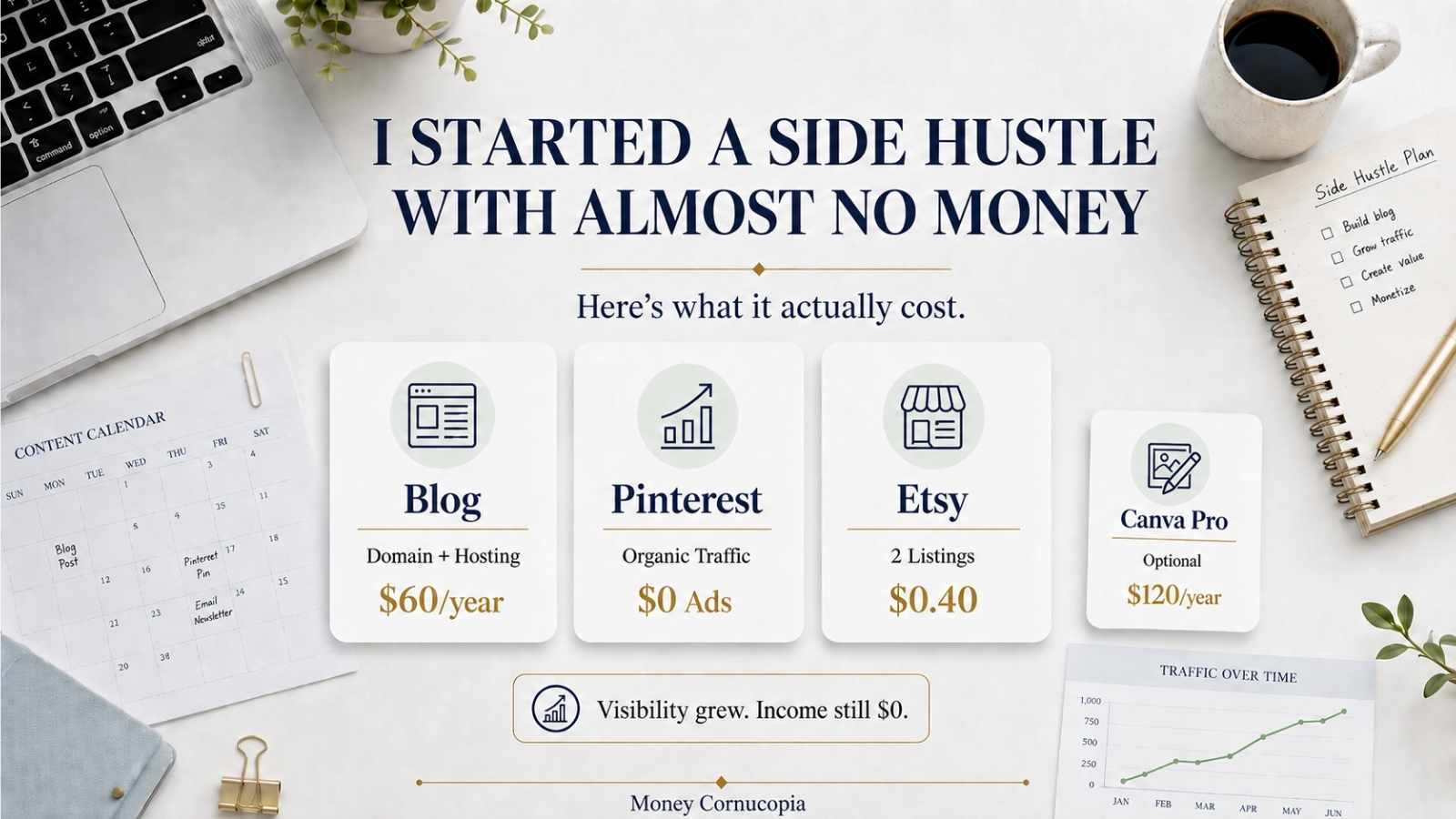
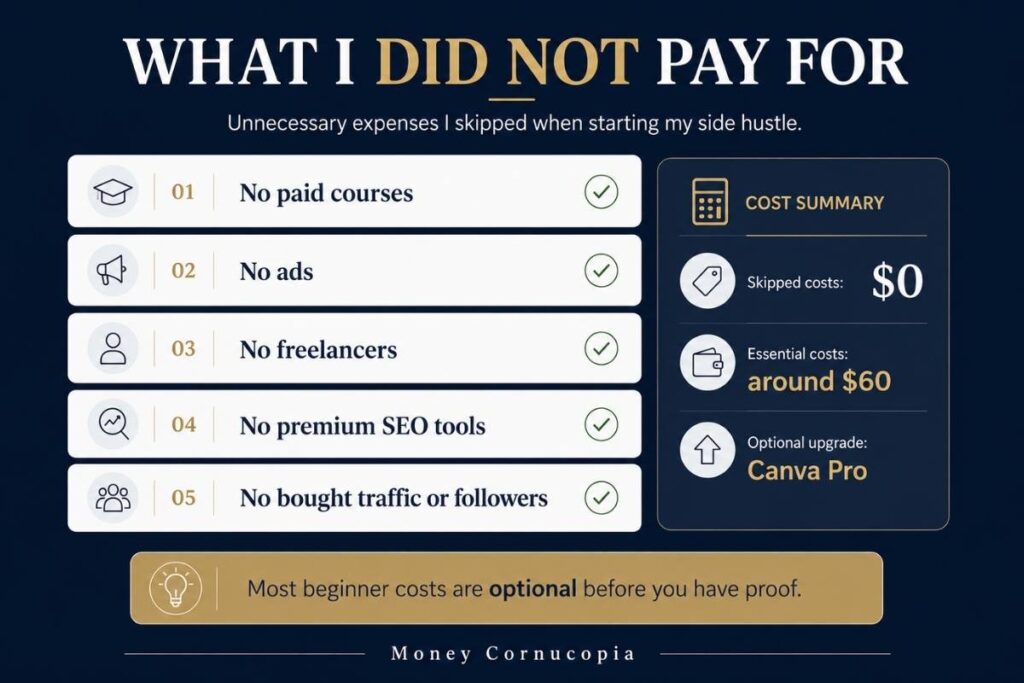
Quick cost summary: My essential startup cost was around $60 for the first year, roughly $20 for a domain and $40 for hosting. Pinterest cost $0, Etsy cost $0.40 for two listings, and Canva Pro was optional at around $120 per year.
Table of Contents
First, What “No Money” Actually Means
When people search “how to start a side hustle with no money,” many are looking for fast cash today. Survey apps, gig work, something that pays this week.
That is not what this article is about, and I want to be upfront so you do not waste your time.
This is about starting a real online side hustle, a blog, Pinterest presence, and digital product shop, for almost no upfront money. These are assets that build slowly. They are not quick cash. If you need money this week, this is the wrong article for you, and I would rather tell you that now than have you read 2,000 words expecting something else.
It is worth knowing you are not alone in looking for a low-cost start. Penny Hoarder’s 2026 survey found that 53% of Americans with side hustles say they would struggle to cover essential expenses without that extra income, which is exactly why starting cheaply matters so much to so many people.
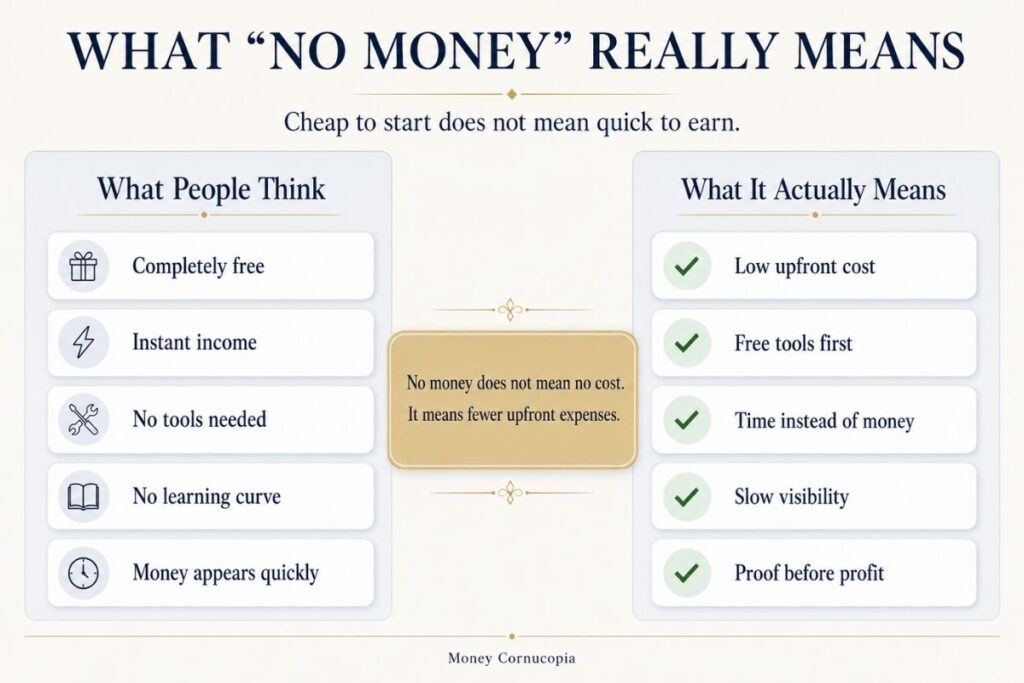
“No money” here means avoiding unnecessary upfront costs. It does not mean zero cost, zero time, or zero learning curve. It means you spend only where you genuinely have to, and you skip everything you can skip at the start.
What I Spent on the Blog
Essential cost: roughly $60 for the first year.
The blog was the only part that required real money to start, and even then, it was modest.
I paid around $20 for the domain name. This is the address of the website, the part people type to find you. Domains are a yearly cost, and most are inexpensive.
I paid around $40 for hosting. Hosting is the service that keeps your website online and accessible. This is also a recurring cost, but for a beginner blog, entry-level hosting is cheap and perfectly sufficient.
That is the entire essential cost of starting the blog: around $60 for the first year. No premium theme, no paid plugins, no developer. I used a free theme and free versions of the plugins I needed.
The content itself costs nothing but time. I wrote every article myself. I did not hire writers, buy content, or pay for any writing tools.
What I Spent on Pinterest
Cost: $0. No ad spend, ever.
Pinterest has been the most surprising part of this entire journey, and it cost me nothing.
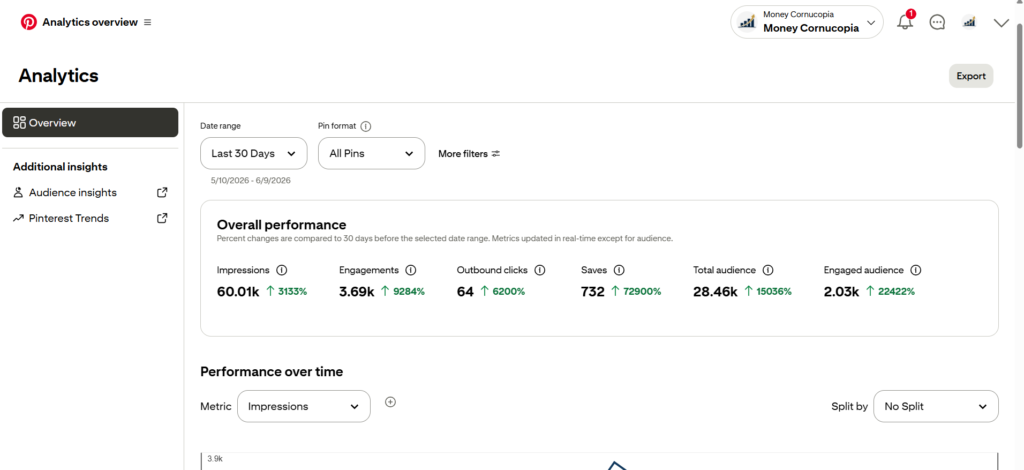
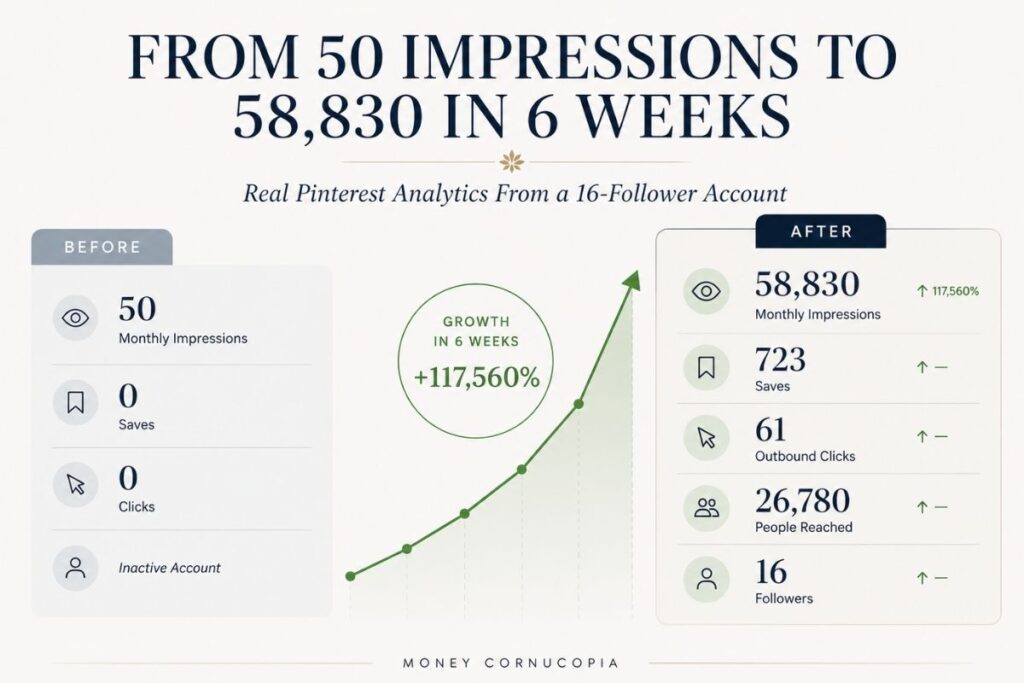
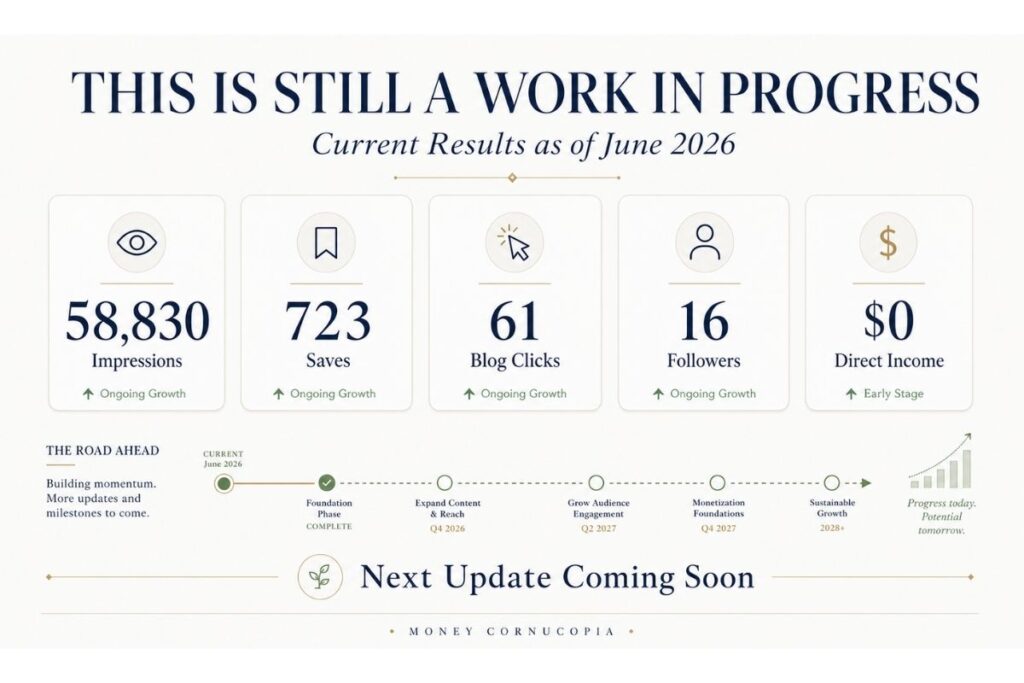
I have spent zero dollars on Pinterest ads. Everything I have built there has been organic, meaning it came from consistent free pinning rather than paid promotion. The results have genuinely surprised me: I went from around 50 monthly impressions to 58,830 in about 5 to 6 weeks, with 723 saves, 61 outbound clicks to my blog, and just 16 followers.
My Etsy shop has two digital product listings, a freelancer tax tracker and a budget planner. Etsy charges $0.20 per listing, so my total Etsy startup cost was 40 cents.
I recently changed my pricing on these from $5.99 to $9.99 after realizing that pricing too low was not building the trust I assumed it would. And to be completely honest, I have made zero sales so far.
I am including this because many people assume Etsy is a free flood of buyers waiting to discover your products. My honest result says otherwise. Listing something on Etsy costs almost nothing, but that does not mean it sells. The cost of entry is tiny. The cost of actually getting noticed and trusted is paid in time, not dollars. I dug into this gap more deeply in whether you can really make money selling PDFs, since my Etsy products are exactly that kind of digital file.
Optional Tool I Use: Canva Pro
Cost: around $120 per year. Helpful, but not required to start.
This is the one expense I want to be careful about, because I do not want to tell you that you need it when you do not.
I use Canva Pro to design my Pinterest pins, blog graphics, and Etsy mockups. It costs around $120 per year. The Pro templates, background remover, and resizing tools genuinely save me time and make my work look more professional.
But here is the honest truth: you do not need Canva Pro to start. The free version of Canva is genuinely capable, and a beginner can create perfectly good pins and graphics without paying anything. Canva Pro helps a lot once you are creating content daily, but it is an upgrade, not a requirement. If your budget is truly zero, start with free Canva and upgrade later only if the work justifies it. I broke down exactly when Pro becomes worth it in my honest Canva Free vs Pro breakdown.
So if you are counting strictly essential costs, my number is around $60. If you include Canva Pro, it is closer to $180 for the first year. Either way, it is far from the expensive setup many people imagine.
What I Did Not Spend Money On
This list matters as much as what I spent.
I did not buy any courses. No “make money on Pinterest” program, no Etsy masterclass, no blogging bootcamp. Everything I learned came from free articles, free videos, and trial and error.
I did not run any ads. Not on Pinterest, not on Google, not anywhere. All my traffic has been organic.
I did not hire anyone. No writers, no virtual assistants, no designers. I did every part myself.
I did not buy expensive software. No premium SEO tools, no paid automation stacks, no subscription pile. I used free tools wherever they existed.
I did not pay for traffic or followers. The 16 followers and 58,830 impressions on Pinterest were all earned, not bought.
The reason I am listing all of this is that these are exactly the costs that beginners are pushed toward constantly. Every one of them is optional at the start, and skipping all of them is part of how I kept my real cost near $60.
The Real Cost Was Not Money
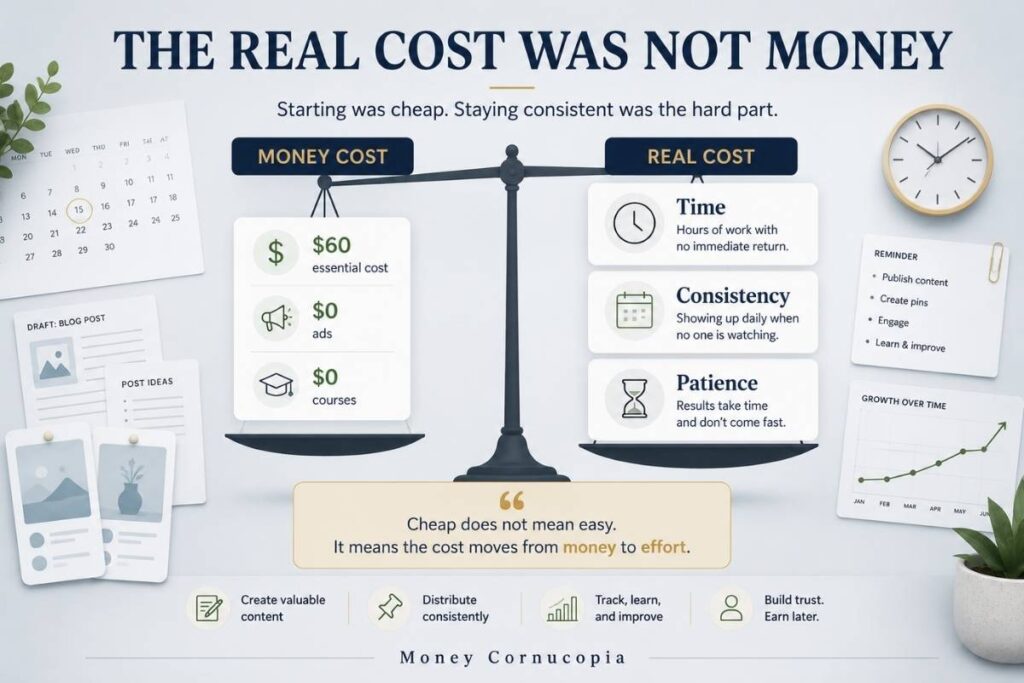
The expensive part of starting a side hustle was not the money. It was everything money cannot buy.
The real cost was time. Writing articles takes hours. Designing pins takes time every single day. Learning what works takes weeks of trying things that do not work first.
The real cost was consistency. Showing up every day to pin, to write, to adjust, even when nothing seemed to be happening. Especially when nothing seemed to be happening.
The real cost was patience. Waiting for Google to start trusting a new site. Waiting for Pinterest to start distributing my pins. Waiting through the long stretch where the numbers are technically growing, but the income is still zero.
I wrote about this stretch in detail in how long it actually takes to make money from a side hustle, because it is the part nobody warns you about. The money cost of starting is small. The psychological cost of waiting, while doubting whether any of it will work, is the real price of admission.
What I Would Do If I Were Starting Again With $0
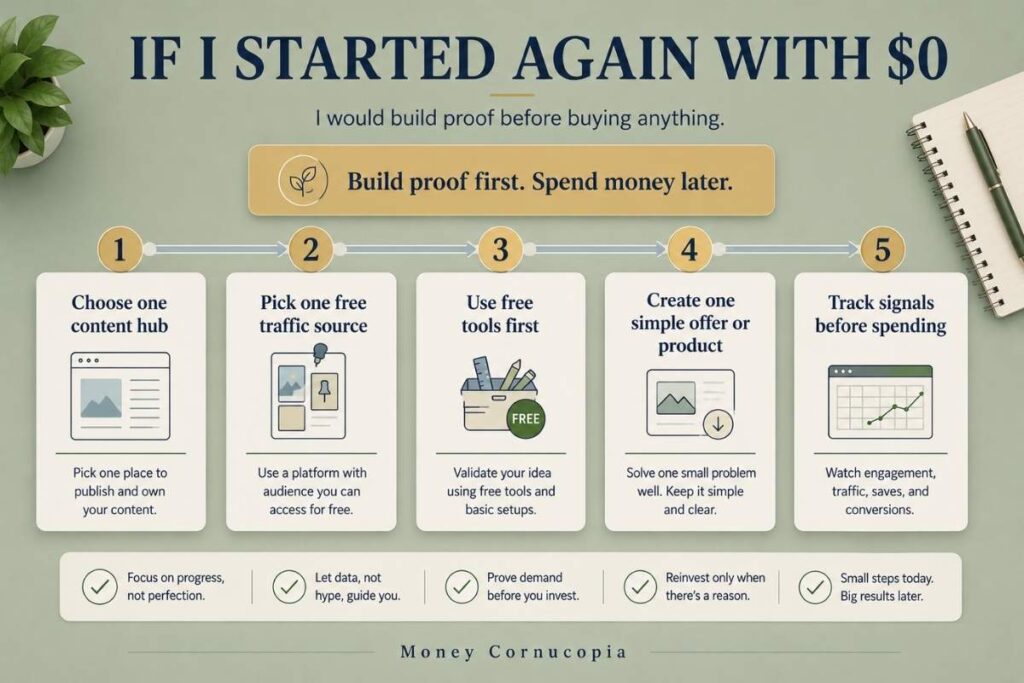
If I had to begin again today with almost nothing, here is exactly how I would do it.
I would not start by buying tools, courses, or ads. I would start with one free traffic source, one simple content platform, and one offer or product, and I would use free tools until the work itself proved an upgrade was worth it.
The specific setup would be this. Start one content hub, a basic blog or even a free platform if a domain is out of budget. Pick one free traffic source and commit to it daily, which for me was Pinterest. Use free Canva for all graphics until you are creating enough volume that Pro pays for itself. Create one simple digital product or pick one affiliate path rather than spreading yourself across five. Track everything in a basic free spreadsheet so you can see which signals are growing. And run no ads at all until you have proof that people actually want what you are making.
The order matters. Most people spend money first and build proof later. I would build proof first and spend money only where the proof demanded it. Starting this way means your only real risk is your time, and time spent learning what works is never fully wasted, even if the first idea does not succeed.
So, Can You Start a Side Hustle With No Money?
Yes, you can start for almost nothing. No, that does not mean you will earn quickly.
Here is my honest answer after living it.
You can absolutely start a real online side hustle for very little money. Around $60 covers a domain and hosting. Pinterest is free. Etsy listings are cents. The free versions of most tools are good enough to begin. The “you need money to make money” idea is not true for getting started.
But starting is not the same as earning. The first goal of a cheap side hustle is not income. It is proof of visibility, evidence that real people are finding and engaging with what you make. My visibility has grown enormously. My income has not arrived yet.
This slow start is more normal than the hype suggests. According to Side Hustle Nation’s 2026 survey data, the median side hustle earns around $200 a month, and roughly half of side hustlers make under $100, which tells you that modest or slow early income is the norm, not the exception.
If you start expecting cheap to mean fast, you will quit in the first month when the money is not there. If you start understanding that cheap means slow but possible, you have a real chance.
The Honest Breakdown
Area
What I used
Cost
Result so far
Blog
Domain, hosting, free theme
~$60/year
~9,000 monthly impressions, a handful of Google clicks
Pinterest
Organic pins, no ads
$0
58,830 impressions, 723 saves, 61 clicks
Etsy
2 digital product listings
$0.40
0 sales so far
Design
Canva Pro (optional)
~$120/year
Faster, more professional pins and mockups
Courses, ads, tools, freelancers
None
$0
Skipped entirely
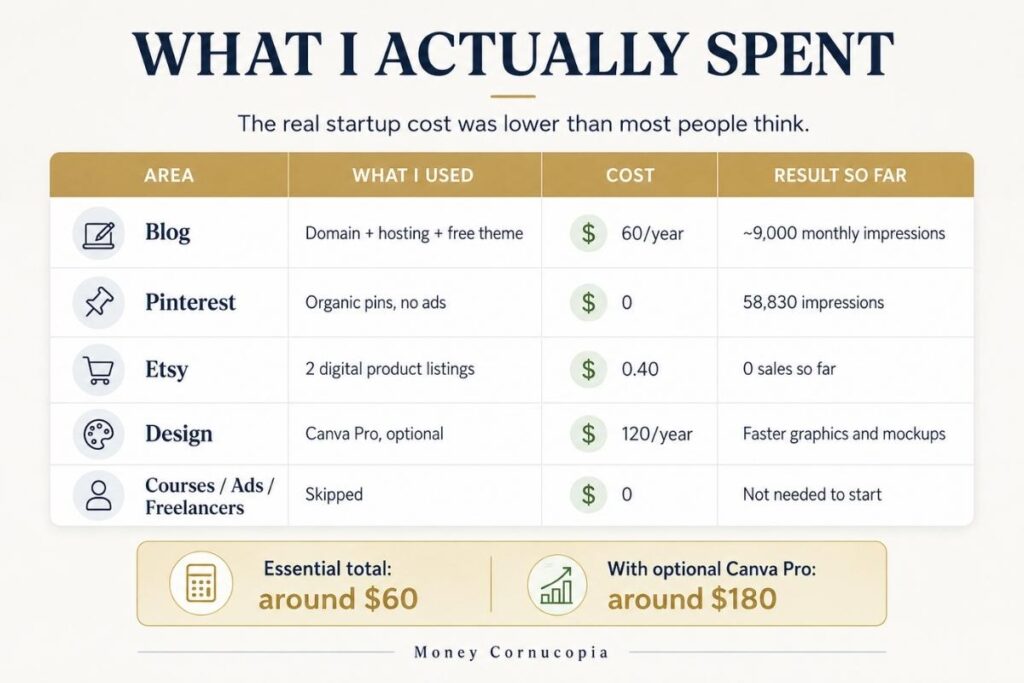
Essential total to start: around $60. With the optional Canva Pro: around $180 for the first year.
Frequently Asked Questions
Can you really start a side hustle with no money?
You can start a real online side hustle for very little money, though rarely literally zero. A blog needs a domain and hosting, which cost around $60 a year combined. Pinterest is free, and Etsy listings cost $0.20 each. Many tools have free versions. So while “completely free” is usually a myth, “very cheap” is genuinely achievable.
How much does it actually cost to start a side hustle?
In my case, the essential cost was around $60 for the first year, covering a domain and basic hosting. Adding optional tools like Canva Pro brought it closer to $180. The higher cost was not money but time and consistency over several months before seeing meaningful results.
What side hustle can I start with no money online?
The lowest-cost online side hustles are usually content-based or service-based: blogging, Pinterest traffic, freelance services, digital templates, affiliate content, or simple digital products. The cheapest option depends on whether you need fast income or are building long-term traffic. Service-based hustles tend to earn fastest, while content and product-based ones take longer but can compound over time.
What is the cheapest side hustle to start?
Service-based side hustles using skills you already have are often the cheapest because they require no inventory or upfront product cost. For digital asset side hustles like blogging, Pinterest, and digital products, the cost is low, but the timeline to income is longer. The cheapest option depends on whether you need money quickly or are building something over time.
Do you need to pay for tools to start a side hustle?
Not to start. Free versions of design tools like Canva, free blogging plugins, and free Pinterest scheduling are enough to begin. Paid tools like Canva Pro genuinely help once you are creating content daily, but they are upgrades rather than requirements. Starting with free tools and upgrading only when the work justifies it is a sensible approach.
How long before a cheap side hustle makes money?
Longer than most people expect. Low-cost digital side hustles like blogs, Pinterest, and Etsy shops build visibility before income. In my own case, I grew to tens of thousands of Pinterest impressions and thousands of blog impressions while still earning $0, because traffic and trust build before sales do. Several months of consistent effort is a realistic expectation before meaningful income.
Is Etsy free to start selling on?
Almost. Etsy charges $0.20 per listing, so listing a handful of products costs cents. However, listing something does not guarantee sales. The real challenge is visibility and trust, which take time to build, not money to buy.
Final Thoughts
Starting a side hustle with almost no money is genuinely possible. I did it for around $60 in essential costs, plus one optional tool, across a blog, a Pinterest account, and an Etsy shop.
But the cheap part was the easy part. The expensive part, the part that actually tests whether you will succeed, was the time, consistency, and patience required to keep going while the income stayed at zero.
If you are waiting until you have money to start, you may be waiting for a barrier that is smaller than you think. Sixty dollars and a willingness to show up consistently is genuinely enough to begin.
What it is not enough for is instant income. That part is still being built, on my side too. But you cannot build it at all until you start, and starting costs far less than most people believe.
If you searched this question, you are probably not looking for inspiration. You are looking for a number. Something that tells you whether what you are feeling right now, the part where nothing seems to be working, is normal or a sign that you should stop.
I cannot give you a single number. Nobody honestly can. But I can show you something most articles do not: three side hustles running at the same time, at three different stages, with three different timelines, and exactly what each one looks like right now while none of them have made a single dollar yet.
This is not a success story. This is a real-time look at the stage before money, the part almost nobody documents because it is boring, slow, and does not make a good headline.
Quick Answer: How Long Does It Take?
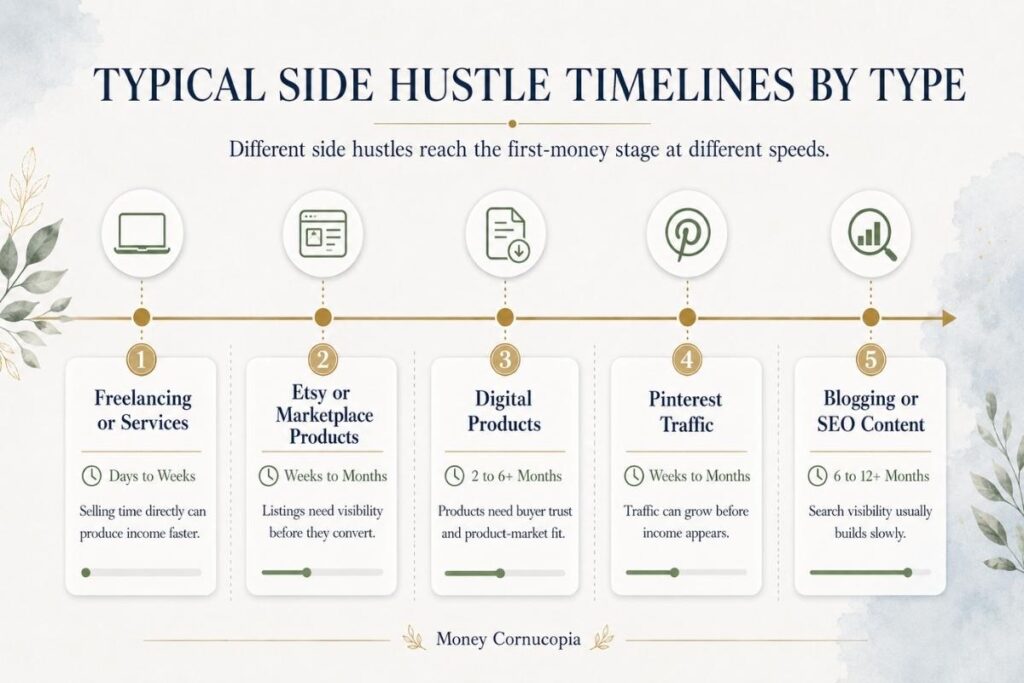
Service-based side hustles can sometimes produce income in days or weeks because you are selling your time directly to one buyer. Product-based side hustles, like digital products on Etsy, often take two to six months or more because they require both visibility and buyer trust. Content-based side hustles like blogging typically take six to twelve months or longer because search visibility builds slowly. Pinterest-driven traffic can grow fast, sometimes within weeks, but the income that traffic produces usually lags behind the traffic itself.
But the better question is not just “how long until money?” It is “are there signals before the money?” That distinction is the core of this article.
Table of Contents
Typical Side Hustle Timelines by Type
Side hustle type
Typical first-money timeline
Why
Freelancing or services
Days to weeks
You sell directly to one buyer with minimal trust-building required
Etsy or marketplace products
Weeks to months
Listings need visibility before they can convert
Digital products (general)
2 to 6+ months
You need product-market fit and buyer trust before conversions happen
Pinterest traffic
Weeks to months
Impressions can grow quickly but the income that traffic produces usually lags behind
Blogging or SEO content
6 to 12+ months
Search visibility takes time to build from a new domain
This table answers the generic version of the question. The rest of this article shows what those ranges actually look like from inside them.
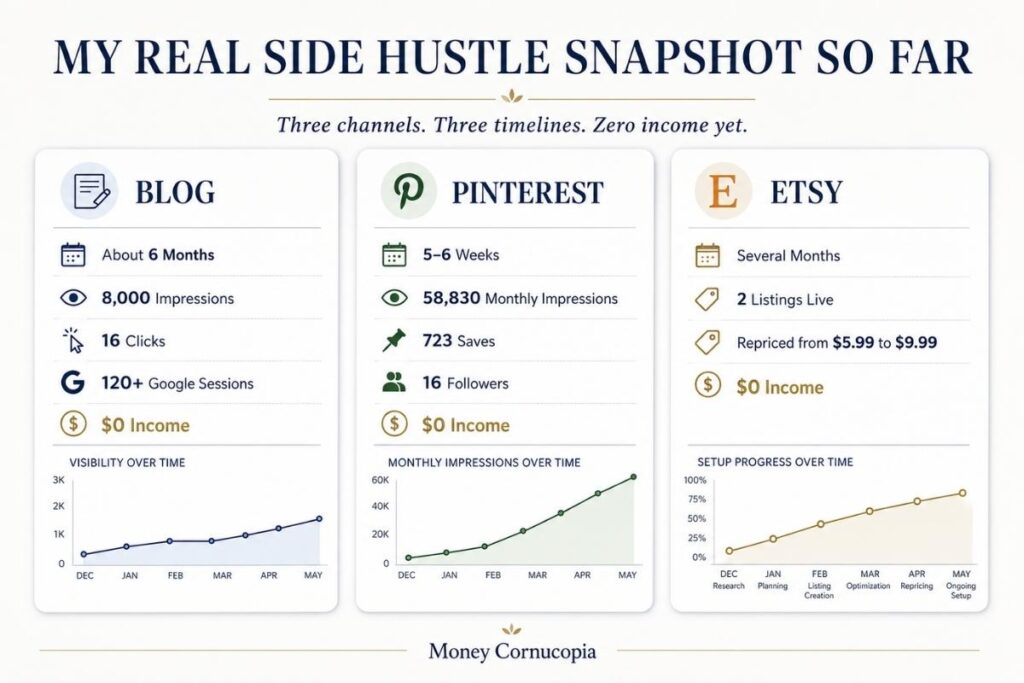
My Real Side Hustle Timeline So Far
Here is exactly where each part of my side hustle stands right now.
Side hustle
Time invested
Current status
Income
Blog (content and SEO)
About 6 months
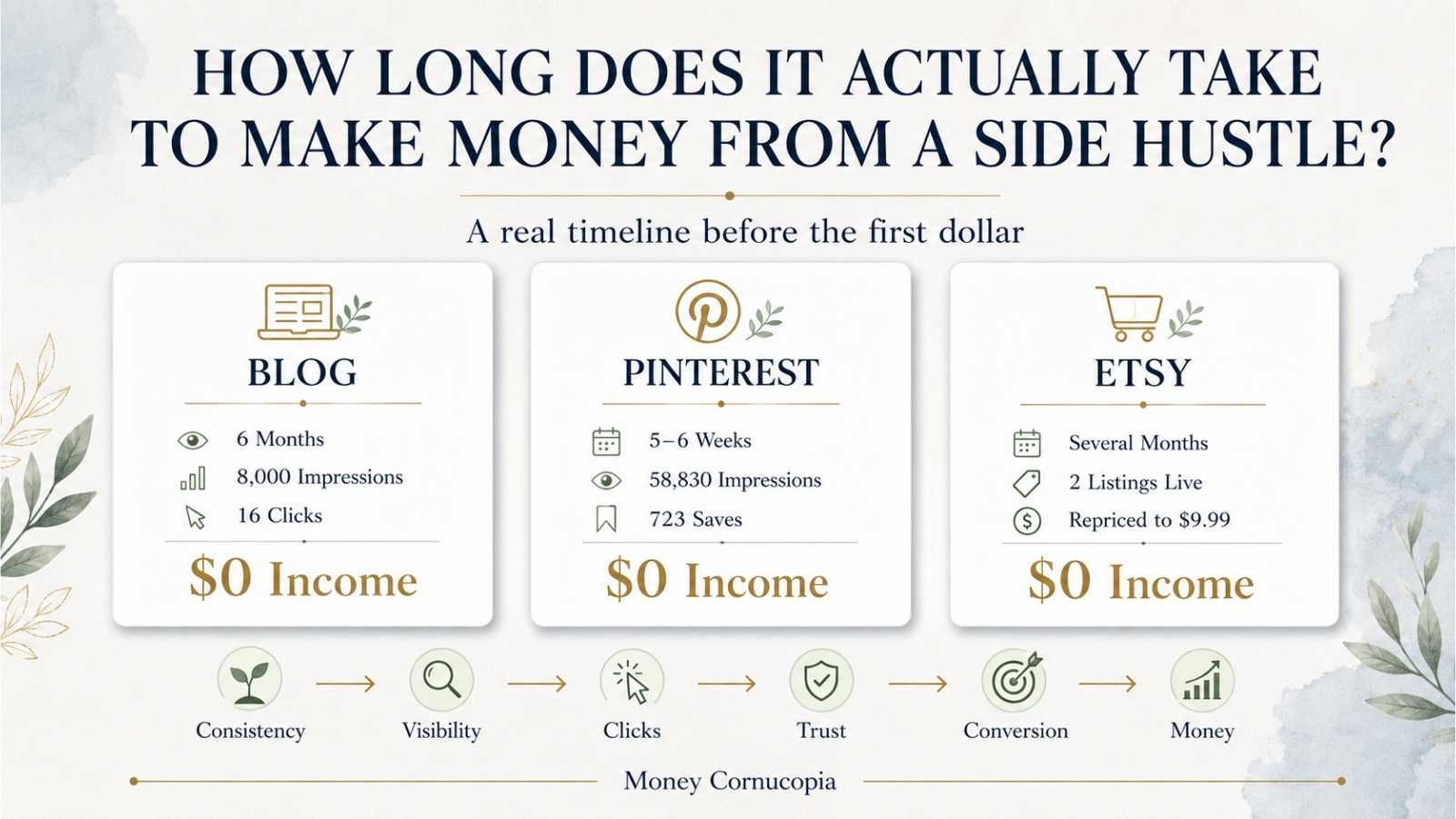
16 clicks, ~8,000 impressions, 120+ Google sessions in last 28 days
$0
Pinterest traffic
5 to 6 weeks
50 to 58,830 monthly impressions, 16 followers, 723 saves
$0
Etsy digital products
Several months
2 listings live, repriced from $5.99 to $9.99
$0
Three different channels. Three different timelines. The same number at the end of each row.
I want to be clear about what this table is and is not. It is not proof of success. It is not a humble brag dressed up as failure. It is the actual data, the kind you do not usually see because most people either quit before they would share numbers like this, or they wait until the numbers look better before publishing anything.
My blog went from 12 clicks and 4,050 impressions to 16 clicks and roughly 8,000 impressions in about a month. That is real growth. It is also still 16 clicks. My Pinterest account went from 50 monthly impressions to 58,830 in five to six weeks, which I wrote about in detail in how I reached 58,000 monthly Pinterest views with just 16 followers. That is also real growth. It has also produced exactly zero dollars.
Why Visibility Comes Before Money
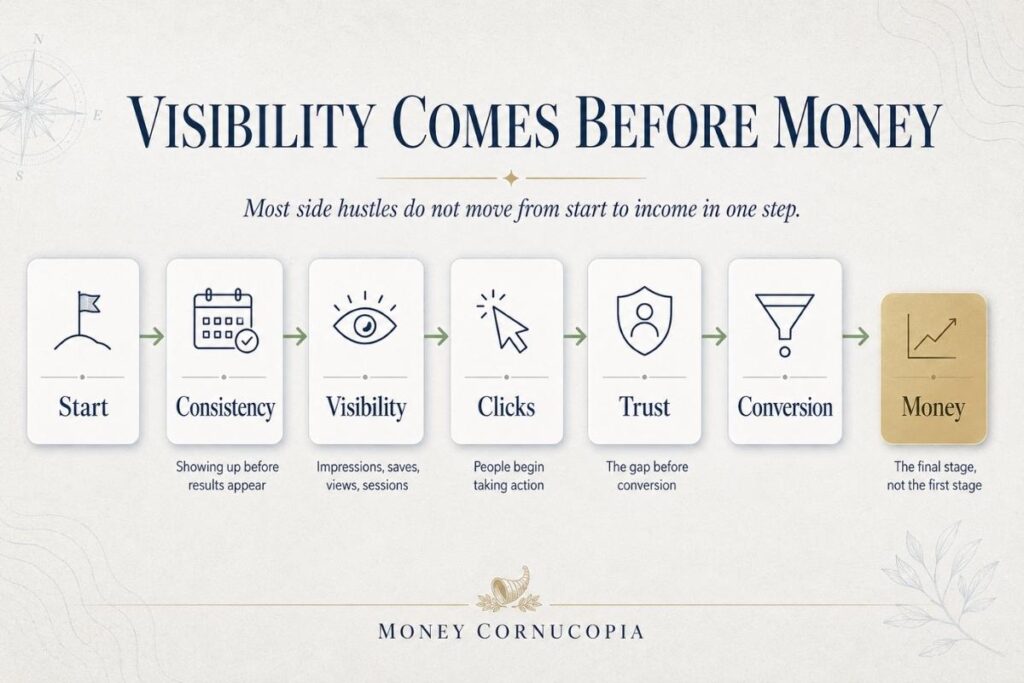
A side hustle does not move from start to money in one step. It moves through stages, and most of those stages produce nothing you can spend.
The path looks like this:
A side hustle does not move from start to money in one step
1
Start — You publish, list, or launch something
2
Consistency — You show up regularly enough for platforms to notice
3
Visibility — Impressions, views, and search appearances begin growing
4
Clicks — People start visiting your blog, shop, or product pages
5
Trust — Returning visitors, saves, favorites, and engagement build credibility
6
Conversion — A visitor becomes a buyer, subscriber, or affiliate click
7
Money — Income follows once conversion is working consistently
Most beginners quit somewhere between Visibility and Conversion — the stage that produces nothing you can spend but where almost everything important is being built.
When my blog impressions doubled, it felt like something important happened. And it did. But doubling impressions from a tiny base still produces a tiny number of clicks, and clicks still need to convert to something, whether that is ad revenue, an affiliate click, or a reader who eventually buys a product.
When my Pinterest impressions went from 50 to nearly 59,000, it felt like the floodgates had opened. They had, in a sense. But 723 saves and 61 outbound clicks across a month are still a small number of actual visits, and visits are still several steps away from a sale.
I am currently somewhere in the visibility-to-clicks stage across all three of my projects. None of them have reached conversion yet. That is not a failure. It is just where the timeline currently sits.
For content-based side hustles specifically, new sites usually need time to build enough content, relevance, and authority before search traffic becomes meaningful. According to Ahrefs’ research on SEO timelines, most sites begin to see measurable results within three to six months, though Google has indicated it can take up to a year for a new site to find its place in the rankings. My blog at 6 months, with growing impressions but still few clicks, fits squarely inside that range.
The Stage Most Beginners Misunderstand: Signals vs Sales
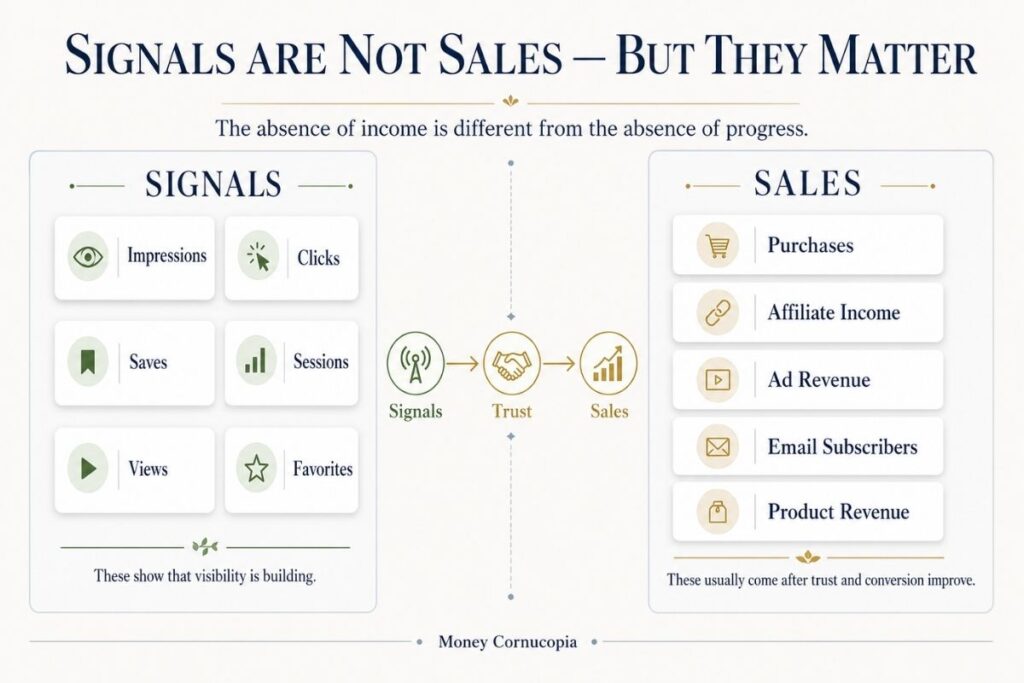
A signal is something that tells you people are interested, even if they have not bought anything yet. Signals are not money. But the absence of signals is very different from the presence of signals without sales.
My Pinterest saves are a signal. My blog impressions are a signal. If my Etsy listings start getting more views or favorites after I reprice them today, that will be a signal too.
If you have zero impressions, zero clicks, zero saves, zero views, and zero engagement of any kind after a genuinely consistent effort, that is useful information. Something about visibility itself needs to change.
But if you have growing impressions, growing saves, growing sessions, and the only thing missing is the final conversion step, that is a completely different situation. That is not a sign to quit. That is a sign you are in the stage where most people give up just before things start working, because the stage itself produces nothing you can point to as proof.
I covered the deeper version of this idea in 3 reasons your side hustle still is not growing, and the honest answer is that “not growing” and “not yet converting” often look identical from the inside, but they require completely different responses.
What I Am Fixing Next
Here is exactly what I am working on right now, across all three.
For the blog, I am focused on continuing to publish consistently and improving internal linking between articles, since 16 clicks from roughly 8,000 impressions tells me my content is starting to appear in search results but is not yet earning enough clicks to convert that visibility into meaningful traffic.
For Pinterest, I recently applied for the Canva affiliate program so that the traffic Pinterest is already sending to my Canva-related content can start contributing to income once that approval comes through.
For Etsy, I am changing my prices from $5.99 to $9.99 today, a decision I researched and explained in detail in why I repriced my Etsy listings. I do not expect this single change to produce sales by itself. But it removes one variable that may have been quietly working against me, which means whatever happens next will be a slightly cleaner signal.
None of these are dramatic changes. They are small adjustments to systems that are already partially working. That is what most of this stage actually looks like.
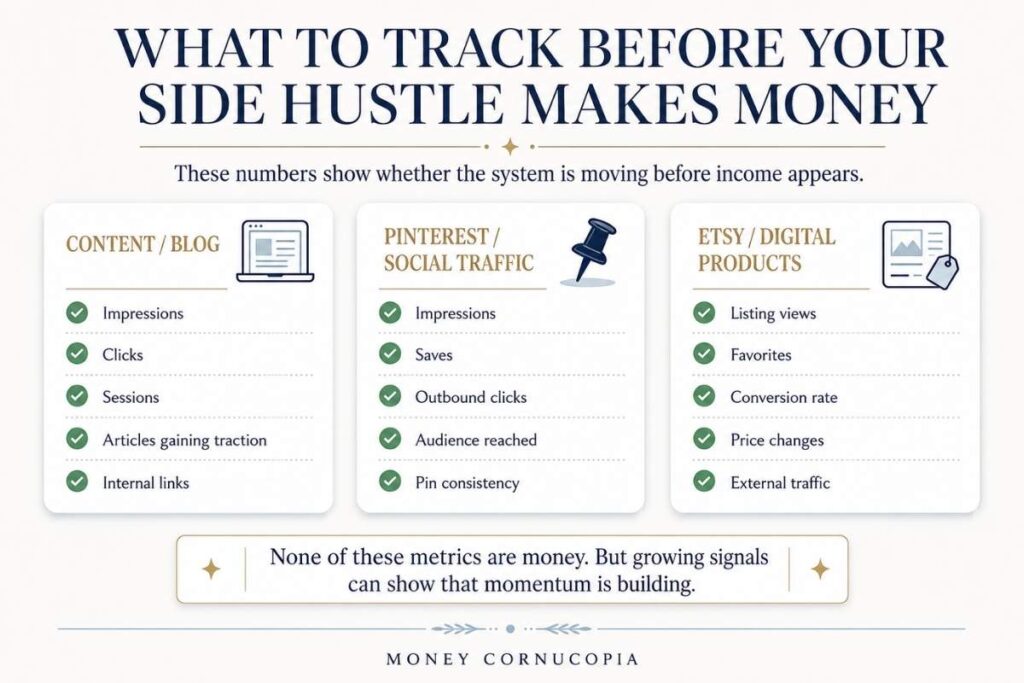
What to Track Before Your Side Hustle Makes Money
If income is not here yet, these are the numbers that tell you whether you are moving in the right direction.
For a content-based side hustle, track impressions, clicks, sessions, and which articles are gaining traction in Search Console month over month.
For Pinterest or social traffic, track impressions, saves, outbound clicks, and total audience reached.
For an Etsy shop or digital product store, track listing views, favorites, conversion rate, and outbound clicks from external sources like Pinterest.
Across all of them, track publishing consistency. Whether you showed up this week is something entirely within your control, even when the numbers are not.
None of these metrics are money. But growth in these metrics, even slow growth, is the difference between a side hustle that is quietly building and one that genuinely needs a different approach.
The Doubt Nobody Talks About
Sometimes it feels like none of this is going anywhere.
I want to be honest about something that I think every single person doing this feels, and almost nobody admits in writing.
Sometimes it genuinely feels like there is no progress and no money in this field, and that I am not going to achieve anything. The competition feels enormous. There are huge, established players in every single space I am trying to build in, whether that is finance content, digital products, or Pinterest marketing. The thought that keeps surfacing is simple: with this much competition, with these big fish already in the water, why would I get any of it?
This doubt does not go away just because the numbers are technically improving. Going from 50 to 58,000 Pinterest impressions did not make the doubt disappear. Going from 12 to 16 clicks on the blog did not make it disappear either. The doubt lingers regardless of what the dashboard says, because the dashboard still says $0, and $0 is the number that doubt cares about.
I do not have a clever way to make this feeling go away. I just keep going anyway.
So, When Should You Quit a Side Hustle?
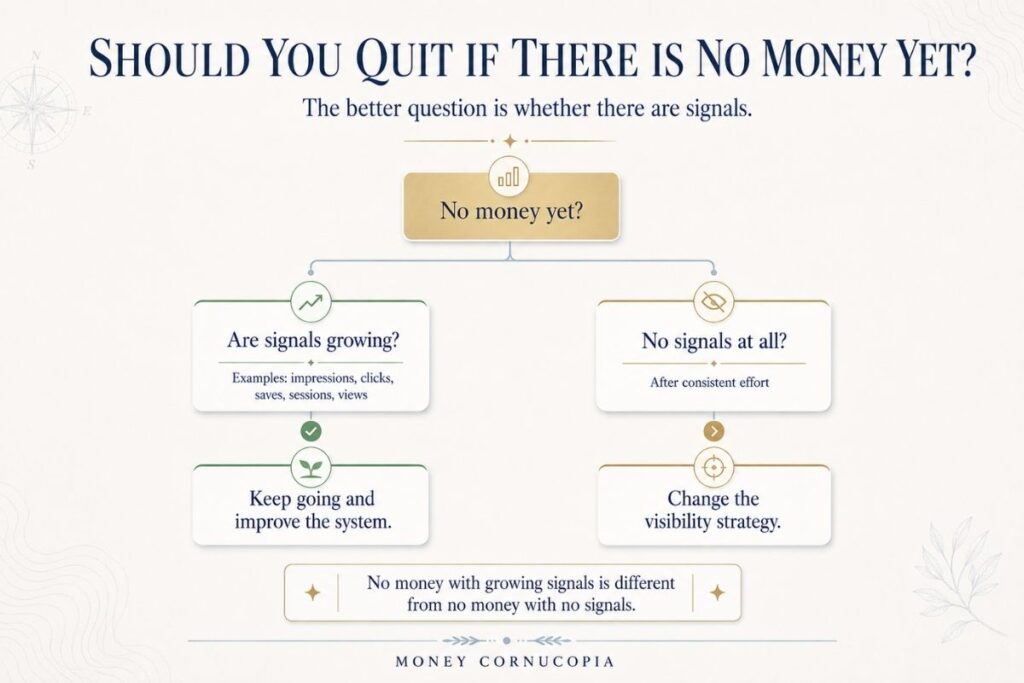
Not because there is no money yet. But pay attention if there are no signals at all.
Here is the honest distinction I use for myself.
No money but growing signals (impressions, clicks, saves, sessions, views) is normal and is not a reason to quit. This describes where all three of my projects currently sit.
No money and no signals at all, after a genuinely sustained and consistent effort, is different. That is a situation where something about visibility itself needs to change before anything else matters.
For myself, my honest answer is this: I am giving this at least 6 months of consistent effort before I make any real decision about whether it is working. Not 6 months from when I started, but 6 months of actually showing up consistently, which is a slightly different timeline for each of my three projects since they started at different points.
When I feel the doubt creeping in, and it creeps in often, I tell myself the same thing: keep going, give it the full runway you promised yourself, and then decide based on the real picture, not based on how a single bad week feels.
Frequently Asked Questions
How long does it take to make money from a side hustle?
There is no single answer because it depends entirely on the type of side hustle. Service-based side hustles can produce income in days or weeks because you are selling your time directly. Digital products and content-based side hustles like blogging typically take several months to a year because they require building traffic, trust, and an audience before the first sale or meaningful click happens.
Is it normal to make $0 after 6 months?
For content-based side hustles like blogging, yes, this is common. According to Ahrefs’ research on SEO timelines, most sites need three to six months to begin showing measurable results, and Google has indicated full results can take up to a year for new sites. The presence of growing signals like impressions and sessions, even without income, generally indicates the timeline is progressing normally.
How do I know if my side hustle is working if I am not making money yet?
Look for growing signals rather than income. Increasing impressions, saves, sessions, views, or engagement over time indicates that visibility is building, which typically precedes conversion. The absence of any growing signals after a genuinely consistent effort is a more meaningful indicator that something needs to change than the absence of income alone.
Should I quit my side hustle if it is not making money?
Not if signals are growing. A side hustle with increasing visibility but no sales yet is generally in a normal early stage rather than a failing one. Consider stepping back or changing strategy if there are no growing signals at all despite sustained, consistent effort over a meaningful period.
What is the difference between a service-based and product-based side hustle timeline?
Service-based side hustles can generate income quickly because you sell your time directly to one buyer with minimal trust-building required. Product-based side hustles take longer because they require a platform or audience to discover the product, and buyers need to trust an unproven seller enough to purchase something intangible or unfamiliar.
How do I know if I should change my strategy or just wait longer?
If your signals are growing month over month, the honest answer is usually to continue and give the timeline more room. If your signals have been flat for a sustained period despite consistent effort, that is when reviewing your strategy, whether that is your content, your product, your pricing, or your visibility channels, becomes more useful than simply waiting longer.
Final Thoughts
A side hustle is not slow because nothing is happening. It is slow because the first things that happen are invisible, boring, and unpaid.
Right now I have a blog that gets 16 clicks a month, a Pinterest account that gets 58,000 impressions and zero sales, and an Etsy shop with two listings and zero purchases that I am repricing today in the hope it removes one small obstacle.
None of that is impressive on its own. But six months ago the blog had almost nothing. Six weeks ago Pinterest had almost nothing. The signals are growing even though the income is not, and that is the actual stage I am in.
If you are in this stage too, the honest answer to “how long does it take” is: longer than you want and probably not as long as your doubt is telling you tonight. Keep going long enough to find out which one is true.
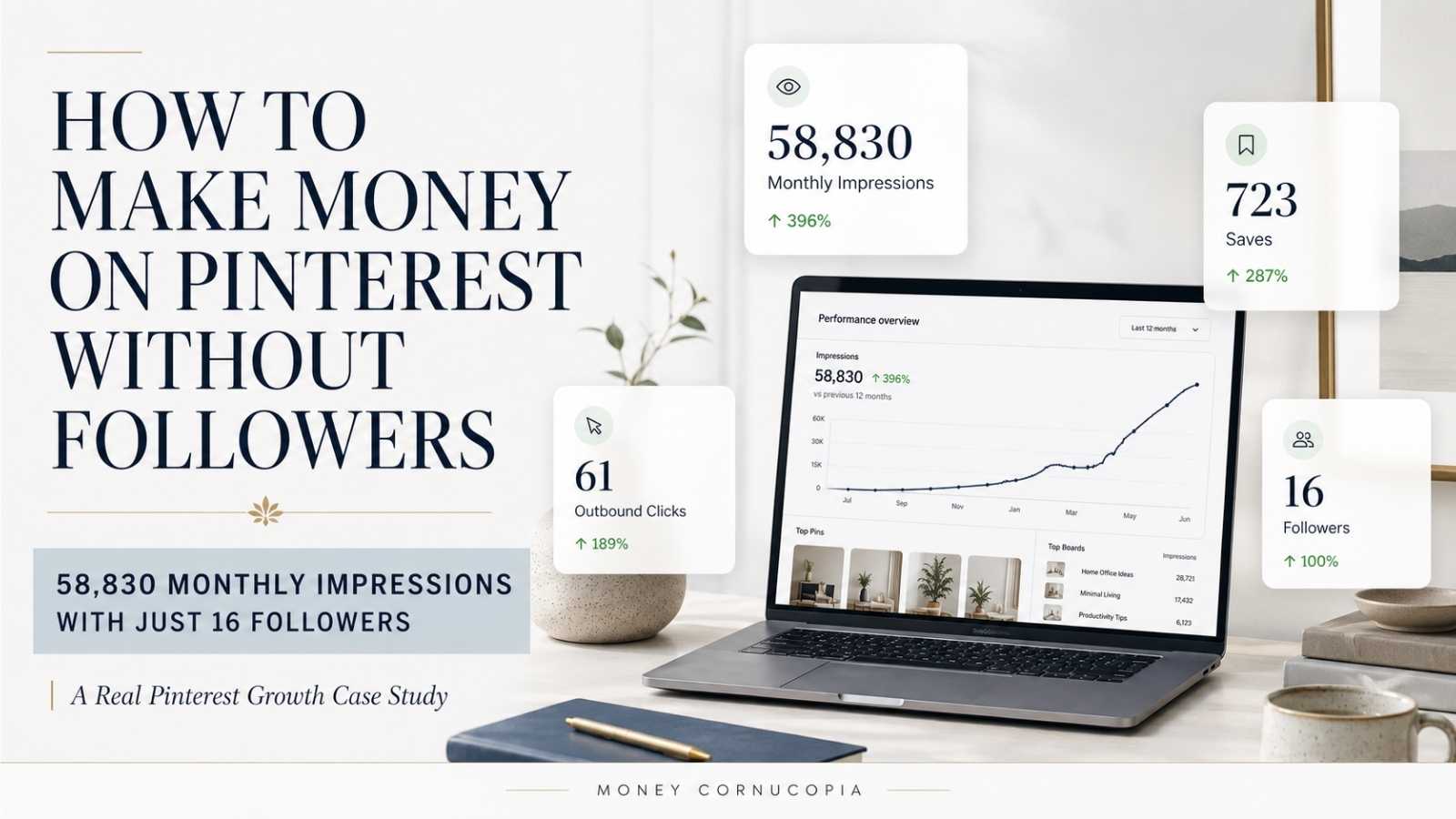
If you are wondering how to make money on Pinterest without followers, this case study shows exactly what happened when I grew a Pinterest account to nearly 59,000 monthly impressions with only 16 followers, zero ad spend, and 5 to 6 weeks of consistent effort.
Six weeks ago, that number was around 50 impressions. I had roughly 20 pins published and almost zero activity. I was not growing. I was not even trying.
This article is the honest story of what changed, what I actually did, and whether Pinterest can make you money without a large following. I am not writing this from the other side of success. I am writing it from the middle of the process, with real numbers, real mistakes, and zero income earned yet.
If that sounds more useful than another “7 ways to make money on Pinterest” list, keep reading.
Table of Contents
My Pinterest Results: Before and After
Metric
Before (6 weeks ago)
Now (last 30 days)
Monthly impressions
~50
58,830
Saves
~0
723
Outbound clicks
0
61
Total audience reached
Minimal
26,780
Engaged audience
~0
1,890
Followers
0
16
That is roughly a 1,170 times increase in impressions in under two months. From 50 to 58,830. With 16 followers.
I created my Pinterest account in December 2025 when I launched this blog. I worked on it inconsistently for about a month, published around 20 to 30 pins, saw almost nothing happen, and stopped. Then I stopped working on the blog too. Both sat untouched for several months.
In May 2026, I decided I wanted to actually build something. Not just start things and abandon them. I came back to the blog and came back to Pinterest at the same time, and I committed to showing up every single day.
Direct Pinterest income so far: zero. My Etsy shop has received one click from Pinterest. My blog has received 61 visits. No affiliate commissions yet. I am telling you this at the very beginning of this article because I want you to trust everything else I say in it.
Can You Make Money on Pinterest Without Followers?
Yes. But the path is different from what most articles describe.
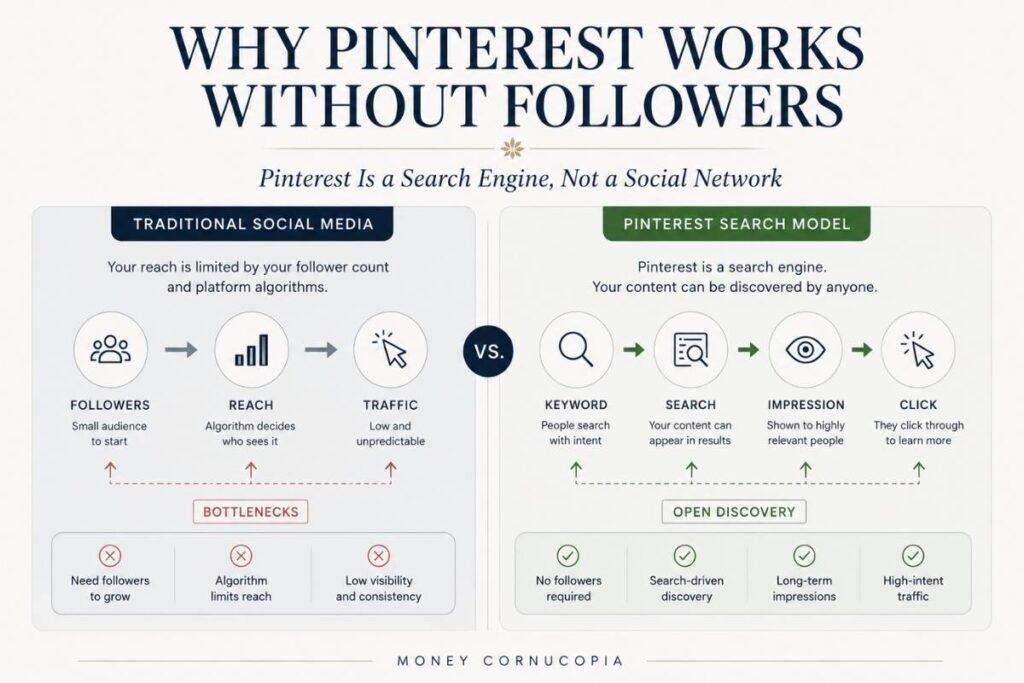
Pinterest is not Instagram. On Instagram, your follower count largely controls your reach. On Pinterest, it does not. Pinterest functions as a visual search engine. When someone searches “budget planner for freelancers” or “how to start investing with $100” or “Notion template for ADHD,” the platform shows them pins based on keyword relevance and engagement signals, not based on how many people follow the creator.
This is why I can have 16 followers and reach 26,780 people in a month. Those people were not following me. They were searching for topics I had created pins about, and Pinterest decided my content was relevant enough to show them.
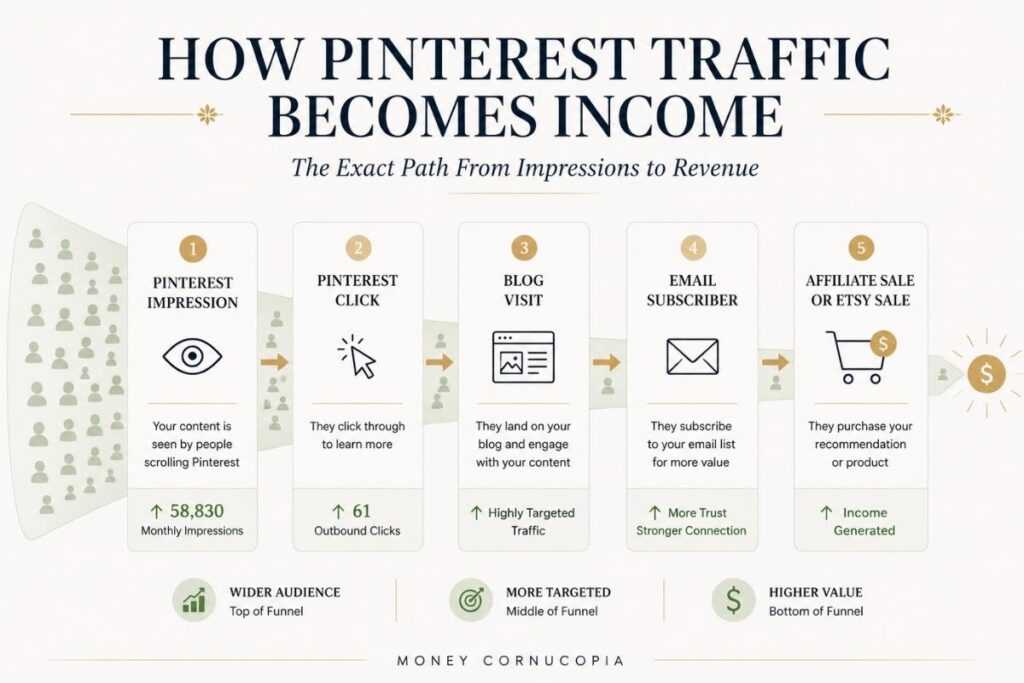
How Pinterest Traffic Actually Becomes Income
Most articles skip this explanation. Here is the honest funnel.
Getting impressions is not the same as making money. Understanding the path between them is the most important thing to understand before you commit to Pinterest as an income strategy.
The journey looks like this:
The path from Pinterest impression to income
1
Pinterest impression. Someone searching a relevant topic sees your pin in their feed or search results
2
Pinterest click. Your pin title and design create enough curiosity that they click through to your blog or Etsy shop
3
Blog visit or product view. The visitor reads your article or looks at your product listing
4
Conversion. They click an affiliate link, buy a product, sign up for a newsletter, or return later as a reader who eventually buys
Right now I am at the top of this funnel. I have impressions. I have a growing number of clicks. The conversions are not significant yet because the volume of clicks is still small. But the funnel is real, and the direction is right.
Here is how I am planning to monetize each step:
How each step of the funnel converts to income
1
Blog traffic will eventually qualify for a display advertising network once monthly pageviews reach the required threshold. Pinterest is building that traffic now
2
Etsy traffic from Pinterest means buyers who arrive already warm rather than cold Etsy search traffic competing against thousands of established sellers
3
Affiliate commissions will convert Pinterest readers who click through to relevant blog articles — currently building toward programs like Canva after publishing the Canva Free vs Pro breakdown
The compounding advantage is that Pinterest pins do not disappear after 24 hours like Instagram posts. A pin I published three weeks ago is still circulating today. Every pin I publish now becomes part of a growing asset base that keeps driving traffic long after I have stopped thinking about it.
Why Pinterest Works Without Followers
Most platforms make starting from zero nearly impossible. Pinterest is the exception.
When I was building this blog, the hardest part of every other platform was the same problem. You need followers to get reach. You need reach to get followers. Starting from zero means being invisible for months or years.
Pinterest broke that pattern immediately. The reason is simple. People on Pinterest are not scrolling to see what their friends are doing. They arrive with a specific question or need. They are in search mode. A pin about compound interest does not need 10,000 followers behind it to reach someone who just searched “what is compound interest.” It needs to be relevant, readable, and keyword-focused.
That is a set of skills anyone can develop regardless of their audience size.
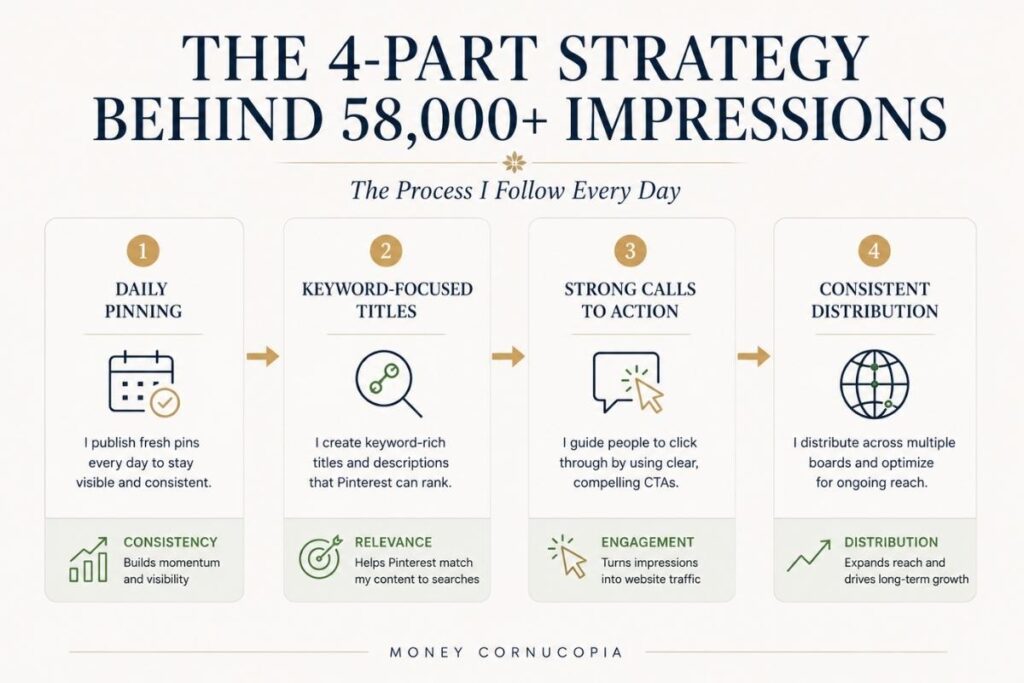
The Strategy That Got Me to 58,000 Impressions
Here is exactly what I did. No tool recommendations. No course upsells.
Daily pinning without exception
I pin every day. Sometimes three to five pins, sometimes more, sometimes fewer, but every single day without exception. I also repin content from other accounts in my niche daily to stay active on the platform.
Each pinning session takes about one hour. I design new pins, schedule them in advance using Pinterest’s built-in scheduler, and repin a handful of relevant pins from other creators. The scheduler is the most important tool I use because it means I can batch work and still maintain daily consistency.
For each article I publish on my blog, I create multiple pins spread across several days. Different titles, different designs, different angles on the same content. This gives each piece I write extended distribution rather than a single appearance.
Design and tools
I use a mix of Canva and AI image generators for visuals. I almost always start from scratch rather than using someone else’s template, though I have built my own templates in Canva to speed up the process. One pin takes me between five and ten minutes.
I prefer infographic-style pins. Clean, informative, structured like a quick visual answer rather than an advertisement. They get saved more than any other format I have tried because people find them useful enough to want to return to later.
The title lesson
I learned through watching videos and trial and error that the title of a pin determines almost everything. A beautiful design with a weak title gets almost no traction. A simple design with a strong title can reach thousands of people.
I treat every pin title the way I treat an article headline: it must answer a question, create curiosity, or solve a specific problem. Before writing a pin title, I type my topic into Pinterest’s search bar and look at the autocomplete suggestions. Those are real searches happening right now. I build my titles around those phrases.
The CTA lesson that changed my outbound clicks
For weeks, my saves were growing, but my outbound clicks stayed frustratingly low. I had hundreds of saves and only a handful of blog visits. People were saving my content but not clicking through.
The problem was simple. I was either not including a call to action or using generic language like “Read more.” When I switched to specific, direct CTAs like “Read the full breakdown at the link” or “See the exact numbers in this article” my outbound clicks started improving. Pinterest users are browsers by nature. A clear, specific CTA is what converts a browser into a visitor.
Boards matter from the start
I have four boards: Side Hustle Tips, Money Basics, Digital Products, and Passive Income Ideas. Each has a keyword-rich name that reflects what people actually search on Pinterest.
If I were starting over today, this is the first thing I would get right. When I first created my account in December, I only set up two boards with names that were not optimized for search. I had to rename and restructure them later, and that caused my impressions to drop temporarily because Pinterest had to relearn the context of my boards. Name your boards correctly from the beginning. Do not rename them.
The Pinterest Reality Nobody Talks About
The days that test you are not general. They are very specific.
There is the day you publish a pin you spent 20 minutes designing and it gets four impressions. You check again an hour later. Still four. You wonder if the algorithm has stopped caring about your account entirely.
There is the week where your saves are climbing, but your outbound clicks are flatlining. Seven hundred saves. Sixty-one blog visits. You realize that people are bookmarking your content to never return to it. You start questioning whether your CTAs are working or whether your content is actually worth clicking on.
There is the specific frustration of seeing an old pin from three weeks ago suddenly get fifty saves in one day, while your newest pin sits at zero impressions. Pinterest is not linear. It does not reward recency the way other platforms do. Old content resurfaces randomly, and new content sometimes sits untouched for days.
These are the moments that test consistency. Not the broad fear of failure. The specific small failures of individual pins, specific weeks of stalled clicks, specific mornings of checking analytics and seeing nothing new.
But I do not take a day off.
That is the only thing I have figured out that actually works. You do not need to make your best pin every day. You just need to make something. The platform rewards accounts that show up. Accounts that disappear get deprioritized. I have seen this directly when I compare my current growth to the months I was inactive.
Three specific things I wish I had known before my first pin:
Set up boards correctly from day one. Name them with searchable keyword phrases. Do not rename them after the fact. Every rename resets the algorithm’s understanding of your content and causes a temporary drop in impressions that takes weeks to recover from.
Start with strong CTAs from the very first pin. Do not wait until your saves are high before worrying about outbound clicks. The CTA habit is easier to build at the beginning than to retrofit into an established pinning routine.
Treat every title as a search query. Type your topic into Pinterest’s search bar and read the autocomplete suggestions before writing a single word of your pin title. Those suggestions are real searches happening right now. Build your titles around those phrases, not around what sounds clever to you.
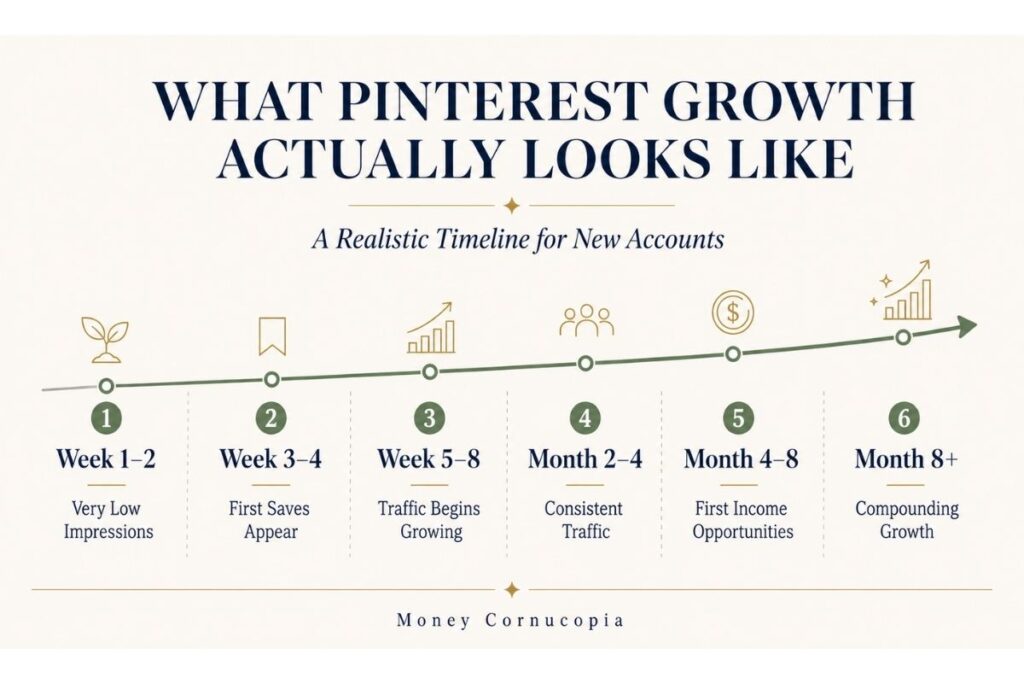
Realistic Expectations: What Actually Happens Week by Week
Timeline
What realistically happens
Week 1 to 2
Very low impressions — algorithm is still learning your content and boards
Week 3 to 4
First saves appearing, impressions starting to grow noticeably
Week 5 to 8
Meaningful impression growth, first outbound clicks improving as CTAs strengthen
Month 2 to 4
Consistent blog or Etsy traffic beginning, saves compounding from older pins
Month 4 to 8
First income possible if monetisation is already in place
Month 8 and beyond
Older pins keep circulating passively, compounding traffic builds without proportional extra effort
I am currently at week 5 to 6. My impressions are growing, my saves are compounding, and my outbound clicks are improving as my CTAs get stronger. Income is not here yet. That is the honest position, and I have no reason to pretend otherwise.
Next Update
This is a living case study, not a finished success story.
When my Pinterest-driven income changes, when my outbound clicks cross a meaningful threshold, or when my strategy shifts based on what the analytics show, I will update this article with the real new numbers.
June 2026: 58,830 monthly impressions, 16 followers, 61 blog clicks, 1 Etsy click, $0 direct income. Building consistently every day.
Frequently Asked Questions
Can you really grow Pinterest without followers?
Yes. Pinterest is a visual search engine, not a social network. Your reach is determined by keyword relevance and content quality rather than follower count. My account reaches over 26,000 people monthly with 16 followers because my pins appear in search results for topics people are actively looking for.
How long does it take to see Pinterest results?
In my experience, meaningful impression growth started in weeks 3 to 4 of consistent daily pinning. Outbound clicks took longer because I needed to improve my CTAs. Most creators report seeing real traction after 4 to 8 weeks of consistent effort.
How many pins should a beginner post per day?
I post between three and five pins per day, sometimes more, sometimes fewer. The most important thing is consistency. One pin every single day for two months outperforms ten pins daily for two weeks, then nothing. The algorithm rewards accounts that show up regularly.
Do you need a blog to make money on Pinterest?
No, but having a blog helps significantly. Without a blog, you can link pins directly to an Etsy shop, Gumroad store, or affiliate product pages. With a blog, you can build a deeper relationship with visitors and create content that naturally promotes multiple income streams. I cover how a blog fits into the full picture in my digital products shop guide.
Why are my Pinterest saves high but outbound clicks low?
This was my exact problem for weeks. The most common cause is weak or missing calls to action. Pinterest users are browsers by nature. A specific, direct CTA like “Read the full breakdown at the link” gives them a clear reason to click now rather than save for later.
What type of pins get the most saves?
Infographic-style pins that provide immediate visual value perform best for saves. A pin that teaches something or answers a question clearly gets saved because people want to return to the information. Curiosity-driven titles that promise a specific insight also accumulate saves consistently.
Is Pinterest still worth starting in 2026?
Yes. Pinterest had over 570 million monthly active users in early 2026. Unlike Instagram or TikTok content that disappears within 24 to 48 hours, Pinterest pins continue driving traffic for months or years after publication. For personal finance, digital products, and side hustle content, Pinterest users are actively searching for solutions rather than passively scrolling, which makes them far more engaged visitors.
Can you make money on Pinterest without a blog?
Yes. You can link pins directly to affiliate products, Etsy listings, or digital product storefronts like Gumroad. Having a blog amplifies the income potential because it gives you a destination to warm up visitors before they buy, but it is not a requirement to start.
Does Pinterest pay you for views?
No. Pinterest does not pay creators directly for impressions or views the way YouTube pays for video views. Pinterest income comes indirectly through what you do with the traffic. Views become blog visits, blog visits become ad revenue or affiliate clicks, and affiliate clicks become commissions. The platform drives traffic. You monetise the traffic through your own products, affiliate programs, or display advertising on your blog.
How many Pinterest views do you need to make money?
There is no fixed number because it depends entirely on your monetization method. For blog display ads, the threshold varies by network, but most require thousands of monthly pageviews rather than Pinterest impressions. For Etsy or digital product sales, even a small number of highly targeted clicks can convert to sales. For affiliate marketing, one well-placed link in a high-traffic article can earn commissions regardless of total view count. The more useful question is not how many views, but what happens after those views.
Can you make money on Pinterest as a beginner?
Yes, though not immediately. As a beginner, the first 4 to 8 weeks are typically spent building impression volume and learning what content resonates with your audience. Income usually follows traffic, and traffic takes time to compound. My account reached 58,000 monthly impressions in 5 to 6 weeks as a beginner with no prior Pinterest experience. The income from that traffic is still being built. Starting as a beginner is not a disadvantage on Pinterest, the way it is on follower-dependent platforms.
Final Thoughts
Six weeks ago, I had 50 monthly impressions and zero followers on a Pinterest account I had abandoned for months.
Today I have 58,830 impressions, 723 saves, and 26,780 people who have seen my content without a single penny spent on advertising.
I still have not earned any direct income from Pinterest. I still face doubt on the days where pins get three impressions and analytics look flat. But I do not take a day off.
If you are reading this and thinking you cannot get these results because you do not know enough or do not have enough followers, I want to say one thing clearly.
Six weeks ago, I did not know anything either. I learned everything through trial and error, watching videos, and showing up the next day regardless of what happened the day before.
The only thing I have now that you do not have is that I started.
Your side hustle has zero sales. Your blog has zero clicks. Your Etsy shop has zero reviews.
You have been showing up for weeks, maybe months, and the numbers still look embarrassingly quiet. So you start asking the question most beginners eventually ask.
Is this normal, or am I wasting my time?
The honest answer: most side hustles go through a quiet period before they make money. Blogs can take months before Google sends meaningful traffic. Etsy shops can sit with zero sales before the first order appears. Pinterest can feel dead until the platform starts understanding your content.
I know because I quit during my quiet months.
I built this blog in December 2025, published for a month, watched the analytics show nothing, and walked away for five months. I told myself it was not working. The truth is I did not give it enough time to work.
This article is about what I learned when I came back. About what quietly builds underneath the zeros, why the early months feel so discouraging, and how to know whether your side hustle is actually failing or simply too young to judge.
If you are in your quiet months right now, this is the article I wish someone had written for me before I quit the first time.
Quick Answer: Why Your Side Hustle Is Not Making Money Yet
Most side hustles do not make money immediately because the early months are spent building visibility, trust, content, listings, skills, and platform signals that are invisible to you but essential for growth.
A blog may need 3 to 6 months before Google starts sending traffic. An Etsy shop may need more listings, views, and reviews before sales become consistent. Pinterest can move faster, but only when your pins are keyword-focused and published consistently.
The mistake is judging the entire side hustle by the first few weeks of results. The better question is not “Am I making money yet?” It is “Are any signals improving?”
This article is for the beginner who is publishing, pinning, listing, or pitching consistently but still seeing zero sales, zero clicks, or zero traffic. If you have not done anything consistently yet, the problem is not the quiet months. It is the missing system. The quiet months only apply when you have been showing up, and the results have not caught up yet.
Table of Contents
My Side Hustle Still Has Zero Sales and Zero Google Clicks. Here Is What Changed Anyway.
Here are my real numbers. Not a success story. A progress report from the middle of the process.
I started MoneyCornucopia in December 2025. I published a handful of articles about compound interest, inflation, and investing basics. Then I checked my analytics every single day. Every day, the number was the same. Zero.
Zero clicks. Zero visitors. Zero comments. Zero anything.
After about a month, I stopped publishing. I did not make a dramatic decision to quit. I just stopped showing up. The blog sat untouched for five months while I convinced myself it was not going to work.
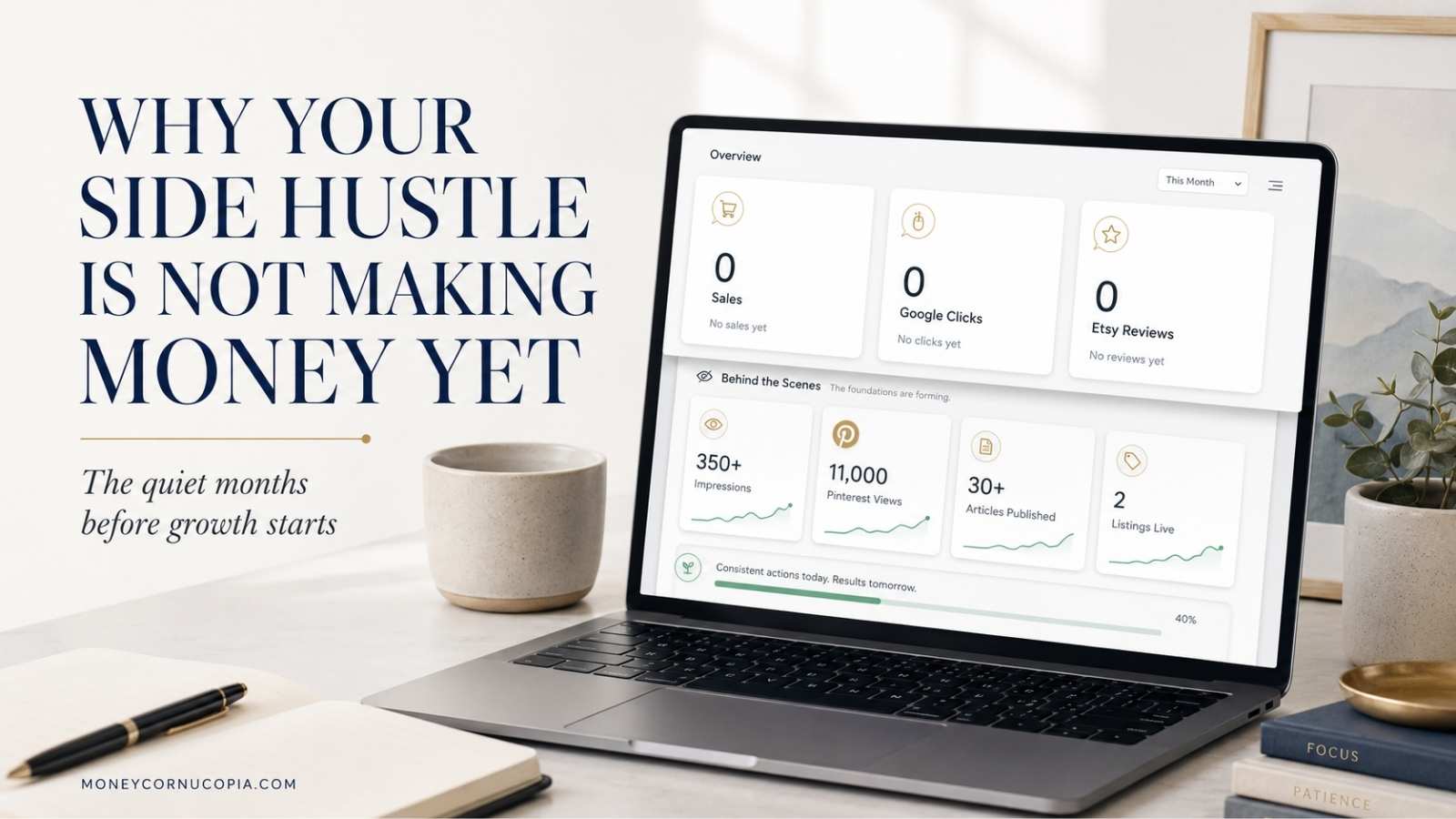
Then, about a month ago, I came back. I started publishing again with a real strategy. Here is what my dashboard looks like now:
Metric
When I quit (January 2026)
Now (May 2026)
Published articles
~10
30+
Google clicks
0
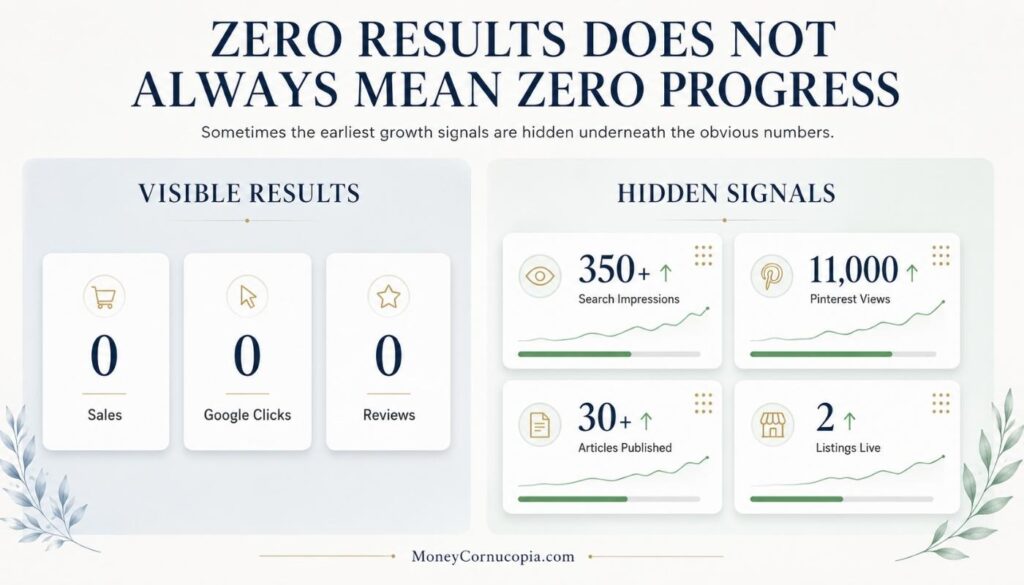
0 — but 350+ impressions appearing
Etsy shop sales
0
0 — but 2 listings now live
Pinterest daily views
0
~11,000
Pinterest followers
0
10
Money spent on ads
$0
$0
Look at that table carefully. The Google clicks column still says zero. The Etsy sales column still says zero. If I were only looking at those two numbers, I would feel like nothing has changed.
But something has changed. Google is now showing my articles in search results 350+ times over the last three months. Pinterest went from dead silence to 11,000 daily views in 20 days. Those are not vanity metrics. Those are signals that the quiet months are doing their work underneath.
How Long Does It Take for a Side Hustle to Make Money?
There is no single timeline, but most beginner side hustles take anywhere from a few weeks to a year before they produce meaningful income.
Service-based side hustles like freelancing can earn faster because you are selling labor directly. Content-based side hustles like blogs, Etsy digital products, and Pinterest-driven systems usually take longer because they depend on search algorithms, trust signals, content volume, and platform distribution.
Here is the realistic timeline most beginners should expect before judging a blog, Etsy shop, Pinterest strategy, or freelance side hustle:
Side hustle type
Quiet period
First signs of progress
When growth may compound
Blog (SEO content)
3 to 6+ months
Impressions, indexing, early clicks
8 to 12+ months
Etsy digital products
1 to 3+ months
Views, favorites, first sale
6 to 12 months
Pinterest marketing
2 to 6 weeks
Impressions, saves, outbound clicks
2 to 4 months
YouTube channel
3 to 12 months
Early views, better retention
12+ months
Freelancing
Days to 3 months
Replies, calls, first client
3 to 6+ months
Notion templates on Etsy
2 to 6 months
Views, favorites, first reviews
6 to 12 months
These are rough timelines, not promises. Every side hustle is different. But the common thread is clear: every single one has a quiet period where the numbers show nothing, but the foundation is being built.
The critical insight: different side hustles have different quiet periods. Pinterest rewards consistency within weeks. Google takes months. Etsy sits somewhere in between. If you are comparing your blog’s month 2 results to someone else’s Pinterest month 2 results, you are comparing a marathon to a sprint.
Why the Quiet Months Feel Like Failure
Because your brain measures progress in outcomes, not in process.
When you check your Etsy dashboard and see zero sales, your brain does not think “my listings are being indexed and will start appearing in search results within a few months.” Your brain thinks, “this is not working, and I am wasting my time.”
When you check your blog analytics and see zero clicks, your brain does not think “Google is crawling my content and building topical authority signals that will compound over the next six months.” Your brain thinks, “nobody cares about what I am writing.”
I know exactly how this feels because I have lived it multiple times.
When I saw zeros on my blog after a month of work, I felt like I was not good enough. Like all my effort was going to nothing. Like I was failing at something that everyone else online seemed to be succeeding at effortlessly.
The self-doubt was the worst part. Not the lack of money. Not the lack of recognition. The quiet voice in your head that says, “maybe you are just not cut out for this.”
That voice made me quit for five months. And the cruel irony is that quitting during the quiet months is the one decision that guarantees the quiet months never end.
What Is Actually Building Before Your Side Hustle Starts Making Money
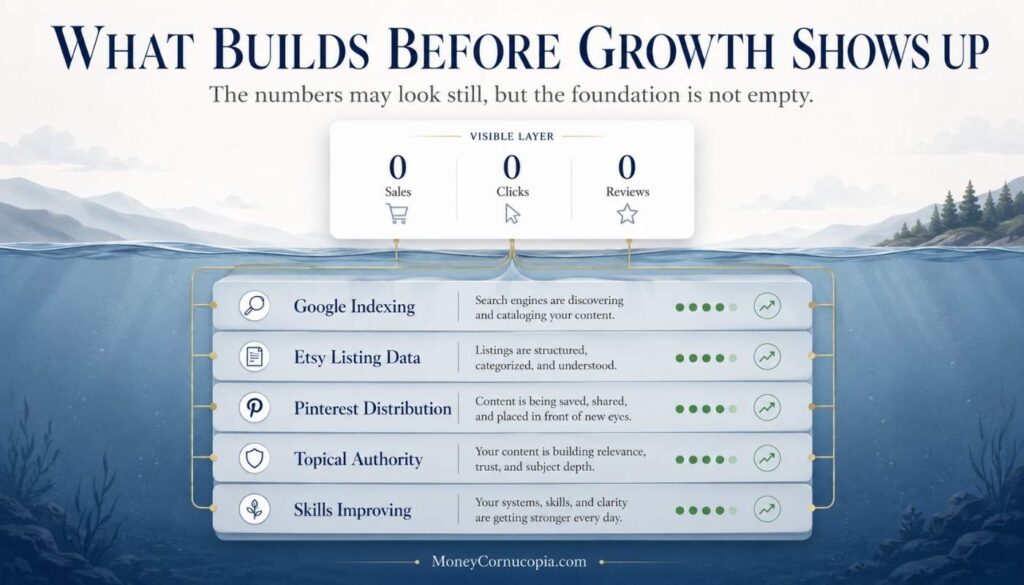
The zeros are not empty. They are full of invisible progress.
Google Is Learning Your Blog
Every article you publish gets crawled and indexed by Google. During the first 3 to 6 months of a new site, Google is running a trust evaluation. It asks: does this site publish consistently? Does it cover topics in depth? Does each article connect to a broader knowledge cluster? Google Search Central explains how this crawling and indexing process works.
My blog has zero Google clicks. But when I checked Google Search Console, I found that Google is showing my articles in search results 350+ times. It is testing my content with real searchers. It just has not moved me high enough on the page for anyone to click yet.
Those 350 impressions are not a failure. They are Google saying, “I see you; I am watching; keep going.”
Etsy Is Learning Your Listings
Etsy can feel especially painful in the quiet months because the silence is so visible. You create a product, upload the images, write the description, choose the tags, publish the listing, and then nothing happens. No sales. No reviews. Maybe not even many views.
That does not always mean the product is bad. Sometimes it means the shop is still too thin for Etsy to understand. One or two listings do not give the platform much data. A new shop has no buyer history, no reviews, no conversion signals, and no proven listing performance.
Many experienced Etsy sellers recommend building well beyond one or two listings because a tiny shop gives you very little data to learn from. Etsy’s own Seller Handbook also emphasizes that getting a first sale often requires improving photos, listings, and shop trust signals.
My shop has 2 listings and zero sales. I do not have enough evidence to say the shop failed. I only have enough evidence to say the shop is still too early. The quiet months on Etsy should not only be about waiting. They should be about building enough listings for the shop to become testable.
Pinterest Is Learning Your Content
I created my Pinterest account 6 months ago. Posted a few random pins. Saw nothing. Quit.
When I came back 20 days ago with a real strategy (consistent daily pinning with keyword-focused titles), the results were immediate. 11,000 daily views within three weeks. Zero dollars spent. Zero followers needed. Pinterest distributes content based on keyword relevance, not follower count, which means discovery is available to anyone who pins consistently with searchable titles.
Google ranks individual pages, but a focused cluster of related content can help those pages make more sense within your site’s overall authority. A single article about Notion templates might rank on page 8. But 5 articles about Notion templates, digital products, Etsy selling, and Pinterest marketing all linking to each other? That cluster starts climbing because Google sees a site that genuinely covers the topic.
My site went from 10 articles about random finance topics to 30+ articles across two focused categories. Each new article strengthens every other article in the cluster. That is invisible progress that no dashboard shows you, but Google is counting every single connection.
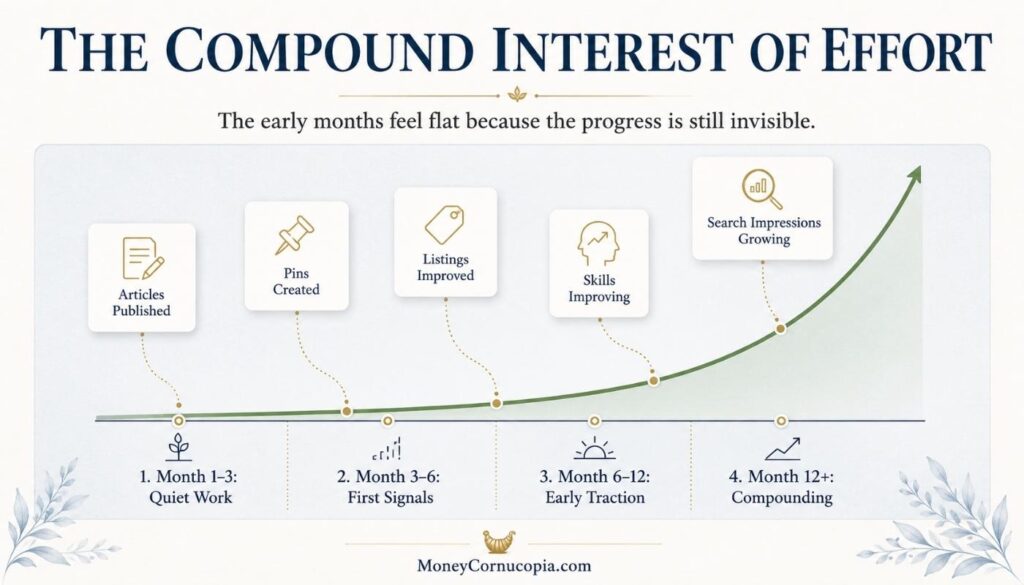
The same math that grows money grows side hustles. You just cannot see it until the curve bends.
In my article on the time value of money, I explained how $100 invested at 7% per year becomes $761 over 30 years. The first 10 years are boring. Your $100 becomes $197. Barely noticeable. Then compounding kicks in, and the growth accelerates.
Side hustles follow the same curve.
Stage
What is happening
What it feels like
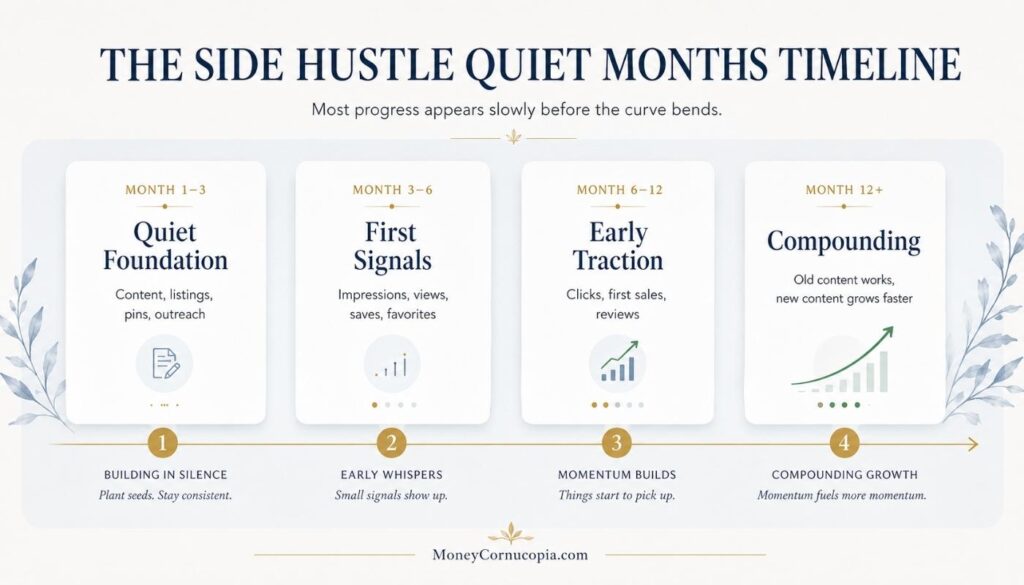
Month 1 to 3
You publish content, create listings, and build pins. Platforms are crawling and learning your content
Throwing effort into a void — nothing appears to be happening
Month 3 to 6
Google starts indexing. Pinterest starts distributing. A few impressions appear. Maybe a first sale
Still feels slow — but the first real signals appear if you look closely
Month 6 to 12
Articles move from page 5 to page 2. Pinterest pins from month 2 start getting traction. One sale becomes two
The curve starts bending — small wins become more visible and more frequent
Month 12 and beyond
Old content keeps driving traffic. New content ranks faster. Reviews build on reviews. The system feeds itself
Compounding takes over — growth accelerates without proportional extra effort
The quiet months are months 1 to 6. They are the flat part of the compound interest curve. They feel like nothing is happening because the numbers are too small to see. But the compounding has already started. You just have to stay long enough to see the curve bend.
How to Know If Your Side Hustle Is Failing or Just in the Quiet Months
The quiet months are normal. But they should not become an excuse to ignore bad strategy.
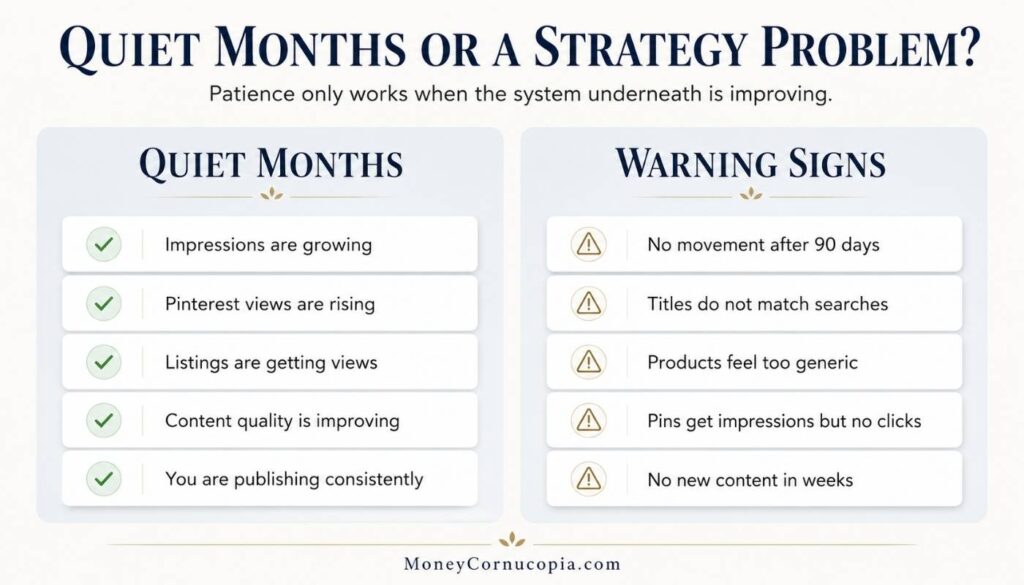
Sometimes your side hustle is not quiet because it is young. It is quiet because something needs adjusting. Patience matters, but patience only works when the system underneath is improving.
You Are Probably in the Quiet Months If
You are probably in the quiet months if
1
Your Google impressions are growing, even without clicks yet
2
Your Pinterest views are rising, even without much outbound traffic
3
Your Etsy listings are getting views or favorites, even without sales
4
Your content quality is visibly improving from your first post to your latest
5
You are publishing consistently and learning what gets ignored and what gets attention
6
The trend lines are moving upward, even if the absolute numbers are still small
You May Need to Adjust Your Strategy If
Warning signal
What to adjust
Nothing has moved after 90 days of consistent daily effort
Audit your strategy from the beginning — the problem is usually positioning, keywords, or product specificity, not effort
Your article titles do not match what people actually search for
Research keywords before writing — write to answer real searches, not just topics you find interesting
Your products are too generic to stand out in a crowded market
Niche down further — a specific buyer with a specific problem converts far better than a broad product
Your pins are getting impressions but zero outbound clicks
Rewrite your pin titles to be more specific and benefit-driven — the text overlay needs to promise a clear result
Your articles are indexed but not targeting clear keywords
Check Google Search Console for what queries are triggering impressions and rewrite your content around those
You have not added new listings, articles, or pins in weeks
Inconsistency is the most common reason the quiet months never end — rebuild the daily habit before anything else
If the signals are slowly improving, you are in the quiet months. Stay the course.
If nothing is improving despite consistent effort, do not quit. Adjust. In 3 reasons your side hustle still isn’t growing, I covered the most common strategic mistakes that keep side hustles stuck even when the creator is working hard.
The Pattern I Keep Seeing in My Own Life
Every good thing I have built followed the same pattern: try, see nothing, doubt everything, come back with a plan, and then watch things slowly start working.
When I left my stable job to pursue a professional exam, I was terrified. When I could not clear the exam, I felt like a complete failure. But stumbling into freelancing after that failure turned out to be one of the best decisions of my life. The “failure” was actually a redirect.
When I put $1,000 into gold jewelry for my wife in 2020, the decision felt impulsive. Six years later, that gold more than doubled. When I lost $1,000 on an insurance investment I did not understand, the lesson felt expensive and pointless. But it taught me about risk in a way no textbook ever could.
When I quit my blog for five months, I thought I was admitting defeat. But those five months gave me clarity about what I was doing wrong. Coming back with a focused strategy produced more results in one month than my unfocused first month ever did.
The pattern is always the same. The quiet months feel like the end. They are actually the setup for the beginning.
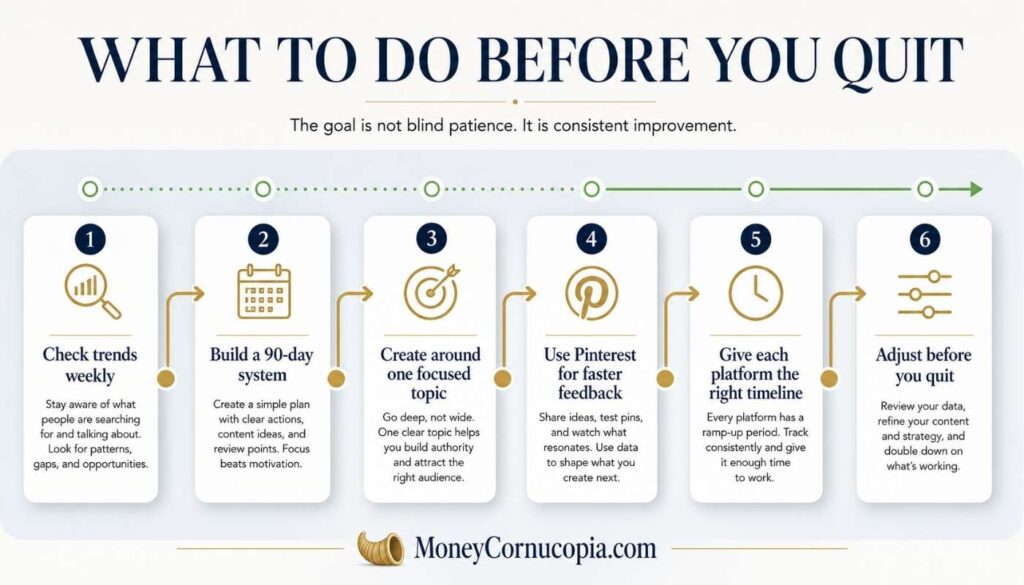
What to Do When Your Side Hustle Is Not Making Money Yet
Stop Checking Analytics Every Day
When I was checking daily, every zero felt personal. It was like stepping on a scale every hour and being surprised that you have not lost weight since breakfast.
Switch to weekly or monthly check-ins. Instead of “zero today, zero yesterday,” you start seeing 350 impressions this quarter that did not exist last quarter. Same data. Different timeframe. Completely different emotional experience.
Build a 90-Day System Instead of Chasing Daily Results
“I want to make $1,000 this month” is a goal. “I will publish 2 articles per week and create 6 Pinterest pins per article” is a system.
Goals depend on outcomes you cannot control. Systems depend on the effort you can control. During my five months away, I had no system. When I came back, I built one: write consistently, pin daily, optimize old content, and publish new content. The system does not guarantee results on any given day. It guarantees that I am building the conditions for results to eventually appear.
Create More Content Around One Focused Topic
Five articles on five different topics tell Google nothing. Five articles on one topic tell Google you are an authority. I covered this principle in how to build a digital products shop for passive income. The creators who succeed are the ones who go deep on one topic before going wide.
Use Pinterest to Speed Up the Feedback Loop
If Google takes 6 months to give you feedback, Pinterest can give you feedback in 2 weeks. My Pinterest account went from dead to 11,000 daily views in 20 days simply by pinning consistently with keyword-focused titles. That feedback told me which topics resonate, which titles get attention, and which content is worth expanding.
If you are waiting for Google and feeling stuck, start pinning. Pinterest is the fastest free way to learn what your audience actually cares about.
Give Each Platform the Right Timeline
Do not judge your blog by week 2 standards. Do not judge your Etsy shop by its first listing. Do not judge Pinterest by your first 5 pins.
Each platform has its own quiet period. Expecting Google speed from Pinterest or Pinterest speed from Google will make you feel like a failure on both when you are actually progressing normally on each.
Embrace Being Bad at It
I recently came across an idea that changed how I think about this entire process. You have to be willing to be genuinely bad at something before you can become good at it. Not just tolerate being bad. Actually embrace it. Stop being ashamed of the zeros. Stop feeling embarrassed about the empty dashboard. Start treating every zero as proof that you showed up.
I decided to start being bad at this on purpose. To publish articles that might not rank. To create pins that might not get clicks. To list products that might not sell. Because the alternative, not publishing anything to avoid the zeros, guarantees that nothing ever improves.
The quiet months end faster when you stop protecting yourself from failure and start accumulating it.
Frequently Asked Questions
Why is my side hustle not making money yet?
Because most side hustles need time to build visibility, trust, skill, and distribution. If your impressions, views, listings, content quality, or audience signals are improving, the side hustle is likely not failing. It is simply too early to judge. The better question to ask is whether any signals are moving upward, not whether the final results have arrived yet.
How long should I give a side hustle before quitting?
Give one focused strategy at least 90 days of consistent effort before judging it seriously. For SEO driven blogs, give it closer to 6 to 12 months because Google traffic usually takes longer than social or service-based side hustles. The keyword is “consistent.” Sporadic effort over 6 months does not count as giving it time.
Is zero traffic normal for a new blog?
Yes. Zero or very low traffic is completely normal for a new blog in the first 3 to 6 months. Google needs time to crawl, index, and trust your content before ranking it. The better early signal is not traffic but whether Google is indexing your pages and showing impressions in Search Console. If impressions are appearing, your content is being tested even if nobody is clicking yet.
Is zero sales normal for a new Etsy shop?
Yes, especially if the shop has only a few listings, no reviews, and no external traffic. Most successful Etsy sellers report very few or zero sales for the first 1 to 3 months. If your listings are getting no views after consistent optimization and building out your catalog, you may need better keywords, mockups, product positioning, or external traffic from Pinterest.
What is the fastest way to get feedback on a new side hustle?
Pinterest, short-form social content, freelancing outreach, and direct audience feedback usually provide faster signals than Google SEO. Pinterest gave me 11,000 daily views within 20 days of consistent pinning. Google has given me zero clicks after 6 months. Both are working, but Pinterest provides feedback much faster.
How do I know if my side hustle is failing or just slow?
Check for invisible growth signals. Are Google impressions increasing? Are Pinterest views rising? Are Etsy listing views growing? Are your skills improving? If trend lines are moving up, you are in the quiet months. If every metric has been completely flat for 90+ days of consistent effort, it may be time to adjust strategy, not quit entirely.
Can I speed up the quiet months?
You can shorten them, but not eliminate them. The fastest accelerators are consistent publishing, Pinterest distribution, and focused topic clustering. You cannot skip the quiet months entirely because platforms need time to evaluate and trust your content. But you can make sure you are not accidentally extending them through inconsistency.
What is the biggest mistake people make during the quiet months?
Quitting. The second biggest mistake is changing strategy every week. Jumping from blogging to YouTube to dropshipping to freelancing every time something does not produce immediate results means you never give any single approach enough time to compound. Pick one strategy, execute it consistently for at least 90 days, and then evaluate.
Final Thoughts
Six months ago, I published my first article on this blog. One month later, I quit because the numbers showed nothing. Five months after that, I came back with a plan and started publishing consistently.
My Google clicks are still zero. My Etsy sales are still zero. And for the first time, I am not panicking about it.
Because I can see what is building underneath. The 350 Google impressions that did not exist before. The 11,000 daily Pinterest views that came from nothing. The 30+ articles forming a content cluster that Google is slowly learning to trust. The skills that have improved dramatically from article 1 to article 30.
None of this shows up in the numbers that most people check. It is all happening in the quiet months, underneath the zeros, in the gap between “this is not working” and “this is starting to work.”
If you are in your quiet months right now, here is what I want you to know.
The zeros do not mean you are failing. They mean you have not been at it long enough for compounding to kick in.
Self-doubt is normal. Every creator who eventually succeeded felt exactly what you are feeling right now. The ones who made it are the ones who did not quit during the silence.
And the most important thing I have learned in this entire process: you do not have to be good at something to start. You just have to be willing to be bad at it long enough to get better.
I am still in my quiet months. I am still seeing zeros in places that matter. But I am also seeing the first signs that the foundation is real.
The compound interest of effort is working. I just have to stay long enough to see the curve bend.
Most people do not quit their side hustle because they are lazy. They quit because it feels like nothing is happening.
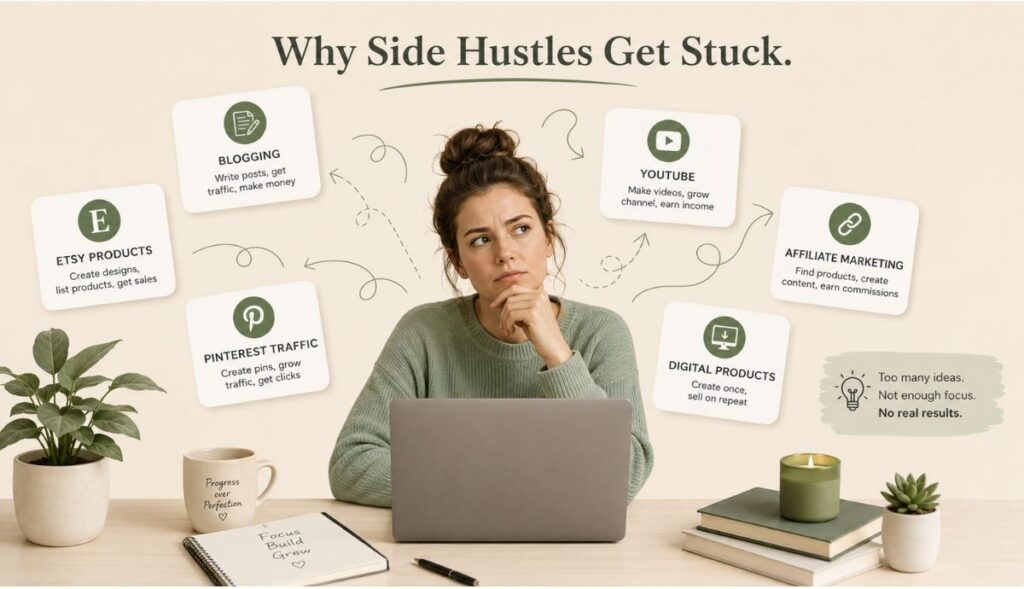
You post the pins, write the blog posts, create the product, watch a few videos, try a few strategies, and change your plan again. But somehow, everything still feels stuck. That is the frustrating part. You are busy, but the side hustle is not really growing.
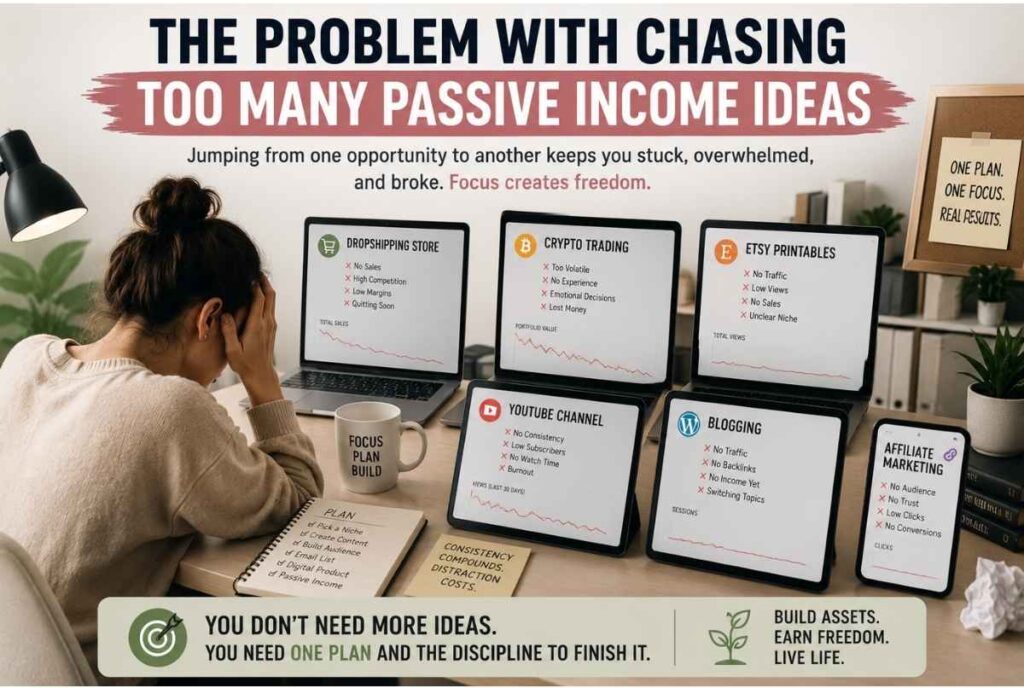
I have felt this myself. One week, I was convinced blogging was the answer. The next week, Etsy’s digital products looked like the smarter move. Then, Pinterest traffic became the focus. Then, affiliate marketing started sounding like the better path.
The problem was not that any of those ideas were bad. The problem was that I kept moving before anything had enough time to work.
And that is where a lot of beginners get trapped. A side hustle does not grow just because you start it. It grows when you build a system around it.
Here are three reasons your side hustle still is not growing.
1. You Keep Chasing New Ideas Instead of Building One System
This is probably the most common mistake. You start with one idea, then immediately see someone else making money with another one. So you switch.
You try Etsy for two weeks. Then you try blogging. Then you try YouTube. Then you try printables. Then you start researching affiliate marketing. Every new idea feels like the missing piece, but most of the time, it is just another distraction.
The truth is that most side hustles look boring before they start working. A blog needs articles before it gets traffic. An Etsy shop needs products, listings, keywords, and trust. Pinterest needs consistent pins before it understands your content. Digital products need both creation and promotion.
Even U.S. Bank’s passive income guide explains that passive income often still requires upfront effort or ongoing oversight before it becomes steady.
That is the part people skip. They want the income stage without surviving the building stage.
If your side hustle is not growing, ask yourself this: Have I actually committed to one path long enough to give it a fair chance?
Because if the answer is no, the problem may not be the business model. It may be the constant restarting.
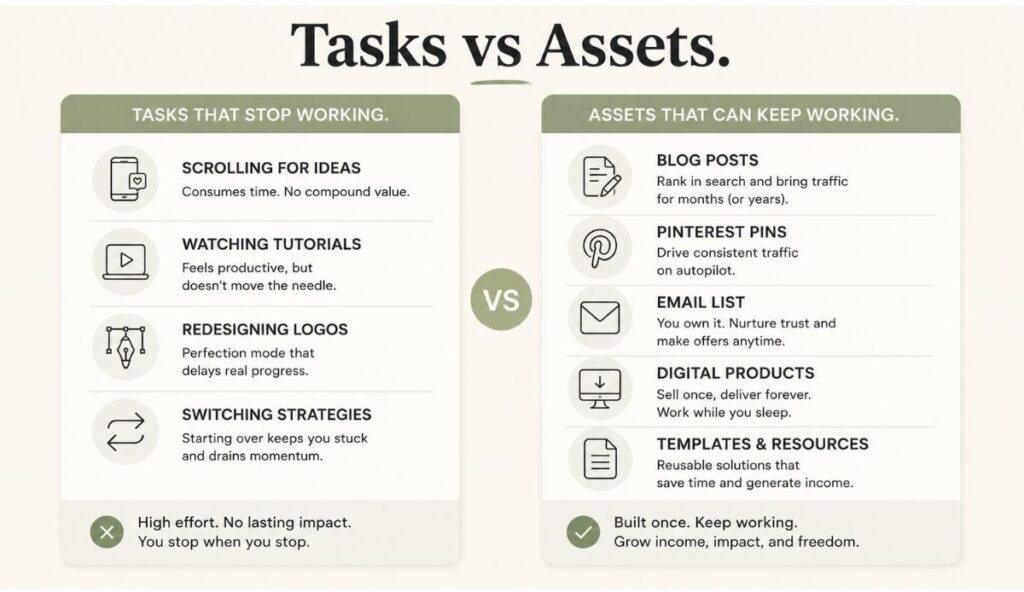
2. You Are Doing Tasks, But Not Building Assets
This is a big mindset shift. Not every task helps your side hustle grow long-term.
Scrolling for ideas is not an asset. Watching another tutorial is not an asset. Redesigning your logo five times is not an asset. Those things may feel productive in the moment, but they do not always create something that can keep working for you later.
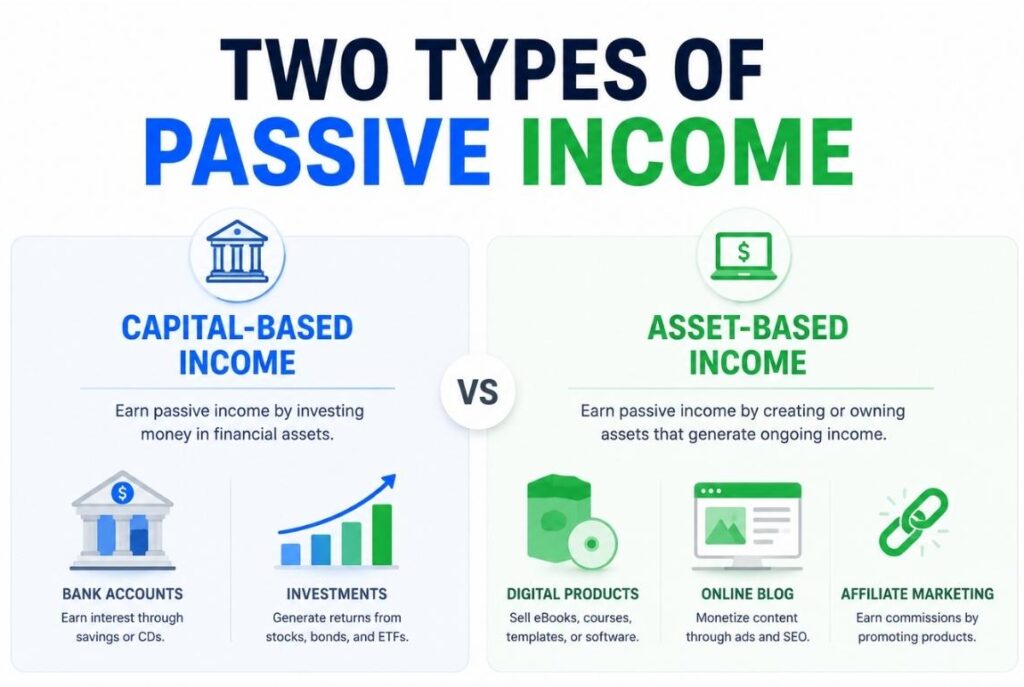
An asset is something that can keep working after you create it. A blog post can become an asset. A Pinterest pin can become an asset. An email list is an asset. A digital product is an asset.
A budget tracker, tax tracker, printable planner, or spreadsheet template can become an asset if people can find it and buy it repeatedly.
That is why I think digital products are so powerful for beginners. Etsy explains that digital downloads can be listed as instant downloads, which means customers receive the file automatically after purchase through the platform’s digital delivery system. You can read Etsy’s own guide here: How to Sell Digital Downloads on Etsy.
That does not mean digital products are effortless. You still need good design, useful products, strong titles, keyword research, product photos, and traffic. But once the product exists, it has the potential to keep selling without being recreated every single time.
That is very different from trading hours for dollars forever.
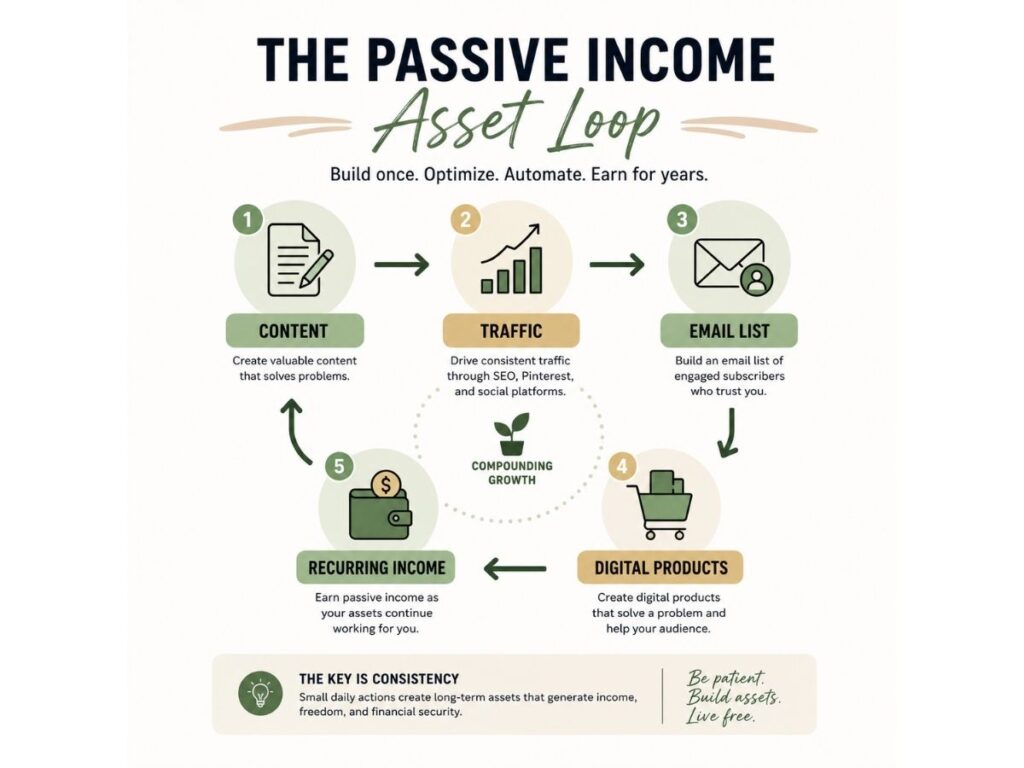
This is also why I am focusing more on content, Pinterest, and digital products now. They connect together. A blog post can educate. A Pinterest pin can bring traffic. A digital product can solve the reader’s problem.
That is a system.
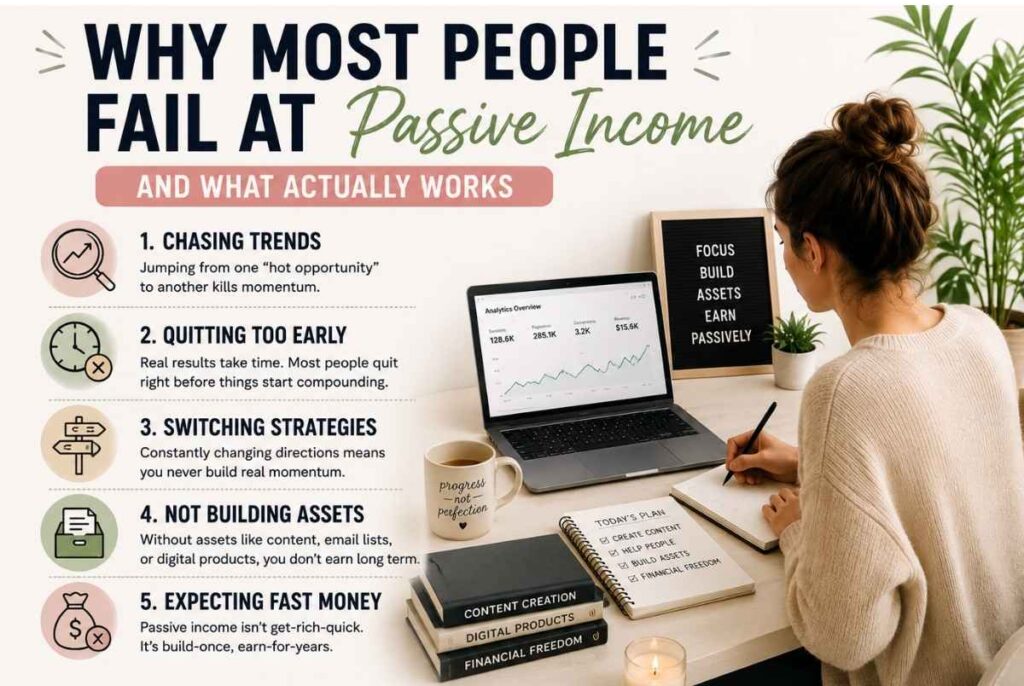
If you have already read my article on why most people fail at passive income, this is the next layer. Passive income becomes more realistic when you stop chasing random tasks and start building things that can compound.
And if you are just starting from a small budget, you can also read my guide on passive income ideas under $100 to see beginner-friendly ways to start building your first income stream.
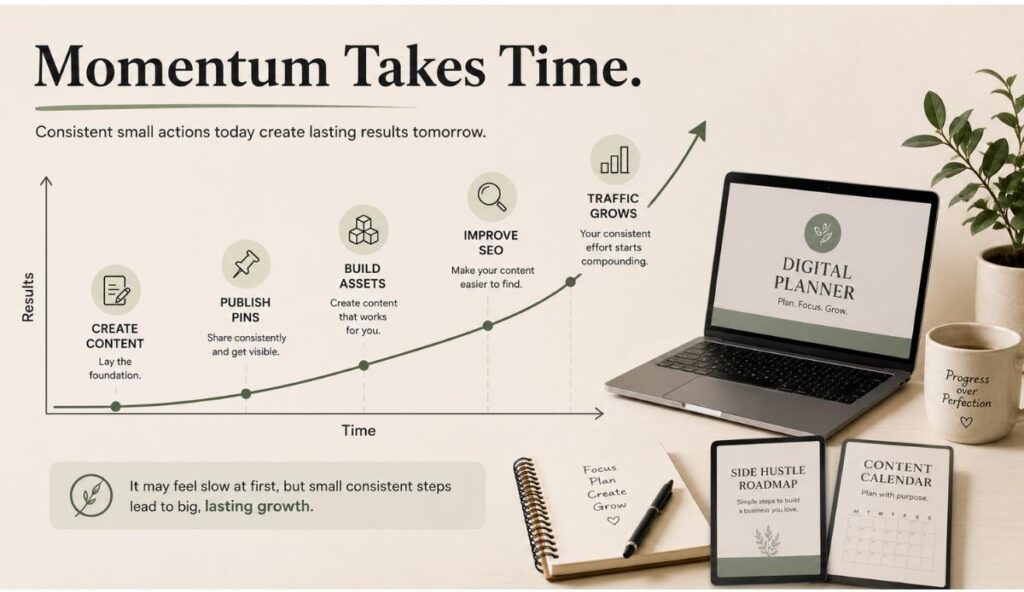
3. You Quit Before Momentum Has Time to Show Up
This one hurts because it is so easy to do. Most side hustles do not fail loudly. They fail quietly.
You publish a few posts, and nothing happens. You upload a few Etsy listings, and nobody buys. You create pins and only get a few impressions. Then you start thinking the idea does not work, the niche is wrong, or maybe you should try something else.
But early growth is usually invisible.
Pinterest may need time to understand your account. Google may need time to trust your site. Etsy may need time to test your listings. Readers may need to see your brand more than once before they trust you.
Pinterest’s own business guide recommends creating new original pins regularly, adding URLs, and organizing pins into clear boards to help with consistency and discovery. You can see their advice here: Pinterest Business Pin Guide.
That is the boring answer, but it is also the real answer. Most people quit during the quiet phase.
The people who grow are usually the ones who keep improving while the numbers still look unimpressive. They do not just post and pray. They test better titles, improve product photos, write clearer descriptions, create more useful content, build internal links, and study what gets impressions instead of ignoring the data.
That is how momentum starts. Not overnight, but slowly. Then, if you stay with it long enough, the growth can start to feel much easier.
Final Thoughts
If your side hustle still is not growing, it does not automatically mean you picked the wrong idea. It might mean you are switching too often. It might mean you are doing too many tasks that do not become assets. Or it might mean you are quitting before the system has enough time to work.
The goal is not to chase every new opportunity online. The goal is to build something useful, give it enough time, and create assets that keep working even when you are not starting from zero every week.
That is how a side hustle starts becoming something bigger.
And honestly, that is the kind of growth worth building.
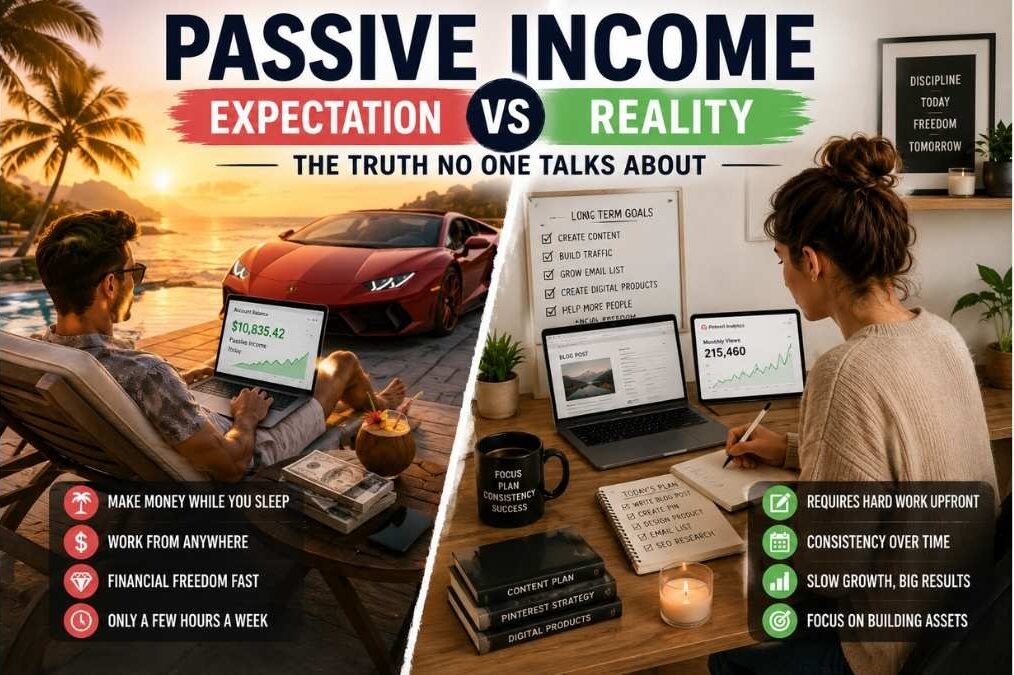
Everybody wants passive income until they realize how long it actually takes to build.
Social media makes it look easy. One creator claims they made thousands selling digital products in a month. Another says they built a successful Etsy store over a weekend. Suddenly, passive income starts sounding like a shortcut instead of what it really is.
And honestly, that misunderstanding is exactly why most people fail.
Not because passive income is fake.
But because most people spend more time chasing trends than building real assets.
I learned this myself after jumping between blogging, affiliate marketing, Pinterest, digital products, and countless other ideas without sticking to one long enough to see results. Every new opportunity felt exciting for a few days until another trend appeared and stole my attention.
Eventually, I realized something important.
The people actually making money online are usually doing very boring things consistently for years. They keep publishing content. They build digital products. They grow traffic slowly. And over time, those assets start compounding.
That is what passive income really is.
Not quick money.
Just long-term leverage.
Passive Income Is Not Easy Money
One of the biggest misconceptions online is that passive income means effortless income.
It does not.
Most passive income streams require a large amount of active work upfront before they become semi-passive later.
According to U.S. Bank’s passive income guide, passive income often requires upfront effort or ongoing oversight before income becomes predictable.
That is the part most creators never talk about.
People see the results.
They rarely see the years behind them.
For example, someone selling printable budget trackers on Etsy might only make a few dollars at first. But after creating multiple products, optimizing Pinterest pins, improving SEO, and consistently publishing content, those small sales can slowly turn into recurring monthly income.
The internet rewards momentum more than talent.
Most People Keep Restarting From Zero
This is probably the biggest reason people never make money online.
They never stay in one direction long enough.
Today, it is dropshipping.
Next month, it is AI automation.
Then Amazon KDP.
Then, faceless YouTube channels.
Then crypto.
Every trend looks exciting when someone else is showing screenshots of success online. But constantly switching strategies destroys momentum before it has time to grow.
Meanwhile, the people quietly building real passive income are usually doing repetitive work consistently for years.
They keep writing articles.
They improve old content.
They create new digital products.
They learn Pinterest SEO.
They grow email lists.
And eventually, those small actions start compounding into something meaningful.
That is how real online businesses are built.
Not through shortcuts.
Through consistency.
This is also why building assets matters so much.
A blog post is an asset.
A Pinterest account is an asset.
An email list is an asset.
A digital product is an asset.
Every article you publish can continue bringing traffic for years. Every Pinterest pin can continue getting impressions months later. Every printable or template can continue generating sales long after it is created.
That is very different from constantly chasing the newest trend online.
What Actually Works in 2026
If I had to start over from zero today, I would keep things extremely simple.
I would choose one niche.
I would focus on searchable content.
I would create digital products around that content.
And I would commit to it for at least one year before expecting major results.
That is the part most people do not want to hear.
Real passive income grows slowly in the beginning.
But once momentum starts building, growth becomes much easier because your assets continue working in the background.
A single article can rank on Google for years.
A Pinterest pin can continue driving traffic.
A digital product can keep selling every month.
That is why more creators are building digital assets instead of relying entirely on social media algorithms. Platforms like Pinterest and Etsy reward consistency over time, especially when paired with strong content and SEO.
If you are just getting started, focus less on finding the “perfect” passive income idea and more on building something useful consistently.
That alone already puts you ahead of most people.
Final Thoughts
Passive income is not about making money while doing nothing.
It is about creating systems, content, and products that continue working long after the original effort is finished.
Most people fail because they quit too early or keep restarting from zero every few weeks.
The people who eventually succeed are usually the ones who stay patient while everyone else gets distracted.
Right now, I am personally focusing on content, Pinterest, and digital products because those are assets that can compound over time instead of disappearing overnight.
And honestly, that feels far more realistic than chasing every new trend on the internet.
Quick Answer: Best Passive Income Ideas Under $100
If you only want the direct answer.
You can start passive income with under $100 using a few realistic methods:
High-yield savings accounts
Dividend ETFs
Digital products (templates, guides, printables)
Print-on-demand (design-based sales)
Affiliate marketing
Blogging or niche websites
Stock photography or video
But these fall into two real categories:
1. Capital-based income (money works for you)
Savings accounts
Dividend ETFs
2. Asset-based income (you build something)
Digital products
Affiliate marketing
Blogging
Print-on-demand
Stock content
Here’s the truth most beginners miss:
Capital-based income is safe but grows slowly
Asset-based income takes time but scales much higher
Nothing meaningful happens instantly with $100
This guide will show you:
what each method actually requires
how long it really takes
and which one fits your situation best
Most people fail not because they pick wrong — but because they expect results too early.
What this guide will help you do
Instead of giving you generic ideas, this guide helps you make a real decision.
You will learn:
which passive income method fits your time and skills
realistic income timelines (not marketing claims)
what $100 can actually do in each system
and why most beginners quit too early
The goal is simple: Help you choose one path and actually stick with it long enough to see results.
Why this matters (important mindset shift)
Most people approach passive income backwards.
They look for:
“What can make me money fast?”
Instead of:
“What system can I consistently build for 6–12 months?”
This difference is exactly why most beginners fail before they ever see results.
Table of Contents
Can You Really Start Passive Income With $100 or Less?
Yes — you can start passive income with under $100, but not in the way most people expect.
You won’t get meaningful income right away. Instead, you use $100 to either earn small returns through investing or build assets that can grow into income over time.
There are two realistic ways passive income starts with a small budget:
1. Money-based returns Your $100 earns interest or dividends automatically. Examples: high-yield savings accounts, dividend ETFs. These are safe, but income starts very small at low balances.
2. Skill-based income assets You use your time to build something once that can earn repeatedly. Examples: digital products, blogging, affiliate marketing, print-on-demand. These take longer but scale far higher over time.
The key point is simple: $100 doesn’t create passive income by itself — it starts a process that builds income over time.
This is the honest picture. Most people quit during the setup phase because nobody told them how long it actually takes. You will not make that mistake.
3 Best Quick-Start Picks for Absolute Beginners
If you’re starting with under $100, don’t try everything. You’ll just dilute your effort and quit early.
Instead, pick one starting path based on your goal, not curiosity.
Here’s the correct priority order:
1. High-Yield Savings Account — Your Financial Base
This is the safest starting point and should be your default first move.
You’re not trying to “get rich” here — you’re simply putting your money in a place where it doesn’t lose value to inflation as quickly as a normal bank account.
Why this is #1:
Zero effort after setup
Zero risk
Builds the habit of earning from money, not just saving it
Gives you a stable base for future investing
Best for: anyone who is unsure where to start or feels overwhelmed
Use this free Compound Interest Calculator to see how a high-yield savings account could grow your money over time
2. Digital Products — Fastest Path to First Real Income
This is the first real income opportunity in this list.
You create something once (template, guide, planner), then sell it repeatedly.
Why this is #2:
Fastest chance of earning your first $1–$100 online
Scales without extra work per sale
Builds a real digital asset, not just savings
Best for: people willing to learn basic design or research what sells
3. Print-on-Demand — Best “Set and Forget” Creative Option
Startup cost: $0 | Setup time: few hours per design | Risk: Low
You upload designs once, and platforms handle printing + delivery.
You earn a commission when something sells.
Why this is #3:
No inventory or customer handling
Can grow into passive catalog income
Works best long-term, not instantly
Best for: creative beginners who can consistently upload designs over time
Important reality check
If you are expecting quick results, none of these will feel fast.
Savings = immediate but tiny returns
Digital products = slow start, then scaling income
Print-on-demand = slowest start, but long-term passive potential
The mistake most beginners make is choosing based on excitement instead of which system they can stick with for 6–12 months.
What Every Beginner Must Understand Before Choosing a Strategy
Most people fail at passive income not because they pick the wrong idea — but because they choose without understanding what actually drives results.
Before you choose any method, apply these four filters. If a strategy fails even one of them, it will not work for you long-term.
1. Time Commitment vs Reality
Passive income is built in the setup phase, not the earning phase.
Ask yourself:
Can I consistently give 5–10 hours per week for 3–6 months?
Or do I need something I can set up once and forget?
Why this matters: Blogging, digital products, and affiliate marketing require sustained effort before any return appears. High-yield savings and dividend investing require almost no ongoing effort but grow slowly.
If your time expectation is wrong, the strategy will feel like it is “not working” when it actually is just in its build phase.
2. Risk Tolerance (Money vs Time Risk)
There are only two types of risk here:
Financial risk: losing money (investing, ETFs)
Time risk: investing effort without guaranteed returns (digital products, content)
Ask yourself:
Am I okay with market fluctuations?
Or do I prefer zero financial risk, even if growth is slower?
Key insight: Beginners often fear financial risk but ignore time risk — even though time loss is what causes most failures.
3. Skill Fit (Your Hidden Advantage)
Your background determines your fastest path:
Good at writing → blogging, affiliate marketing
Good at design → print-on-demand, digital products
Good at organization → templates, planners, Notion tools
Good at research → niche websites, affiliate content
Why this matters: You don’t start from zero. You start from whatever you already understand better than average.
Most people ignore this and choose based on “what sounds best,” which slows them down by months.
4. Time to First Meaningful Result
This is where expectations break.
Real timelines are:
Savings accounts → immediate (but very small)
Digital products → 1–6 months
Affiliate/blogging → 6–18 months
Print-on-demand → 3–12 months
If you expect income too early, you will quit before the system has time to compound.
The Simple Rule That Prevents Failure
If you forget everything else, remember this:
Pick the strategy you can consistently execute for 6–12 months, not the one that sounds most exciting today.
Excitement fades. Consistency compounds.
Passive income is not built by choosing the best idea — it is built by finishing the idea you actually stick with.
All 7 Methods: Side-by-Side Comparison
Strategy
Startup cost
Effort level
First income
Risk
Income ceiling
High-yield savings
$0
Very low
Immediate
None
Low to medium
Dividend ETFs
$1+
Low to medium
1st quarter
Low to medium
High (long-term)
Digital products
$0 to $20
Medium
1 week to 6 months
Low
High
Print-on-demand
$0
Medium
3 to 9 months
Low
Medium to high
Blogging
$30 to $60
High
8 to 18 months
Low to medium
Which Passive Income Strategy Is Right for You?
Use this section as a decision filter, not a list. Pick the scenario that matches you most closely.
If you want zero risk and zero complexity → Start here
High-yield savings account
Dividend ETFs
Why: These require the least decision-making and protect your money while you learn how passive income works.
If you want your first online income fastest → Choose this path
Digital products (Etsy, Gumroad)
Why: This is the fastest way to turn a skill or idea into actual sales from under $100, even if you start from zero.
If you are creative and can stay consistent → Choose this path
Print-on-demand
Stock photography
Why: These rely on volume and consistency, not upfront money. They grow slowly but can become semi-passive over time.
If you can commit long-term (6–18+ months) → Choose this path
Blogging
Affiliate marketing
Why: These take the longest to build, but they have the highest long-term income potential once they gain traction.
If you’re still unsure → do this first
Start with a High-Yield Savings Account + one skill-based method
This gives you:
financial stability (safe base)
and exposure to real income-building systems
You don’t need to “pick perfectly” right away — but you do need to start somewhere structured.
The key principle most people ignore
The best strategy is not the one with the highest income potential — it is the one you can actually execute consistently without quitting.
Every method here works. The difference is whether you finish it or abandon it.
1. High-Yield Savings Accounts — Zero Risk, Instant Setup
What it is: A savings account that pays significantly more interest than a standard bank — typically 4%–5% annually in 2026, versus the 0.01%–0.05% most traditional banks offer. Your money earns automatically after a one-time setup.
Best for: Anyone starting with little money who wants zero financial risk and an immediate, if small, return on idle cash. Effort: Very Low — one-time setup, no ongoing management required. Return potential: Low to Medium — scales directly with balance over time.
Startup Cost
$0 (some accounts accept $1 minimum)
Time to First Income
Immediate — interest accrues daily, paid monthly
12-Month Expectation
~$4–$45 on a $100–$1,000 balance at 4.5% APY
Risk
None — FDIC-insured up to $250,000
Why It Works
At $100, a 4.5% annual yield earns roughly $4.50 for the year. That is not a life-changing number. The strategic value is not in the early dollar amount — it is in two things:
1. Stopping the invisible loss. Money sitting in a standard bank account paying 0.01% while inflation runs at 3% loses real purchasing power every year even as the number stays flat. Moving $100 to a high-yield account is the simplest financial correction available — and it costs nothing.
2. Building the compounding foundation. The habit of directing money to productive accounts, and the growing balance that results from adding to it consistently, creates a financial base that makes every other strategy on this list more effective.
The FDIC insures deposits up to $250,000 at member banks. Your principal is protected. No other strategy on this list offers that level of security.
Maria, 22, moves $80 from her checking account to a high-yield savings account at 4.3% APY and sets up a $20/month automatic transfer. By the end of year two, her balance is near $580 and her annual interest is over $24 — earned without a single additional action since the initial setup.
How to Get Started
Compare rates at online banks (look for 4%+ APY with no monthly fees)
Open an account — most take 10 minutes online
Transfer your starting balance
Set up a recurring monthly deposit, even if it is small
Leave it alone and let it compound
Beginner Mistake to Avoid
Skipping this because $4 per year feels too small to matter. The early returns are minor — the habit and the base they build are not.
2. Dividend ETFs — Build a Compounding Investment Habit
What it is: An exchange-traded fund (ETF) that holds a diversified basket of dividend-paying stocks and distributes regular income — called dividends — to investors, typically every quarter. You earn a proportional share of those payments just by holding the fund.
Best for: Beginners who want real market participation and a long-term compounding investment habit. Works best when you contribute consistently over months and years. Effort: Low to Medium — setup takes one session; the real work is emotional (staying calm during market volatility). Return potential: High over the long term; minimal on a small starting balance.
Startup Cost
As little as $1 (fractional shares via Fidelity, Robinhood, or Schwab)
Time to First Income
First quarterly dividend cycle after purchase
12-Month Expectation
$4–$8 on a $100 starting balance at 4% yield
Risk
Low–Medium (market fluctuation; no FDIC protection)
Why It Works
Dividend investing is one of the most well-established low investment passive income strategies in personal finance. When you own shares of a dividend ETF, you receive a portion of the profits those underlying companies distribute — whether or not you do anything that day.
The mathematical reality of dividend income at small balances:
Balance
Annual yield (4%)
Monthly income
$100
$4
$0.33
$1,000
$40
$3.33
$10,000
$400
$33.33
$50,000
$2,000
$166.67
The people you see posting about living off dividends accumulated that capital over 10–20 years of consistent investing — or started with substantially more money than $100. Neither path involves a shortcut. Starting with $100 is not a waste: you are building the habit, learning the mechanics, and establishing the compounding foundation that grows meaningfully over time.
James, a college student, puts $50 into a broad dividend ETF and adds $15/month from his part-time job. His first-year dividend income: roughly $6. But three years in, his balance has grown past $600 through contributions and compound growth — and his annual dividend income is approaching $25. The habit, the education, and the compounding base are now solidly in place.
How to Get Started
Open a brokerage account that offers fractional shares (Fidelity, Robinhood, or Schwab)
Research broad dividend ETFs — look for low expense ratios and diversified holdings
Start with whatever you have ($1 minimum on most fractional platforms)
Set up automatic monthly contributions, even $10–$20
Reinvest dividends automatically when the platform offers DRIP (dividend reinvestment plan)
Beginner Mistake to Avoid
Investing money you may need within 12 months, or selling during a market dip. Dividend ETF investing is a multi-year strategy. Short-term price drops are expected. Selling during them converts a temporary paper loss into a permanent real one.
3. Selling Digital Products — Create Once, Earn Repeatedly
What it is: Creating a downloadable file — a template, study guide, printable, Canva design, or preset — and selling it repeatedly through platforms like Etsy or Gumroad. You build the file once and it can sell to an unlimited number of buyers without any per-sale fulfillment work.
Best for: Students, freelancers, teachers, and anyone with specialized knowledge or design skills who wants the fastest path to their first online sale. Effort: Medium — significant upfront work to research and create; genuinely passive once a product has reviews and search visibility. Return potential: High — one product, unlimited sales, zero inventory cost.
Startup Cost
$0–$20 (Canva free tier covers most creation needs)
Time to First Income
Days to 6 months, depending on niche research quality
12-Month Expectation
$0–$200 depending on niche fit and early review accumulation
Risk
Low — primarily time invested
Why It Works
The economics of digital products are fundamentally different from physical products. Once the file exists, selling one copy costs exactly the same as selling ten thousand. No inventory. No shipping. No per-unit cost. A four-hour project can sell at 2am on a Tuesday to someone in a different country while you sleep — and then again the next day to someone else entirely.
Platforms like Gumroad charge zero monthly fees — only a percentage per sale — making the true startup cost zero. Etsy charges a small listing fee per item but delivers built-in search traffic from millions of active buyers, a significant distribution advantage for new sellers without an existing audience.
What Actually Sells: High-Performing Categories for Beginners
Category
Examples
Why it works
Finance templates
Budget spreadsheets, debt payoff trackers
Specific problem, immediate utility
Education resources
Subject study guides, flashcard decks
Students pay for organized, reliable content
Design assets
Resume templates, social media Canva kits
Saves buyers hours of creative work
Niche printables
Meal planners, habit trackers, planners
Clear use case, repeat customers
Creative tools
Lightroom presets, font packs
Buyers know exactly what they are getting
The common thread: specificity sells. A generic budget spreadsheet competes with thousands of free versions. A “travel nurse budget and expense tracker for 13-week contracts” serves a specific person with a specific problem — and that person pays.
Market research is more important than creative ability. Before building anything, spend time on Etsy searching what is selling in your target niche. Look at products with reviews. Look at what has recent sales. Build toward demonstrated demand, not personal preference.
Realistic Scenario
Priya, a nursing student, creates detailed pharmacology study guides in Canva and lists them on Etsy at $4–$7 each. Months 1–2: $38 total. Month 6: $90–$120/month from accumulated reviews and Etsy search visibility — earned from the same products she built in the beginning. The two months of concentrated work are now generating consistent recurring income.
How to Get Started
Identify a niche where you have real knowledge or skill
Search Etsy and Gumroad to find what buyers are already purchasing in that niche
Create your product using free tools (Canva, Google Sheets, or Notion)
Open a free Gumroad or Etsy shop and list your product
Gather your first reviews by promoting to your network or offering a limited free download
Beginner Mistake to Avoid
Building a product based on what you want to make rather than what buyers are actively searching for. Market research before creation is the single most important step in this model.
4. Print-on-Demand — Earn Royalties Without Inventory
What it is: You upload original designs to platforms like Redbubble or Merch by Amazon. When a customer purchases a product — a mug, t-shirt, tote, or phone case — featuring your design, the platform handles printing, shipping, and customer service. You earn a royalty per sale without managing any inventory.
Best for: Beginners with some design interest or ability who want a zero-cost, zero-inventory side income stream they can build gradually. Effort: Medium — design creation is accessible with free tools; discoverability within a competitive marketplace requires strategic niche focus and consistent output. Return potential: Medium to High — grows as catalog size and organic search rankings compound over time.
Startup Cost
$0 on Redbubble, Merch by Amazon, and most platforms
Time to First Income
3–9 months of consistent, niche-focused uploading
12-Month Expectation
$0–$60/month by months 8–12 with focused niche strategy
Risk
Low — time investment only
Why It Works
Print-on-demand removes every traditional barrier to selling physical products. No capital tied up in inventory. No shipping logistics. No customer service. Platforms like Redbubble and Merch by Amazon handle every operational element after your design goes live.
Canva’s free tier has enough capability to create professional designs without prior graphic design training. The technical barrier is genuinely low. The strategic challenge — getting designs discovered within marketplaces hosting millions of competing items — is where focused effort is required.
Niche Strategy: The Decision That Determines Everything
Generic designs are invisible. Specific niche designs reach buyers with high purchase intent.
Think in specifics: not “dog lovers” but “rescue dog owners who do yoga.” Not “teachers” but “middle school science teachers who love true crime podcasts.” The more specific the niche, the less competition and the more enthusiastic the buyer tends to be.
Within a chosen niche, catalog volume matters. Organic search rankings on these platforms compound as more designs accumulate. Consistency — regular uploading of themed, niche-focused designs over months — is the mechanism that builds income. Sporadic uploads in random categories earn almost nothing.
Realistic Scenario
Carlos, a graphic design student, spends weekends building a themed catalog around specialty coffee culture on Redbubble. After four months and roughly 90 designs, he earns his first sale. By month eight, he is generating $40–$60/month passively from a growing catalog. Real recurring income from upfront creative work, with no inventory and no shipping.
How to Get Started
Choose one specific niche to focus on — research demand using Redbubble’s search and bestseller lists
Set up free contributor accounts on Redbubble and Merch by Amazon
Create your first 10–15 themed designs using Canva (free)
Upload with precise, buyer-relevant titles and keyword tags
Commit to a consistent weekly upload schedule for the first 6 months
Beginner Mistake to Avoid
Uploading sporadically across unrelated categories and abandoning the account after 60 days with no sales. The income curve on print-on-demand tilts upward sharply after a niche-focused catalog reaches critical mass — but that takes consistent output over 6–9 months to get there.
5. Blogging or a Niche Website — The Highest Long-Term Ceiling
What it is: A content website built around a specific topic that earns income through display advertising, affiliate link commissions, sponsored content, and digital product sales — often a combination of all four over time.
Best for: People who can genuinely commit to 12–24 months of consistent publishing, have real expertise or deep interest in a specific niche, and are willing to invest in the longest timeline in exchange for the highest long-term income potential. Effort: High — sustained, consistent effort across the full first year before meaningful income typically appears. Return potential: Very High — the highest ceiling of any strategy on this list.
Startup Cost
$30–$60 for domain and hosting (first year)
Time to First Income
8–18 months for meaningful ad revenue
12-Month Expectation
Little to no income months 1–8; first $20–$50 around months 8–12
Risk
Low–Medium (time + small financial investment)
Why It Works
A niche content site is the only strategy on this list where the income ceiling is, practically speaking, uncapped. Established sites earn simultaneously through multiple channels — display ads running 24/7, affiliate commissions from product recommendations, digital product sales, and occasional sponsored content — all from the same base of content.
In 2026, the quality bar has risen considerably. Thin articles, recycled advice, and AI-generated summaries without genuine insight no longer rank reliably. What earns durable rankings is depth, demonstrated expertise, and content that reflects real understanding of a specific topic and audience.
This is exactly the approach that drives traffic to sites like this one — where every piece is grounded in actual financial thinking rather than surface-level rewrites. Articles like our guide to building wealth from scratch earn ongoing traffic because they go deeper than the generic alternatives. That depth is what you are aiming to replicate in your own niche.
Niche Selection: The Most Important Choice You Make
The right niche sits at the intersection of three things:
Genuine knowledge or sustained interest on your part
Meaningful search demand from an identifiable audience
Clear monetization pathways through affiliates, ads, or digital products
Avoid niches that are:
Too broad to rank in competitively (e.g., “personal finance” or “fitness”)
Specific but with no search demand or limited buyer intent
Interesting to you but with weak affiliate or ad monetization options
The Technical Setup (Under $60 Total)
Platform:WordPress.org — most flexible for building content sites with ranking intent
Aisha works full-time in healthcare. She starts a niche blog focused on financial decisions specific to healthcare workers — student loan repayment, travel nursing income, contract negotiation. She publishes two well-researched articles per week for 14 months. Month eight: first display ad revenue of $30. Month 18: $400/month consistently, with publishing reduced to once a week. The existing archive keeps earning.
How to Get Started
Choose a niche where your knowledge intersects with demonstrated search demand
Register a domain and set up hosting (total: $45–$75 first year)
Install WordPress — most hosts offer one-click setup
Write your first 10 articles before expecting any traffic
Learn basic on-page SEO (meta titles, internal linking, keyword targeting)
Publish consistently — 1–2 articles per week — for the full first year
Beginner Mistake to Avoid
Writing broadly about everything and ranking for nothing. Niche focus consistently outperforms broad topic coverage in the critical first two years of a content site.
6. Stock Photography and Video — Get Paid for Content You Already Create
What it is: Uploading original photos or video clips to stock content marketplaces. Buyers — brands, publishers, content creators, and marketers — purchase licenses to use your content. You earn a royalty each time your content is downloaded, indefinitely after upload.
Best for: People who already take photos or record video for any purpose and want to convert existing content into a recurring passive revenue stream with minimal additional effort. Effort: Low to Medium — creating and uploading content; keyword optimization per submission is essential. Return potential: Medium — scales directly and predictably with portfolio size.
Startup Cost
$0 — contributor accounts are free on all major platforms
Time to First Income
3–12 months depending on portfolio size and keyword quality
12-Month Expectation
Under 100 files: $0–$15/month. 100–300 files: $15–$60/month by month 12
Risk
Low — time investment only
Why It Works
Stock photography converts content you may already be creating into permanent, recurring income assets. Every approved file in your portfolio is a passive earner — it can be downloaded today, next month, or three years from now, generating royalties each time without any action required from you.
The three major platforms for beginners:
Platform
Best for
Royalty structure
Shutterstock
Broad commercial content
Per-download, tiered rates
Adobe Stock
Premium buyers, Creative Cloud users
33% royalty on most content
Pond5
Video footage
Higher per-clip rates than photos
Why Video Consistently Outperforms Photos
Short video clips — 10 to 30 seconds of clean, usable B-roll — command higher royalties than still images across most platforms and are in persistent demand from content creators, marketers, and publishers. If you already record video for any reason, clean footage of everyday activity, food, nature, or urban environments uploaded to stock platforms requires almost no additional workflow.
What Gets Rejected (And How to Avoid It)
Every submission is reviewed. Common rejection reasons:
Soft focus or motion blur
Excessive digital noise in low-light shots
Visible branded logos or copyrighted products
Recognizable individuals without a signed model release
The model release requirement catches most beginners off guard. Any identifiable person in a commercial photo requires a signed release form. Most public spaces and architecture do not require property releases — but check each platform’s contributor guidelines before uploading in volume.
How to Get Started
Open free contributor accounts on Shutterstock, Adobe Stock, and Pond5
Review each platform’s technical requirements and content guidelines
Start uploading your best existing photos or clips — aim for 50+ in the first month
Write precise, keyword-rich titles, descriptions, and tags for every submission
Track which content earns downloads and upload more of the same type
Beginner Mistake to Avoid
Uploading content without keyword research. Stock platforms function as search engines. A technically excellent photo with weak keyword tags earns nothing. The same photo with precise, buyer-relevant tags earns repeatedly.
7. Affiliate Marketing — Earn Commissions From Content That Lasts
What it is: Creating content — articles, videos, Pinterest pins, or social posts — that recommends products or services using trackable referral links. When someone purchases through your link, you earn a commission: typically 3%–30% of the sale depending on the program and product category.
Best for: Beginners comfortable creating content on free platforms (YouTube, Pinterest, Medium) who understand that trust-building must precede commissions by several months. Effort: Medium to High — content creation and audience building require sustained output before income appears. Return potential: High — quality content with affiliate links can earn commissions for years after the original publication date.
Startup Cost
$0 using free platforms; $30–$60 for a personal website
Time to First Income
Weeks with existing audience; 6–18 months from zero
12-Month Expectation
$0–$150 depending on niche, content quality, and traffic source
Risk
Low — time investment only when starting free
Why It Works
Affiliate marketing scales differently from any other income stream on this list. Capital-based strategies require more money to earn more. Asset-based strategies like stock photography require more volume. Affiliate marketing requires more trust and relevance — both of which compound over time without proportional increases in financial investment.
A single well-ranked article or video reviewing a product with genuine purchase intent can earn commissions for years. It does not expire. It does not cost more to serve one reader or ten thousand. Unlike display advertising, commission rates often scale with the value of what someone buys — meaning one well-placed recommendation on a high-value product can outperform hundreds of ad impressions.
Connects you to hundreds of individual brand programs
Commission rates: Often 10%–30%
Strength: Higher income per sale in the right niche
Best for: Niche-focused content with a defined audience and demonstrated search demand
The Content-First Principle (Non-Negotiable)
Affiliate marketing only works when the surrounding content is genuinely valuable independent of any affiliate link. Content that exists primarily to earn a commission is immediately recognized by readers and increasingly filtered by search algorithms.
The sequence that converts:
Identify a specific problem your target audience is actively searching for
Create content that solves that problem more thoroughly than existing resources
Where naturally relevant, recommend a product or tool you have genuine knowledge of
The trust built in steps 1 and 2 creates the conversion in step 3
Pinterest as a free distribution channel: For personal finance, home, and lifestyle niches, a single well-designed pin can route consistent traffic to affiliate content for months or years passively — with no ongoing maintenance after the initial upload.
Realistic Scenario
Tom starts a YouTube channel reviewing budget home gym equipment and joins Amazon Associates. His first five videos receive minimal views. By his fifteenth video, one product review begins ranking in YouTube search. Over the following six months, that single 90-minute video generates $40 in Amazon commissions. He does not touch the video again. It continues earning indefinitely.
How to Get Started
Choose a niche where you have genuine knowledge and an identifiable audience with buying intent
Pick a free content platform — YouTube, Pinterest, or a free blog on Medium
Apply to Amazon Associates (free, straightforward approval)
Create your first 10–15 pieces of content focused entirely on helping your audience — no sales focus
Add affiliate links where naturally relevant once content is established
Expand to higher-commission programs on ShareASale as your niche authority grows
Beginner Mistake to Avoid
Selecting topics based on commission rates rather than genuine audience relevance. High-commission products that nobody in your audience actually needs convert at near zero. Relevance and trust determine commissions — not the commission rate alone.
Honest Timeline: How Long Does Passive Income Actually Take?
Most beginners underestimate timelines — and that is the main reason they quit too early.
Passive income does not fail because the idea is wrong. It fails because the expectation of speed is wrong.
To understand this properly, you need to separate passive income into three phases:
Phase 3: Meaningful income (noticeable monthly cash flow)
Phase 1: Setup (no income yet)
Phase 2: First earnings (small, inconsistent income)
Here are honest timelines:
Strategy
First earnings
Meaningful income
High-yield savings
Immediate
$100/month requires large capital (~$25k+)
Dividend ETFs
1 to 3 months
$100/month requires long-term investing (~$25k to $40k+)
Digital products
1 week to 6 months
6 to 24 months
Print-on-demand
3 to 9 months
1 to 3 years
Stock photography
3 to 12 months
1 to 3 years
Affiliate marketing
1 to 18 months
6 to 24 months
Blogging
8 to 18 months
12 to 36 months
What these timelines actually mean
1. The first phase feels like nothing is happening
For most strategies, the first 1–3 months produce:
zero income
or extremely small results
This is where most people quit.
But this phase is not failure — it is setup and signal building.
2. Small income comes before stable income
When income finally starts, it usually looks like:
$0.50 here
$5 there
random spikes, not consistency
This is normal. It is the system testing market demand.
3. Real income comes from compounding, not initial effort
The biggest mistake beginners make is assuming:
“If I don’t earn quickly, it won’t work.”
In reality:
most strategies take 6–24 months to become meaningful
growth is slow at first, then accelerates
The truth most people don’t tell you
If you want $100/month or more from passive income:
savings accounts require large capital
investing requires time + compounding
online systems require consistent output over months
No version bypasses this structure.
Why people quit too early
Almost everyone quits during this phase:
“I worked for 30 days and nothing happened.”
But in most real cases:
30 days is still early setup
90 days is early testing
180+ days is where signals start compounding
The correct mindset shift
Instead of asking:
“Why am I not earning yet?”
Ask:
“Am I still in the setup phase — and am I staying consistent long enough for compounding to start?”
That single shift determines success more than strategy choice.
The Recommended Starting Path for Beginners With $100
If you have $100 and no current passive income, this sequence is the most reliable starting path:
Week 1 — Establish your financial base: Open a high-yield savings account paying 4%+ APY. Move your $100 there. Set up the smallest automatic monthly contribution you can manage — even $10. This runs passively from this point forward regardless of which other strategy you choose.
Weeks 2–3 — Choose one time-based strategy: Review the comparison table and the decision guide above. Choose the single strategy that best matches your current skills, available weekly hours, and patience for delayed income. Do not start two strategies simultaneously.
Months 1–3 — Learn before you earn: Treat this as an education phase, not an income phase. If you chose digital products, spend this time researching what sells before creating anything. If you chose affiliate marketing, study your niche and content formats. If you chose blogging, write your first ten articles before expecting traffic. The foundation built here determines whether months 6–12 produce income.
Months 3–9 — Consistent output: This is the phase that most people plan to do and few actually complete. Consistent, niche-focused effort — regular uploads, articles, listings, or designs — is the mechanism that builds compounding passive income. Treat it as a part-time commitment with a specific weekly time block.
Months 6–12 — Evaluate and adjust: By now you have real data. Which content, designs, or products are gaining traction? Double down on what is working. Improve or retire what is not. This is also the right time to consider adding a second income stream — once the first is generating consistent results.
The principle that matters most: One strategy, executed consistently across the full timeline, outperforms three strategies executed sporadically across the same period. Every time.
5 Mistakes That Kill Most Passive Income Attempts
Most people don’t fail because passive income “doesn’t work.”
They fail because they repeat a few predictable mistakes that slowly destroy momentum before results appear.
1. Switching strategies too early
What happens: People start blogging, then switch to affiliate marketing after 2–3 weeks. Then try print-on-demand. Then quit.
Why it kills results: Every passive income system has a delayed payoff curve. Switching resets progress back to zero before compounding begins.
Warning signs:
“Maybe this other method is easier”
Starting multiple income ideas in one month
No single project has reached 60–90 days of consistency
2. Expecting income during the setup phase
What happens: Beginners expect results in the first 2–4 weeks and assume silence means failure.
Why it kills results: Most systems need time to build:
content indexation (blogging, affiliate)
product visibility (digital products, POD)
audience trust (any content-based income)
Warning signs:
Checking earnings daily
Feeling discouraged before 60–90 days
Judging success before traffic or exposure exists
3. Choosing based on hype instead of consistency fit
What happens: People pick the “highest earning potential” idea instead of the one they can realistically stick to.
Why it kills results: Passive income is not a one-time decision — it is a repeated behavior over months.
Even a “high potential” strategy fails if you abandon it early.
Warning signs:
Excited at start, bored after a few weeks
Difficulty maintaining weekly effort
No long-term routine built around the strategy
4. Treating everything like a quick experiment
What happens: Beginners test ideas casually instead of committing structured time.
Why it kills results: Passive income requires accumulation:
content builds authority
listings build ranking
assets build visibility
Without consistency, nothing accumulates.
Warning signs:
No fixed weekly schedule
Working only when motivated
No measurable progress tracking
5. Ignoring demand and trying to “create demand”
What happens: People build products, blogs, or designs without checking if anyone actually wants them.
Why it kills results: Passive income does not come from creation alone — it comes from matching existing demand.
If no one is searching, buying, or clicking, nothing converts.
Warning signs:
“I think this idea is good” instead of market validation
No keyword or marketplace research
Low or zero engagement despite effort
The pattern behind all failures
All five mistakes come down to one root issue:
Most beginners treat passive income like a short project, but it actually behaves like a long-term system.
The correction that fixes everything
If you want to avoid 90% of failure cases:
Build consistency, not excitement
Stick to one strategy long enough for it to compound
Focus on demand, not ideas
Expect delays before results
Frequently Asked Questions
What is passive income?
Passive income is money earned from an asset or system that continues generating income after the initial work or investment has been completed. In simple terms, it means you do the work once (or invest money once), and the income continues over time with little ongoing effort. Most passive income streams still require upfront work or capital before they become truly passive.
Can I make passive income with $100?
Yes, but $100 alone will not generate significant income immediately. With $100, you can either: earn very small returns through savings or investing or start building an income system (like digital products or affiliate marketing) that can scale over time The real value of $100 is not immediate income — it is starting a compounding system early.
What is the easiest passive income to start?
The easiest passive income to start is a high-yield savings account because it requires no skill, no risk, and almost no setup time. However, if your goal is long-term income growth, digital products are often the easiest entry point into scalable online income.
How long does passive income take to work?
Most passive income strategies take between 6 to 18 months to produce meaningful income. Some methods (like savings accounts) start immediately but grow very slowly, while others (like blogging or affiliate marketing) take longer but scale much higher. The key factor is consistency, not speed.
Can students build passive income?
High-yield savings accounts have the least financial risk because deposits are protected (in insured banking systems). Time-based methods like digital products and affiliate marketing also have low financial risk but require time investment instead of money.
Is affiliate marketing worth starting from scratch?
Yes, but only if you are willing to commit long enough for trust and traffic to build. Most beginners fail because they expect fast results, while affiliate marketing typically takes 6–18 months to generate meaningful income from zero.
Can passive income replace a full-time income?
Yes, but usually not quickly. Replacing a full-time income typically requires: 1. Multiple income streams 2. Consistent effort over several years 3. And accumulated assets (content, traffic, or capital) It is a long-term outcome, not a short-term goal.
What is the biggest passive income myth?
The biggest myth is that passive income requires no work. In reality, every passive income stream requires either: 1. Upfront money (capital-based systems) 2. Or upfront effort (asset-building systems) The “no work required” version does not exist.
What should I do first with $100?
The best first step is to put your $100 into a high-yield savings account while deciding which long-term income strategy fits your skills. This gives you: 1. Safety for your money 2. And time to choose a realistic income-building path
Final Thoughts
Passive income under $100 is real — but it is not fast or automatic.
The systems in this guide work, but only under one condition:
You give them enough time to compound.
Most beginners fail for one reason: They quit before the system starts producing returns.
The winning approach is simple:
pick one strategy
stay consistent for months, not weeks
let compounding do the heavy lifting
$100 is not the income engine — it is just the starting point.
What you build from here depends on consistency, not capital.