If you searched this question, you are probably not looking for inspiration. You are looking for a number. Something that tells you whether what you are feeling right now, the part where nothing seems to be working, is normal or a sign that you should stop.
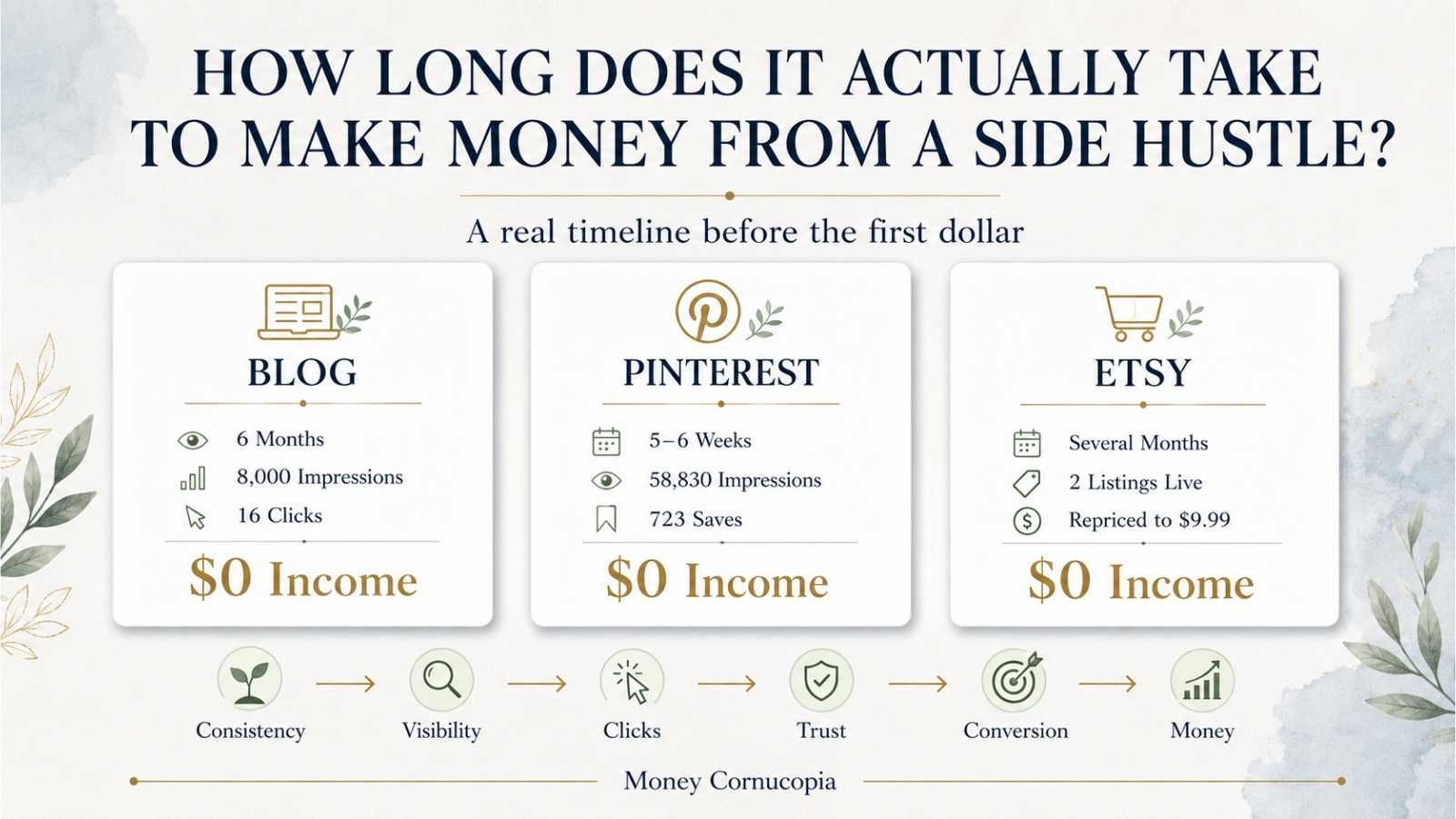
I cannot give you a single number. Nobody honestly can. But I can show you something most articles do not: three side hustles running at the same time, at three different stages, with three different timelines, and exactly what each one looks like right now while none of them have made a single dollar yet.
This is not a success story. This is a real-time look at the stage before money, the part almost nobody documents because it is boring, slow, and does not make a good headline.
Quick Answer: How Long Does It Take?
Service-based side hustles can sometimes produce income in days or weeks because you are selling your time directly to one buyer. Product-based side hustles, like digital products on Etsy, often take two to six months or more because they require both visibility and buyer trust. Content-based side hustles like blogging typically take six to twelve months or longer because search visibility builds slowly. Pinterest-driven traffic can grow fast, sometimes within weeks, but the income that traffic produces usually lags behind the traffic itself.
But the better question is not just “how long until money?” It is “are there signals before the money?” That distinction is the core of this article.
Table of Contents
Typical Side Hustle Timelines by Type
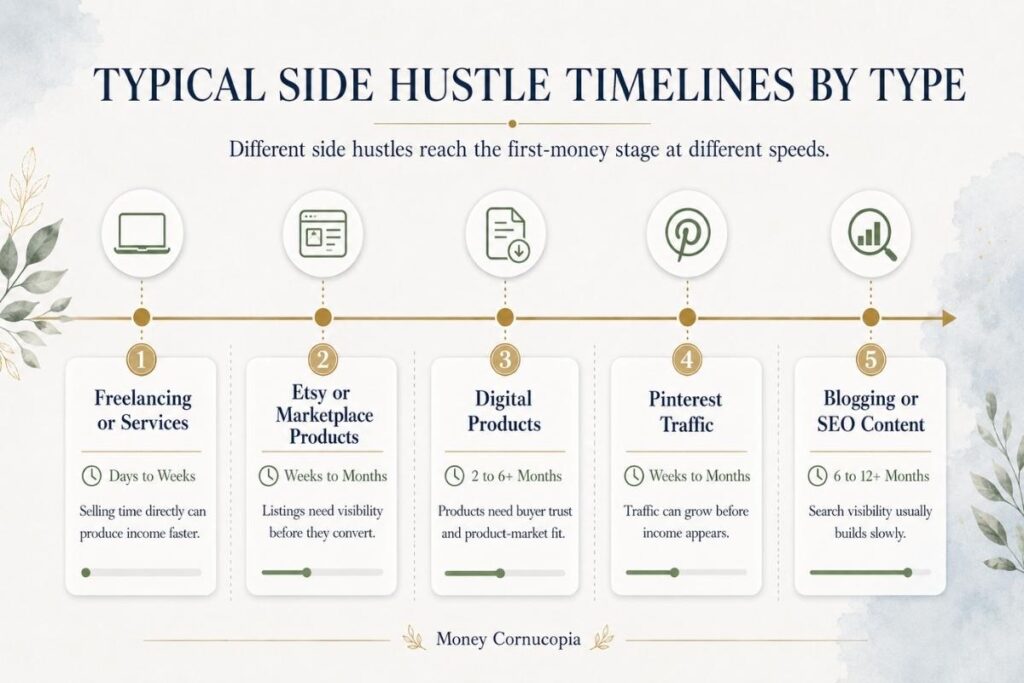
| Side hustle type | Typical first-money timeline | Why |
|---|---|---|
| Freelancing or services | Days to weeks | You sell directly to one buyer with minimal trust-building required |
| Etsy or marketplace products | Weeks to months | Listings need visibility before they can convert |
| Digital products (general) | 2 to 6+ months | You need product-market fit and buyer trust before conversions happen |
| Pinterest traffic | Weeks to months | Impressions can grow quickly but the income that traffic produces usually lags behind |
| Blogging or SEO content | 6 to 12+ months | Search visibility takes time to build from a new domain |
This table answers the generic version of the question. The rest of this article shows what those ranges actually look like from inside them.
My Real Side Hustle Timeline So Far
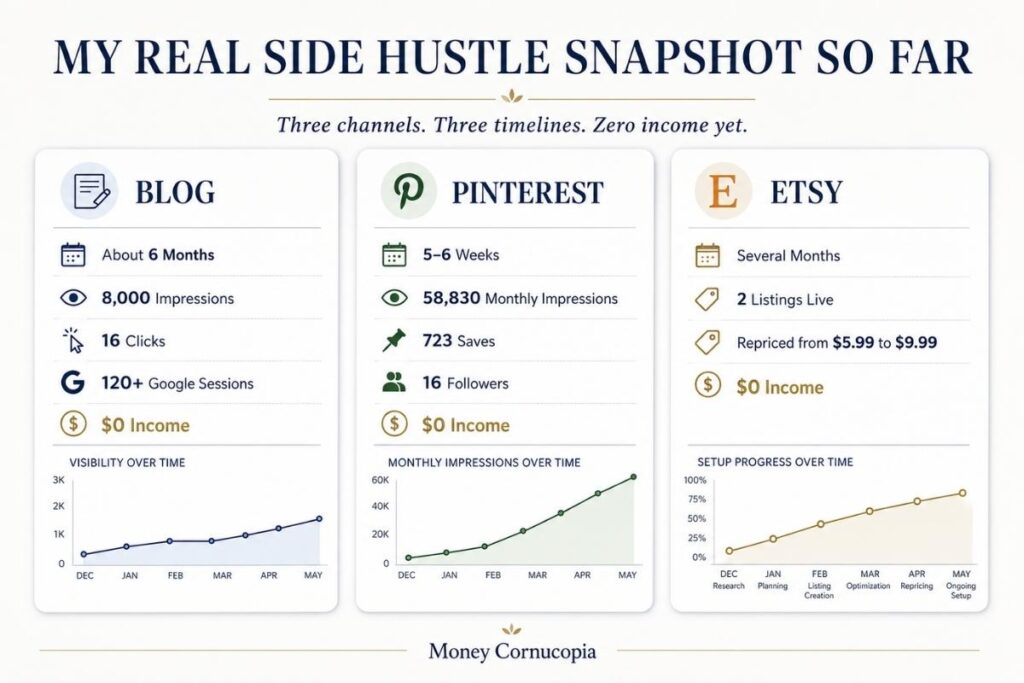
Here is exactly where each part of my side hustle stands right now.
| Side hustle | Time invested | Current status | Income |
|---|---|---|---|
| Blog (content and SEO) | About 6 months | 16 clicks, ~8,000 impressions, 120+ Google sessions in last 28 days | $0 |
| Pinterest traffic | 5 to 6 weeks | 50 to 58,830 monthly impressions, 16 followers, 723 saves | $0 |
| Etsy digital products | Several months | 2 listings live, repriced from $5.99 to $9.99 | $0 |
Three different channels. Three different timelines. The same number at the end of each row.
I want to be clear about what this table is and is not. It is not proof of success. It is not a humble brag dressed up as failure. It is the actual data, the kind you do not usually see because most people either quit before they would share numbers like this, or they wait until the numbers look better before publishing anything.
My blog went from 12 clicks and 4,050 impressions to 16 clicks and roughly 8,000 impressions in about a month. That is real growth. It is also still 16 clicks. My Pinterest account went from 50 monthly impressions to 58,830 in five to six weeks, which I wrote about in detail in how I reached 58,000 monthly Pinterest views with just 16 followers. That is also real growth. It has also produced exactly zero dollars.
Why Visibility Comes Before Money
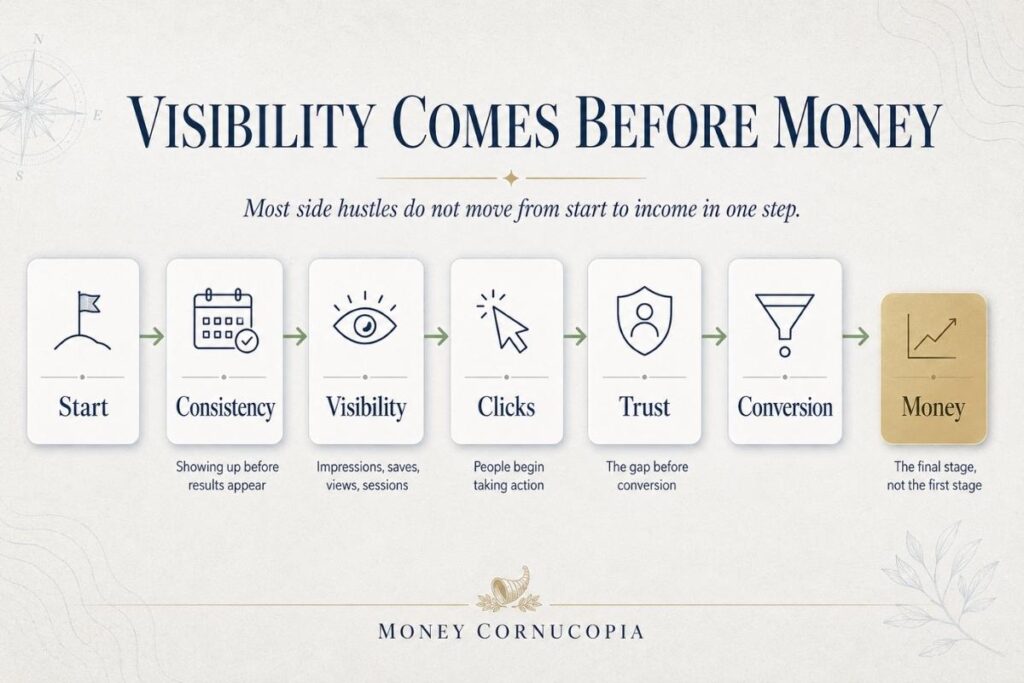
A side hustle does not move from start to money in one step. It moves through stages, and most of those stages produce nothing you can spend.
The path looks like this:
A side hustle does not move from start to money in one step
| 1 | Start — You publish, list, or launch something |
| 2 | Consistency — You show up regularly enough for platforms to notice |
| 3 | Visibility — Impressions, views, and search appearances begin growing |
| 4 | Clicks — People start visiting your blog, shop, or product pages |
| 5 | Trust — Returning visitors, saves, favorites, and engagement build credibility |
| 6 | Conversion — A visitor becomes a buyer, subscriber, or affiliate click |
| 7 | Money — Income follows once conversion is working consistently |
Most beginners quit somewhere between Visibility and Conversion — the stage that produces nothing you can spend but where almost everything important is being built.
When my blog impressions doubled, it felt like something important happened. And it did. But doubling impressions from a tiny base still produces a tiny number of clicks, and clicks still need to convert to something, whether that is ad revenue, an affiliate click, or a reader who eventually buys a product.
When my Pinterest impressions went from 50 to nearly 59,000, it felt like the floodgates had opened. They had, in a sense. But 723 saves and 61 outbound clicks across a month are still a small number of actual visits, and visits are still several steps away from a sale.
When I look at my Etsy shop, the listings are live, the descriptions are written, the mockups exist. But none of that is the same as a buyer deciding to purchase. I covered exactly this gap in my article about why my Etsy listings had zero sales, and again when I looked at whether my pricing was the actual problem.
I am currently somewhere in the visibility-to-clicks stage across all three of my projects. None of them have reached conversion yet. That is not a failure. It is just where the timeline currently sits.
For content-based side hustles specifically, new sites usually need time to build enough content, relevance, and authority before search traffic becomes meaningful. According to Ahrefs’ research on SEO timelines, most sites begin to see measurable results within three to six months, though Google has indicated it can take up to a year for a new site to find its place in the rankings. My blog at 6 months, with growing impressions but still few clicks, fits squarely inside that range.
The Stage Most Beginners Misunderstand: Signals vs Sales
A signal is something that tells you people are interested, even if they have not bought anything yet. Signals are not money. But the absence of signals is very different from the presence of signals without sales.
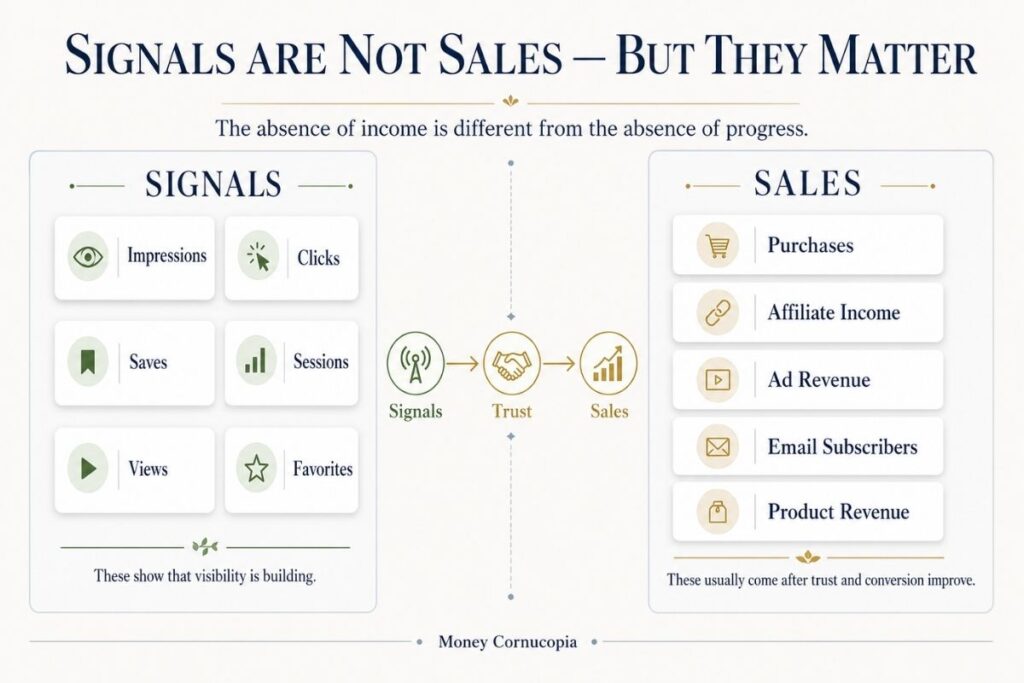
My Pinterest saves are a signal. My blog impressions are a signal. If my Etsy listings start getting more views or favorites after I reprice them today, that will be a signal too.
If you have zero impressions, zero clicks, zero saves, zero views, and zero engagement of any kind after a genuinely consistent effort, that is useful information. Something about visibility itself needs to change.
But if you have growing impressions, growing saves, growing sessions, and the only thing missing is the final conversion step, that is a completely different situation. That is not a sign to quit. That is a sign you are in the stage where most people give up just before things start working, because the stage itself produces nothing you can point to as proof.
I covered the deeper version of this idea in 3 reasons your side hustle still is not growing, and the honest answer is that “not growing” and “not yet converting” often look identical from the inside, but they require completely different responses.
What I Am Fixing Next
Here is exactly what I am working on right now, across all three.
For the blog, I am focused on continuing to publish consistently and improving internal linking between articles, since 16 clicks from roughly 8,000 impressions tells me my content is starting to appear in search results but is not yet earning enough clicks to convert that visibility into meaningful traffic.
For Pinterest, I recently applied for the Canva affiliate program so that the traffic Pinterest is already sending to my Canva-related content can start contributing to income once that approval comes through.
For Etsy, I am changing my prices from $5.99 to $9.99 today, a decision I researched and explained in detail in why I repriced my Etsy listings. I do not expect this single change to produce sales by itself. But it removes one variable that may have been quietly working against me, which means whatever happens next will be a slightly cleaner signal.
None of these are dramatic changes. They are small adjustments to systems that are already partially working. That is what most of this stage actually looks like.
What to Track Before Your Side Hustle Makes Money
If income is not here yet, these are the numbers that tell you whether you are moving in the right direction.
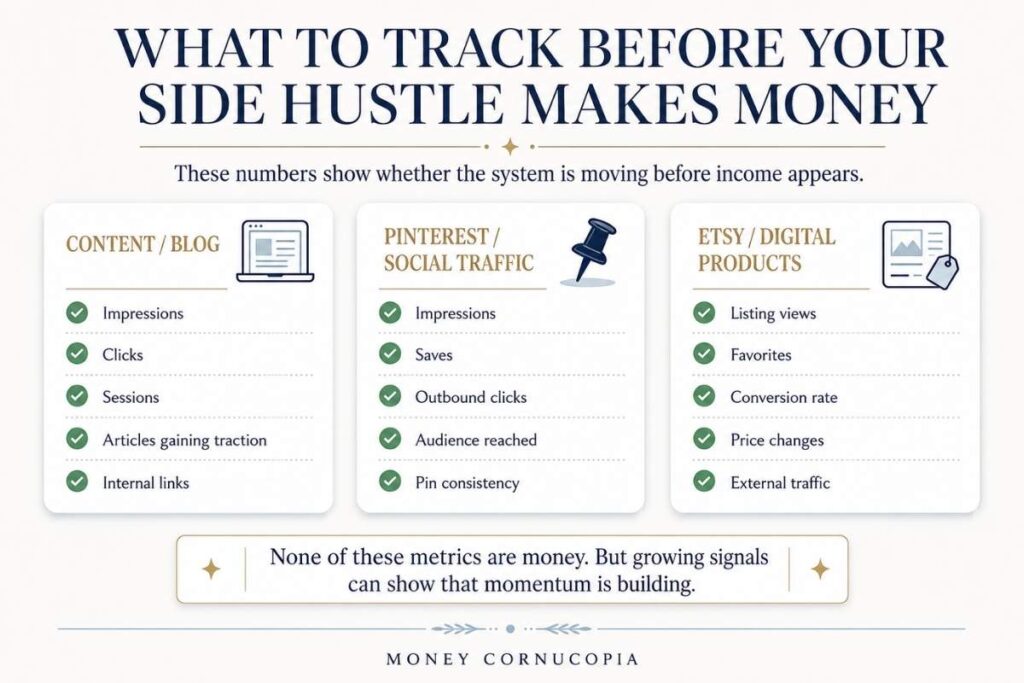
For a content-based side hustle, track impressions, clicks, sessions, and which articles are gaining traction in Search Console month over month.
For Pinterest or social traffic, track impressions, saves, outbound clicks, and total audience reached.
For an Etsy shop or digital product store, track listing views, favorites, conversion rate, and outbound clicks from external sources like Pinterest.
Across all of them, track publishing consistency. Whether you showed up this week is something entirely within your control, even when the numbers are not.
None of these metrics are money. But growth in these metrics, even slow growth, is the difference between a side hustle that is quietly building and one that genuinely needs a different approach.
The Doubt Nobody Talks About
Sometimes it feels like none of this is going anywhere.
I want to be honest about something that I think every single person doing this feels, and almost nobody admits in writing.
Sometimes it genuinely feels like there is no progress and no money in this field, and that I am not going to achieve anything. The competition feels enormous. There are huge, established players in every single space I am trying to build in, whether that is finance content, digital products, or Pinterest marketing. The thought that keeps surfacing is simple: with this much competition, with these big fish already in the water, why would I get any of it?
This doubt does not go away just because the numbers are technically improving. Going from 50 to 58,000 Pinterest impressions did not make the doubt disappear. Going from 12 to 16 clicks on the blog did not make it disappear either. The doubt lingers regardless of what the dashboard says, because the dashboard still says $0, and $0 is the number that doubt cares about.
I do not have a clever way to make this feeling go away. I just keep going anyway.
So, When Should You Quit a Side Hustle?
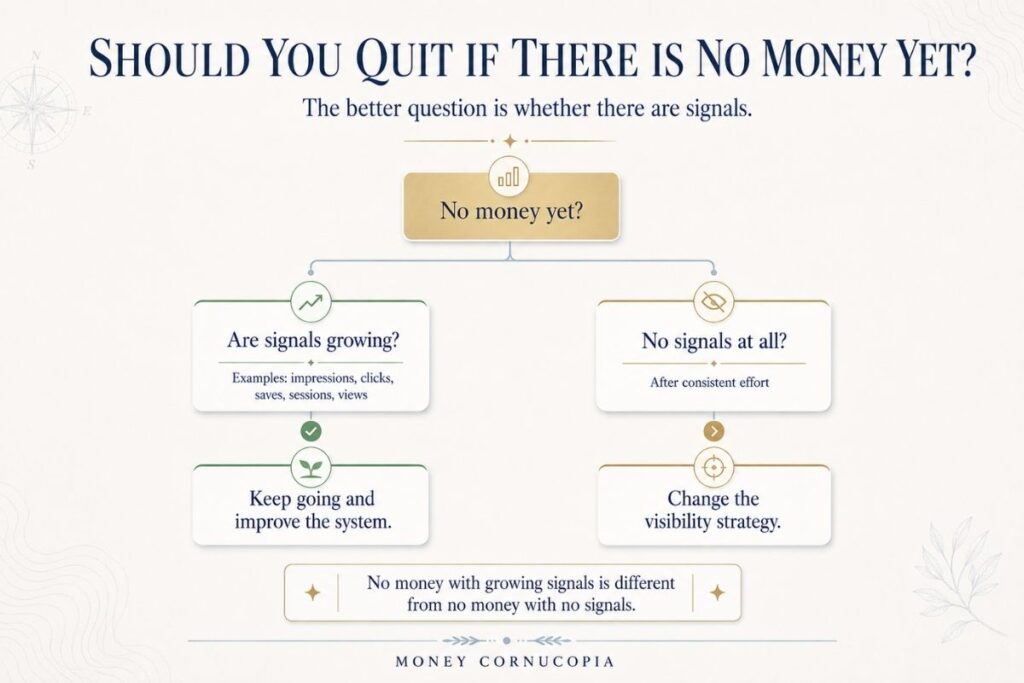
Not because there is no money yet. But pay attention if there are no signals at all.
Here is the honest distinction I use for myself.
No money but growing signals (impressions, clicks, saves, sessions, views) is normal and is not a reason to quit. This describes where all three of my projects currently sit.
No money and no signals at all, after a genuinely sustained and consistent effort, is different. That is a situation where something about visibility itself needs to change before anything else matters.
For myself, my honest answer is this: I am giving this at least 6 months of consistent effort before I make any real decision about whether it is working. Not 6 months from when I started, but 6 months of actually showing up consistently, which is a slightly different timeline for each of my three projects since they started at different points.
When I feel the doubt creeping in, and it creeps in often, I tell myself the same thing: keep going, give it the full runway you promised yourself, and then decide based on the real picture, not based on how a single bad week feels.
Frequently Asked Questions
How long does it take to make money from a side hustle?
There is no single answer because it depends entirely on the type of side hustle. Service-based side hustles can produce income in days or weeks because you are selling your time directly. Digital products and content-based side hustles like blogging typically take several months to a year because they require building traffic, trust, and an audience before the first sale or meaningful click happens.
Is it normal to make $0 after 6 months?
For content-based side hustles like blogging, yes, this is common. According to Ahrefs’ research on SEO timelines, most sites need three to six months to begin showing measurable results, and Google has indicated full results can take up to a year for new sites. The presence of growing signals like impressions and sessions, even without income, generally indicates the timeline is progressing normally.
How do I know if my side hustle is working if I am not making money yet?
Look for growing signals rather than income. Increasing impressions, saves, sessions, views, or engagement over time indicates that visibility is building, which typically precedes conversion. The absence of any growing signals after a genuinely consistent effort is a more meaningful indicator that something needs to change than the absence of income alone.
Should I quit my side hustle if it is not making money?
Not if signals are growing. A side hustle with increasing visibility but no sales yet is generally in a normal early stage rather than a failing one. Consider stepping back or changing strategy if there are no growing signals at all despite sustained, consistent effort over a meaningful period.
What is the difference between a service-based and product-based side hustle timeline?
Service-based side hustles can generate income quickly because you sell your time directly to one buyer with minimal trust-building required. Product-based side hustles take longer because they require a platform or audience to discover the product, and buyers need to trust an unproven seller enough to purchase something intangible or unfamiliar.
How do I know if I should change my strategy or just wait longer?
If your signals are growing month over month, the honest answer is usually to continue and give the timeline more room. If your signals have been flat for a sustained period despite consistent effort, that is when reviewing your strategy, whether that is your content, your product, your pricing, or your visibility channels, becomes more useful than simply waiting longer.
Final Thoughts
A side hustle is not slow because nothing is happening. It is slow because the first things that happen are invisible, boring, and unpaid.
Right now I have a blog that gets 16 clicks a month, a Pinterest account that gets 58,000 impressions and zero sales, and an Etsy shop with two listings and zero purchases that I am repricing today in the hope it removes one small obstacle.
None of that is impressive on its own. But six months ago the blog had almost nothing. Six weeks ago Pinterest had almost nothing. The signals are growing even though the income is not, and that is the actual stage I am in.
If you are in this stage too, the honest answer to “how long does it take” is: longer than you want and probably not as long as your doubt is telling you tonight. Keep going long enough to find out which one is true.
Leave a Reply