
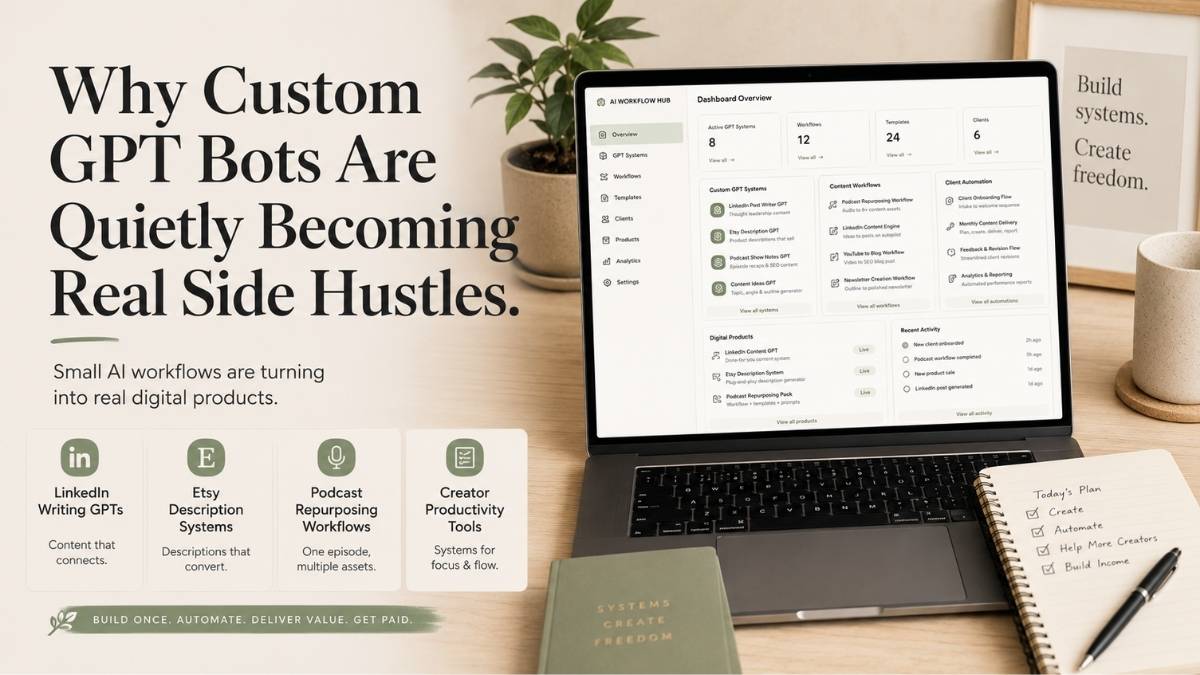
Custom GPT bots and AI workflow templates are quietly becoming one of the more interesting side hustles in the creator economy right now.
Not because people are building complicated AI startups.
But because creators are packaging small, useful workflows into digital products and services that save people time.
Over the past few months, more creators have started selling things like:
| Product type | Who buys it |
|---|---|
| LinkedIn writing GPTs | Professionals and founders who post content regularly on LinkedIn |
| Etsy description systems | Etsy sellers who want faster and more consistent product listings |
| Podcast repurposing workflows | Podcasters turning episodes into show notes, clips, and social content |
| AI research dashboards | Writers and marketers who need organized research systems |
| Pinterest content systems | Bloggers and digital product sellers driving traffic through Pinterest |
| Proposal writing assistants | Freelancers and agencies who send proposals to clients regularly |
Some creators charge hundreds of dollars for custom setups. Others are packaging these workflows into downloadable templates, GPT systems, and recurring digital products that continue selling over time.
What makes this trend interesting is that most of these systems are not especially advanced.
They are just useful.
And honestly, I think that is exactly why this space is quietly growing right now.
Most People Are Not Actually Buying “AI”
One thing that becomes obvious after looking at successful AI products is that buyers are usually not paying for AI itself.
They are paying to save time.

A freelancer might pay for a workflow that transforms rough meeting notes into organized proposals. An Etsy seller might want a GPT that writes SEO-optimized product descriptions faster. A blogger might pay for a content workflow that turns one article into Pinterest descriptions, email drafts, and social media captions without starting from scratch every time.
The technology matters far less than the reduction in mental effort.
That is probably why so many generic prompt packs started losing momentum. Most people do not want another folder filled with random prompts they will never organize properly. They want workflows that fit naturally into the way they already work.
That shift toward practical usefulness is becoming increasingly visible across creator platforms like Gumroad, marketplaces like Etsy, and even inside tools like OpenAI GPT Builder, where creators are packaging specialized workflows into smaller products and services.
If you have been paying attention to smaller creator businesses recently, you can already see this happening with:
| Workflow type | What it does |
|---|---|
| LinkedIn content GPTs | Turns ideas or notes into ready-to-post LinkedIn content consistently |
| Podcast repurposing workflows | Converts episode transcripts into show notes, clips, and captions |
| Etsy listing systems | Generates SEO-optimized titles, tags, and descriptions faster |
| Proposal writing assistants | Transforms rough meeting notes into polished client proposals |
| AI research dashboards | Organizes AI-generated research into a searchable structured system |
| Pinterest content systems | Produces pin titles, descriptions, and scheduling plans in one flow |
| Email response workflows | Drafts professional replies to common client and customer emails |
| Client onboarding automations | Streamlines new client intake, contracts, and welcome sequences |
Many of these are not even marketed as “AI products.”
They are positioned as productivity tools, creator systems, or workflow assets because buyers care more about outcomes than technology.
That subtle positioning difference matters much more than most people realize.
Smaller AI Systems Often Feel More Valuable
One of the more surprising things about this trend is that smaller AI workflows often feel more useful than massive, complicated systems.
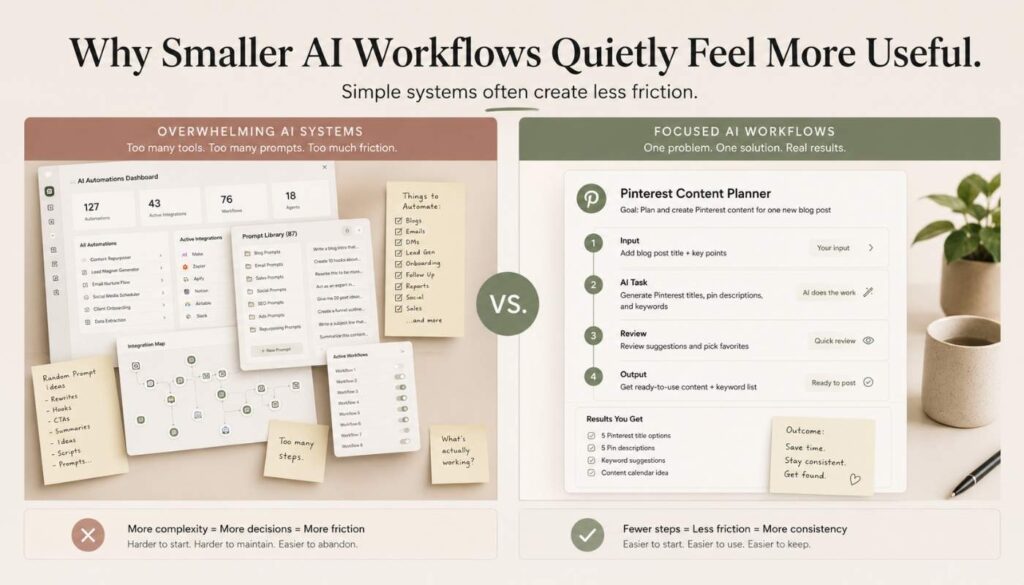
Some creators are building giant dashboards filled with endless automations, layered prompts, integrations, databases, and tools. They look impressive initially, but many quietly become exhausting to maintain. Over time, the workflow itself starts creating friction.
Meanwhile, smaller systems solving one annoying, repetitive problem can quickly become genuinely valuable.
That is probably why focused AI products are quietly outperforming many broad “all-in-one” systems right now. Instead of trying to automate an entire business, they reduce friction in one specific area of the workflow.
A simple GPT that helps freelancers respond to client inquiries faster may end up being more useful than an advanced automation setup requiring constant maintenance.
Honestly, this feels very similar to what is happening across the broader creator economy right now. Simpler workflow products often perform better because they are easier to understand, easier to maintain, and easier to integrate into real workflows.
That same pattern is showing up with AI products too.
It also connects closely to the growing trend of smaller workflow-based digital products and Notion template marketplace systems that creators have quietly been selling for years. Smaller systems usually create less friction, which makes them easier for people to keep using consistently.
You can already see a similar shift happening in:
- How to Build a Digital Products Shop for Passive Income in 2026
- 7 Surprisingly Simple Notion Templates People Keep Paying For
because both trends are ultimately built around the same idea:
People increasingly want simpler systems that save time instead of complicated setups that create more maintenance.
The Real Opportunity Is Packaging Workflows Clearly
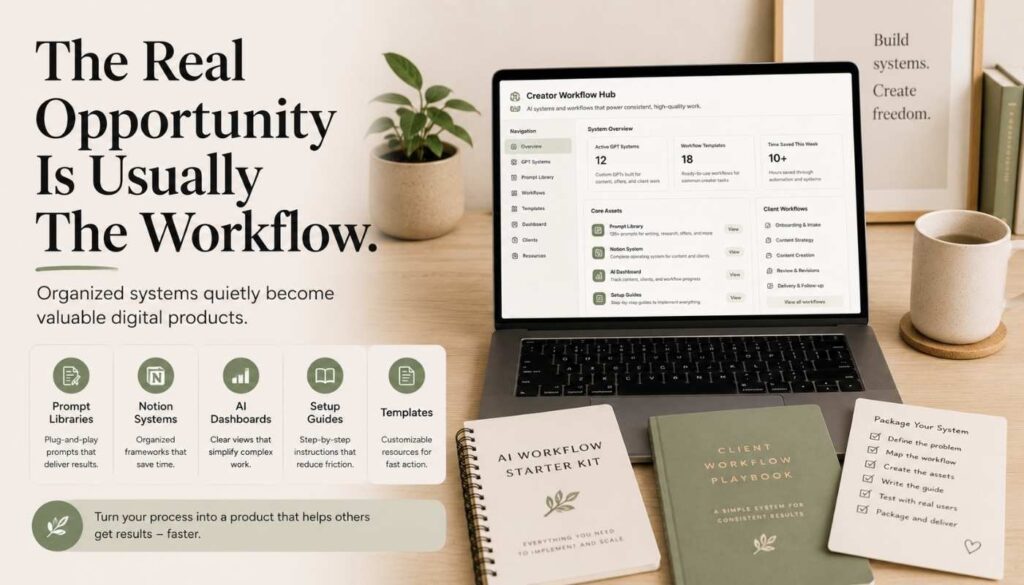
A lot of people assume the opportunity is building advanced AI technology from scratch.
Increasingly, it looks like the real opportunity is packaging workflows clearly enough that people can immediately use them.
Some creators are combining:
What a polished AI workflow product includes
| 1 | A custom GPT built around one specific workflow |
| 2 | A small Notion workspace to organize outputs |
| 3 | A workflow template showing each step clearly |
| 4 | A prompt library organized by use case |
| 5 | Setup instructions for getting started quickly |
| 6 | A walkthrough guide explaining how to use everything |
and turning that into polished digital products.
Others are offering lightweight setup services where they customize workflows for specific businesses or industries.
Interestingly, the AI itself is often not the main product.
The organization is.
That explains why creators with strong systems thinking are starting to stand out more. They are not necessarily more technical than everyone else. They are simply better at transforming messy, repetitive workflows into structured systems people can actually use.
And right now, that skill is becoming surprisingly valuable online.
Why This Trend Will Probably Keep Growing
Most businesses still do not know how to integrate AI into their daily workflows properly.
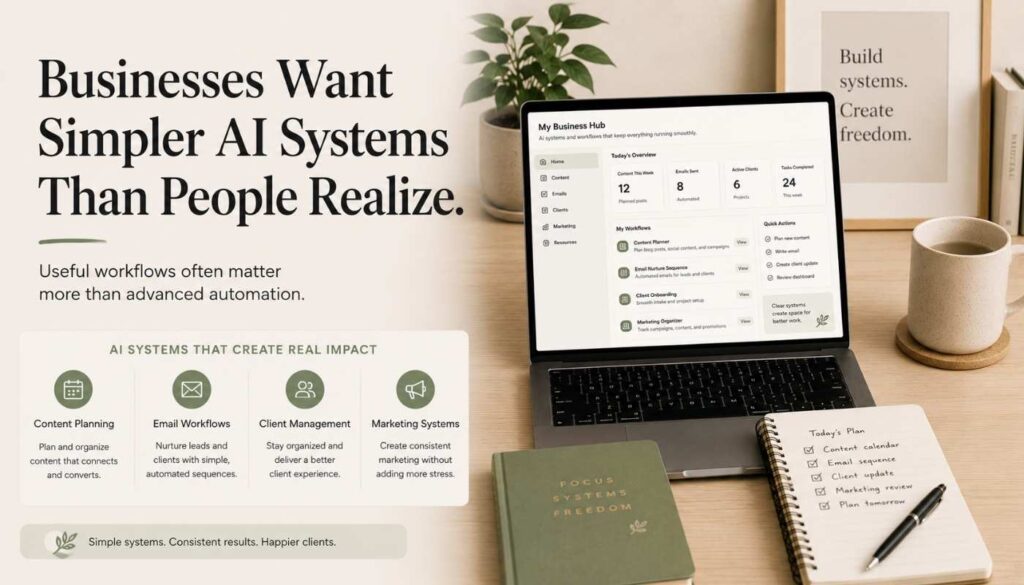
They know AI can probably save time somewhere, but the implementation side still feels confusing. That uncertainty creates a growing opportunity for creators who can simplify workflows and package them clearly.
Especially because many people are already overwhelmed by:
What most people are already overwhelmed by
| 1 | Scattered prompts saved across random chats and folders |
| 2 | Disconnected tools that do not work together naturally |
| 3 | Too many AI platforms with no clear system for using them |
| 4 | Unfinished automations that never got properly implemented |
| 5 | Workflow chaos from constantly switching between apps |
| 6 | Information overload with no clear system for organizing it |
A clean workflow that saves someone even two hours every week can easily feel worth paying for.
And unlike many short-lived online trends, this shift feels tied to something more practical. Businesses will probably continue looking for:
| What businesses need | Why it matters long term |
|---|---|
| Faster systems | Time saved on repetitive tasks compounds into significant productivity gains |
| Reusable workflows | A workflow built once can save hours across every similar project going forward |
| Organized templates | Structure reduces decision fatigue and keeps output quality consistent |
| Simplified automation | Automations that are easy to maintain actually get used consistently |
| Content repurposing tools | One piece of content reaching more platforms multiplies return on effort |
| Workflow efficiency | Leaner processes allow small teams and solo creators to scale without burnout |
for a very long time.
That does not mean every AI side hustle will suddenly become successful. Low-effort products are already flooding the market, and generic prompt packs are becoming increasingly easy to ignore.
But creators who focus on solving specific workflow problems instead of chasing hype will probably continue finding opportunities here.
Especially the ones building realistic systems that people can actually maintain consistently.
Leave a Reply