
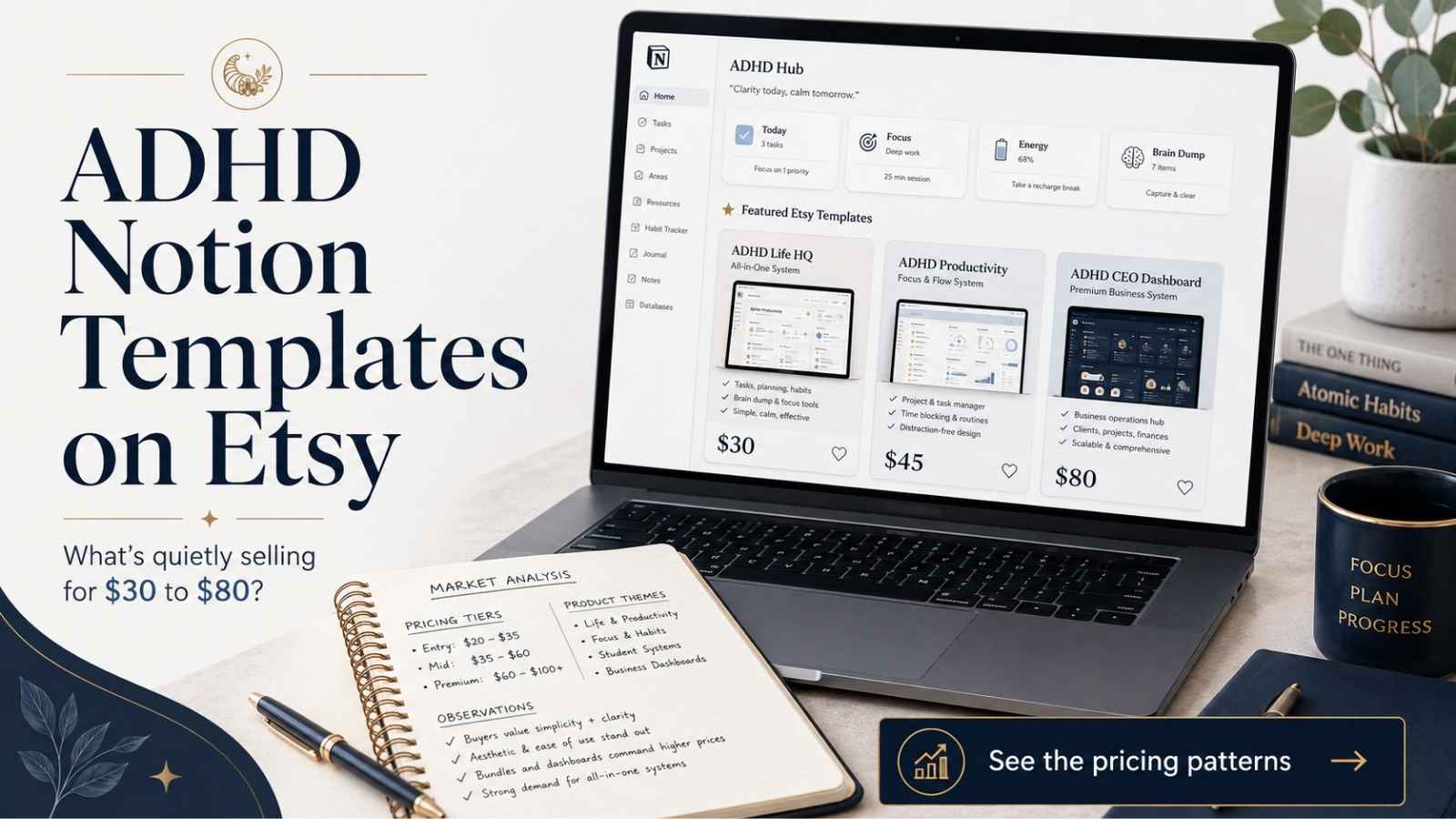
Most Notion templates on Etsy are starting to look painfully similar.
A clean dashboard. A habit tracker. A weekly planner. A few pastel icons. Maybe a “second brain” label added somewhere for good measure.
But when I started looking closely at ADHD Notion templates, I noticed something more interesting. The templates that looked more valuable were not always the prettiest ones. They were the ones built around very specific friction points.
Task paralysis. Brain dumps. Forgotten deadlines. Messy routines. Emotional overwhelm. Too many ideas. Too many tabs. Too much planning that never turns into action.
That is where the opportunity gets interesting.
ADHD Notion templates are not just another productivity aesthetic. They show why niche-specific digital products can feel more valuable than generic dashboards. Buyers are not only looking for a planner. They are looking for a system that feels like it understands how their brain actually works.
The general Notion template market typically sells for $10 to $15 per template, which is the reality most sellers should expect. But within ADHD focused Notion templates, a smaller premium tier sits at $30 to $80, especially when those templates are sold as bundles, Life OS dashboards, gamified planners, or complete systems.
This article focuses on that premium tier. Not because every ADHD template sells at those prices, but because that tier reveals something important about the digital product market in 2026.
People will often pay more for a digital product when it feels specific, useful, emotionally recognizable, and easier than starting from scratch.
That is the part that many beginner template sellers miss.
TLDR: The Quick Answer
The typical Notion template sells for $10 to $15, but a smaller premium tier of ADHD focused Notion templates sits at $30 to $80. This article studies the premium tier specifically.
After looking at 20 of the higher priced ADHD focused Notion templates on Etsy, the premium listings I kept noticing were positioned around $30 to $80, especially when they were sold as bundles, Life OS dashboards, gamified planners, or deeper planning systems.
The strongest templates shared three patterns. They reduced decision fatigue. They used an ADHD-friendly structure instead of overwhelming dashboards. And they were packaged in a way that made the buyer feel like the product was built for their actual daily struggles.
Quick takeaways
| 1 | The premium pricing range observed was roughly $30 to $80, mostly for bundles and complete systems |
| 2 | Most beginner sellers should not start at this tier — entry level pricing of $12 to $25 is more realistic |
| 3 | Simple student planners and lightweight dashboards usually sit lower, around $15 to $30 |
| 4 | The most interesting underserved angle was gamified quest planning for ADHD adults |
| 5 | The strongest pricing strategy was tiered bundles such as beginner, intermediate, and pro |
| 6 | The best free traffic opportunity appears to be Pinterest, supported by Etsy search and short form social |
| 7 | The biggest lesson: specificity sells better than generic productivity |
Table of Contents
Why I Went Looking in the First Place
I run a small Etsy shop where I currently sell finance templates, personal improvement templates, and planners. Sales have been steady but slow, and I have been thinking seriously about adding Notion templates to my catalog.
The question I kept coming back to was simple.
Which Notion niche still has buyers who are actively searching and willing to pay?
Generic productivity Notion templates are difficult right now. The market is crowded, the prices have been pushed down by free templates and giant bundles, and many sellers are competing with creators who already have thousands of Pinterest pins, years of reviews, and polished brand ecosystems.
That does not mean Notion templates are dead. It means generic Notion templates are harder to sell, and most of them sit at the $10 to $15 price point because that is where the volume is.
So instead of looking at the broad productivity dashboard space, I wanted to study one smaller corner of the market where buyers seemed to have a more specific problem and where some sellers were managing to price above the typical $10 to $15 average.
That led me to ADHD friendly Notion templates, specifically the premium tier of that niche.
This article is also a natural follow-up to my guide on 7 surprisingly simple Notion templates people are quietly paying for in 2026, where I looked at the broader template trend. Here, I wanted to zoom in and ask a more specific question.
What are the higher-priced ADHD Notion template sellers actually packaging, positioning, and pricing on Etsy?
The answer was more interesting than I expected.
The templates that looked strongest were not random ADHD planners. They were systems built around real friction points: brain dumps, task paralysis, forgotten deadlines, messy routines, energy crashes, reward systems, and the feeling of constantly restarting after abandoning yet another planner.
That is where this niche starts to make sense.
A generic planner says, “Organize your week.”
An ADHD friendly planner says, “Here is a simpler way to come back when your week already fell apart.”
That second promise is much more specific, and specificity is often what makes a digital product easier to sell at a premium price.
A Quick Note Before We Go Further
This article is about Etsy research, digital product positioning, and Notion template strategy. It is not medical advice.
ADHD friendly templates may help some people organize tasks, reduce planning friction, or create simpler routines, but they do not diagnose, treat, cure, or medically manage ADHD.
The most trustworthy sellers in this niche are careful with that distinction.
That matters because this is a health-adjacent niche. If you build products in this category, your language should stay grounded. You can say “ADHD friendly,” “designed to reduce overwhelm,” “supports task organization,” or “built for low friction planning.”
You should not claim that a template fixes ADHD or replaces professional support.
For readers looking for real ADHD resources, organizations like CHADD and the ADDA are good starting points.
That line matters for trust, ethics, and long-term brand quality.
How I Studied These ADHD Notion Templates
To keep this research practical, I looked at 20 ADHD focused Notion templates and related Etsy listings. I was not trying to reverse engineer private sales data because Etsy does not publicly provide that level of information.
I also want to be upfront about one thing. I focused mostly on the premium and mid-premium tier of ADHD Notion templates because that is where the most interesting positioning is happening. The broader Notion template market typically sits at $10 to $15 per template, which is the reality most beginner sellers should expect when they start out. The $30 to $80 tier is the outlier premium segment, not the typical price.
This article studies the premium segment to understand what is working at the top of the market and what beginner sellers can eventually aspire to as they build reviews, branding, and audience trust.
What I studied in each listing
| 1 | Listing titles and keyword positioning |
| 2 | Product photos and mockups |
| 3 | Price points and sale pricing |
| 4 | Bundle structures |
| 5 | Review counts and buyer language |
| 6 | Shop positioning and bio language |
| 7 | Whether sellers were cross promoting on Pinterest or Instagram |
| 8 | Whether similar concepts appeared on the Notion Marketplace |
| 9 | Which features appeared repeatedly across different sellers |
So when I talk about what is “selling,” I am using the term in the practical marketplace sense: what sellers are actively listing, pricing, packaging, reviewing, and positioning as premium products.
That is important because we should stay honest about the data. I did not access private revenue dashboards. I studied visible patterns across listings.
And even with that limitation, the patterns were clear.
The strongest ADHD Notion templates in this premium tier were not simply pretty dashboards. They had a specific buyer, a clear use case, and a reason to exist beyond aesthetics.
How Much Are ADHD Notion Templates Actually Selling For?
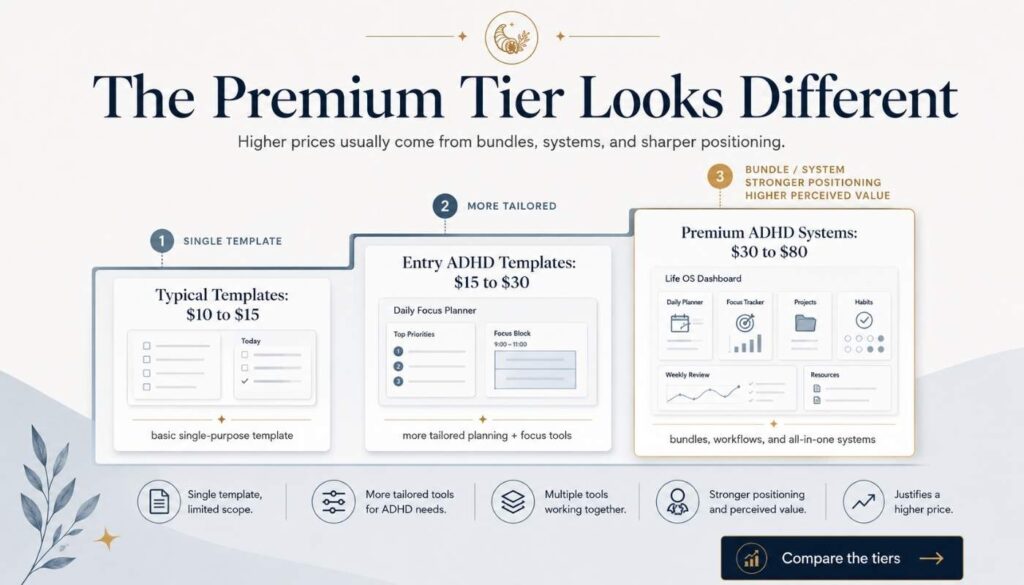
Most Notion templates on Etsy sell for $10 to $15. That is the reality of the broader market and what most beginner sellers should expect when they list their first template.
But ADHD focused Notion templates show a wider price distribution because the niche supports premium positioning when the product is specific, well packaged, and clearly differentiated. The 20 listings I studied skewed toward the mid-premium and premium tier, which is where this analysis focuses.
Within that premium tier:
| Price tier | Typical format |
|---|---|
| $15 to $25 | Simple ADHD planners and student dashboards |
| $25 to $40 | Mid range ADHD templates with stronger positioning |
| $40 to $80 | Complete systems, niche specific dashboards, and bundles |
The key thing I noticed is that price usually rises when the product feels less like a single template and more like a complete system.
A basic ADHD daily planner may struggle to justify a higher price unless it has strong visuals, clear onboarding, and a specific promise. But a Life OS dashboard, gamified quest planner, or tiered bundle can be positioned higher because the buyer sees more structure, more guidance, and more perceived value.
That is the real lesson.
The price is not just about how many Notion pages are inside the product. It is about how clearly the product solves a painful, repeated problem, and whether the seller has the branding and reviews to support a higher price.
For example, a $19 ADHD student planner might sell because it helps with assignments and exams. A $55 ADHD creator dashboard might sell because it organizes ideas, content, deadlines, client work, and digital product planning in one system.
The second product solves a broader workflow problem for a buyer with more earning potential, so the pricing ceiling is naturally higher.
That same principle shows up across digital products generally. In my guide on how to build a digital products shop for passive income in 2026, I talked about why simple products often become more valuable when they are packaged around a clear buyer problem.
ADHD Notion templates are a good example of that idea in action.
If you are thinking of building a similar product, use this free Etsy Digital Product Pricing Calculator to estimate your profit after Etsy fees before you set your price.
The Full Pricing Breakdown Across 20 Premium Listings
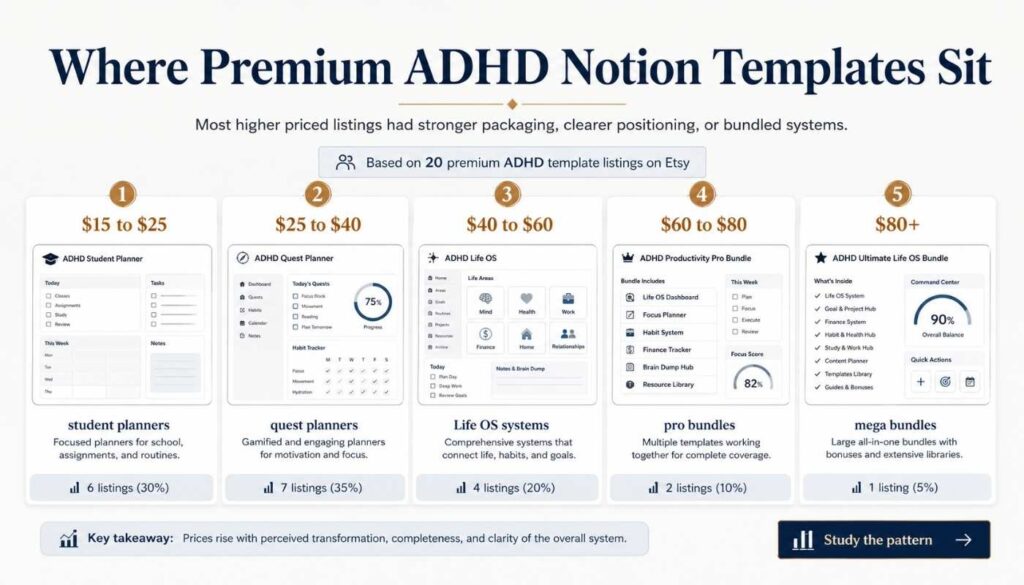
Here is the rough price distribution I observed across the 20 ADHD Notion template listings I studied. Remember that this sample skewed toward the premium end of the niche, so this is not representative of the entire Notion template market.
| Price tier | Share of listings studied | Most common format |
|---|---|---|
| $15 to $25 | About 20% | Student planners, simple daily dashboards, lightweight task systems |
| $25 to $40 | About 40% | Quest planners, color coded daily dashboards, mid range productivity systems |
| $40 to $60 | About 25% | Life OS templates, niche specific templates, creator or freelancer dashboards |
| $60 to $80 | About 10% | Premium Life OS templates, pro tier bundles, deeper guided systems |
| $80 and above | About 5% | Mega bundles, full shop bundles, larger systems, or rights based packages |
The middle tier, around $25 to $40, had the most activity in this sample. That tells me this is where many mid-level sellers are positioning their premium ADHD templates.
But it also means this tier is crowded.
The $40 to $60 range looked more interesting from a seller’s perspective. There were fewer direct competitors, and the templates in this tier usually had stronger positioning. They were not just “ADHD planners.” They were complete systems, niche-specific dashboards, or templates with a clear philosophy behind them.
The $80 plus tier was smaller, but it is worth paying attention to. Products at this level usually need stronger authority signals: better branding, multiple templates, a larger bundle, a clear audience, a walkthrough, or a shop that already looks established.
For a new seller, I would not start by trying to sell an $80 ADHD Notion template immediately. I would not even start at $40. I would launch a focused first template in the $12 to $25 range, gather reviews and feedback, build social proof, and then create a higher-tier version once the first one has traction.
The premium pricing is the destination, not the starting line.
The 7 ADHD Notion Template Formats I Kept Seeing
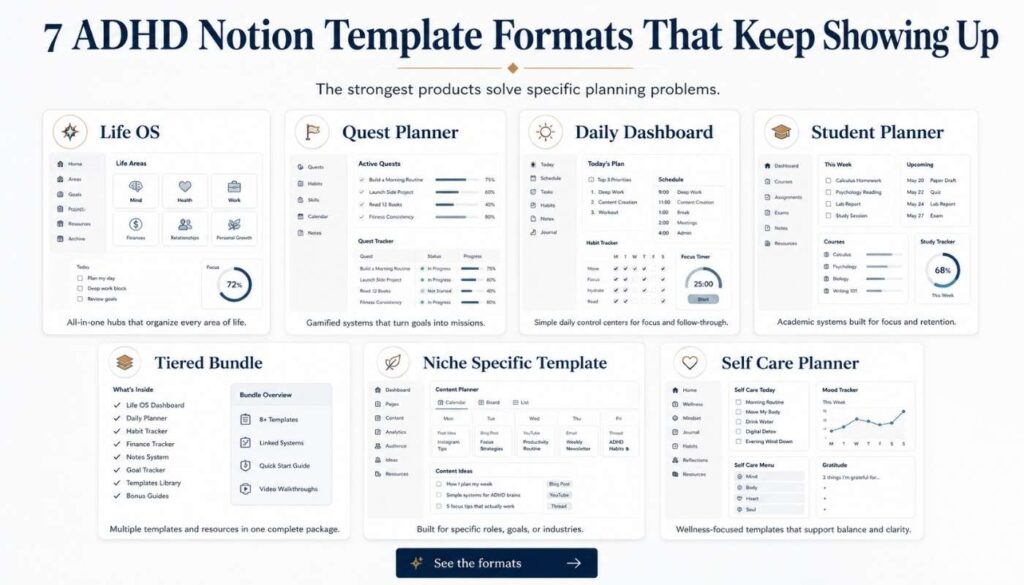
These are the seven formats that kept showing up repeatedly. I grouped them by what they actually help the buyer do, not just by how they look.
1. The Life OS or Second Brain Template
The Life OS template is usually the most expensive category because it promises an all-in-one system.
Instead of offering one daily planner, it tries to organize several parts of a person’s life in one workspace.
A typical ADHD friendly Life OS might include goals, projects, tasks, habits, finances, self-care, journaling, routines, notes, and resources. The strongest examples were usually color-coded and divided into clear life zones so the buyer could understand the system quickly.
That matters because a large template can easily become overwhelming. If the navigation is confusing, a Life OS stops feeling helpful and starts feeling like another abandoned productivity project.
The better versions avoided that by using visual sections, simple labels, and beginner-friendly onboarding.
Why buyers may pay more for this format: they are not just buying a planner. They are buying the feeling of having one place to organize everything.
That is a powerful promise when the buyer already feels scattered.
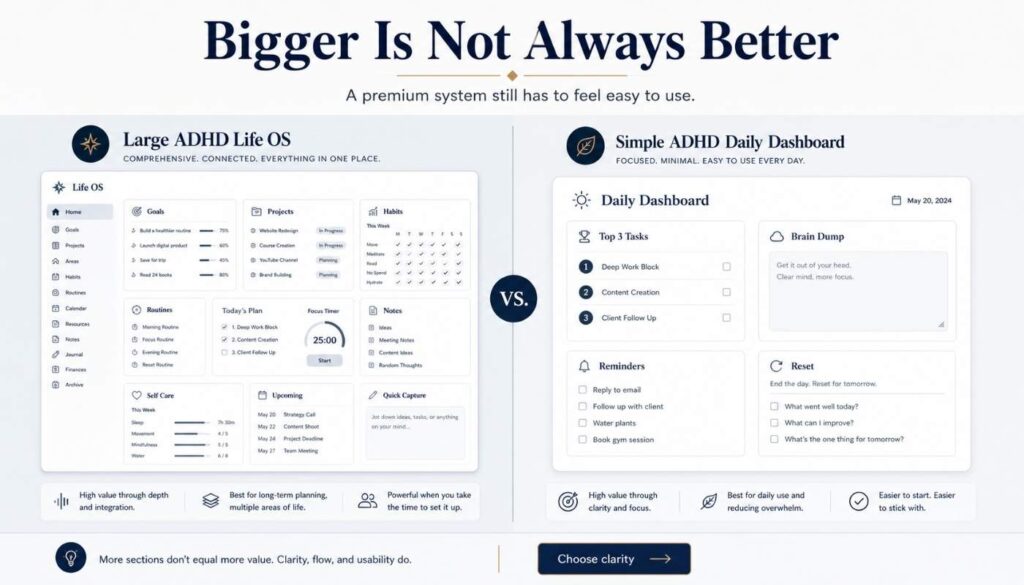
The weakness is that this category is also harder to build well. A Life OS has to feel complete without becoming mentally heavy. That is a difficult balance, and it is where many sellers overdo it.
If I were creating one, I would avoid making it massive at first. I would build a calm, guided Life OS with fewer sections, clearer navigation, and a strong “restart here” page for when the user falls off.
That one page could be more valuable than another complicated dashboard.
2. The Gamified Quest Planner
This was the format that excited me most as a seller.
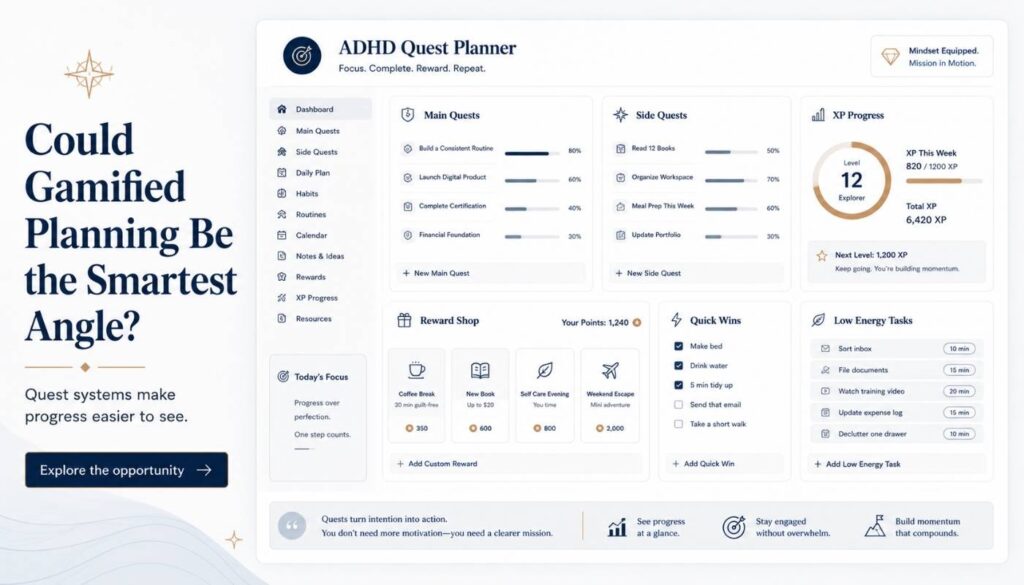
A gamified quest planner turns tasks into quests. Instead of checking off boring to-do items, the user completes small missions, earns points, unlocks rewards, or tracks progress in a more playful way.
This works because many people with ADHD struggle with traditional productivity systems that rely only on discipline and repetition. A gamified planner adds novelty, reward, and momentum.
A strong quest planner might include:
| Feature | Why it works for ADHD buyers |
|---|---|
| Main quests and side quests | Breaks work into levels that feel manageable instead of overwhelming |
| XP or points for completed tasks | Creates visible progress that motivates continued action |
| A reward shop | Adds dopamine motivation by tying effort to meaningful personal rewards |
| Tiny two to five minute task steps | Reduces task paralysis by making the starting point feel almost effortless |
| Streaks that do not punish restarts | Removes the guilt spiral that causes most people to abandon planners entirely |
| Accountability characters or future self prompts | Creates emotional connection and personal investment in the system |
| Quick wins for low energy days | Keeps users engaged even when capacity is limited, instead of stopping entirely |
The reason this category stands out is that it is not just another daily planner. It has a clear philosophy.
The philosophy is simple: make starting easier and make progress feel rewarding.
That is much stronger than “track your habits and goals.”
From a seller’s angle, this may be one of the best opportunities in the ADHD Notion niche because it feels specific, visual, Pinterest-friendly, and emotionally easy to understand.
It also has room for expansion. A seller could create a beginner quest planner, a freelancer quest planner, a student quest planner, and a creator quest planner.
That is how one idea becomes a product line.
3. The Color Coded Daily Dashboard
The color-coded daily dashboard is simpler than a Life OS but more structured than a plain to-do list.
This is the template someone buys when they want one screen to open every morning. They do not want a giant system. They want to know what needs attention today.
A good ADHD friendly daily dashboard usually includes:
| Section | Why it belongs in an ADHD daily dashboard |
|---|---|
| Today’s top three tasks | Limits decision fatigue by narrowing focus to what actually matters today |
| Quick brain dump area | Clears mental clutter fast so the user can focus without losing stray thoughts |
| Appointments or reminders | Keeps time-sensitive items visible at a glance so nothing gets missed |
| Simple energy check | Helps the user choose appropriate tasks based on how they actually feel today |
| Weekly view | Provides wider context so today’s tasks connect to the bigger picture |
| Overflow list | Holds tasks that did not get done without cluttering the main today view |
| Small routine section | Anchors the day with a light structure that does not feel rigid or punishing |
| Not today parking area | Captures ideas and tasks that are real but not urgent so they stop competing for attention |
The strongest versions reduce visual clutter. They do not ask the user to manage ten databases before breakfast.
This format can sell well because it appeals to buyers who have already tried complicated systems and abandoned them. They are not looking for more structure. They are looking for a structure they can actually keep using.
The pricing ceiling is usually lower than a full Life OS, but the buyer pool may be larger because the concept is easy to understand.
A simple daily dashboard can also work well as an entry level product in a tiered system. The seller could offer the dashboard first, then upsell a fuller ADHD life planner or creator workflow system later.
4. The ADHD Student Planner
Student planners are one of the most obvious ADHD Notion template categories, but they still have real potential because the buyer problem is clear.
Students are not just managing tasks. They are managing deadlines, exams, notes, classes, reading, assignments, and mental overload.
A regular planner may not be enough if the system does not help them prioritize and remember what matters.
An ADHD student planner might include:
| Section | What it helps the student manage |
|---|---|
| Assignment tracker | Keeps all pending work visible so nothing gets forgotten or submitted late |
| Class dashboard | Organizes course details, schedules, and contacts in one place |
| Exam preparation planner | Breaks revision into structured steps to reduce last minute overwhelm |
| Study session tracker | Logs focus time and progress so effort feels visible and rewarding |
| Reading list | Tracks required and optional reading so nothing piles up unnoticed |
| Deadline reminders | Surfaces upcoming due dates before they become urgent stressors |
| Focus timer area | Structures short work sessions to maintain attention without burnout |
| Weekly school overview | Gives a bird’s eye view of the week so priorities are clear from Monday |
| Wellness check in | Encourages self awareness around energy, sleep, and mental load |
| Quick reset page | Helps the student restart after a missed day without guilt or confusion |
The student market is likely more price sensitive, so I would not expect the same pricing ceiling as a professional or creator-focused template. But the volume potential may be stronger, especially if the template is visually appealing and easy to share on TikTok or Pinterest.
The strongest angle here is not “student planner.”
It is more specific:
Stronger niche angles for student planners
| 1 | ADHD college planner |
| 2 | ADHD assignment tracker |
| 3 | ADHD exam prep dashboard |
| 4 | Notion planner for neurodivergent students |
| 5 | ADHD study dashboard for overwhelmed students |
That kind of specificity gives the product a much clearer reason to exist.
5. The Tiered Bundle
The tiered bundle was probably the smartest pricing strategy I noticed.
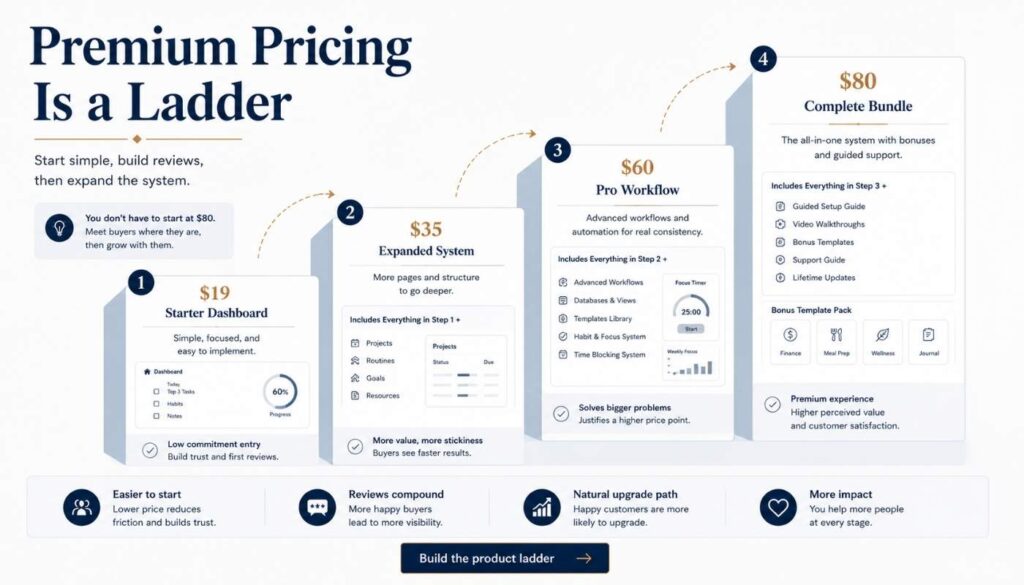
Instead of selling one template, stronger shops often created a ladder. Beginner. Intermediate. Pro. Each tier added more depth, more dashboards, more guidance, or more customization.
This works because buyers enter the market with different levels of trust.
Some are curious but cautious. They may buy the beginner version. Others already know they want a complete system and may choose the pro version. Some will buy the full bundle because the discount makes it feel like better value.
A tiered bundle might look like this:
| Tier | Suggested price | What it includes |
|---|---|---|
| Beginner | $19 to $29 | Simple dashboard, brain dump, daily planner |
| Intermediate | $35 to $49 | Daily planner, task system, habits, weekly reset |
| Pro | $60 to $80 | Full Life OS, walkthrough, examples, bonus dashboards |
This is a good strategy because it gives sellers more than one way to earn from the same idea. It also lets the buyer choose based on confidence and budget.
If you launch only one template, you may be leaving money on the table.
But the key is not to create fake tiers. Each tier has to feel meaningfully different. The pro version should not just have more pages. It should solve more of the buyer’s workflow.
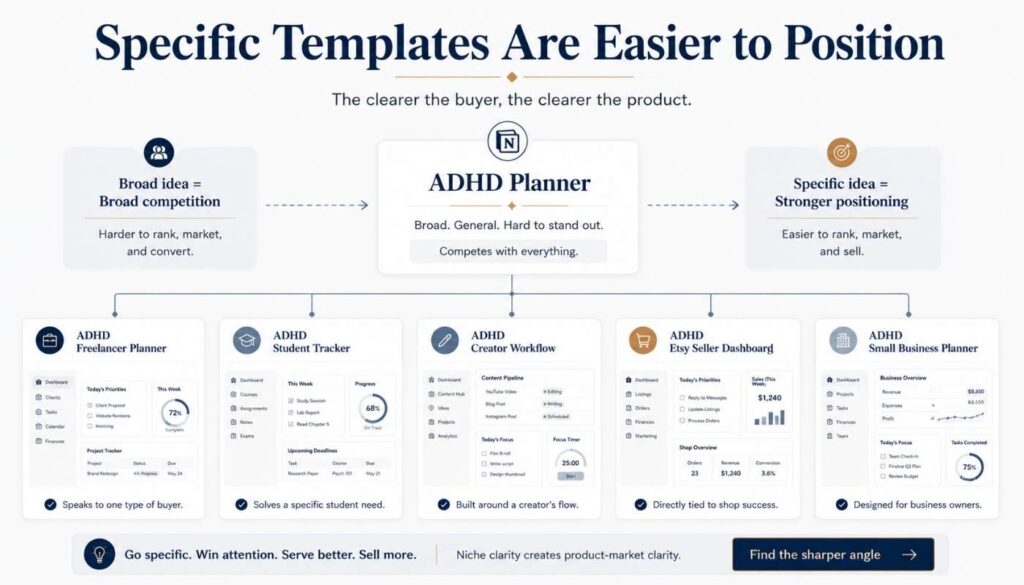
6. The Niche Specific ADHD Template
This is where I think the strongest long-term opportunity sits.
Generic ADHD productivity is already competitive. Niche-specific ADHD productivity is much more interesting.
I saw variations aimed at ADHD creators, entrepreneurs, students, freelancers, coaches, parents, and small business owners. This makes sense because ADHD affects planning differently depending on the buyer’s daily life.
An ADHD freelancer does not need the same system as an ADHD college student. An ADHD content creator does not need the same system as an ADHD parent managing household routines.
A niche-specific template can include sections that feel immediately relevant.
For an ADHD content creator, that might mean:
| Section | What it helps the creator manage |
|---|---|
| Content idea capture | Saves ideas instantly before they disappear into distraction |
| Script planning | Breaks video or podcast content into structured sections before recording |
| Posting schedule | Keeps publishing dates visible so content does not pile up unpublished |
| Pinterest workflow | Organizes pin creation, scheduling, and performance notes in one place |
| Sponsor notes | Tracks brand partnerships, deadlines, deliverables, and payment status |
| Digital product ideas | Stores product concepts with notes on audience, format, and next steps |
| Launch checklist | Ensures nothing gets skipped when publishing or launching a new product |
| Task parking lot | Holds tasks that cannot be done now so they are not forgotten or distracting |
| Low energy content options | Lists pre-approved content ideas for days when creative energy is low |
For an ADHD freelancer, that might mean:
| Section | What it helps the freelancer manage |
|---|---|
| Client tracker | Keeps all active and past clients organized with key contact and project details |
| Project deadlines | Surfaces upcoming due dates before they become urgent or missed |
| Proposal follow-ups | Logs sent proposals with follow-up dates so leads do not go cold silently |
| Invoice reminders | Tracks payment status and flags overdue invoices before they are forgotten |
| Weekly workload view | Shows all active work in one view so capacity does not get overcommitted |
| Admin task list | Separates business admin from client work so neither gets ignored |
| Energy-based task sorting | Matches tasks to current focus capacity so the right work happens at the right time |
| Must do today dashboard | Narrows the day to the highest priority tasks so nothing important gets buried |
This is exactly where MoneyCornucopia’s broader theme connects. The best digital products are often simple systems built for specific people with specific problems.
This also connects naturally to my article on custom GPT bots and AI workflow templates, because the underlying pattern is the same: people pay for systems that reduce friction and make repeated work easier.
7. The Self-Care or Wellness Planner
The self-care planner is a gentler category.
It does not usually have the highest pricing ceiling, but it can create a strong emotional connection.
These templates are usually positioned around support, reflection, and daily check-ins rather than aggressive productivity.
They may include:
| Section | What it supports |
|---|---|
| Mood tracking | Helps the user notice emotional patterns over days and weeks |
| Emotion check-ins | Creates a moment of self-awareness before diving into the day |
| Medication reminders | Reduces missed doses through simple visible daily prompts |
| Sensory overload notes | Gives a safe space to log triggers and plan low stimulation time |
| Hydration logs | Tracks a simple daily habit that is easy to forget when hyperfocused |
| Basic wellness routines | Keeps morning and evening anchors visible without rigid scheduling |
| Journal prompts | Guides reflection without requiring the user to start from a blank page |
| Self-compassion pages | Reframes setbacks gently so the user stays willing to return to the system |
| Low-pressure habit tracking | Logs progress without punishing missed days or creating guilt |
The key with this category is careful language.
A self-care planner should not claim to treat ADHD. It should support planning, reflection, and personal awareness. That is safer, more realistic, and more trustworthy.
The best versions feel gentle without becoming vague. They give the buyer a place to return to when life feels messy.
This category may also work well as a bundle add-on. For example, a seller could offer an ADHD task dashboard, then add a self-care reset pack as a bonus or upgrade.
That increases perceived value without turning the main template into a giant system.
Side-by-Side Comparison of All 7 Formats
Here is how the seven formats compare from a seller’s perspective.
| Format | Price range | Target buyer | Competition |
|---|---|---|---|
| Life OS or Second Brain | $35 to $80 | Power users, professionals, serious planners | High |
| Gamified Quest Planner | $25 to $45 | Young adults, overwhelmed planners, dopamine seekers | Low to medium |
| Color Coded Daily Dashboard | $20 to $40 | Notion beginners, overwhelmed users | High |
| ADHD Student Planner | $15 to $30 | Students, college learners, online learners | Medium |
| Tiered Bundle | $30 to $80 | Multiple buyer types at different trust levels | Medium |
| Niche Specific Template | $30 to $55 | Freelancers, creators, parents, coaches, entrepreneurs | Low to medium |
| Self Care or Wellness Planner | $20 to $40 | Buyers seeking gentle structure and low pressure planning | Medium |
The two most interesting opportunities are gamified quest planners and niche-specific ADHD templates.
The gamified planner has a strong visual appeal and clear differentiation. The niche-specific template has stronger business potential because it can target buyers with clearer problems and a higher willingness to pay.
If I had to choose one direction, I would combine both.
An ADHD quest planner for freelancers, creators, or Etsy sellers would be much more defensible than another generic ADHD life planner.
What I Noticed About the Buyers
If you want to build something that sells in this niche, you need to understand the buyer first.
After reading the listing copy, reviews, and product positioning, three patterns stood out.
1. ADHD Buyers Are Not Only Buying a Planner
Many buyers in this niche appear to be looking for hope that a system might finally feel usable.
That does not mean sellers should exploit that emotion. It means the product needs to be built with real care.
A regular planner says, “Organize your week.”
An ADHD friendly planner needs to say, “This is simple enough to come back to, even after you fall behind.”
That is a different promise.
2. ADHD Buyers Test Fast and Abandon Fast
This is one of the biggest product design lessons in the niche.
If the template takes too long to understand, the buyer may abandon it before getting value. That is why strong onboarding matters so much.
A good ADHD friendly Notion template should include:
What strong ADHD template onboarding includes
| 1 | A quick start guide showing the first three steps |
| 2 | A simple first action the buyer can complete immediately |
| 3 | Example pages showing the template already filled in |
| 4 | Minimal setup friction so the buyer can start within minutes |
| 5 | Clear navigation so no section requires hunting to find |
| 6 | A short walkthrough video explaining each main section |
| 7 | A reset page for when the buyer stops using it and wants to restart |
That last feature is very underrated.
A reset page acknowledges the real behavior pattern: people fall off systems. The product becomes more useful when it helps them restart without guilt.
3. ADHD Buyers May Buy More Than One System
This is important for sellers.
Many buyers in this space have tried several planners before. They may buy a daily planner, then a student dashboard, then a Life OS, then a self-care tracker. They are often searching for the system that finally clicks.
That means trust matters.
If a buyer likes your first product, there may be room for more products later. This is why product stacking works well in this niche.
A seller could eventually offer:
A sample ADHD product stack
| 1 | ADHD daily dashboard — entry level product |
| 2 | ADHD task sorting system — second offer |
| 3 | ADHD freelancer planner — niche specific upsell |
| 4 | ADHD self care reset kit — bundle add on |
| 5 | ADHD content creator workflow — premium offer |
| 6 | ADHD Life OS bundle — full system at top tier pricing |
That is how a narrow niche can still become a product ecosystem.
What Makes the Strongest ADHD Notion Templates Different
After reviewing the listings, five differentiators stood out.
1. Dopamine Mechanics. Reward shops, XP systems, progress bars, streaks, and quest language appeared in the more memorable products. These features create a sense of progress, which is important when ordinary task lists feel flat. The key is not to make the template childish. The key is to make progress feel visible.
2. Energy Matching. Some stronger templates included mood or energy-based planning. Instead of treating every task the same, they helped users match tasks to their current capacity. That might look like low-energy tasks, quick wins, deep focus tasks, admin tasks, social energy tasks, or creative tasks. This is useful because the problem is not always time. Sometimes the problem is energy.
3. Bad Day Protocols. This was one of the smartest features I noticed. A bad day protocol, minimum viable day page, or restart section makes the template feel realistic. It tells the buyer, “This system expects imperfect days.” That is much more useful than a planner that assumes perfect consistency.
4. Community Aware Language. The strongest listings used language that felt familiar without becoming condescending. Phrases like “done beats perfect,” “low pressure planning,” “brain dump,” “executive function support,” and “no judgment reset” fit the niche better than generic productivity language. If the copy sounds like a productivity coach scolding the buyer, it will not work. If it sounds like a calm system built by someone who understands the problem, it becomes much more compelling.
5. Aesthetic Flexibility. Some buyers want soft pastels. Others want dark mode, minimal neutrals, or bright color-coded zones. Offering multiple aesthetic options can increase perceived value without changing the core system. This is especially useful for Notion templates because visual comfort affects whether people actually want to return to the dashboard.
My Honest Take as Someone About to Enter This Market
I will be direct. The ADHD Notion template space is competitive.
You cannot win by making “another ADHD planner.” And you cannot start at premium pricing on day one if your shop has no reviews, no audience, and no proof of demand.
But the market is not closed.
The reason is that many listings still feel either too generic or too visually focused. A pretty dashboard is not enough. The stronger opportunity is building a template with a real philosophy behind it, even if you launch it at $15 to $25 first.
That is the lesson I keep coming back to.
In my article on why most people fail at passive income in 2026, I talked about how many people fail because they compete in the busiest part of the market without finding a sharper angle. This ADHD Notion research confirms the same idea.
The broad market is crowded.
The specific corners still have room.
My current plan would be an ADHD quest planner for freelancers or creators. I would launch the entry version at around $19 to $25 to gather reviews and feedback. Once I had social proof, I would build a fuller system priced around $45 to $65, and eventually a complete bundle at $70 to $80.
That feels more realistic than launching a giant $80 product from day one.
What I Would Build If Starting From Scratch Today
Here is the practical playbook I would follow.
First, I would choose one specific buyer inside the ADHD niche. Not “people with ADHD.” That is too broad. I would pick ADHD freelancers, ADHD students, ADHD content creators, ADHD Etsy sellers, or ADHD small business owners.
Then I would build around one clear philosophy. Maybe the product is dopamine-based. Maybe it is energy-based. Maybe it is built around bad day protocols. Maybe it is for people who constantly abandon planners and need a reset system.
The philosophy matters because it makes the template easier to explain.
Next, I would create a simple first version. I would not start with a huge Life OS. I would start with one narrow problem, such as:
“I keep forgetting what I was supposed to do next.”
That could become a task sorting dashboard with:
A simple task sorting dashboard might include
| 1 | Brain dump inbox |
| 2 | Today view with top three priorities |
| 3 | Energy based task filter for low and high focus days |
| 4 | Quick wins section for small fast tasks |
| 5 | Waiting list for tasks blocked by others |
| 6 | Rollover tasks that did not get done today |
| 7 | Weekly reset to clear and restart with a clean view |
| 8 | Bad day protocol for minimum viable action on hard days |
I would launch this first version at $19 to $29, not $50.
Then I would package it properly.
A strong ADHD Notion template should include:
Packaging checklist for a strong ADHD Notion template
| 1 | A quick start PDF explaining the first steps |
| 2 | A short walkthrough video covering each main section |
| 3 | Example pages showing the template already in use |
| 4 | A reset page for when the buyer falls off and wants to restart |
| 5 | A simple Notion duplicate link with clear instructions |
| 6 | Clear listing photos showing the template in a readable way |
| 7 | Before and after screenshots showing the problem and the solution |
| 8 | Pinterest friendly mockups for driving organic traffic |
The goal is not to make the system look impressive. The goal is to make the buyer think:
“This might actually be easy enough for me to use.”
That is the conversion point.
Finally, I would build a product ladder. The first template would be simple and affordable. The second tier would add more dashboards. The third tier would become the full system, eventually reaching that $60 to $80 premium range as the shop builds reviews and authority.
That is how you climb to the premium tier, honestly, instead of pretending to be there on day one.
Possible ADHD Notion Template Ideas Inspired by This Research
Here are the ideas I would consider first:
| Template idea | Best suited for |
|---|---|
| ADHD Quest Planner for Freelancers | Freelancers managing multiple projects who struggle with task prioritization |
| ADHD Brain Dump and Task Sorting System | Anyone overwhelmed by too many ideas with no clear place to put them |
| ADHD Friendly Daily Dashboard for Creators | Content creators who need a simple morning workflow without overwhelm |
| ADHD Student Assignment Tracker | College students managing deadlines, exams, and coursework simultaneously |
| ADHD Content Creator Workflow Dashboard | Bloggers and social creators planning content across multiple platforms |
| ADHD Weekly Reset Planner | People who start strong each week but lose momentum by Wednesday |
| ADHD Habit Tracker With No Shame Restarts | Buyers who have abandoned habit trackers before and want a forgiving system |
| ADHD Digital Product Idea Tracker | Etsy sellers and creators who generate ideas faster than they can act on them |
| Low Friction Life Admin Dashboard | Adults managing household tasks, appointments, and finances in one system |
| ADHD Project Planner for People With Too Many Ideas | Creative entrepreneurs who start projects easily but struggle to finish them |
The strongest ideas are not necessarily the biggest ones. They are the ones that solve a repeated problem the buyer already recognizes.
That is also why this topic connects well with 3 Reasons Your Side Hustle Still Isn’t Growing. Most side hustles do not only need motivation. They need better systems, clearer positioning, and more specific buyer problems.
This is the same reason small, strange digital products can sometimes work better than broad products. The clearer the problem, the easier it becomes to explain the value. I explored that idea more in 1 Strange Digital Product People Are Quietly Making Money With.
Frequently Asked Questions
Are ADHD Notion templates still profitable in 2026?
ADHD Notion templates can still be a profitable micro niche in 2026, especially for sellers who build specific, well-packaged systems rather than generic planners. The category has visible Etsy activity, active Notion marketplace listings, and buyer interest around an ADHD-friendly organization. That said, profitability is not guaranteed. Sellers still need strong research, good mockups, clear positioning, and steady traffic.
How much should I charge for an ADHD Notion template?
For a beginner seller with no reviews, the realistic starting range is $12 to $25 for a focused first template. This matches the typical Notion template market, which usually sits at $10 to $15.
Premium ADHD templates with strong positioning, branding, and reviews can eventually reach $30 to $80, but that pricing is the destination, not the starting line. Most new sellers should not launch at premium pricing without first building social proof and a small audience. Once you have reviews and traction, you can introduce a higher-tier version of your template.
What is the best platform to sell ADHD Notion templates?
Etsy is a strong starting point because people already search for digital planners and Notion templates there. Gumroad, Payhip, and the Notion Marketplace can also work as additional sales channels. The best approach is usually not relying on one platform. Etsy can help with search intent, while Pinterest and Instagram can help create discovery.
Do I need to have ADHD to create ADHD Notion templates?
No, but you do need to research carefully and use respectful language. Many strong creators in this niche have ADHD themselves, which can give them a more authentic voice. If you do not, you should study ADHD communities, read reviews, listen to buyer frustrations, and avoid making medical claims. The goal is to build a useful planning tool, not to present yourself as an ADHD expert.
How long does it take to make a sellable ADHD Notion template?
A focused first template could take two to four weeks if you already understand Notion. That includes research, template structure, design, testing, product photos, Etsy listing copy, a quick start guide, and a walkthrough video. If you are new to Notion, it may take longer.
How do you promote ADHD Notion templates?
A focused first template could take two to four weeks if you already understand Notion. That includes research, template structure, design, testing, product photos, Etsy listing copy, a quick start guide, and a walkthrough video. If you are new to Notion, it may take longer.
What features make an ADHD Notion template more likely to sell?
The strongest features I noticed were dopamine reward mechanics, energy-based task sorting, bad day protocols, quick start guides, simple navigation, and ADHD aware brand language. Multiple aesthetic options can also increase perceived value. The best templates reduce overwhelm rather than adding more complexity.
Is this a good beginner digital product niche?
It can be, but only if you niche down and price realistically. “ADHD planner” is already competitive. “ADHD quest planner for freelancers” or “ADHD student assignment tracker” is much more specific and easier to position. Beginners should avoid starting with a massive all-in-one dashboard at premium prices, and instead solve one painful problem very clearly at a fair entry-level price.
Final Thoughts
The ADHD Notion template space taught me one thing above everything else:
Competition does not always mean the door is closed.
Sometimes it means the broad version of the market is crowded, but the specific corners are still full of opportunity. The premium tier of any niche is also reachable, but it is a destination you climb toward, not a price you launch with.
That is what I see here. Generic Notion productivity templates are difficult. Generic ADHD planners are also getting crowded. But focused, thoughtful, ADHD friendly systems for specific buyers still have room, especially when sellers are patient enough to start at fair entry pricing and grow into premium positioning over time.
The shops that stood out were not only selling attractive dashboards. They were selling a philosophy. A way to restart. A way to reduce overwhelm. A way to make planning feel less punishing and more usable.
That is what beginner digital product sellers should pay attention to.
The real opportunity is not in copying the prettiest ADHD Notion template on Etsy. The opportunity is in understanding why buyers are searching for these templates in the first place.
They want less friction.
They want fewer decisions.
They want a system that does not collapse the first time they miss three days.
And in a crowded digital product market, that kind of clarity can still sell, even when you start at $19 instead of $79.
So if you are thinking about adding Notion templates to your Etsy shop in 2026, I would not start with another generic productivity dashboard. I would start with one specific buyer, one repeated problem, and one simple system that feels easier than starting from scratch. Launch it at a fair price. Build reviews. Then climb toward the premium tier as your authority grows.
That is where the opportunity still feels open.
Leave a Reply