Category: Money Basics

Simple explanations of everyday money concepts like compound interest, inflation, investing, and interest rates. No jargon, no fluff. Just the financial basics that help you make smarter decisions with your money over time.

  • Stocks vs. Bonds: Are You an Owner or a Lender?

    Stocks vs. Bonds: Are You an Owner or a Lender?

    We’ve all been there: sitting at a coffee shop or scrolling through news headlines, hearing people talk about “the market.” It sounds like a secret club with its own language. But when you strip away the jargon and the complex charts, investing really boils down to just two roles you can play in the economy.

    You are either an Owner or a Lender.

    Think of your money as a tool for building your future. To use that tool effectively, you need to understand the materials you’re working with. In the world of finance, those materials are Stocks and Bonds.

    One is built for speed and growth; the other is built for safety and stability. To build a portfolio that actually works, you have to decide which role fits your goals: the potential for high-speed growth or the comfort of a steady, predictable return.

    In this post, we’re breaking down the simple logic behind these two building blocks so you can decide exactly how to mix them for your own financial success.


    The “Lender” Role: How Bonds Work

    Imagine your neighbor wants to start a lemonade stand. They need $100 for supplies, but they don’t have it. You decide to help them out by becoming a Lender.

    When you buy a Bond, you are essentially giving a loan to a company or a government. In return, they give you a “I.O.U.” with a promise.

    • The Deal: You give them your $100 today. They promise to pay you back that $100 in exactly one year, plus an extra $5 as a “thank you” (interest) for letting them use your money.
    • The Safety Net: Even if the lemonade stand has a slow month, the neighbor is still legally obligated to pay you back your original $100 plus interest. This makes it a “Fixed Income” investment.
    • The Downside: Your profit is capped. If the lemonade stand becomes a massive success and makes $1,000, you still only get your $105 back. You don’t share in the extra glory.

    The “Owner” Role: How Stocks Work

    Now, imagine a different scenario. You don’t want to just lend money; you want to be a part of the business. You decide to become an Owner.

    When you buy a Stock, you are buying a tiny slice of a company. You own a piece of the “bricks and mortar.”

    • The Deal: You give the neighbor $100. In exchange, you now own 10% of the lemonade stand forever.
    • The Risk: There are no promises. If the lemons rot or no one is thirsty, the neighbor doesn’t owe you anything. You could lose your $100.
    • The Reward: Your potential is unlimited. If the lemonade stand expands into a nationwide chain, your 10% “slice” of the business grows with it. That $100 investment could eventually be worth thousands.

    Quick Comparison: Which One is Which?

    FeaturesBonds (The Lender)Stocks (The Owner)
    Main GoalPreservation & IncomeGrowth & Wealth
    PredictabilityHigh (You know what you’ll get)Low (It can go up or down)
    PriorityYou get paid firstYou get paid last
    The “Vibes”Calm and steadyExciting and bumpy

    The “Why” Behind the Choice

    Choosing between being an owner or a lender isn’t about picking a “winner.” It’s about picking the right tool for the job.

    When to be a Lender (Bonds)

    Bonds are for the “Defense” part of your game plan. You lean toward bonds when:

    • You need the money soon: If you’re buying a house in two years, you don’t want your down payment swinging 20% up or down in the stock market.
    • You prioritize sleep over excitement: If market volatility causes you physical stress, a higher bond count acts as a shock absorber for your emotions.
    • You want a steady “Paycheck”: Retirees often love bonds because they provide regular interest payments (called coupons) that act like a steady stream of income.

    When to be an Owner (Stocks)

    Stocks are for the “Offense.” You lean toward stocks when:

    • You have time on your side: If you’re 25 and won’t touch this money for decades, you can afford to let the “lemonade stand” go through a few rainy seasons because you know the sunny years will likely make up for it.
    • You want to beat inflation: If you just keep cash in a drawer, it loses value over time as prices go up. Stocks have historically been the best way to outrun the rising cost of living.
    • You want to participate in innovation: Being an owner means you profit from the world’s best ideas and hardest-working companies.

    The “Priority” Secret

    Here is one thing most people don’t realize: Lenders get paid first. If a company runs into trouble and has to close its doors, the law says they must pay back their debts (the Bondholders) before the owners (the Stockholders) get a single penny. This is why stocks are riskier—you are the last person in line to get paid, but if the company is a success, you get the biggest share of the pie.


    Finding Your Perfect Mix: Putting the Concepts Together

    Now that you know the difference between being an owner and a lender, the big question is: How much of each should you have?

    Finding the right mix is where the Risk-Return Tradeoff comes into play. As we’ve seen, you generally can’t have high returns without taking on the higher risk of ownership. Conversely, the safety of being a lender usually comes with lower growth.

    This is why Diversification is your best friend. By holding both stocks and bonds, you aren’t just “guessing”—you are building a balanced structure. When the stock market is volatile, your bonds act as the stabilizer. When inflation rises, your stocks act as the engine.

    The Traditional 60/40 Rule

    A clean 2D pie chart showing a 60/40 investment split: 60 percent in gold for stocks (owner) and 40 percent in navy for bonds (lender).

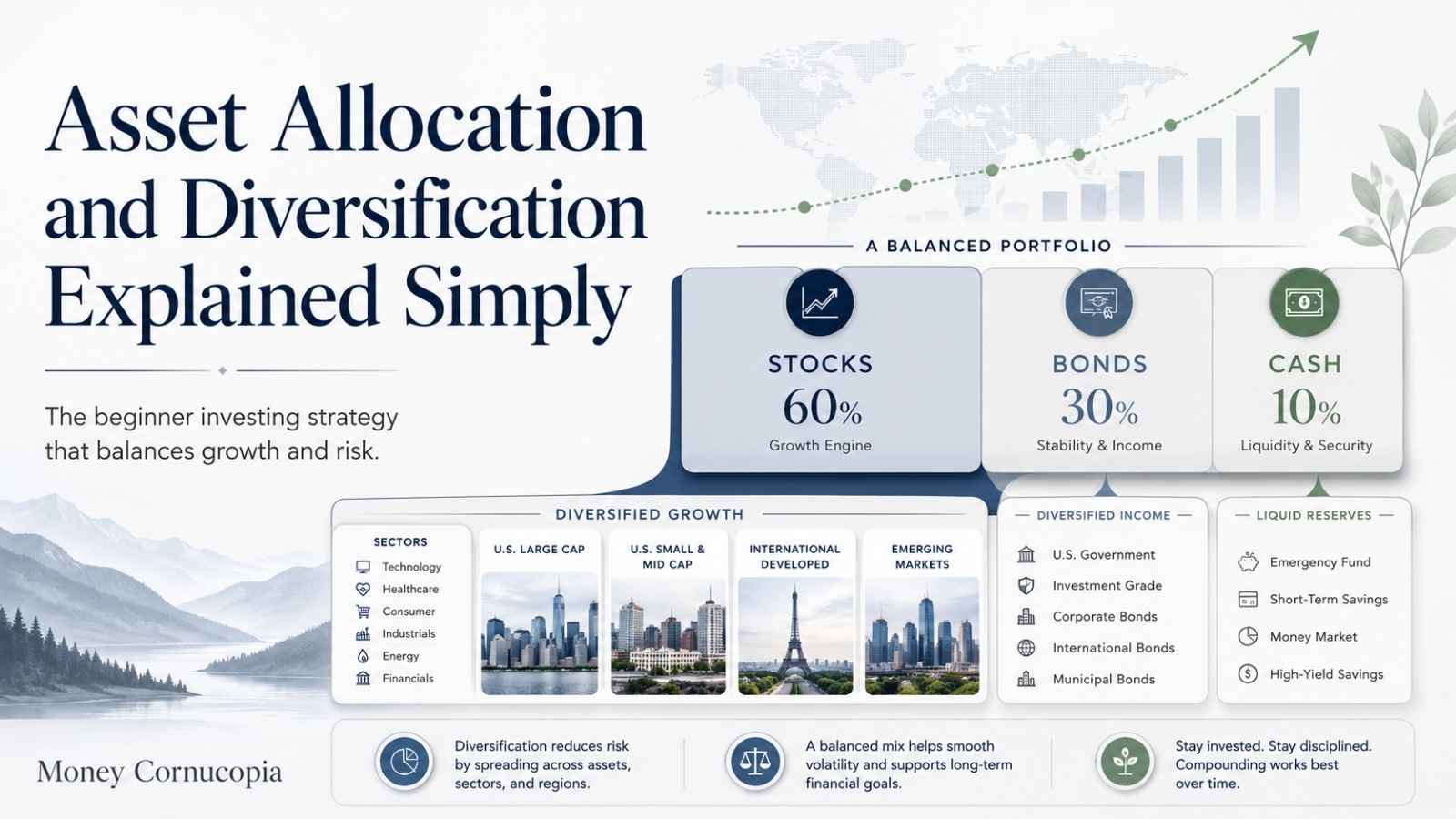
    For decades, many investors used a simple “Gold Standard”: 60% Stocks and 40% Bonds. * The 60% in Stocks provides the growth to build wealth.

    • The 40% in Bonds acts as the anchor, keeping the ship steady when the stock market gets stormy.

    The “Age” Shortcut

    A common rule of thumb is to “Subtract your age from 100.” The result is the percentage of your portfolio that should be in stocks.

    • Example: If you are 30 years old, you might hold 70% in stocks and 30% in bonds.
    • As you get older, you slowly shift more toward bonds to protect the wealth you’ve already built.
    A minimalist horizontal slider graphic showing a portfolio shift from gold (stocks) to navy (bonds) as an investor ages.

    Conclusion: Designing Your Future

    There is no “one size fits all” answer. The right mix depends entirely on your own timeline and your personal comfort with risk.

    Whether you choose to be a bold Owner chasing the next big innovation or a cautious Lender seeking steady security, the most important step is simply getting started. By understanding how these two building blocks work together, you are no longer just “playing the market”—you are an architect, intentionally designing a future that belongs to you.

    Frequently Asked Questions (FAQs)

    Which is better for beginners: stocks or bonds?

    There isn’t a “better” one, but most beginners start with a mix. If you are young and looking to grow your money over many years, you might lean more toward stocks. If you are nervous about the market and want to see how things work first, starting with bonds or a “balanced fund” can help you get your feet wet without the high drama of price swings.

    Can I lose all my money in bonds?

    It is much harder to lose everything in bonds than in stocks, but it isn’t impossible. This usually only happens if the company or government you lent money to goes bankrupt (called a “default”). This is why many people stick to “Government Bonds” or “Investment Grade” corporate bonds—they are considered much safer “lenders.”

    Do I have to pick individual stocks and bonds myself?

    Not at all! In fact, most people don’t. You can buy “bundles” of stocks or bonds through things like Mutual Funds or ETFs. This allows you to be an “Owner” or a “Lender” to hundreds of companies at once, which automatically helps with your Diversification.

    How often should I change my mix of stocks and bonds?

    You don’t need to check it every day. Most people review their mix once a year. As you get closer to a big goal (like retirement or buying a house), you might slowly move more money from the “Owner” side (stocks) to the “Lender” side (bonds) to lock in your gains and reduce risk.

    Do stocks and bonds always move in opposite directions?

    Usually, when the stock market goes down, bonds go up (or stay steady) because investors run to safety. However, this isn’t a perfect rule. There are times when both can go down at once, which is why having a clear plan and a long-term view is so important.


  • What is The Risk-Return Tradeoff: A Beginner’s Guide To Investing

    What is The Risk-Return Tradeoff: A Beginner’s Guide To Investing

    The Age-Old Question: Can I Get Rich Without Taking Risks?

    Every aspiring investor asks the same question: “How can I grow my money without the fear of losing it all?” It’s a natural instinct to seek safety, especially when it comes to your hard-earned cash. Yet, if you’ve ever looked at a savings account statement, you’ve probably felt that nagging doubt – your money isn’t really growing, it’s just sitting there. This brings us to one of the most fundamental concepts in finance: The Risk-Return Tradeoff.

    In this beginner’s guide, we’re going to demystify this critical relationship. You’ll learn why you cannot have high investment returns without accepting a certain level of uncertainty, and more importantly, how to navigate this balance to build a strategy that aligns with your comfort level. Forget complex jargon; we’ll break down the “cost of admission” to wealth building and show you how to make informed decisions about your money’s future. Ready to understand the core dynamic of investing? Let’s dive in.


    The “Price of Admission” to Wealth

    Think of the Risk-Return Tradeoff as a see-saw. On one side, you have your Potential Return (how much money you could make). On the other side, you have Risk (the chance that you could lose money or that things won’t go as planned).

    In the world of investing, these two are physically linked. You cannot push the “Return” side up without the “Risk” side rising as well.

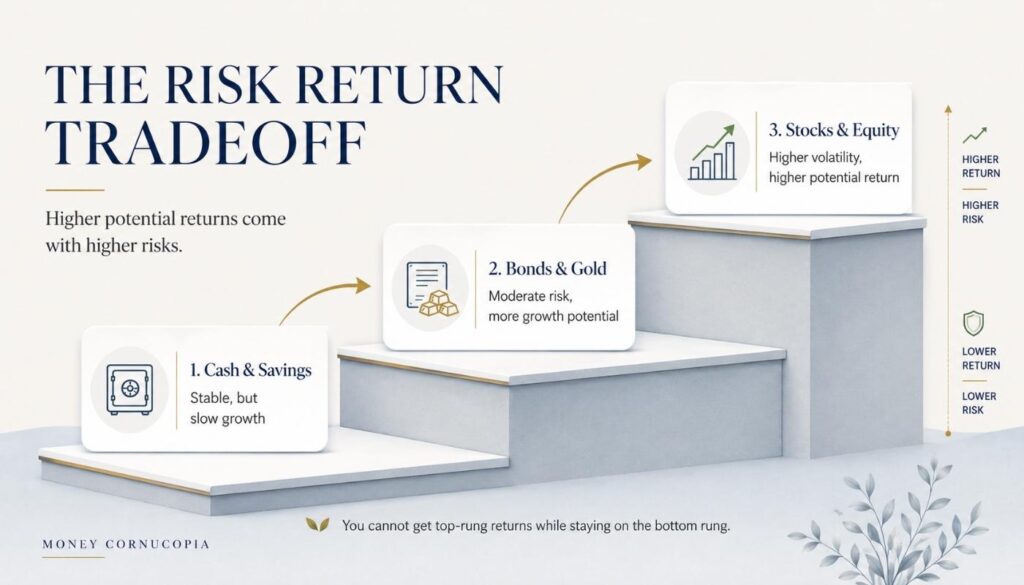
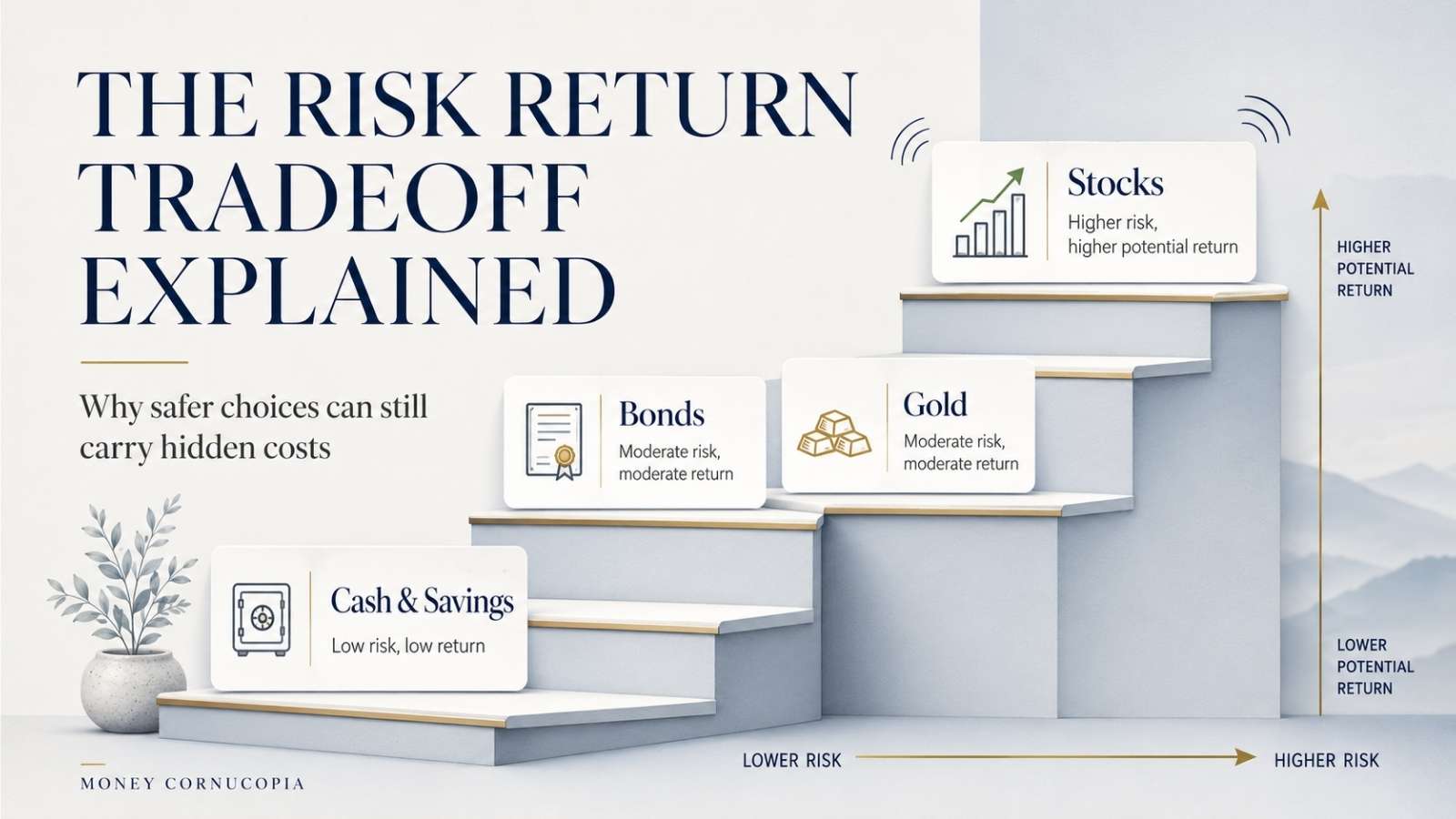
    The Three Levels of the “Ladder”

    To make this easy to understand, imagine your money is on a ladder. The higher you climb, the better the view, but the more the ladder shakes.

    • The Bottom Rung (Cash & Savings): Very sturdy. No shaking. But you’re barely off the ground. After inflation, you might actually be losing “buying power.”
    • The Middle Rung (Bonds): You’re higher up now. You can see more growth, but there’s a slight breeze. You’re lending money to a company or government for a steady “thank you” fee (interest).
    • The Top Rung (Stocks): The view is incredible. This is where real wealth is built. However, the ladder shakes when the wind blows (market volatility). To enjoy the view, you have to be okay with the shaking.

    Key Takeaway: Risk isn’t a “mistake” you made; it is the fee you pay for the opportunity to grow your wealth.

    Excellent. Now that the reader understands that risk is a “fee” for growth, we need to address the most practical question: “How much risk should I actually take?” This part of your syllabus—The Risk-Return Tradeoff—is personal. What is right for a 22-year-old isn’t right for a 65-year-old.


    Finding Your “Sleep at Night” Factor

    In the financial world, we call this your Risk Tolerance. It’s basically a measure of how much your investments can drop in value before you start panicking and want to sell everything.

    To find your balance, you need to look at two things:

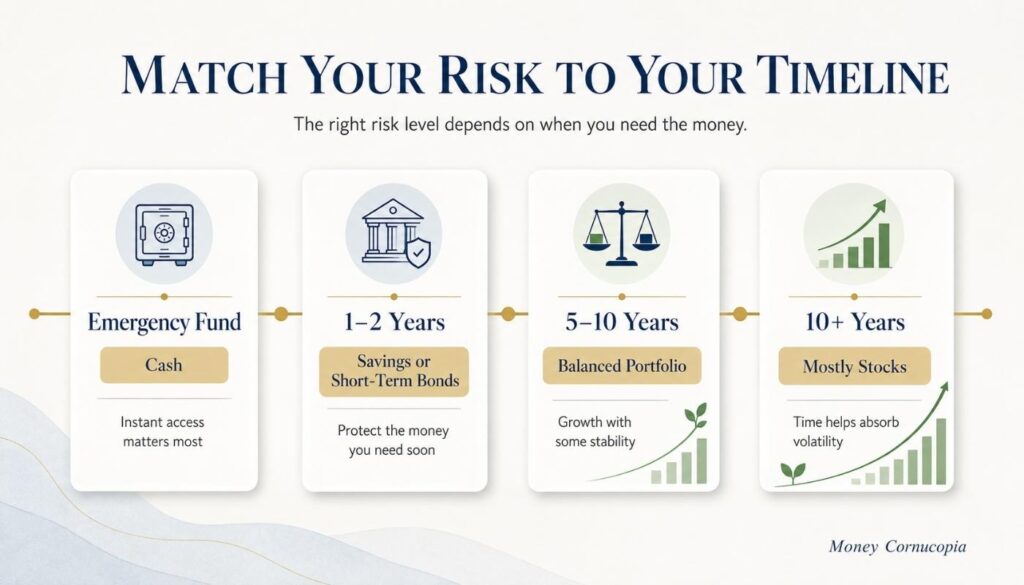
    1. Your Time Horizon (The “When”)

    This is the most important factor.

    • Long-term (10+ years): You can take High Risk. If the market crashes tomorrow, you have a decade for it to bounce back. You can afford the “zigzag” path.
    • Short-term (1-3 years): You should take Low Risk. If you need that money for a house down payment next year, you can’t afford a market dip today.

    2. Your Emotional Stomach (The “Who”)

    Imagine waking up and seeing that your $10,000 is now worth $8,000.

    • Do you say, “Great! Stocks are on sale, I’ll buy more!”? (High Risk Tolerance)
    • Or do you get a pit in your stomach and lose sleep? (Low Risk Tolerance)

    The “Golden Rule” of the Tradeoff

    The goal isn’t to take the most risk; it’s to take the right amount of risk to hit your goals without causing you to quit when things get bumpy.

    A split-screen illustration in navy and gold. On the left, a person sleeps soundly under a steady, straight navy growth line. On the right, a person tosses and turns in bed under a wild, jagged gold line, representing the emotional impact of high investment volatility on risk tolerance.

    Real-World Examples

    Let’s look at how this tradeoff looks in real life with three common “investing personalities”:

    • The “Safety First” Saver: Puts money in a high-yield savings account.
      • Risk: Near zero.
      • Return: ~4%.
      • The Catch: Might not keep up with the rising cost of living (inflation).
    • The “Balanced” Builder: Uses a mix of 60% stocks and 40% bonds.
      • Risk: Moderate.
      • Return: ~6-8% historically.
      • The Catch: Some ups and downs, but generally smoother.
    • The “Aggressive” Accumulator: Invests 100% in a Diversified Stock Index Fund.
      • Risk: High.
      • Return: ~10% historically.
      • The Catch: Must be prepared to see the “value” drop by 30% or more in a bad year.

    Excellent plan. A strong conclusion and an FAQ section are crucial for both reader retention and SEO. The FAQ can be a goldmine for long-tail keywords.

    A professional vector illustration of a minimalist dashboard dial on a navy blue background. The gauge features a color-coded spectrum from green to red, labeled "Low" and "High" to represent investment risk levels. A gold needle points toward the high-risk zone, visually illustrating the concept of risk tolerance in a wealth-building strategy.

    Conclusion: Your Personal Balance

    Understanding the Risk-Return Tradeoff isn’t about picking the riskiest investment possible. It’s about finding your personal sweet spot where your potential for growth meets your comfort level with uncertainty. Your financial journey is unique, and so should be your approach to risk.

    As you move through the “Architecture of Wealth” curriculum, remember that smart investing isn’t about avoiding all risk—it’s about understanding it, managing it, and using it strategically to achieve your long-term goals. Don’t let fear paralyze you, but also don’t let greed blind you. Find the balance that allows your money to work hard for you, while still letting you sleep soundly at night.


    Frequently Asked Questions

    What is the main difference between “risk” and “volatility” in investing?

    Risk is the chance of permanently losing your money or not achieving your financial goals. Volatility is simply how much an investment’s price goes up and down over a short period. A volatile investment isn’t always risky if you have a long time horizon; its price swings might just be temporary.

    Is there any investment with absolutely no risk?

    Almost none. Even cash in a bank account carries inflation risk (your money buys less over time) and, in very rare cases, bank default risk (though most countries have insurance like FDIC/FSCS). Every investment has some form of risk, however small.

    Does taking more risk always guarantee higher returns?

    No, it doesn’t guarantee anything. It only gives you the potential for higher returns. Sometimes, a high-risk investment can result in significant losses. The key is understanding that greater potential reward comes with greater potential for loss.

    How does my age affect my risk tolerance?

    Generally, younger investors with a longer time horizon (many years until retirement) can afford to take more risk because they have more time to recover from market downturns. As you get closer to needing your money, it’s wise to reduce your risk exposure to protect your capital.

    Can diversification reduce risk?

    Yes, absolutely! Diversification is often called the “only free lunch in finance” because it allows you to reduce non-systematic risk (the risk specific to one company or industry) without necessarily reducing your potential returns. By spreading your investments across different assets, you minimize the impact if one particular investment performs poorly.


    Key Takeaways: The Architecture of Risk

    If you only remember three things from this lesson, let it be these:

    • Risk is the “Price of Admission”: You cannot achieve high growth without accepting some uncertainty. If an investment promises “high returns with zero risk,” it is likely a scam.
    • Time is Your Best Friend: The longer your “Time Horizon” (how long you can leave the money alone), the more risk you can afford to take.
    • Personal Comfort Matters: The best investment strategy is the one you can stick to. If your portfolio is so risky that you can’t sleep, it’s time to rebalance.
  • Michael Saylor Turned $250 Million Into $59 Billion With One Rule. The Same Rule Works With $100.

    Michael Saylor Turned $250 Million Into $59 Billion With One Rule. The Same Rule Works With $100.

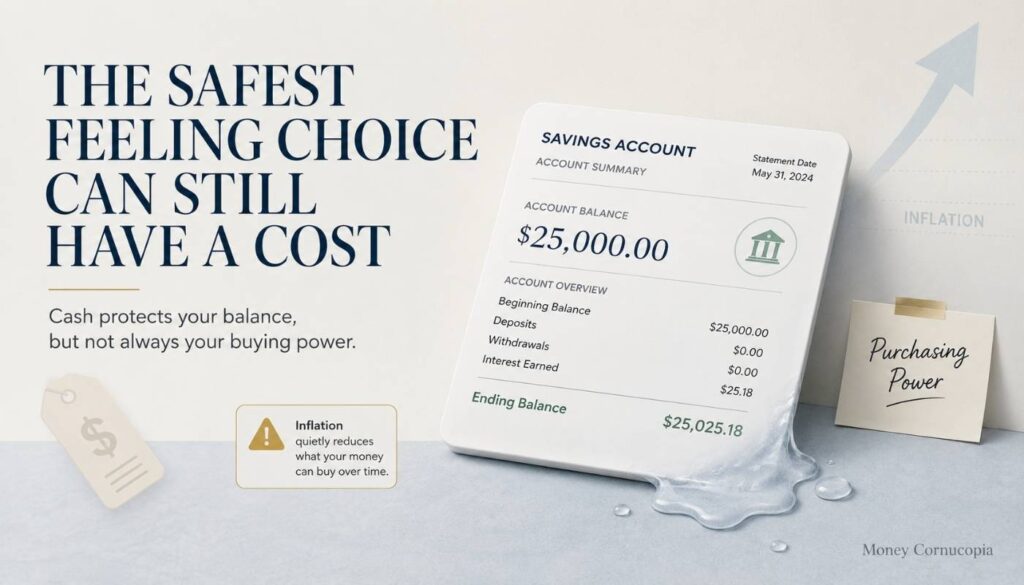
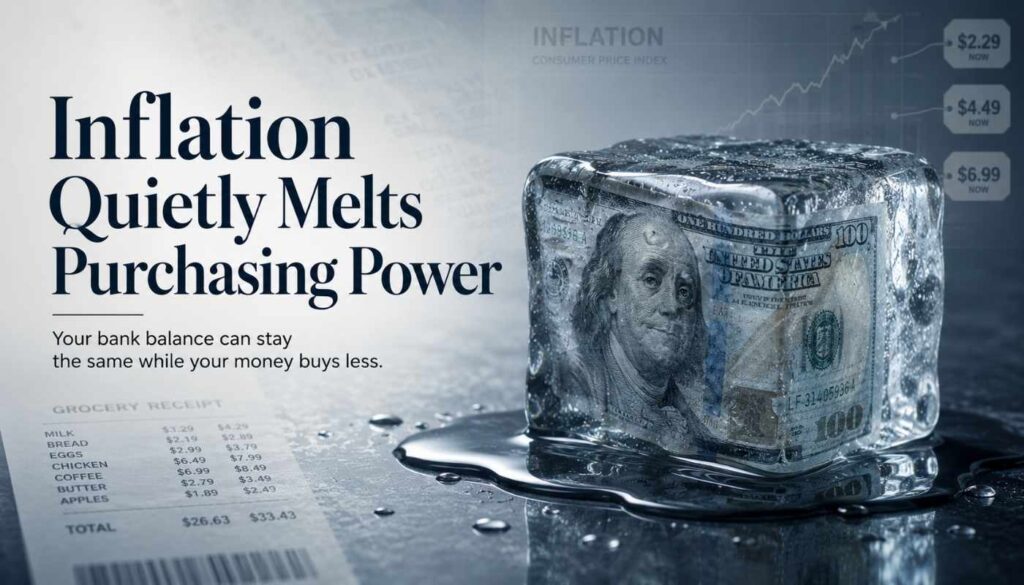
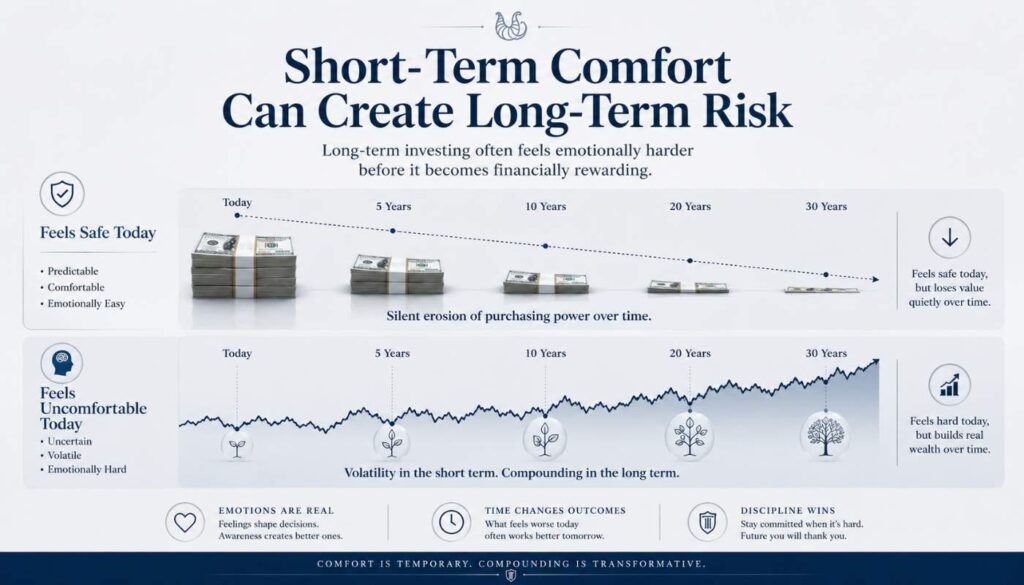
    Your cash is losing value right now. Not because you are spending it. Because inflation is quietly melting it away.

    Most people never think about this. They check their bank balance, see the same number, and assume their money is safe. It is not. Every year that inflation outpaces your savings interest, your purchasing power shrinks. Your balance stays flat. What it can buy does not.

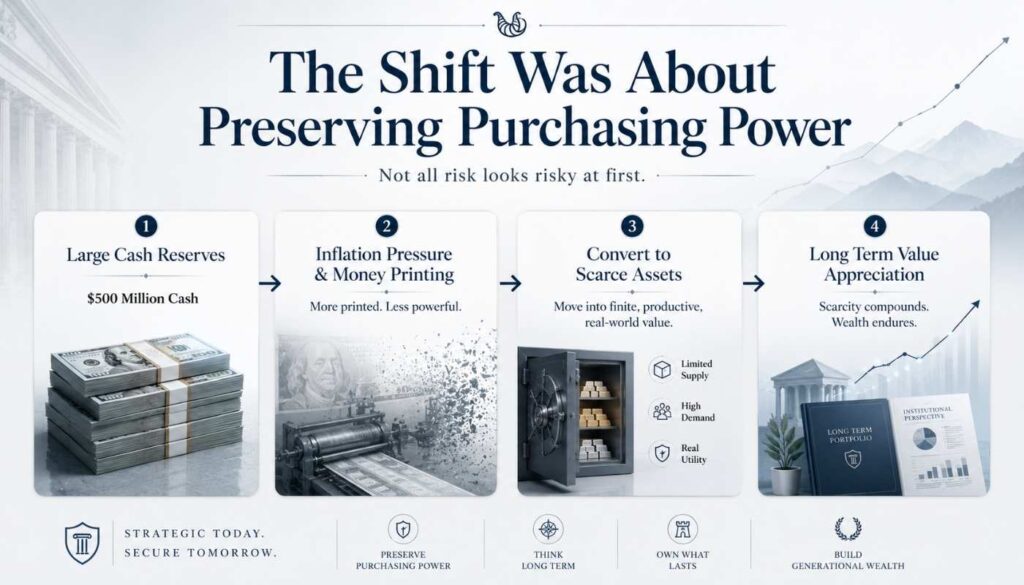
    Michael Saylor, the CEO of a software company called MicroStrategy, noticed this in 2020 when he realized his $500 million in cash reserves was losing roughly $75 million in real value every single year. His response was to apply one of the oldest principles in finance, move his money from a melting asset into a scarce one, and that decision turned $250 million into a fortune worth tens of billions.

    This article is not really about Bitcoin or about billionaires. It is about the one financial principle behind Saylor’s move, why that principle matters for your savings, and how the same rule works whether you have $500 million or $100.

    The Melting Ice Cube Problem

    Most people think of cash as safe. Saylor realized it was the opposite.
    Melting ice cube made of cash symbolizing inflation slowly reducing purchasing power

    Think of your cash as an ice cube sitting on a kitchen counter. Every hour, it melts a little. You cannot see the change minute by minute, but come back after a full day and a half, and the ice cube is gone.
    That is what inflation does to your cash. It does not disappear overnight. It melts slowly, quietly, consistently. A dollar today buys less than a dollar last year. A dollar last year bought less than a dollar five years ago.

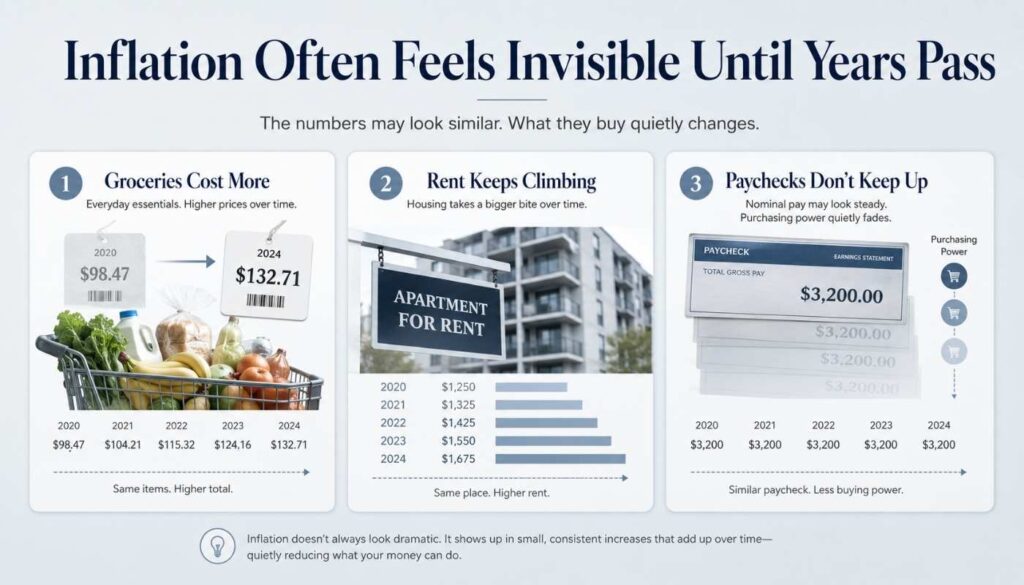
    If you have ever noticed that groceries cost more than they used to, or that rent keeps climbing, or that the same salary feels tighter than it did a few years ago, you have already felt the melting ice cube.

    Between 2020 and 2021, the Federal Reserve’s balance sheet nearly doubled as the government injected trillions into the economy to keep it afloat during the pandemic. I covered this concept in detail in my article on what inflation actually is and how it erodes your purchasing power. The short version is this: when governments print more money, each individual dollar becomes worth less. Your bank balance stays the same, but what it can buy quietly shrinks.

    Editorial finance infographic showing rising grocery prices rent increases and shrinking purchasing power

    Saylor understood this better than most. He calculated that his $500 million was losing roughly $75 million in real purchasing power every single year. Not because he was spending it. Because the dollar itself was becoming worth less.

    He called his cash a “melting ice cube.” And he decided to stop holding it.

    The One Rule Behind the $59 Billion Pivot

    The rule Saylor used is not new. It is one of the oldest principles in finance.

    It is called the Time Value of Money. The idea is simple: a dollar today is worth more than a dollar tomorrow, because today’s dollar can be invested and grow. But there is a flip side that most people miss.

    If you store your money in something that loses value over time (like cash during high inflation), you are going backwards. If you store your money in something that is scarce and holds or gains value over time, you are going forward.

    Saylor thought of money as a battery for storing time and energy. You work, you earn, you save. Those savings are stored energy. The question is, what container are you storing it in?

    A leaky container (cash that inflates away) drains your stored energy over time. A solid container (an asset with a limited supply that holds value) preserves or grows it.

    Comparison infographic showing leaking cash container versus growing asset container

    That is the entire insight. It is not complicated. It is not a secret Wall Street formula. It is a principle you can find in any introductory finance textbook. The difference is that Saylor actually acted on it when most people did not.

    What Saylor Actually Did

    In August 2020, Saylor made his move.

    When Bitcoin was trading around $10,000 per coin, he took $250 million of his company’s cash reserves and converted it into Bitcoin. His logic was straightforward. Bitcoin has a fixed supply of 21 million coins that can never be increased. The U.S. dollar has no supply limit and was being printed at record speed. In the long run, a scarce asset will hold value better than an unlimited one.

    But he did not stop at $250 million. He used three financial strategies to accelerate his position.

    Editorial finance diagram showing transition from cash reserves to long term scarce assets showing Michael Saylor strategy

    Strategy 1: Low-Cost Debt

    Saylor borrowed billions of dollars at extremely low interest rates, often near 0%. The money was cheap to borrow but expensive to hold as cash (because of inflation). So he converted the borrowed cash into Bitcoin immediately.

    This is a concept I covered in my article on the risk-return tradeoff. Higher potential returns come with higher risk. Saylor accepted the risk of Bitcoin’s price volatility in exchange for the potential of long-term appreciation. He calculated that the risk of holding melting cash was actually greater than the risk of holding a volatile but scarce asset.

    Strategy 2: Aggressive Compounding

    As Bitcoin’s value grew, Saylor’s company used the gains to raise more capital and buy more Bitcoin. This created a compounding effect where each purchase made the next purchase possible.

    This is the same principle that makes compound interest powerful for everyday investors. Whether you are compounding interest in a savings account or compounding asset growth in an investment portfolio, the math is the same. Growth builds on growth.

    Strategy 3: Patience Over Decades

    Saylor did not sell when Bitcoin dropped 50%. He did not sell when the media called him reckless. He did not sell when other companies abandoned their Bitcoin positions.

    He held on because he was thinking in decades, not days. The Time Value of Money works over long time horizons. Over 10 or 20 years, a scarce asset in a world of increasing money supply has a mathematical advantage. Saylor trusted the math.

    The Result

    By early 2026, Saylor’s company (now renamed Strategy) held over 600,000 Bitcoin worth tens of billions of dollars. The exact value changes daily with Bitcoin’s price, but the trajectory has been clear. What started as a $250 million bet became one of the largest corporate fortunes built in the 21st century.

    Why Most People Missed This Lesson

    This is not really a story about Bitcoin. It is a story about a financial principle.

    Most people missed Saylor’s lesson because they focused on the wrong part. They saw “CEO buys Bitcoin” and filed it under crypto speculation. What they missed was the underlying logic that applies to everyone.

    The logic is this: if you hold your savings in a form that loses value over time, you are falling behind even if your bank balance stays the same. If you move your savings into assets that hold or grow in value, you are moving forward.

    That does not mean everyone should buy Bitcoin. It means everyone should understand what their cash is actually doing.

    If your savings account pays 3% interest but inflation is running at 4%, your money is melting. Slowly. Quietly. Just like Saylor’s $500 million was melting before he acted.

    The asset you choose depends on your situation, your risk tolerance, and your timeline. It might be index funds. It might be real estate. It might be a diversified portfolio of stocks and bonds. The principle stays the same regardless of the asset.

    Stop storing your time and energy in a leaky container.

    What This Means If You Have $100

    You do not need $500 million for this rule to work. You need $100 and patience.

    The Time Value of Money does not care how much you start with. It cares how long you let it work.

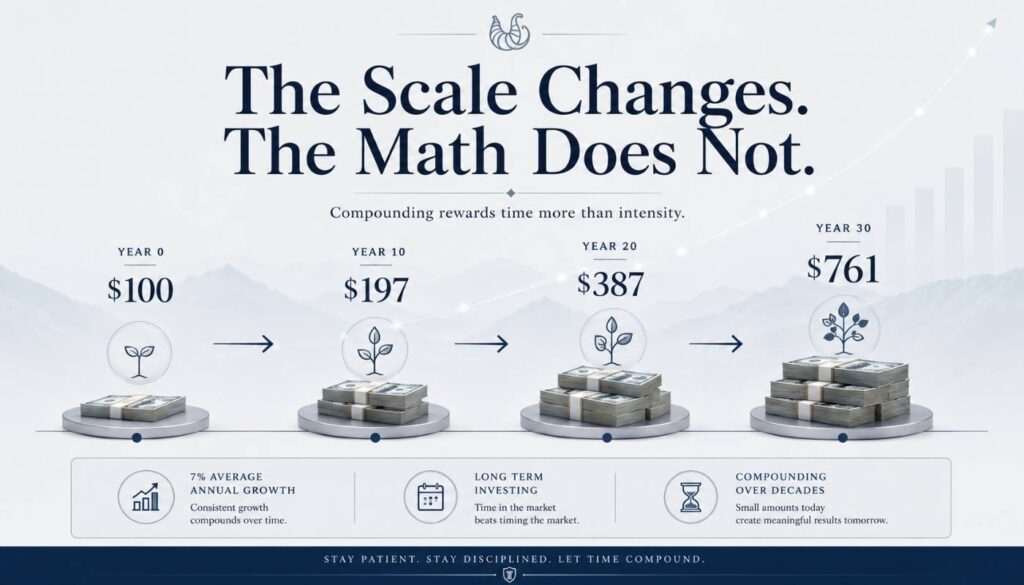
    Long term compounding timeline showing how 100 dollars grows over 30 years

    If you have $100 and you leave it in a regular savings account earning 1% while inflation runs at 3%, you are losing roughly $2 of real purchasing power every year. That is the melting ice cube at a small scale.

    If you take that same $100 and start investing it in an asset that grows at 7% per year on average (the long-term average return of a diversified stock portfolio), your $100 becomes roughly $197 in 10 years, $387 in 20 years, and $761 in 30 years.

    The numbers are smaller than Saylor’s. The math is identical.

    Saylor moved $250 million from a melting ice cube into a scarce asset. You can move $100 from a melting ice cube into a simple investment. The scale is different. The principle is the same.

    That is why this article is in the Money Basics section of this site. Not because everyone should copy Saylor’s exact strategy. But because the rule he used, the Time Value of Money, is the single most important concept in personal finance, most people ignore it until it is too late.

    If you want to understand this concept more deeply, I wrote a full breakdown in Time Value of Money for Beginners that explains it step by step without any jargon.

    Three Takeaways You Can Use Today

    Finance infographic comparing emotional safety of cash with long term investing growth

    1. Cash is a melting ice cube, not a safe haven.

    Holding cash feels safe. In the short term, it is. But over the years and decades, inflation quietly erodes its value. This does not mean you should have zero cash. It means you should understand that cash is for short-term needs, not long-term wealth building. Anything you do not need for the next 6 to 12 months should be working for you, not sitting still.

    2. Think in decades, not days.

    Saylor did not panic when Bitcoin dropped 50% in a single week. He was thinking 10 years ahead. The same mindset applies to any long-term investment. Markets go up and down in the short term. Over 10 and 20 year periods, disciplined investors who hold quality assets have historically come out ahead. The Time Value of Money rewards patience.

    3. The math does not require conviction. It requires action.

    Most people understood intellectually that inflation was eroding their cash in 2020. Very few actually did anything about it. Saylor did. The difference between knowing a principle and applying it is the difference between watching wealth build and watching it melt. You do not need to be certain. You need to start.

    Frequently Asked Questions

    What is the “melting ice cube” concept in finance?

    The melting ice cube is a metaphor for cash losing value over time due to inflation. Just as an ice cube slowly melts when left at room temperature, cash slowly loses its purchasing power when inflation outpaces the interest your savings earn. Michael Saylor used this concept to describe why holding $500 million in cash during a period of aggressive money printing was actually riskier than investing it.

    Is Michael Saylor’s strategy only about Bitcoin?

    No. The underlying principle is the Time Value of Money, which applies to all investing. Saylor chose Bitcoin because he believed it was the scarcest available asset during a period of rapid money printing. But the same principle (moving savings from depreciating containers into appreciating ones) applies to stocks, real estate, bonds, and other investment vehicles. The asset is the vehicle. The principle is the engine.

    Can a regular person use the same rule as Michael Saylor?

    Yes. The Time Value of Money works at any scale. Whether you invest $100 or $100 million, the math of compounding and purchasing power applies equally. The key is to move money you do not need in the short term out of cash and into assets that have the potential to grow faster than inflation over time.

    Is holding cash always bad?

    No. Cash is essential for short-term needs, emergency funds, and financial stability. The melting ice cube concept applies to long-term savings held in cash for years or decades. Financial experts generally recommend keeping 3 to 6 months of expenses in an accessible savings account. Beyond that, long-term savings benefit from being invested in assets that can outpace inflation.

    What is the time value of money in simple terms?

    The Time Value of Money means that a dollar today is worth more than a dollar in the future because today’s dollar can be invested and grow. It also means that a dollar in the future is worth less than a dollar today because inflation reduces what that future dollar can buy. This is the foundational concept behind all investing and the core principle Michael Saylor used to build his fortune.

    Final Thoughts

    Michael Saylor’s story is dramatic. A CEO staring at half a billion dollars in shrinking cash, making a bold move into an asset most people did not trust, and turning it into one of the largest corporate fortunes in modern history.

    But the lesson underneath the drama is not dramatic at all. It is quiet, simple, and available to everyone.

    Your cash is melting. Slowly. Quietly. Whether you have $500 million or $500. The question is not whether inflation is eroding your purchasing power. It is. The question is what you do about it.

    You do not need to buy Bitcoin. You do not need to make a $250 million bet. You need to understand that money sitting still is money moving backwards, and then take even one small step to move it forward.

    That is the rule. It works at $100. It works at $500 million. And it will keep working long after the headlines about Michael Saylor fade.

    If you are just starting to think about this, my guides on compound interest, inflation, and how to start investing with just $100 are good places to begin.

    The ice cube is melting. The only question is what you do next.

  • How to Use Asset Allocation & Diversification to Grow Wealth

    How to Use Asset Allocation & Diversification to Grow Wealth

    Imagine you are standing in a casino with your life savings in your pocket. A man in a suit approaches you and says, “I can give you a way to win more often, but here’s the catch: it also makes it much harder for you to lose everything.”

    In the world of gambling, that’s a scam. But in the world of professional finance, it’s a mathematical reality.

    Most people jump into the stock market like they’re throwing darts at a board—blindfolded. They buy a “hot stock” because a friend mentioned it, or they panic-sell when the news turns red. If you want to build a “Money Cornucopia” that lasts for decades, you don’t need luck. You need the Architecture of Wealth. This begins with the only “Free Lunch” in the financial world: Asset Allocation and Diversification.


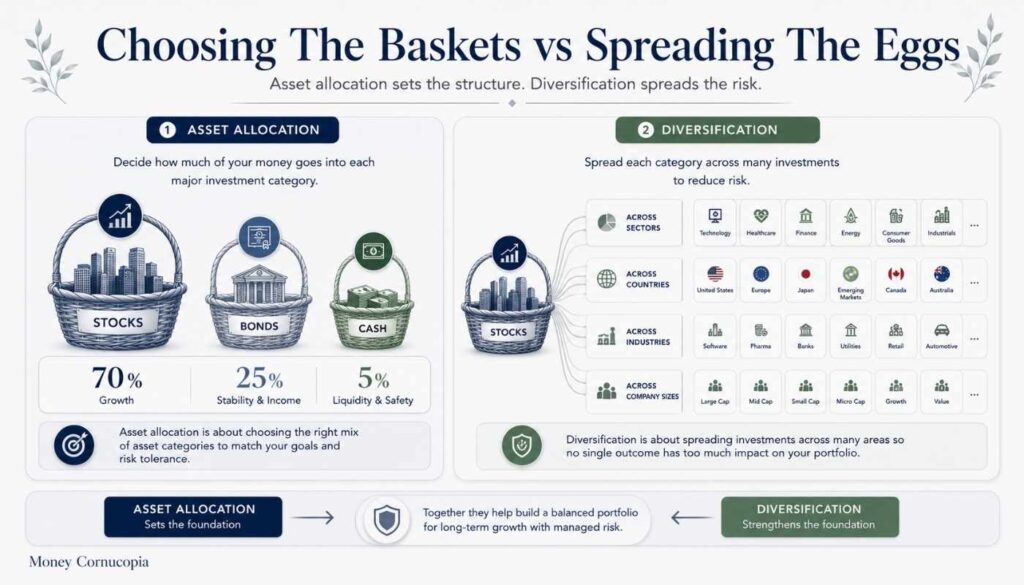
    The Blueprint: What is Asset Allocation?

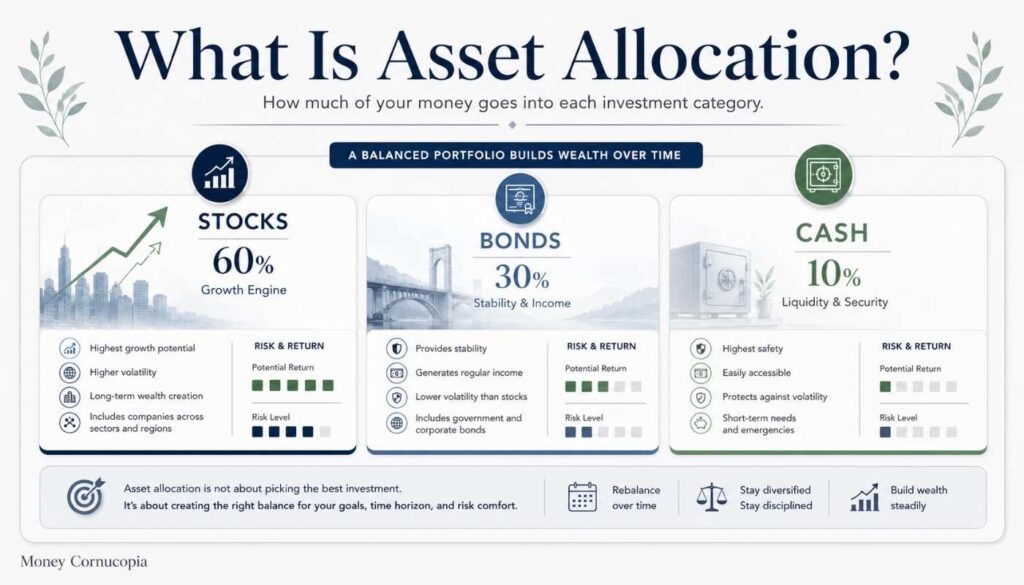
    Before you pick a single stock or buy a single bond, you have to decide on the Blueprint. Asset Allocation is the high-level decision of how you divide your “Investment Pie.” It isn’t about which specific company you buy; it’s about what category of assets you own. Think of your portfolio like a sports team:

    • Stocks (Equities) are your Offense: They go out and score points (growth). They are fast and exciting, but they can leave you vulnerable if the market turns aggressive.
    • Bonds (Fixed Income) are your Defense: They aren’t there to score; they are there to protect your lead. They provide steady, smaller returns to keep the game stable when things get rough.
    • Cash is your Bench: It’s ready to play when you need a timeout or when a sudden “sale” happens in the market.

    The Golden Rule: Studies show that your Asset Allocation—how much “Offense” vs. how much “Defense” you have—determines over 90% of your long-term investment results. It is the most important decision you will ever make as an investor.

    A world map with small pie chart icons over different continents, illustrating the concept of spreading investments across global markets to reduce risk. All about asset allocation

    Diversification: The “Eggs in a Basket” Strategy

    If Asset Allocation is choosing the right baskets (Stocks, Bonds, Real Estate), then Diversification is making sure you don’t put all your eggs in just one of them.

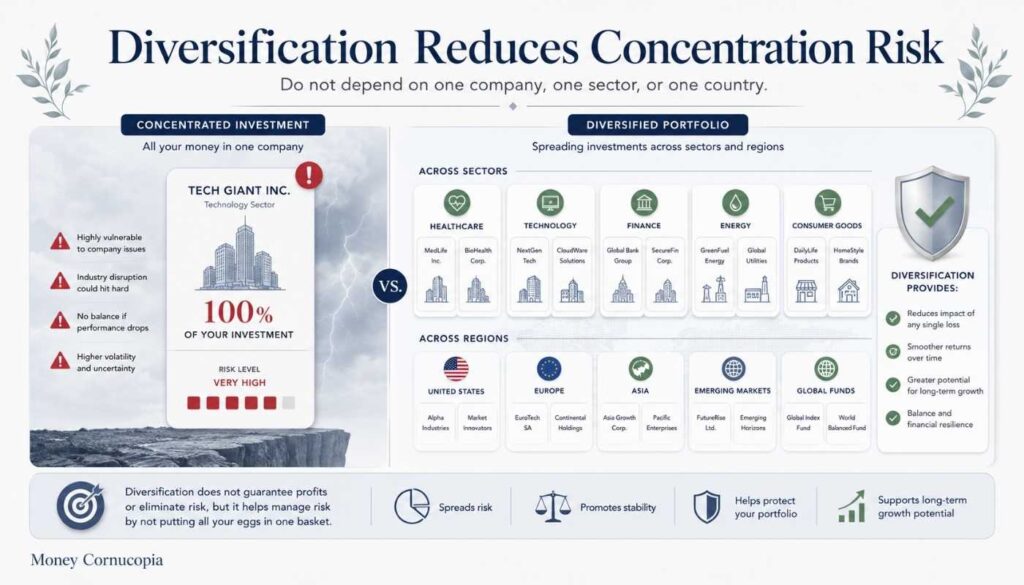
    Imagine you invest all your “Offense” money into a single technology company. If that company succeeds, you’re a hero. But if that specific company goes bankrupt or faces a scandal, your entire “Offense” is wiped out.

    Diversification solves this by spreading your money across hundreds of different companies, industries, and even countries.

    • By Sector: Don’t just own Tech; own Healthcare, Energy, and Consumer Goods.
    • By Geography: Don’t just own U.S. companies; own pieces of the economy in Europe, Asia, and Emerging Markets.

    When you are diversified, you stop cheering for a single “player” to win the game. Instead, you are cheering for the entire world economy to grow over time. Even if one company fails, the other 499 in your portfolio keep moving forward.

    A professional graphic showing multiple baskets labeled with different asset classes, like Real Estate and Tech, to visualize the "don't put all your eggs in one basket" rule.

    The Spectrum of Risk vs. Reward

    In the world of investing, there is a fundamental law: To get higher returns, you must be willing to accept higher risk.

    Understanding where you sit on this spectrum is the secret to staying invested when things get “scary.” If you take on too much risk, you’ll panic-sell during a market dip. If you take on too little, your money won’t grow fast enough to beat Inflation.

    Asset TypePotential RewardRisk Level The “Vibe”
    StocksHighHigh The Rollercoaster: Thrilling but bumpy.
    BondsModerateLow The Escalator: Slow, steady, and predictable.
    Cash/SavingsVery LowMinimalThe Couch: Very safe, but doesn’t go anywhere.

    To keep this post SEO-friendly, we will use clear subheadings (H2 and H3 tags), bold key terms, and focus on the “Search Intent” of someone looking for a strategy they can actually use.

    Here is the next section on balancing Risk vs. Reward.

    A minimalist seesaw diagram showing the relationship between investment risk and potential reward, used to explain financial trade-offs for beginners.

    How to Find Your Perfect Balance

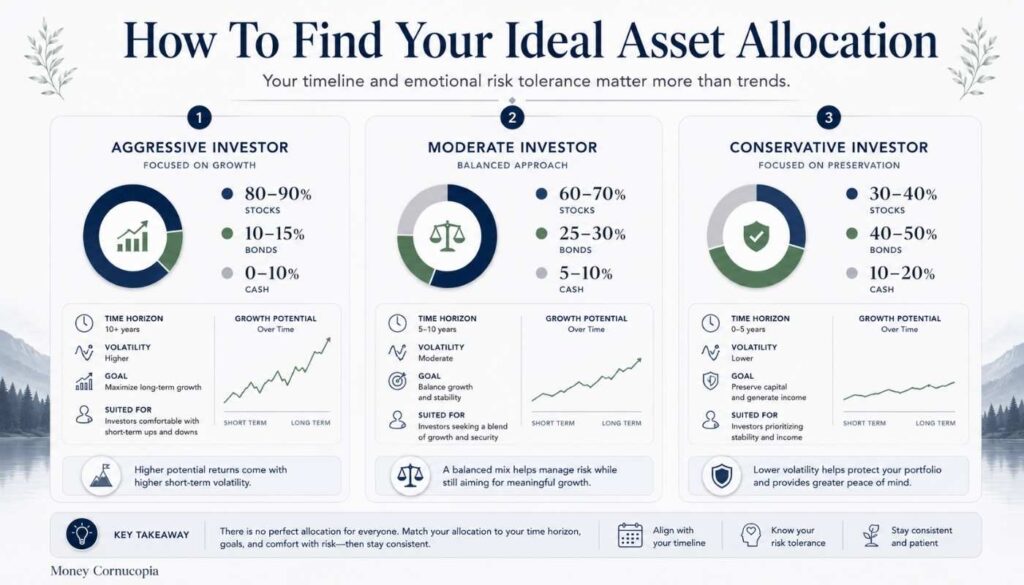
    Your “ideal” Asset Allocation isn’t a random guess. It is usually determined by two things: Your Time Horizon and Your Risk Tolerance.

    1. Your Time Horizon

    How soon do you need the money?

    • Long Term (10+ years): You can afford to have more “Offense” (Stocks) because you have time to wait out the market’s bad days.
    • Short Term (1-3 years): You need more “defense” (bonds/cash) because you can’t afford a market dip right before you need to spend the money.

    For those with a long-term horizon, the goal is to harness Compound Interest. By choosing a higher stock allocation, you give your ‘money tree’ more room to grow over decades.

    2. Your Risk Tolerance

    This is a “gut check.” How would you feel if you opened your account tomorrow and saw it was down 20%?

    • If you would be calm and see it as a “sale” to buy more, you have a High Risk Tolerance.
    • If you would lose sleep or want to sell everything, you have a Low Risk Tolerance.

    The Rebalancing Act: Keeping the Blueprint Intact

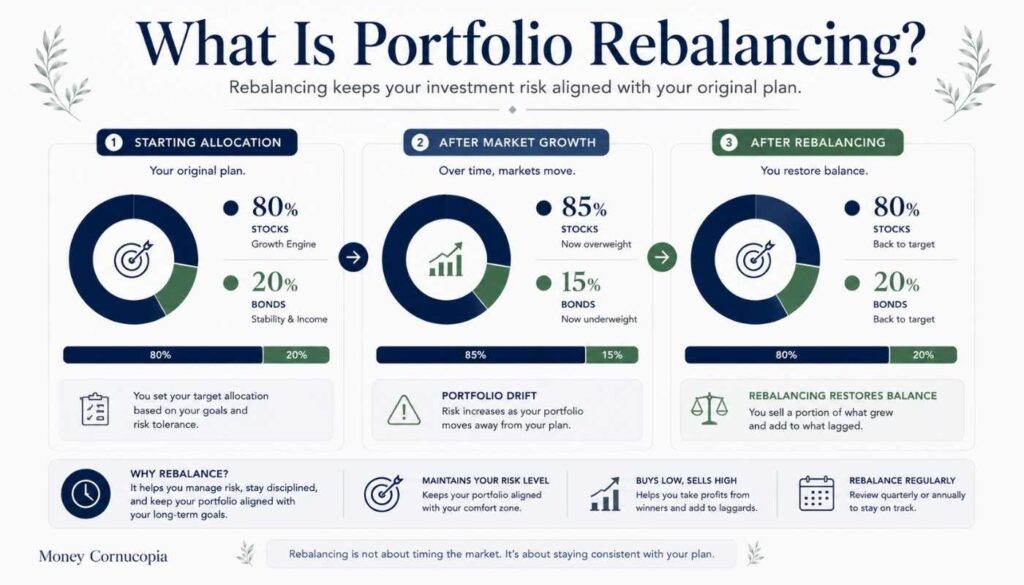
    Over time, your “Investment Pie” will change on its own. If stocks have a great year, they might grow from 60% of your portfolio to 80%. This makes your portfolio riskier than you intended.

    Rebalancing is the process of selling a bit of what has grown too large and buying more of what has lagged behind. This forces you into the most successful habit in investing: Buying Low and Selling High.

    Overview: The Architecture Summary

    • Asset Allocation is your big-picture blueprint (e.g., 70% Stocks, 30% Bonds).
    • Diversification is spreading the risk within those categories (not just one stock, but hundreds).
    • Risk vs. Reward is the balance you choose based on your goals and your “gut.”
    • Rebalancing is how you maintain your blueprint over time.

    Frequently Asked Questions (FAQs)

    Is diversification just for rich people?

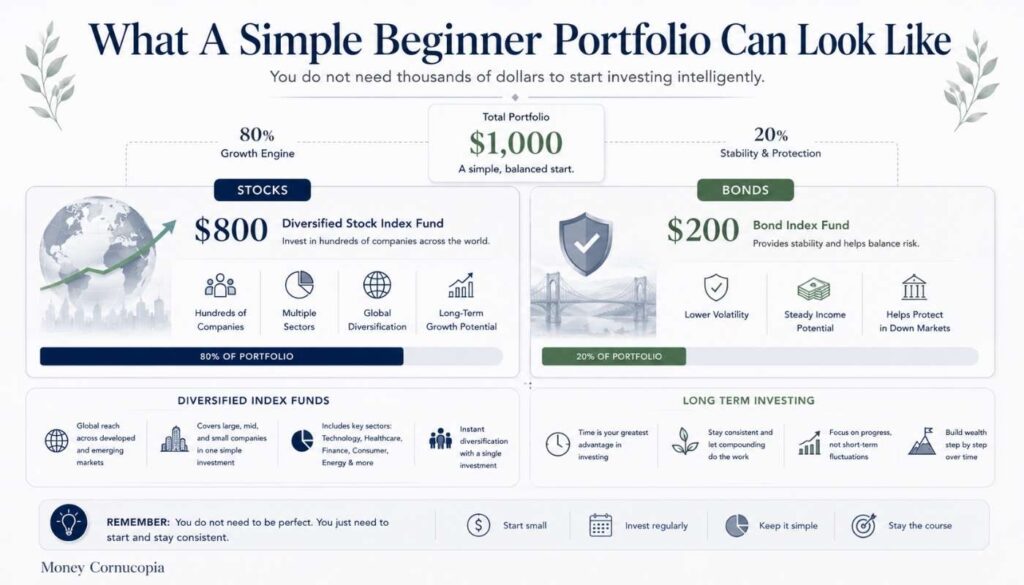
    Not anymore. Thanks to “Index Funds” and “ETFs,” you can own a diversified piece of the entire global economy with as little as $1.

    What is the “standard” asset allocation?

    A classic starting point for many is the “60/40 Portfolio” (60% Stocks, 40% Bonds). However, younger investors often lean toward 80% or 90% stocks for more growth.

    Does diversification guarantee I won’t lose money?

    No. Diversification protects you from the failure of a single company, but it cannot protect you from a general market decline. However, it ensures that when the market recovers, you are still in the game.

    How does Asset Allocation fit with the Time Value of Money (TVM)?

    Asset allocation ensures that your ‘future dollars’ have the best chance of outgrowing your ‘today dollars’ by balancing risk and return.”

    Conclusion: Your Financial Fortress

    By mastering Asset Allocation and Diversification, you have moved from “guessing” to “architecting.” You are no longer betting on a single horse; you are betting on the track itself. You have built a fortress that can withstand market storms while still capturing the growth of the global economy.

    Now that you have your blueprint, it’s time to look at the actual tools we use to build it.

  • What is Opportunity Cost? The Hidden Price of Every Choice

    What is Opportunity Cost? The Hidden Price of Every Choice

    Have you ever felt like a $100 purchase actually cost you much more than $100? If you’ve been following our “Money Cornucopia” curriculum, you already know that Inflation makes your money shrink over time. But there is another “hidden price” that affects every single decision you make: Opportunity Cost.

    In the world of finance, every time you choose to do one thing with your money, you are automatically choosing not to do something else.

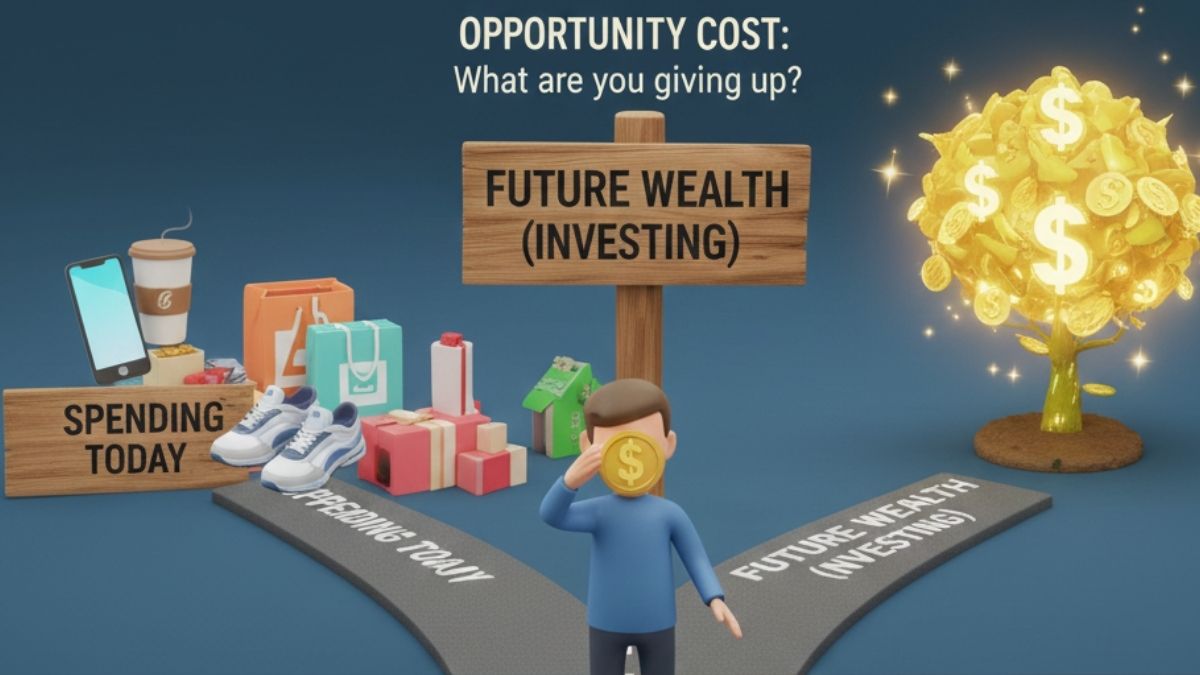
    A person standing at a fork in a road choosing between a path to immediate spending and a path to long-term wealth growth, illustrating the concept of opportunity cost.

    What is Opportunity Cost?

    Think of every dollar you own as a traveler standing at a fork in the road. It can only go down one path. If you send that dollar down “Spending Street” to buy a coffee, it can never go down “Investment Avenue” to earn Compound Interest.

    Opportunity Cost is simply the value of the “path not taken.” It is the benefit you give up when you choose one option over another.

    Why It Matters for Your Wealth

    Most people only look at the price tag when they buy something. But a “Beginner’s Guide to Financial Logic” requires you to look at the Time Value of Money (TVM).

    • The Price Tag: $1,000 for a new TV.
    • The Opportunity Cost: The $5,000 that $1,000 could have become in 20 years if it had been invested instead.

    When you understand this concept, you stop asking, “Can I afford this?” and start asking, “Is this the best use for this dollar right now?”

    A 3D illustration of a person holding a coffee cup while a translucent ghost version of themselves points to a growing investment chart, symbolizing the hidden opportunity cost of daily spending.

    Real-World Examples: The Price vs. The Potential

    To master the Foundations of Financial Logic, you have to train your brain to see what isn’t there. Here are three common scenarios:

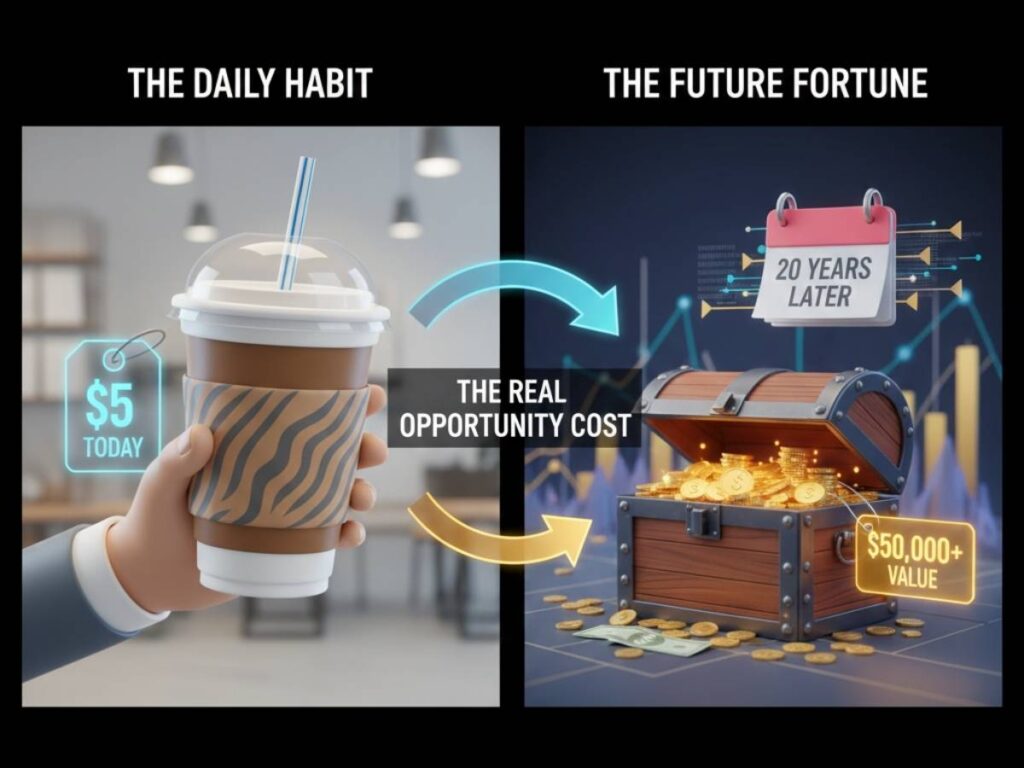
    1. The “Daily Treat” vs. The “Future Fortune”

    Imagine you spend $5 every work day on a premium coffee.

    • The Price Tag: $5.
    • The Opportunity Cost: That $5 per day (about $100 a month) could be put into an investment account. Using Compound Interest, that $100 a month could grow to over $50,000 in 20 years.
    • The Lesson: You aren’t just “buying a coffee”; you are choosing to “not have $50,000” later.
    A split-screen comparison showing a $5 cup of coffee today next to a treasure chest representing the $50,000 it could become in 20 years through compound interest.

    2. The New Car vs. The Used Car + Investment

    Suppose you are deciding between a brand-new car for $40,000 or a reliable used car for $25,000.

    • The Choice: Buying the new car.
    • The Opportunity Cost: The $15,000 difference. If you invested that $15,000, the Time Value of Money (TVM) tells us it would be worth much more in the future.
    • The Lesson: The “cost” of the new car smell is the thousands of dollars in lost growth from that $15,000.

    3. Time: Your Most Limited Resource

    Opportunity cost isn’t just about cash; it’s about your time.

    • The Scenario: Spending 4 hours driving across town to save $20 on a grocery deal.
    • The Opportunity Cost: What else could you have done with those 4 hours? You could have learned a new skill, rested, or worked a side hustle.
    • The Lesson: If your time is worth $25/hour, you just “spent” $100 worth of time to save $20. You actually lost $80!

    How to Calculate Opportunity Cost

    You don’t need a complex calculator for this. Just use this simple mental formula:

    Opportunity Cost = (Value of the Best Option NOT Chosen) – (Value of the Option Chosen)

    If the number is high, you might want to rethink your decision!

    The Trap: Sunk Cost vs. Opportunity Cost

    One reason people struggle with Opportunity Cost is a mental trap called the “Sunk Cost Fallacy.”

    A “Sunk Cost” is money or time you have already spent and cannot get back. Most people keep pouring money into a bad investment or a broken car because they “already put so much into it.”

    • The Sunk Cost Mindset: “I have to finish this expensive meal even though I’m full because I already paid for it.”
    • The Opportunity Cost Mindset: “I already paid for the meal, but if I keep eating, I’ll feel sick and lose my afternoon productivity. My time and health are more valuable than the ‘cost’ of leaving food on the plate.”

    By focusing on the path ahead (the Opportunity Cost) rather than the money already gone (the Sunk Cost), you make much smarter choices.

    A person in a rowboat unable to move toward a sunny island because they are held back by a heavy anchor labeled Sunk Cost, representing past financial mistakes.

    Opportunity Cost in Your Career and Lifestyle

    It isn’t just about what you buy at the store. It affects your biggest life milestones in Semester 1:

    • The “Stay or Go” Career Move: If you stay in a job that pays $50,000 when you could be making $70,000 elsewhere, your “Opportunity Cost” is $20,000 a year. Is the comfort of your current job worth $20,000?
    • Education: Choosing to go to college for four years means you aren’t earning a full-time salary during those years. The “cost” of the degree is the tuition plus the four years of lost wages.
    • Renting vs. Buying: If you put $50,000 into a down payment for a house, the opportunity cost is what that $50,000 could have earned in the stock market (our next topic in Semester 2!).

    Your “Opportunity Cost” Checklist

    Before you make your next big financial move, ask yourself these three simple questions:

    1. What am I giving up? (If I buy this today, what can I not buy or invest in tomorrow?)
    2. Is there a better “Future Use” for this money? (Think back to the Compound Interest lesson—would this $100 be better as $1,000 in the future?)
    3. Am I deciding based on the past or the future? (Avoid the Sunk Cost trap!)

    At a Glance: The Opportunity Cost Summary

    If you only have 30 seconds, here is what you need to know:

    • Definition: Opportunity cost is the value of what you give up when you make a choice.
    • The Concept: Every dollar and every hour can only be spent once. If you choose Path A, the “cost” is everything you would have gained from Path B.
    • Why it Matters: It helps you move beyond looking at “price tags” and starts you thinking about “potential growth”.
    • The Goal: To ensure the path you do choose provides more value than the one you leave behind.

    Frequently Asked Questions (FAQs)

    Is opportunity cost the same as a financial loss?

    No. A loss is when you actually lose money you already had. Opportunity cost is a “hidden” cost because it represents the profit or benefit you could have had but didn’t get because you chose a different path.

    Is opportunity cost always about money?

    Not at all. In our blog, we emphasize that time is your most valuable asset. The opportunity cost of watching 3 hours of TV might be the sleep you didn’t get or the book you didn’t read.

    How do I know if an opportunity cost is “too high”?

    If the “next best alternative” (like investing in the stock market) would have given you a significantly better long-term result than your current choice, the opportunity cost is high. This is why we link this concept to Compound Interest.

    Can I avoid opportunity cost?

    No. Because resources (time and money) are limited, every single choice has an opportunity cost. The goal isn’t to avoid it, but to be aware of it so you can make the best choice possible.

    Mastering the Foundations

    Understanding Opportunity Cost marks the completion of your first semester in the Architecture of Wealth. You now have the four essential “mental models” to view the world like a pro:

    1. TVM: You know money has a time dimension.
    2. Compound Interest: You know how to multiply that money.
    3. Inflation: You know how to protect that money from shrinking.
    4. Opportunity Cost: You know how to choose the right path for every dollar.

    By looking at life through these lenses, you are no longer just a “spender”—you are an architect of your own wealth. You are ready to stop worrying about what things cost today and start focused on what your life can become tomorrow.

  • What is Inflation? A Beginner’s Guide to Purchasing Power

    What is Inflation? A Beginner’s Guide to Purchasing Power

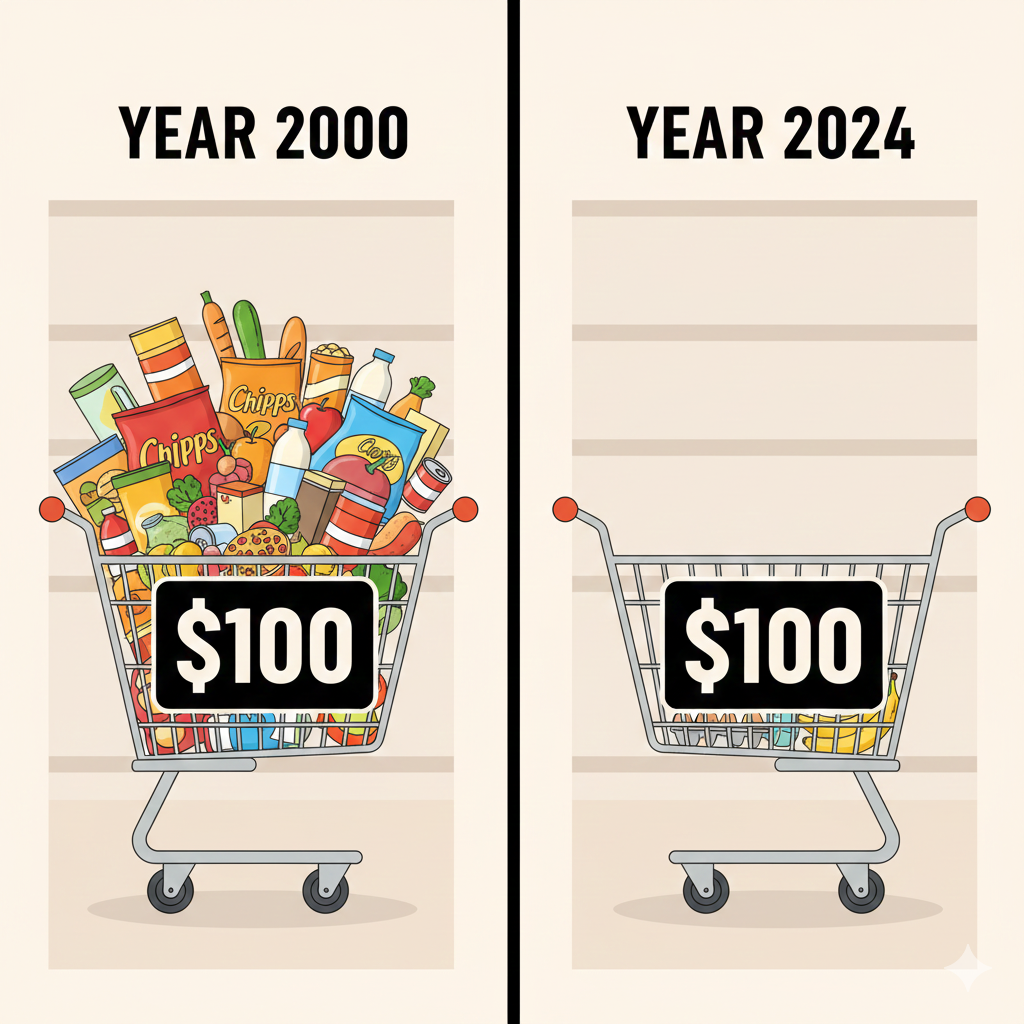
    Have you ever walked into a grocery store and felt like your $100 bill just doesn’t buy as much as it used to? You aren’t imagining things. That “shrinking” feeling has a name: Inflation.

    At Money Cornucopia, we believe you shouldn’t need a PhD in Economics to understand your wallet. If Compound Interest is the “Engine” that builds your wealth, then Inflation is the “Invisible Thief” trying to take a piece of it.

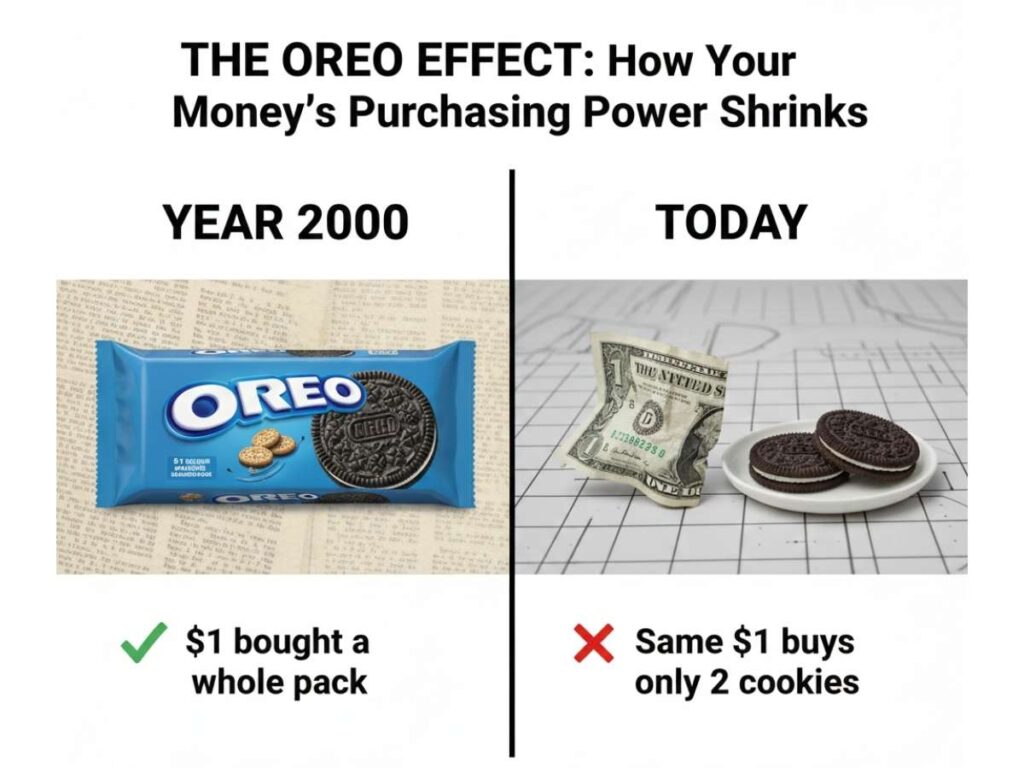
    The Oreo Cookie Example

    To understand inflation, let’s look at everyone’s favorite snack: The Oreo.

    Imagine it is last year, and you have $1.00. You walk into the store, and one pack of Oreos costs exactly $1.00. Your dollar has the “power” to buy that whole pack.

    Now, let’s fast-forward to today. You go back to the same store with the same $1.00 bill. But now, the price of Oreos has gone up to $1.10.

    • What happened? The Oreos didn’t get bigger. The cream didn’t get thicker.
    • The Reality: Your dollar didn’t change its shape, but it lost its Purchasing Power. It can now only buy about 90% of that pack of cookies.
    A side-by-side comparison showing a 1 dollar bill buying a full pack of Oreo cookies in the year 2000 versus the same 1 dollar bill buying only two single cookies today.

    Why Does This Matter?

    Inflation is simply the rate at which the general prices for goods and services rise. When inflation goes up, every dollar you own buys a smaller percentage of a good or service.

    This is why just “saving” money in a jar or a basic bank account can actually be risky. If your money is sitting still while prices are moving up, you are technically getting poorer every year.

    How Do We Measure Inflation? (The Giant Shopping Basket)

    If the price of Oreos goes up, is that “Inflation”? Not necessarily. Sometimes just one thing gets expensive because of a bad harvest or a factory issue.

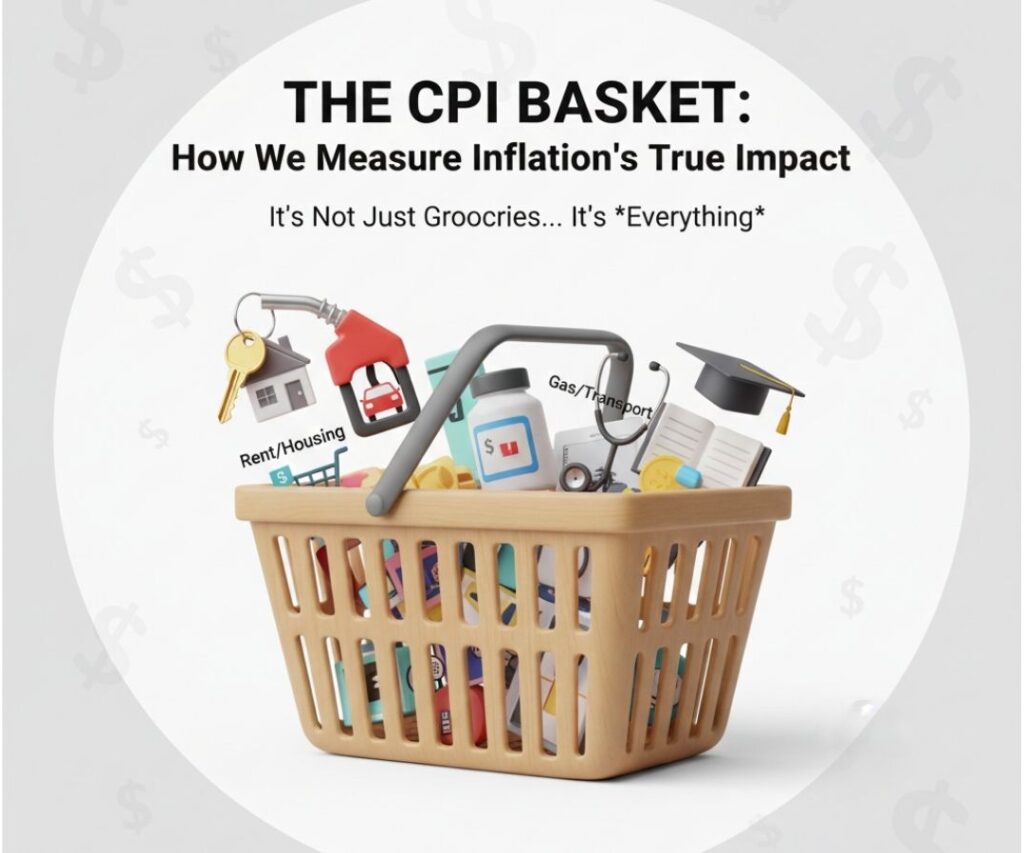
    To measure real inflation, economists don’t just look at one cookie; they look at a Giant Shopping Basket filled with everything a normal person buys in a month.

    What is the CPI (Consumer Price Index)?

    The Consumer Price Index, or CPI, is basically a monthly “receipt” for this imaginary basket. Every month, the government checks the prices of hundreds of items, including:

    • Groceries: Bread, milk, and eggs.
    • Energy: The gas in your car and the electricity in your home.
    • Shelter: What it costs to rent an apartment or pay for a house.
    • Services: Things like haircuts, car repairs, and doctor visits.

    How it works (The Math made Simple):

    Imagine the “Basket of Goods” cost exactly $1,000 last year. If that same basket costs $1,030 today, then the Inflation Rate is 3%.

    Think of it this way: The CPI is like a thermometer for the economy. If the “temperature” (price) of the basket is rising too fast, the economy has a fever!

    A 3D illustration of a wooden grocery basket representing the Consumer Price Index (CPI), containing traditional food items mixed with a house key for rent, a gasoline pump nozzle for fuel, and a medical stethoscope to show how inflation tracks the total cost of living.

    Is Your Savings Account Actually Losing Money? (The Real Return)

    Most people feel happy when they see their bank account balance go up. If you have $1,000 and the bank gives you $10 in interest, you feel richer, right?

    But here is the “Harvard-level” secret: To know if you are actually getting richer, you have to look at the Real Return.

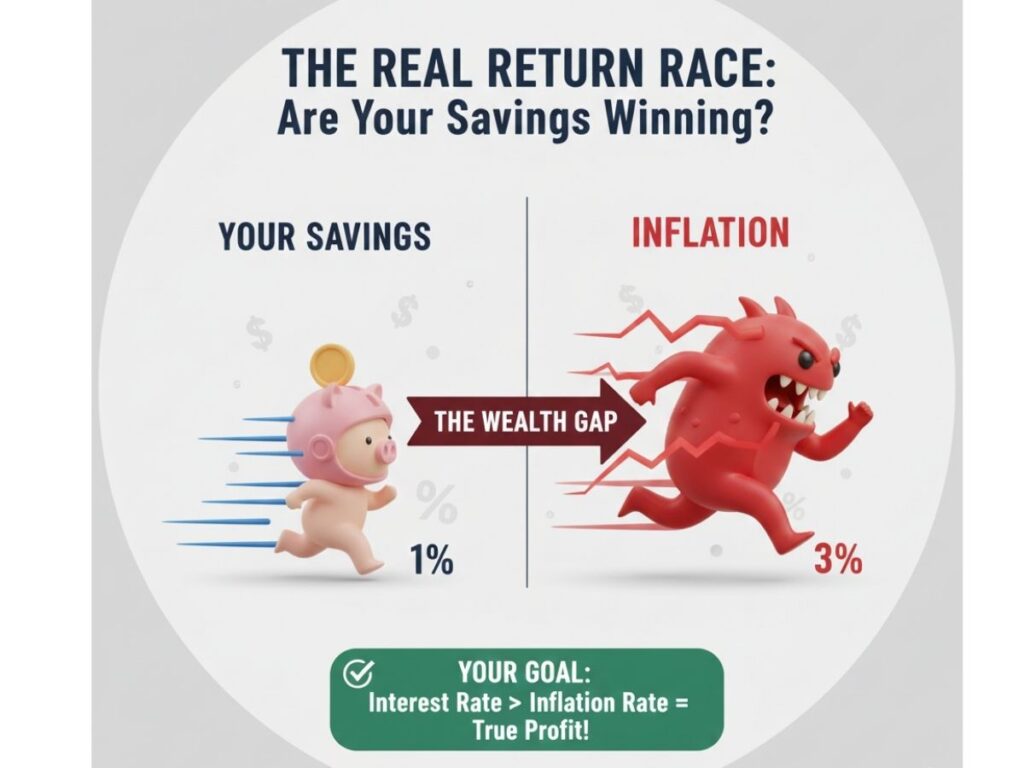
    The Race: Interest vs. Inflation

    Think of your money like a runner in a race.

    • Interest is how fast your money is running forward 🏃‍♂️.
    • Inflation is how fast the finish line is moving away from you 🚩.

    If your money runs at 2 miles per hour, but the finish line moves away at 3 miles per hour, you are actually getting further away from your goals!

    The “Back-of-the-Napkin” Formula:

    You don’t need a fancy calculator for this. Just use this simple subtraction:

    Your Interest RateThe Inflation Rate = Your Real Return

    Example:

    1. Your bank pays you 1% interest.
    2. Inflation (the cost of stuff) goes up by 3%.
    3. 1% – 3% = -2%

    Even though your bank account balance looks bigger, you can actually buy 2% less stuff than you could last year. You are “losing” money even while you’re “saving” it.

    An infographic of a race track where a character representing 'Savings' is running slowly at 1% interest, while a character representing 'Inflation' is sprinting ahead at 3% speed, showing the gap in wealth.

    How to Use This to Build Your “Cornucopia”

    This is exactly why we talk about investing. To build true wealth, you need to find places to put your money where the growth is higher than the inflation rate.

    If inflation is the “Thief,” then a high Real Return is your “Security Guard.”

    How to Build Your “Inflation Shield”

    Now that you know the “Invisible Thief” is out there, how do you stop him? You can’t stop inflation across the whole country, but you can protect your own Money Cornucopia.

    Here are three simple ways to keep your purchasing power strong:

    1. Don’t Keep Too Much “Idle” Cash: While having an emergency fund is smart, keeping all your money in a jar or a 0% savings account is a slow way to lose wealth.
    2. Invest in Productive Assets: Historically, things like Stocks (owning a piece of a company) and Real Estate (owning land) tend to grow faster than inflation over the long term. As prices go up, companies charge more and rents rise, which protects your value.
    3. Invest in Yourself: Your skills and your ability to earn an income are “inflation-proof.” If you are a great plumber or a skilled programmer, your “price” (your salary) will usually go up along with the cost of living.

    Wait! Why can’t the government just print more money?

    It’s the most logical question in the world: “If prices are going up and people are struggling, why doesn’t the government just print more cash and give it to everyone?”

    It sounds like a magic fix, but there is a golden rule in finance: Money is only a “coupon” for stuff. If you print more coupons without making more “stuff” (like bread, cars, or houses), the coupons simply become less valuable.

    The Island Auction Example 🏝️🥖

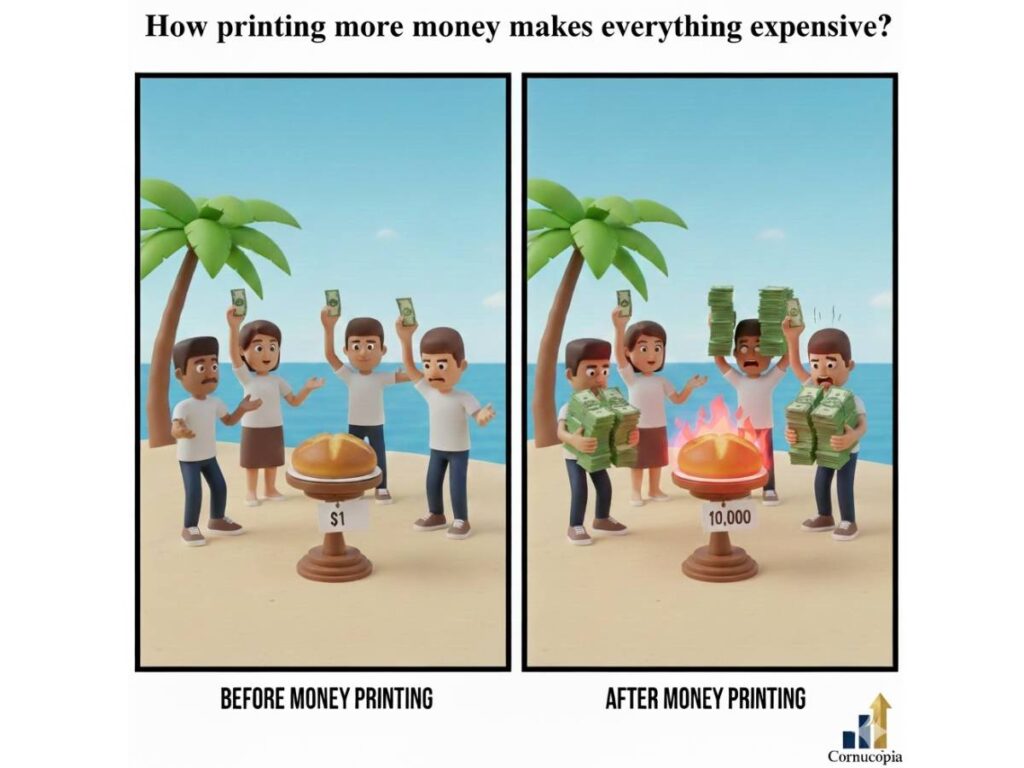
    Imagine you are on a small island with 10 people. There is only one loaf of bread left for sale.

    • Scenario 1: Everyone on the island has exactly $1. When the auction starts, the highest anyone can bid is $1. The price of bread stays at $1.
    • Scenario 2: A helicopter flies over and drops $1,000 for every person. Everyone feels “rich!” But when the auction for that same loaf of bread starts, everyone bids higher and higher because they have so much cash. Suddenly, that same loaf of bread sells for $1,000.
    A two-panel comic of an island auction. Panel one shows five people with 1 dollar bidding on bread priced at 1 dollar. Panel two shows the same people with 1,000 dollars bidding on the same bread now priced at 1,000 dollars.

    The Result: You have 1,000 times more money, but you still only have one loaf of bread. You aren’t richer; the money just lost its “oomph.”

    When a government prints too much money too fast, it’s like that helicopter drop. It leads to Hyperinflation, where prices move so fast that money becomes practically worthless.

    Frequently Asked Questions

    Is inflation always a bad thing?

    Not necessarily! A little bit of inflation (usually around 2%) is considered healthy for the economy. It encourages people to spend and invest their money rather than just sitting on it.

    Why don’t we just stop printing money to stop inflation?

    It’s a balancing act. If the government stops the money flow too suddenly, it can cause “Deflation,” which can lead to businesses closing and people losing jobs. The goal is a “Goldilocks” economy—not too hot, not too cold.

    How often is inflation measured?

    In the U.S., the Bureau of Labor Statistics releases the CPI (Consumer Price Index) report every single month.

    What is the best thing to own during high inflation?

    Historically, “Hard Assets” like real estate or diversified index funds (stocks) have been the strongest “shields” against a rising cost of living.

    Why can’t the government just print more money to stop poverty?

    Printing money doesn’t create more “stuff” (like food, clothes, or houses); it only creates more “paper.” If everyone has more money but the amount of goods stays the same, prices simply skyrocket to match the new amount of cash. This is called Hyperinflation, and it actually makes poverty worse because prices rise faster than people can spend.

    Does my savings account beat inflation?

    Usually, no. Most basic savings accounts pay very low interest (like 0.01% or 1%). If inflation is at 3%, you are technically losing 2% of your wealth every year. This is why we focus on Real Return.

    Key Takeaways: Putting it All Together

    • Inflation is the “Value Thief”: It is the steady increase in prices over time, which means your money loses “purchasing power.”
    • The TVM Connection: Inflation is the reason why the Time Value of Money (TVM) matters so much; a dollar today is worth more than a dollar tomorrow because today’s dollar hasn’t been “shrunk” by inflation yet.
    • Beating the Race: To grow your wealth, your Compound Interest rate must be higher than the inflation rate. If inflation is 3% and your bank pays 1%, you are technically losing money!
    • Invest to Protect: Investing is the “Shield” that helps you maintain your lifestyle, ensuring that your future self can still afford the same basket of goods you buy today.

    Don’t Let the “Invisible Thief” Win! 🛡️

    Now that you know how inflation works, it’s time to decide how you’re going to fight back. Are you growing your wealth, or is the thief taking a bite out of your savings every single month?

    Join the Conversation: We are building a community of “Wealth-Builders” over on the [Money Cornucopia Facebook Page]. Follow us there for daily “money hacks,” simple charts, and a place to ask your questions!

    What’s your “Inflation Story”? Is there a specific item (like eggs, gas, or rent) that has surprised you lately? Head over to our latest Facebook post and let us know!

  • What is Compound Interest? The “Magic” Way to Grow Your Money

    What is Compound Interest? The “Magic” Way to Grow Your Money

    Albert Einstein, one of the smartest people to ever live, once called compound interest the “8th Wonder of the World.” He said, “He who understands it, earns it… he who doesn’t, pays it.”

    That sounds pretty serious, doesn’t it? But don’t worry—you don’t need a PhD in physics to get it.

    If you have ever felt like you are working too hard for your money and getting nowhere, it’s probably because you haven’t turned on your ‘Wealth Engine’ yet. This engine is powered by a concept called the Time Value of Money, and once you understand how it works, you’ll see why time is actually more valuable than the money itself.”

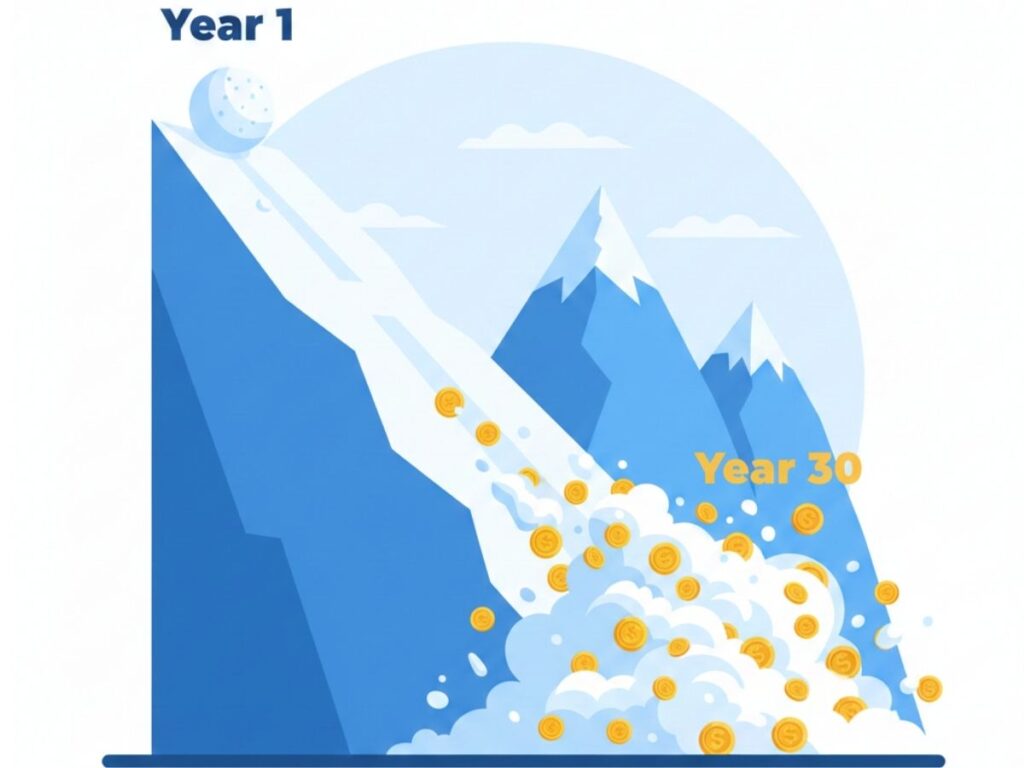
    Imagine you are standing at the top of a snowy mountain. You pack a small handful of snow into a ball and give it a tiny push. At first, it moves slowly. But as it rolls, it picks up more snow. That extra snow makes the ball bigger, and because it’s bigger, it can pick up even more snow even faster. By the time it reaches the bottom, that tiny handful has become a giant, unstoppable boulder.

    An illustration of the snowball effect showing how $1,000 grows into a massive avalanche of wealth over 30 years through compound interest.

    That is the “magic” of compounding. It’s not about how much money you start with; it’s about how that money starts making “babies,” and then those babies start making babies of their own.

    In this blog, we’re going to pull back the curtain and show you exactly how this machine works so you can start building your own mountain of wealth today.

    The Snowflake Effect: How Compound Interest Actually Works

    Think of your first investment like a single, tiny snowflake. By itself, it doesn’t look like much. But compound interest is the “gravity” that turns that snowflake into an avalanche of wealth.

    To understand how compound interest works, you have to think in “cycles.” In the first year, you earn interest on the money you originally put in (your “Principal”). But in the second year, something magical happens: you earn interest on your original money and on the interest you earned the year before.

    It’s like your money is a little worker.

    • Year 1: You have one worker. At the end of the year, he earns you a “baby” worker.
    • Year 2: Now you have two workers (the original and the baby) both working to earn you more money.
    • Year 3: They earn you even more workers!

    Before you know it, you have an entire army of money-workers building your wealth for you. This is compounding interest explained at its simplest level: it is “interest earning interest.” The more time you give your army to grow, the faster it expands.

    Simple Interest vs. Compound Interest: Why One is “Lazy” and the Other is a “Wealth Machine”

    To truly understand compound interest vs simple interest, let’s imagine two friends: Lazy Larry and Smart Susan. Both start with $1,000.

    Lazy Larry uses “Simple Interest.” Every year, his $1,000 earns him $50 in interest. Larry takes that $50 and puts it under his mattress. The next year, his $1,000 earns him another $50. No matter how many years go by, Larry only ever makes $50 a year. His money is “lazy”—it isn’t growing; it’s just standing still.

    Smart Susan uses “Compound Interest.” In the first year, her $1,000 also earns $50. But instead of hiding it, she leaves it in the account. Now she has $1,050 working for her.

    • Next year, she doesn’t just earn interest on her $1,000; she earns interest on that extra $50 too!
    • Her money starts “stacking.”

    In the beginning, the difference looks small. But after 20 years, Susan will have nearly double the money Larry has, even though they started with the exact same amount! Simple interest is like a ladder—you go up one step at a time. Compound interest is like a rocket ship—it starts slow, then clears the clouds and heads for the stars.

    The Three Secret Ingredients of the Compounding “Recipe”

    Think of compounding like baking a cake. If you miss one ingredient, the whole thing falls flat. To master the power of compounding, you need these three things in your kitchen:

    1. Your Money (The Principal)

    This is your “Starter Snowball.” The more snow you start with, the bigger the ball can get. However, as we saw with Sam and Alex in Lesson 1, you don’t need a fortune to start. Even a tiny “snowflake” can become an avalanche if you have the other two ingredients.

    2. Your Percentage (The Interest Rate)

    This is the “Speed” of your wealth machine. A 10% interest rate will grow your money much faster than a 2% rate. This is why we look for good investments rather than just letting money sit in a “lazy” piggy bank.

    3. Your Superpower (Time)

    This is the most important ingredient of all. In the world of finance, Time is more valuable than money. The longer you leave your money alone, the more “cycles” it has to multiply. If you give a small amount of money enough time, it will eventually do all the hard work for you.

    We are making great progress! These next two sections are where the “magic” of Lesson 2 becomes practical. We’re going to give the reader a “superpower” (a math trick they can do in their head) and then show them a real-world story that proves why compounding is so powerful.


    The Rule of 72: A Quick Mental Trick to Double Your Money

    Have you ever wondered exactly how long it takes for your money to double? You don’t need a fancy calculator or a degree from Harvard to find out. There is a simple “brain hack” called The Rule of 72.

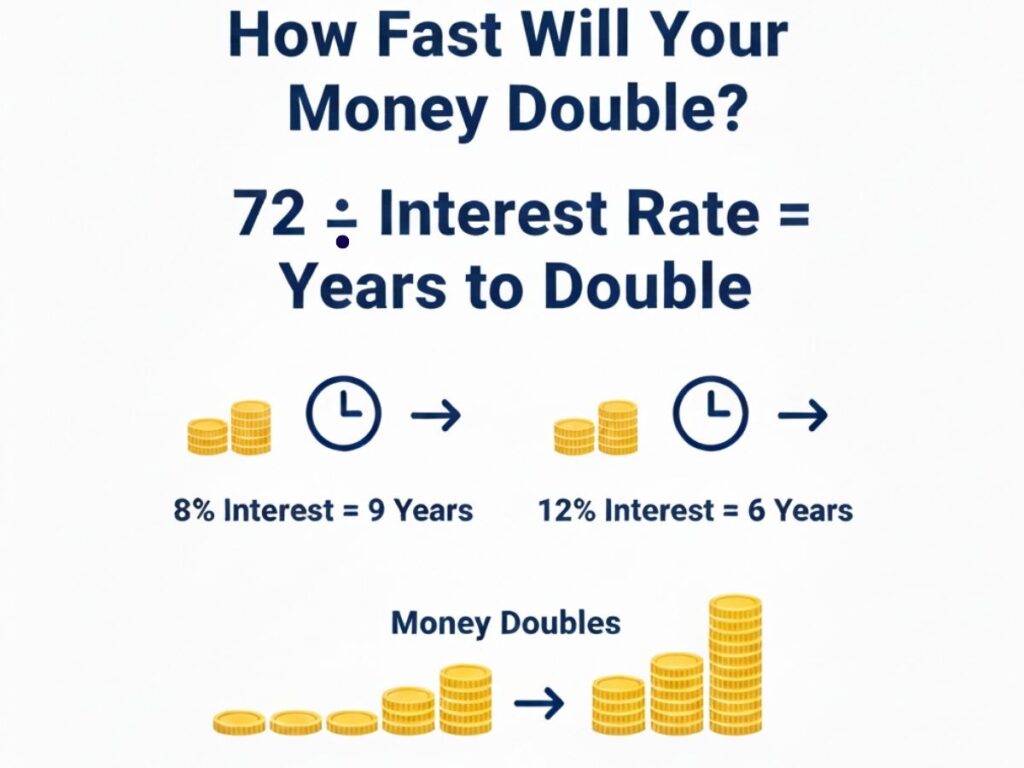
    Here is how it works: Take the number 72 and divide it by the interest rate you are earning. The answer is the number of years it will take for your money to grow into twice its size.

    • Example A: If you earn 7% interest, divide 72 by 7. In about 10 years, your $1,000 becomes $2,000.
    • Example B: If you find a better investment at 10%, divide 72 by 10. Now, your money doubles in only 7.2 years!
    A simple math formula showing how to divide 72 by your interest rate to find out how many years it takes for your money to double.

    This is a great way to see how even a small increase in your interest rate can shave years off your journey to wealth. It’s one of the first things experts teach when explaining what is compound interest for beginners because it makes the math feel like a game.

    Real-Life Example: Watching $1,000 Explode Over 30 Years

    To see the “Snowball Effect” in action, let’s look at a single $1,000 bill. Imagine you tuck it away in a “Wealth Machine” (like a low-cost index fund) that earns an average of 10% interest per year.

    You don’t add any more money; you just let it sit. Here is what happens:

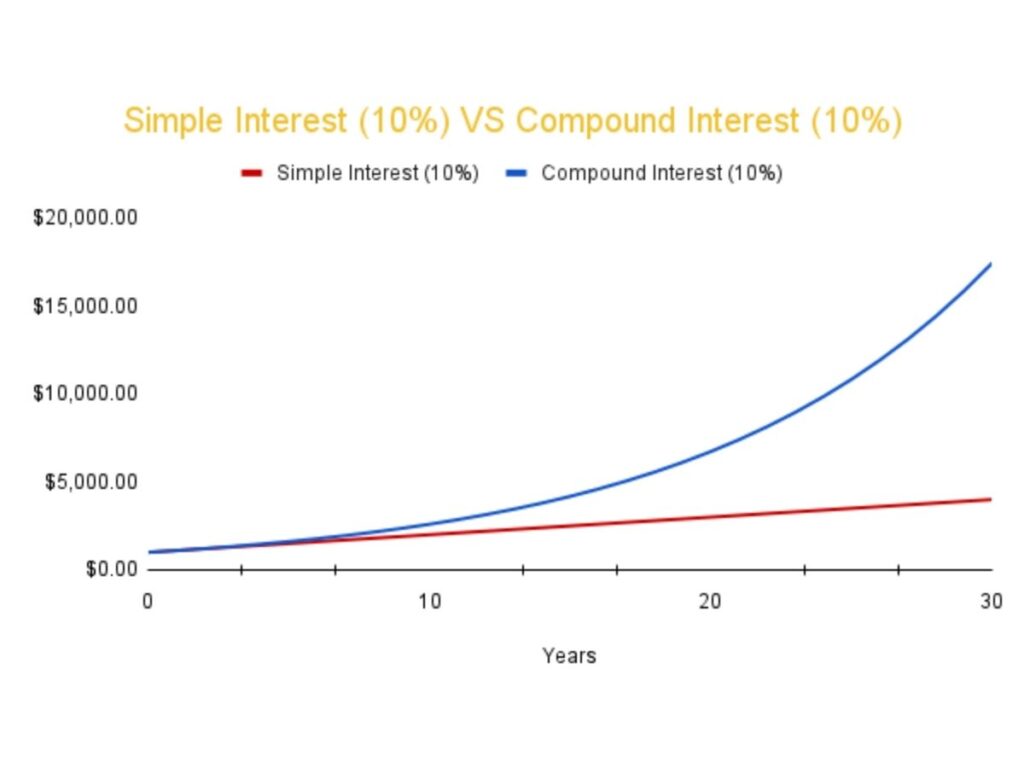
    • Year 10: Your $1,000 has grown to $2,593. Not bad! You’ve more than doubled your money just by waiting.
    • Year 20: This is where it gets exciting. Your money has grown to $6,727. Notice how it grew much more in the second ten years than the first? That’s the “babies having babies” effect.
    • Year 30: Hold onto your hat. Your original $1,000 is now $17,449!
    A line graph comparing simple interest versus compound interest at a 10% annual return over 30 years. The simple interest line grows steadily in a straight line, while the compound interest line curves sharply upward in a 'hockey stick' shape, showing significantly higher wealth accumulation.

    If you had used “Simple Interest” (like Lazy Larry), you would only have $4,000 after 30 years. But because you used compound interest, you have over $17,000. You didn’t work harder; you just let time and compounding do the heavy lifting for you.

    To wrap up Lesson 2, we need to give your readers a clear “map” of what to do next. Most people feel inspired after learning about the “Magic Snowball,” but they get stuck because they don’t know the first step.

    Here are the final two sections to complete your pillar post.


    Action Plan: How to Put Your Money on Autopilot Today

    Knowing how compound interest works is like having a map to a treasure chest—but you still have to walk the path! You don’t need a massive bank account to start your “Wealth Machine.” You just need to follow these three simple steps:

    1. Start Right Now (Even with $5): The “Superpower” of compounding is Time. A single dollar invested today is worth more than ten dollars invested ten years from now. Don’t wait for the “perfect” time; the best time was yesterday, and the second-best time is today.
    2. Automate Your Savings: Set up a “Set it and forget it” system. Most banks allow you to automatically move a small amount of money into an investment account every month. This ensures your “Snowball” keeps rolling even when you aren’t thinking about it.
    3. Leave the Snowball Alone: The biggest mistake people make is taking the money out too early. Remember: the “Magic” happens at the end of the journey, not the beginning. Let your money-workers stay on the job!

    Can I lose money with compound interest?

    Compounding itself is just math. However, if you invest in the stock market, the value can go up and down. That is why we give it Time to recover and grow.

    Do I need to be good at Maths to calculate compound interest?

    Not at all! There are thousands of “Compound Interest Calculators” online that do the work for you. You just need to understand the concept.

    What is the best account for compounding?

    For beginners, low-cost “Index Funds” or “High-Yield Savings Accounts” are great places to start your journey.

    Is compound interest a scam?

    No, it is a mathematical law of the universe! It is the same principle banks use to charge you interest on credit cards—only this time, the money is flowing into your pocket.

    What is Compound Interest for Beginners? (Key Takeaways)

    We’ve covered a lot of ground in this lesson. If you remember nothing else, keep these four “Golden Rules” of the magic snowball in mind:

    • Compounding is a “Wealth Machine”: Unlike simple interest, compound interest makes your money work for you by earning interest on your interest. It’s the difference between walking up a hill and taking a rocket ship.
    • Time is Your Greatest Asset: You don’t need a lot of money to start, but you do need a lot of time. Starting just a few years earlier can result in hundreds of thousands of dollars more in your pocket later.(This is the heart of the Time Value of Money—the longer you wait, the more “future value” you lose!)
    • The “Rule of 72” is Your Shortcut: Whenever you see an interest rate, divide 72 by that number to see how quickly you can double your wealth. It’s the ultimate “cheat code” for investors.
    • Patience is the Secret Ingredient: The biggest growth happens at the very end of the journey. Don’t melt your snowball by spending the money too early!

    What’s Your First Move?

    You are now officially ahead of 90% of the population when it comes to understanding how wealth is actually built. You have the map, and you have the engine. Now, it’s time to protect that wealth from the “thieves” of the financial world.

  • Time Value of Money for Beginners: A Simple Guide | Money Cornucopia

    Time Value of Money for Beginners: A Simple Guide | Money Cornucopia

    Have you ever heard the phrase “Time is money”?

    Most people think it just means you shouldn’t waste your afternoon. But in the world of finance, it is a literal law of the universe. At Harvard, we call this the Time Value of Money (TVM), and it is the single most important secret to building wealth.

    If I offered to give you $1,000 today or $1,000 exactly one year from now, which would you choose?

    Your gut probably tells you to take the money now. You’re right—but do you know why? It’s not just because you’re impatient. It’s because that $1,000 today has a “superpower” that the future $1,000 doesn’t have yet.

    What is the Time Value of Money? (TVM Explained Simply)

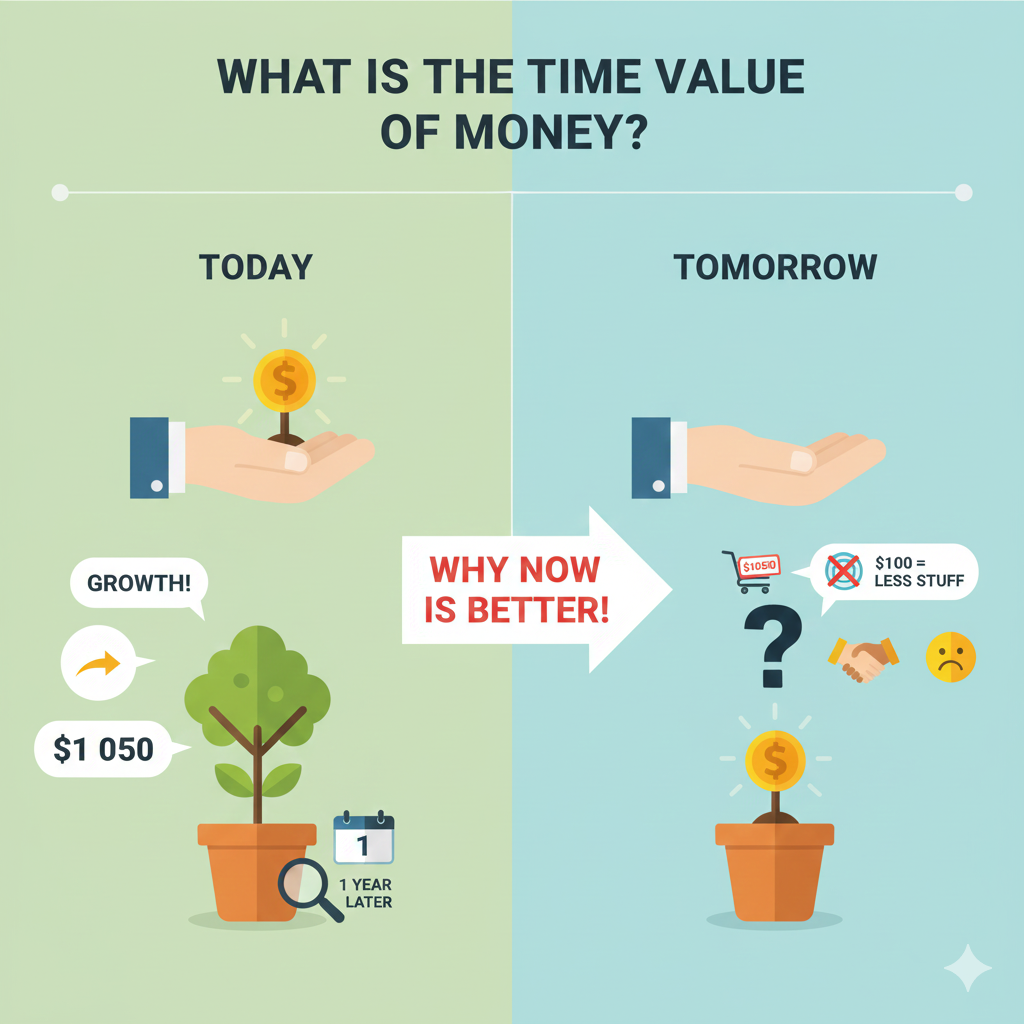
    At its core, the Time Value of Money is the idea that money you have right now is worth more than the same amount of money in the future.

    Think of money like a seed. If I give you a seed today, you can plant it immediately. By next year, you have a small tree. If I wait a year to give you the seed, you’re starting from zero while the other person already has shade and fruit.

    A simple educational diagram showing two scenarios: one where a person plants a 'money seed' today and has a growing tree by next year, and another where they wait a year and still have nothing, illustrating the three core pillars of the Time Value of Money: growth, inflation, and risk.

    There are three main reasons why “now” is always better than “later”:

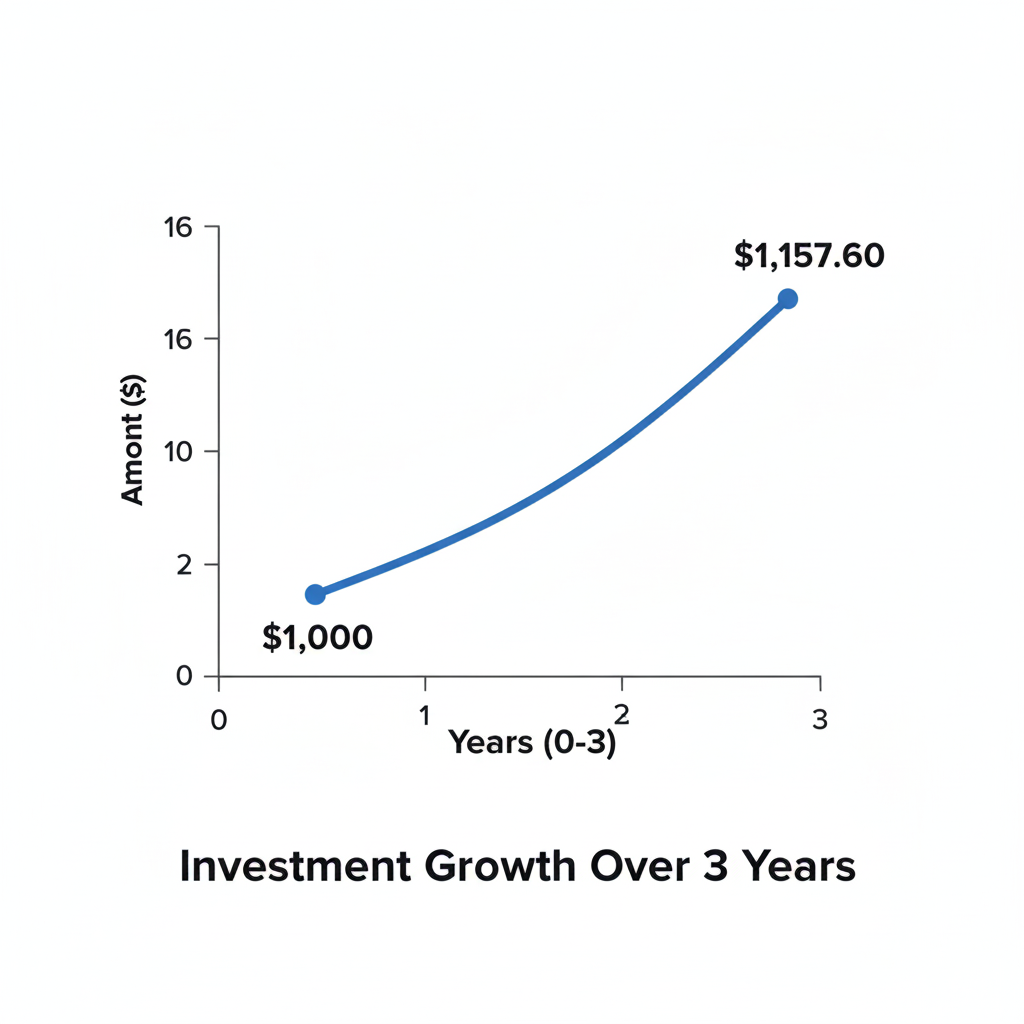
    The Growth Engine (Opportunity Cost): Money in your hand can be invested to earn interest. If you put $1,000 in a savings account at 5% interest, you’ll have $1,050 next year. By waiting for the money, you literally “lose” that $50.

    The Silent Thief (Inflation): Prices usually go up over time. What $100 buys at the grocery store today is almost always more than what $100 will buy five years from now.

    The Risk Factor (Uncertainty): A lot can happen in a year. The person who promised you the money might change their mind, or the economy might shift. Cash in your pocket today has zero “waiting risk.”

    How the “Wealth Machine” Works

    You don’t need to be a math genius to use TVM. You just need to understand how four pieces of a puzzle fit together to create a “Future Value.”

    • Present Value (PV): This is your starting point. The cash you have right now.
    • Interest Rate (r): This is the “speed” of your growth.
    • Time (n): This is the “fuel.” The longer you leave your money alone, the more powerful it becomes.6
    • Future Value (FV): This is the “destination”—the amount your money will grow into.7

    Professor’s Note: If you want to see the math in action, the basic formula is

    8$FV = PV \times (1 + r)^n$.9

    But don’t let the symbols scare you. All it’s saying is: Money x Growth x Time = Wealth.

    future value calculation example | money growth graph 5 percent

    3 Ways TVM Changes Your Life Every Day

    You might not see it, but the “Time Value” rule is working behind the scenes of every dollar you spend or save. Here are three ways it affects you:

    1. The “Early Bird” Secret (Retirement)

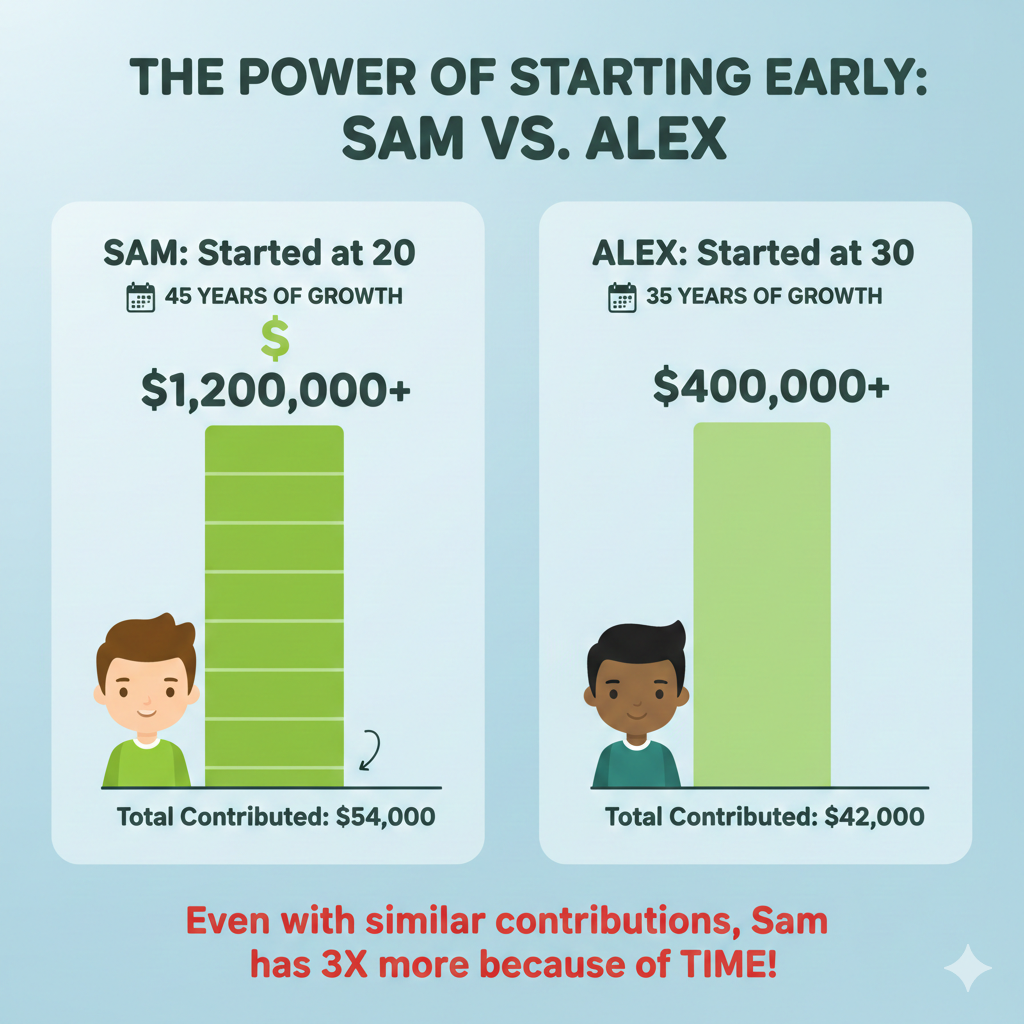
    Imagine two friends, Sam and Alex.

    • Sam starts saving $100 a month when he is 20 years old.
    • Alex waits until he is 30 to start saving the exact same amount.

    Even though Alex only waited 10 years, Sam will end up with way more money by the time they retire. Why? Because Sam’s money had more “Time” to use its growth superpower. In finance, time is like a magnifying glass—the longer you wait, the bigger the numbers get.

    importance of starting early investing | compounding power example

    2. The “Sneaky Thief” (Inflation)

    Have you ever heard your grandparents say, “Back in my day, a movie ticket cost a nickel!”?

    That is TVM in reverse. Because of inflation, the value of a dollar usually goes down over time. If you hide $100 under your mattress for 20 years, it will still say “$100” on the bill when you take it out, but it will buy much less food than it does today.

    inflation impact on purchasing power | dollar value over time
    • The Lesson: To beat the “thief,” your money needs to grow faster than prices rise.

    3. The “Danger of Later” (Credit Card Debt)

    TVM is a best friend to savers, but it’s a bully to people in debt.

    When you buy a $500 game console on a credit card and only pay it back “later,” the bank uses the TVM formula against you. They charge you interest, meaning that $500 today could turn into $700 or $1,000 in debt if you wait too long to pay it off.

    • The Lesson: Use TVM to earn money, don’t let the banks use it to take yours!

    How to Use TVM to Get Rich (Your Action Plan)

    Now that you know the secret, how do you use it? It’s as simple as A-B-C:

    • A. Start Early: Even if you only have $5, put it to work today. Time is more powerful than the amount of money you start with.
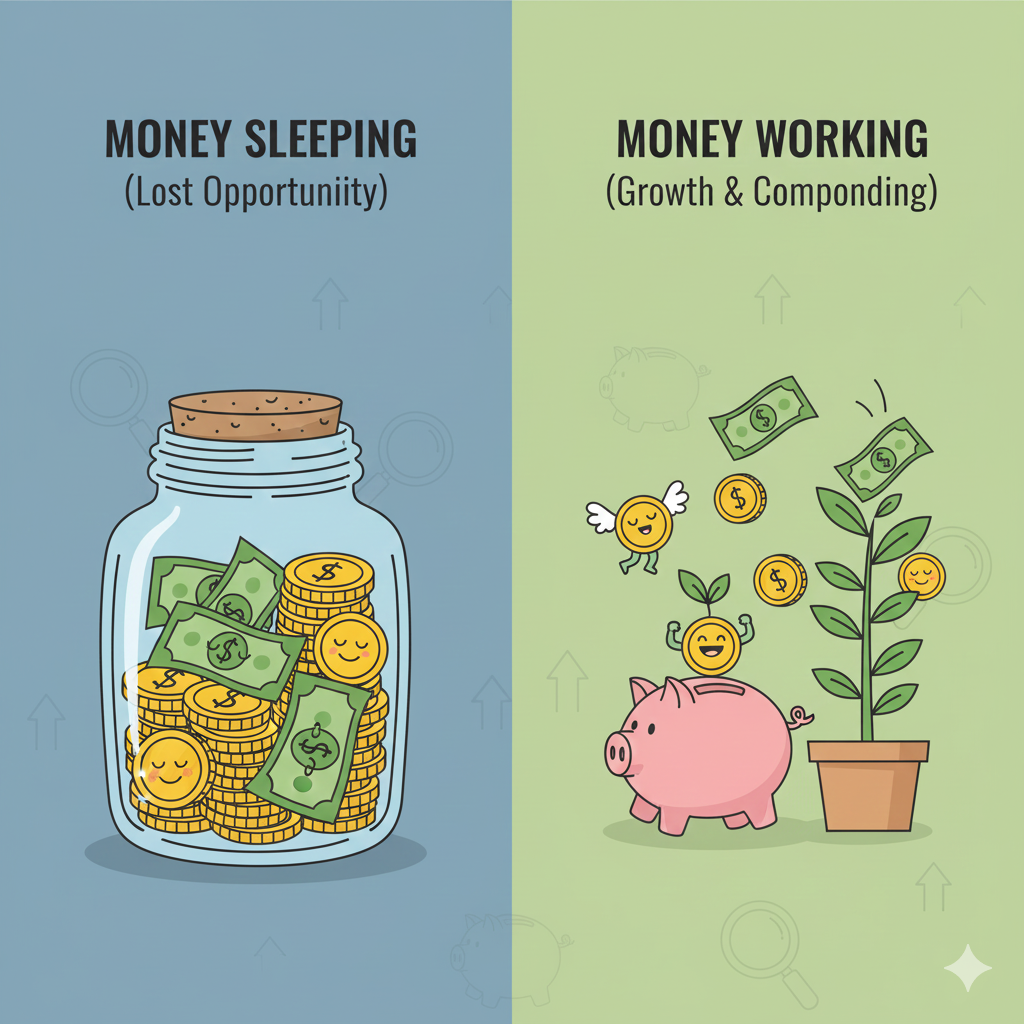
    • B. Look for Interest: Don’t let your money sleep. Put it in a place where it earns “rent” (interest), like a high-yield savings account or an index fund.
    • C. Think in “Future Dollars”: Before you buy something expensive, ask yourself: “If I invested this $100 today, how much would it be worth in 10 years?” Sometimes, that $100 pair of shoes is actually “costing” you $500 in future wealth!
    active vs lazy money illustration | investing habits

    Is the Time Value of Money just another word for Interest?

    Not quite, but they are cousins! Interest is the tool that makes your money grow. Time Value of Money is the rule that says because of that growth, having money now is better than having it later. Think of TVM as the “Why” and Interest as the “How.”

    Does TVM mean I should never save cash?

    Saving cash is great for emergencies (like a flat tire). But for long-term goals, “cold hard cash” actually loses value because of inflation. To grow your wealth, you want your money to be “active” (invested) rather than “lazy” (sitting under a mattress).

    Why do banks care about the Time Value of Money?

    Banks are experts at TVM. When they lend you money for a car or a house, they are giving up their “today money.” They charge you interest to make sure that when you pay them back in the future, the money they get back is worth more than what they gave you.

    How much of a difference does 1 or 2 years really make?

    A huge difference! Because of something called Compounding (which we will cover in our next post!), the money you save in your early years grows the most. Missing even just a year or two of growth can cost you thousands of dollars by the time you retire.

    Can TVM be used for things other than money?

    Yes! You can think of your time and skills the same way. Learning a new skill today is worth more than learning it in five years because you have more time to use that skill to improve your life.

    Class Review: What Did We Learn?

    Before you go, let’s do a quick “recap” of the secret to the Time Value of Money. If you remember nothing else, remember these four things:

    1. A Dollar Today > A Dollar Tomorrow: Because you can invest money today, it is always more valuable than money you have to wait for.
    2. Time is a Multiplier: The longer your money has to grow, the bigger the “Future Value” becomes. This is why starting early is your greatest advantage.
    3. Inflation is the “Thief”: If your money isn’t growing, it’s actually shrinking because prices for things like pizza and toys go up over time.
    4. The Wealth Formula: Wealth is created by combining Money + Growth (Interest) + Time.
    A relatable illustration of a person feeling confident and empowered with financial knowledge, holding a lightbulb or a glowing book, symbolizing the transition from confusion to financial literacy after learning about the Time Value of Money.

    Conclusion: Your Future Self is Waiting

    The Time Value of Money is more than just a math equation from a Harvard classroom; it is the key that unlocks the door to your financial freedom. By understanding that time is just as important as the amount of money you save, you have already taken a bigger step than most adults!

    Your Action Step for Today: Look at your savings. Is your money “sleeping” under a mattress, or is it “working” in an account where it can grow? Even starting with $5 today is better than starting with $500 five years from now.

    What’s your biggest takeaway from today’s lesson? Drop a comment below and let’s discuss!

  • The Simple Budget Guide for Beginners: A Stupidly Easy 3-Step Plan

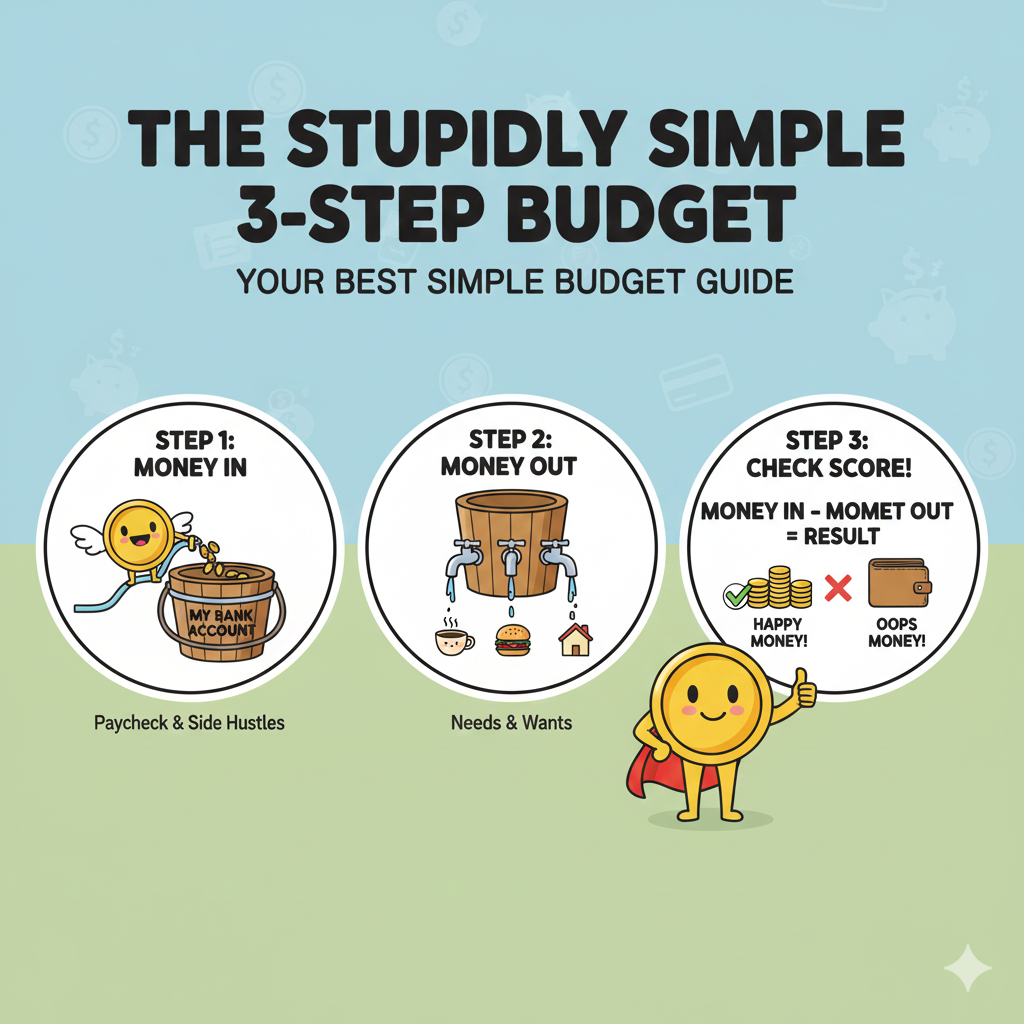
    The Simple Budget Guide for Beginners: A Stupidly Easy 3-Step Plan

    Ever Wonder Where Your Money Ran Off To?

    Do you ever get your money and then, just a few days later, you look at your bank account and it’s almost gone? It feels like a magic trick, but it’s not a fun one. Where did all that cash run off to?

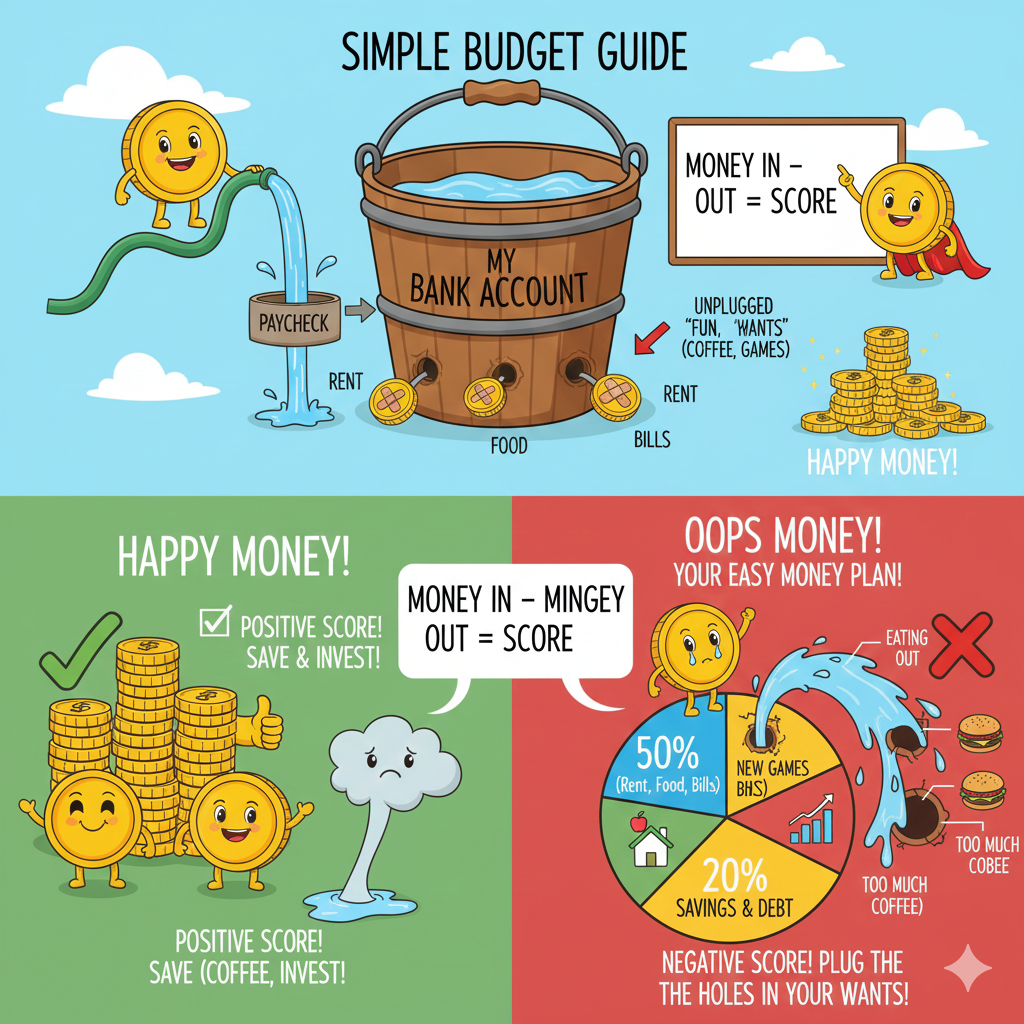
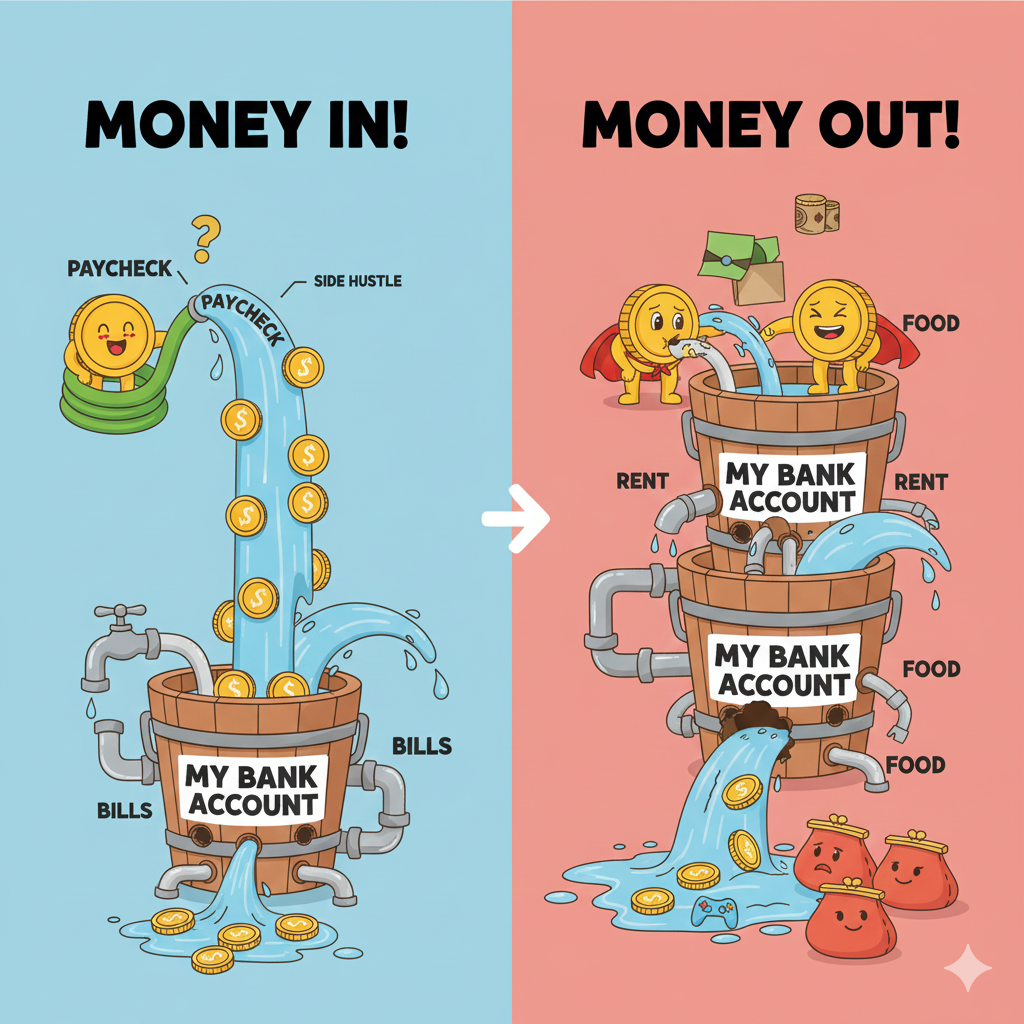
    If this sounds like you, you need a simple budget guide. A budget is just a plan for your money, and we are here to show you a super easy way to start. This is the ultimate simple budget guide for beginners.

    The secret to making your money last is knowing exactly where it goes. And trust me, you can totally do this!

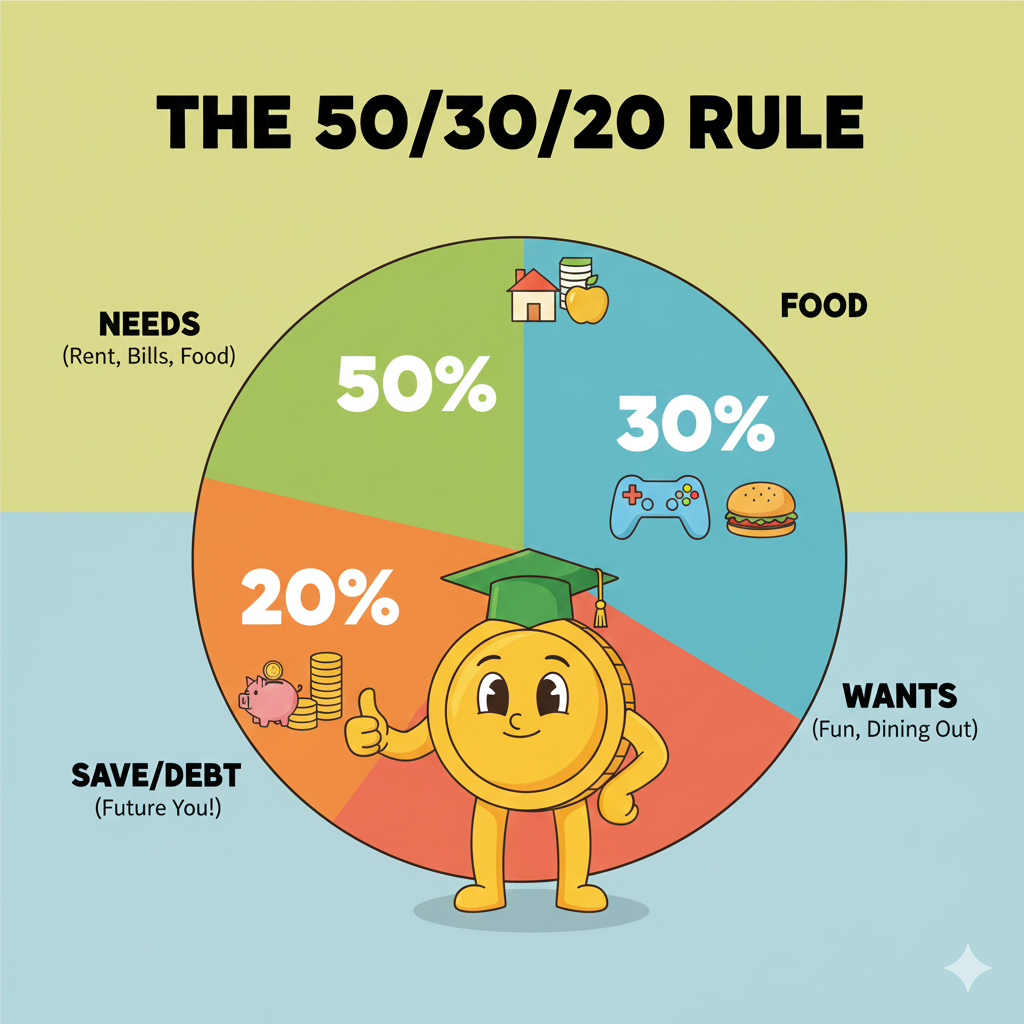
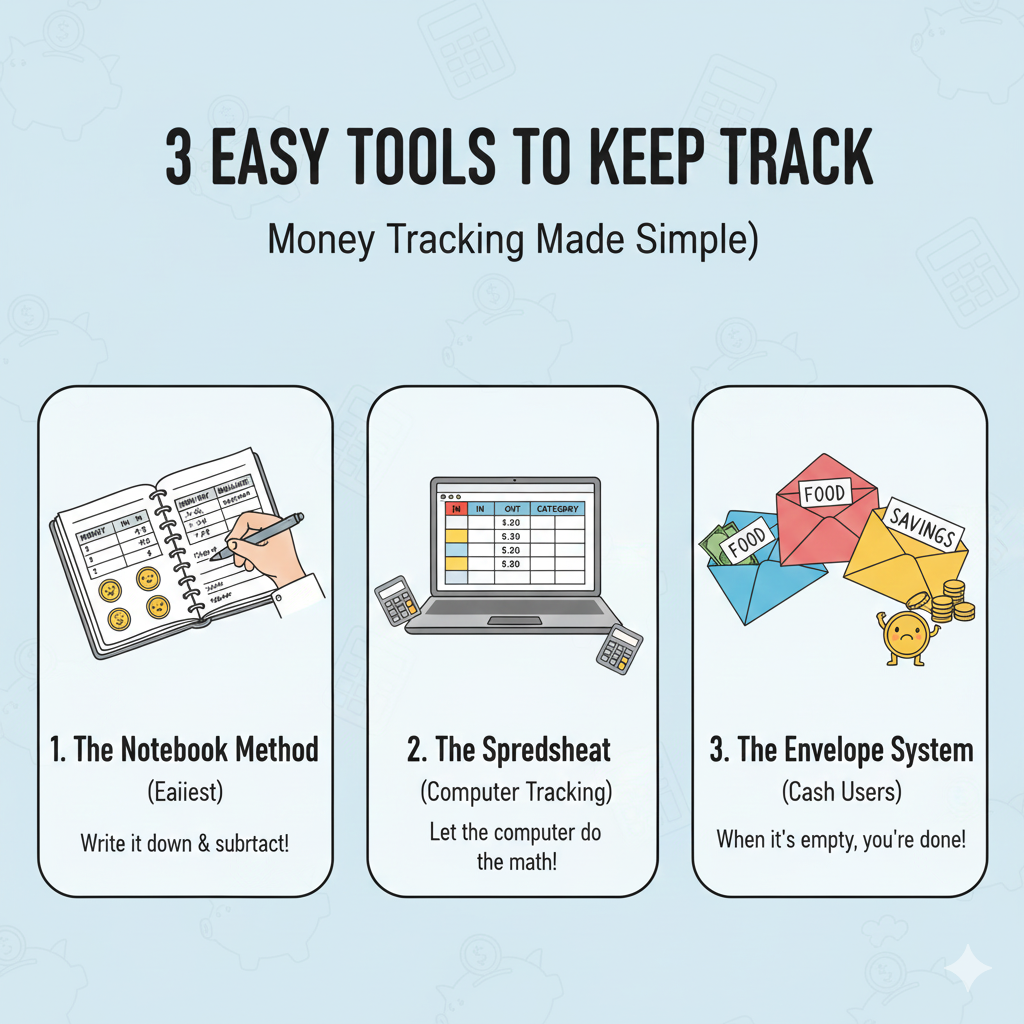
    Budgeting is Just “Money Tracking”

    A budget is just a fancy name for writing down what money you get and what money you spend. That’s it! If you want to know where your money goes every month, this simple “money tracking” is the answer.

    Here’s the simple idea using our simple budget guide:

    Imagine your bank account is a bucket.

    1. The money you get (your paycheck) is the water coming in.
    2. The money you spend (rent, food, fun) is the water going out.

    Your goal is simple: Make sure the water coming in is always more than the water going out.

    Diagram illustrating the Money In minus Money Out score check. Shows happy money (positive score) and oops money (negative score) with specific leaks to plug.

    When the money coming in is bigger, you have a good cash flow, and that gives you control. Now, let’s get to the plan!

    The Stupidly Simple 3-Step Budget: Your Best Simple Budget Guide

    Ready to make your simple budget guide a reality? This plan is so easy, you only need to look at three things. Remember, we are just trying to know where your money goes.

    A colorful cartoon simple budget guide infographic featuring a happy gold coin standing next to a bucket of "Happy Money" and a red "Oops Money" box. The graphic illustrates the 3-step formula (Money In - Money Out = Score) and provides a checklist for fixing spending leaks like new games and too much coffee, making it a comprehensive beginner's visual aid.

    Here are the three steps to start budgeting for beginners right now:

    Step 1: Count Your Buckets (What Money Comes In?)

    This is the fun part! You need to figure out how much money is coming into your bucket every month.

    • The Action: Add up all the money you expect to get this month. This includes your paychecks, any money from a side job, or anything else you earned.
    • The Big Number: Write down that final number. This is your total Monthly Income.
    • Simple Analogy: This is the size of the hose filling your bucket. If the hose is bigger, you get more water! If you get paid on different dates, just try to get a good guess of the total amount.

    Step 2: Spot the Leaks (What Money Goes Out?)

    Now, we look at the spending—the leaks in your bucket. We will break them into two simple groups:

    • A. The Need-to-Haves (The Tapes): These are the bills you MUST pay to live. You can’t skip these.
      • Examples: Rent/mortgage, minimum loan payments, groceries, and essential utilities (like water and electricity).
    • B. The Want-to-Haves (The Holes): These are things you spend money on that are optional. You could live without them, but they are fun!
      • Examples: Eating out at restaurants, new video games, streaming services (like Netflix), or expensive coffee.

    The Action: Add up the total cost of all your Need-to-Haves and all your Want-to-Haves. This is your total Monthly Spending.

    IMPORTANT: Fixed Money vs. Wobbly Money

    When you know where your money goes, you will see that some bills are the same every month, and some change.

    • Fixed Money: This money is spent on bills that are exactly the same every single month. Your rent is a great example. They are easy to track!
    • Wobbly Money: This money is spent on things that change every month, like food or gas for your car. You need to pay attention to these, because they are the sneakiest leaks!

    Step 3: Check the Score! (Do you have “Happy Money” or “Oops Money”?)

    This is the moment of truth! We simply take the money that came in and subtract the money that went out.

    Money In – Money Out = The Score

    • If the Score is POSITIVE: You have “Happy Money”! This means you have extra cash left over. Great job! You can use this money to save, invest, or pay off your debt faster.
    • If the Score is NEGATIVE: You have “Oops Money”. This means your bucket is emptying too fast! Don’t panic. You now know where your money goes.
    A cartoon infographic visually separating budgeting outcomes into "Happy Money" (positive score, represented by a bucket of coins) and "Oops Money" (negative score, represented by a list of spending leaks). This image illustrates Step 3: Checking the Score in the simple budget guide.

    The “Oops Money” Fix-It Plan (How to Plug the Holes)

    If your score is negative, the most important thing you can do is find some holes to plug in your Want-to-Haves list!

    • Challenge Your Wants: Look at your Wobbly Money. Did you eat out too many times? Try packing your lunch for two weeks instead.
    • Cut the Extras: Do you have three different movie streaming services? Maybe just pick one this month.
    • Pause Spending: Decide not to buy anything “optional” for one week. Move that saved money right into your bucket to fix the score.
    Cartoon illustration of the "Oops Money" Fix-It Plan, showing a hand 'plugging' holes in the money flow. This visual represents simple budget solutions for common spending leaks like eating out, new games, and coffee.

    This is what a simple budget guide is all about: taking action to get your score to “Happy Money”!

    Pro Tip: The 50/30/20 Rule for Easy Planning

    Visual representation of the 50/30/20 budget rule for money allocation: 50 percent needs, 30 percent wants, and 20 percent savings, a great tool in any simple budget guide.

    Once you have your three steps figured out, here is a secret rule to make things even easier. It’s called the 50/30/20 Rule, and it’s a favorite simple budget guide for many people.

    This rule just helps you divide your paycheck right away:

    • 50% for Needs: Half of your money should go to your Need-to-Haves (rent, food, bills).
    • 30% for Wants: A little less than a third of your money can go to your Want-to-Haves (fun stuff, eating out).
    • 20% for Saving/Debt: This is the most important part! At least one-fifth of your money should go straight into saving for your future or fighting the Money Monster (debt).

    Don’t worry if you can’t hit these numbers exactly right now. It is just a great, simple goal to aim for as you keep practicing your money tracking.

    3 Easy Tools to Keep Track of Your Bucket (Money Tracking Made Simple)

    You don’t need a fancy math degree to track your money! All you need is a simple way to write down your income and spending.

    1. The Notebook Method (Easiest): Just grab a notebook and a pen. Write your “Money In” at the top of the page, and every time you spend money, write it down and subtract it. It’s the most straightforward way to start budgeting for beginners.
    2. The Spreadsheet (Computer Tracking): If you like typing, use a simple Google Sheet or Excel file. This lets the computer do the subtraction for you. You can label one column “In” and another column “Out.”
    3. The Envelope System (Cash Users): If you use cash, put the cash for each “Want-to-Have” (like entertainment) into separate envelopes. When the envelope is empty, you are done spending for that category until next pay day!
    Infographic showing three easy tools for money tracking: a notebook for the Notebook Method, a laptop screen displaying a spreadsheet for the Spreadsheet Method, and labeled envelopes for the Envelope System, simplifying budget management.

    You Just Started! Take Control Today!

    Congratulations! You just finished your first simple budget guide. Remember, budgeting is not about feeling poor; it’s about giving you control over your money and feeling smart!

    Now that you know where your money goes, you can decide where you want it to go.

    A cheerful illustration of a person confidently standing on a stack of money, holding a diploma or certificate, symbolizing the completion of a financial education journey and the acquisition of good money habits.

    If you want to read more about how to make smart money choices every day, we recommend this great article on 5 Ways to Improve Your Financial Health by a trusted financial resource.

    If your score was “Happy Money,” you can start using that extra cash to fight debt! Learn how to attack big bills in our post about [The Silent Money Monster](Internal Link to Debt Post).