
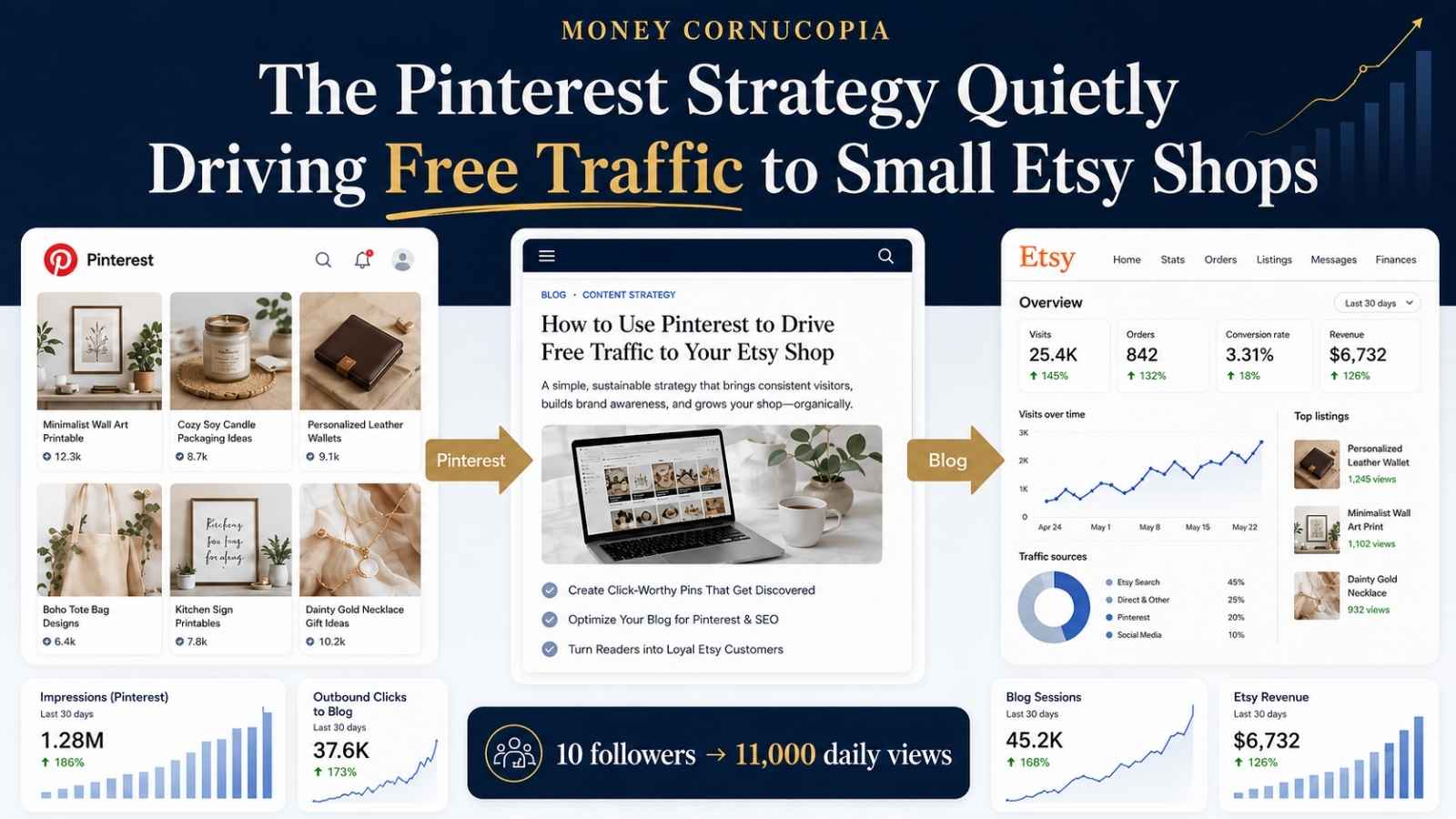
Most small Etsy shop owners completely ignore Pinterest. They put all their energy into Etsy SEO, maybe post on Instagram a few times, and then wonder why nobody is finding their listings.
I almost made the same mistake. Twice.
I run a small Etsy shop called ImproveImprovise where I sell finance templates and planners. I also write about digital product strategy on MoneyCornucopia. For months, I focused only on Etsy search and blog content. Traffic was flat. Clicks were nearly zero. I felt invisible.
I actually created my Pinterest account about 6 months ago. I posted a few pins here and there, saw almost nothing happen, and quietly stopped. The account sat untouched for months. I told myself Pinterest “didn’t work.”
Then, about 20 days ago, I came back with a real strategy instead of random posting. No ads. No scheduling tools. No follower base. Just consistent, daily pinning with clear keywords and a system I am going to share in this article.
The result so far: 10 followers and roughly 11,000 daily views.
Those numbers came after 20 days of consistent work, not 6 months of having an account. The account age did not matter. The strategy and consistency did. That single lesson changed how I think about Pinterest entirely.
Pinterest does not care how many followers you have. It cares how useful your content is. That is why it works for small Etsy sellers who have zero audience and zero budget.
This article is the strategy I am using right now. Not a theory from a course. Not recycled tips from 2019. What is actually working for a real seller with a new shop in 2026.
Table of Contents
Why Pinterest Works Differently Than Every Other Platform
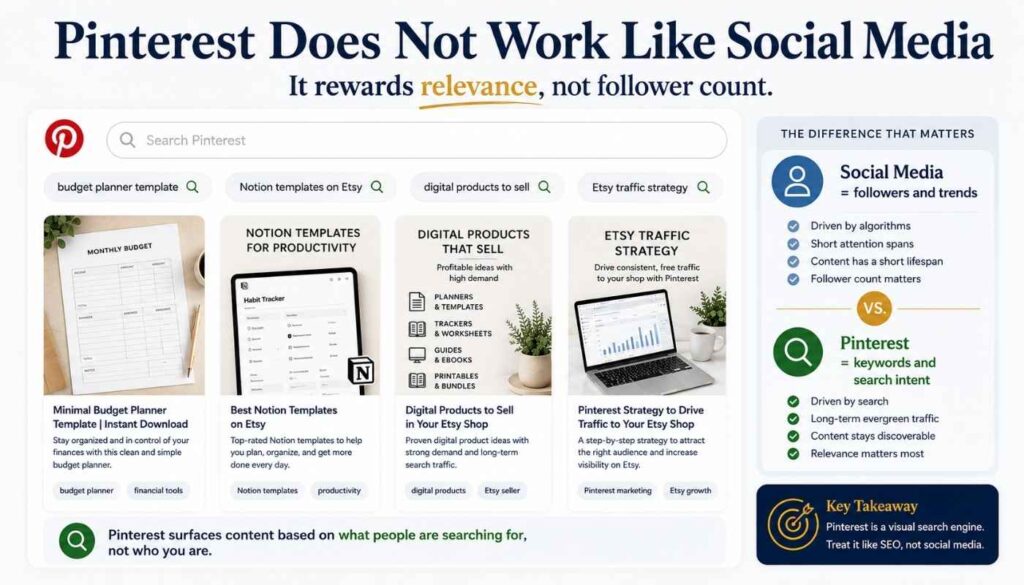
Pinterest is not social media. It is a visual search engine.
This is the single most important thing to understand before you pin anything. Instagram, TikTok, and Facebook reward content that is new, trendy, and generates engagement within hours. If your reel does not go viral in 24 hours, it is dead.
Pinterest works the opposite way. A pin you publish today can drive traffic 6 months from now because Pinterest serves content based on search relevance, not recency. When someone types “budget planner template” into Pinterest’s search bar, the platform shows them the most relevant pins, regardless of when those pins were published or how many followers the creator has.
That changes everything for small Etsy sellers.
On Instagram, you are competing against creators with 100,000 followers and professional content teams. On Pinterest, you are competing on relevance. A new seller with 10 followers can outrank an established creator with 50,000 followers if their pin answers the search query better.
This is exactly what happened with my account. I have 10 followers. My pins are getting 11,000 daily views. Those views are not coming from my followers. They are coming from Pinterest’s search engine, showing my content to people who are actively looking for what I create.
If you want to understand why this matters from a broader side hustle perspective, I wrote about this exact pattern in 3 Reasons Your Side Hustle Still Isn’t Growing. The third reason was not building assets that work without you. A Pinterest pin is exactly that kind of asset. You create it once, and it keeps working.
What I Learned From My First 20 Days on Pinterest
Here are the real numbers and lessons, not the polished version.
I want to be fully transparent about my Pinterest journey. This is not my first attempt. I created the account 6 months ago, posted randomly for a few days, saw nothing, and quit. When I came back 20 days ago with a real strategy, everything changed.
Here is the contrast:
| Metric | First attempt (6 months ago) | After 20 days of consistent pinning |
|---|---|---|
| Followers | 0 | 10 |
| Daily impressions | Nearly zero | ~11,000 |
| Strategy | Random, inconsistent posting | Daily pinning with keyword focus |
| Pins published | A handful over a few days | ~60 in 20 days |
| Ads spent | $0 | $0 |
| Tools used | None | Free Canva only |
| Result | Quit after seeing no traction | Growing daily |
The difference between the two attempts was not the platform. It was the approach. Random posting without keywords or consistency produces nothing. Daily posting with clear keywords and a system produces results within weeks.
What Surprised Me
Views started before followers did. By day 3 or 4 of my consistent pinning, my pins were already getting impressions even though I had zero followers. This confirmed that Pinterest distributes content based on keyword relevance, not follower count. On Instagram, zero followers means zero reach. On Pinterest, zero followers means nothing if your keywords are right.
Some pins took off; most did not. Out of roughly 60 pins, maybe 8 to 10 are driving the majority of my views. The rest are sitting quietly. That is normal and expected. The lesson is to pin consistently and let Pinterest’s algorithm figure out what resonates.
Pin design matters less than I expected. My best-performing pins are not my most beautiful ones. They are the ones with the clearest text overlay and the most specific title. A pin that says “5 ADHD Notion Templates That Actually Sell on Etsy” outperforms a prettier pin with a vague title like “Notion Planner Ideas.”
The One Strategy: The Blog to Pinterest to Etsy Flywheel
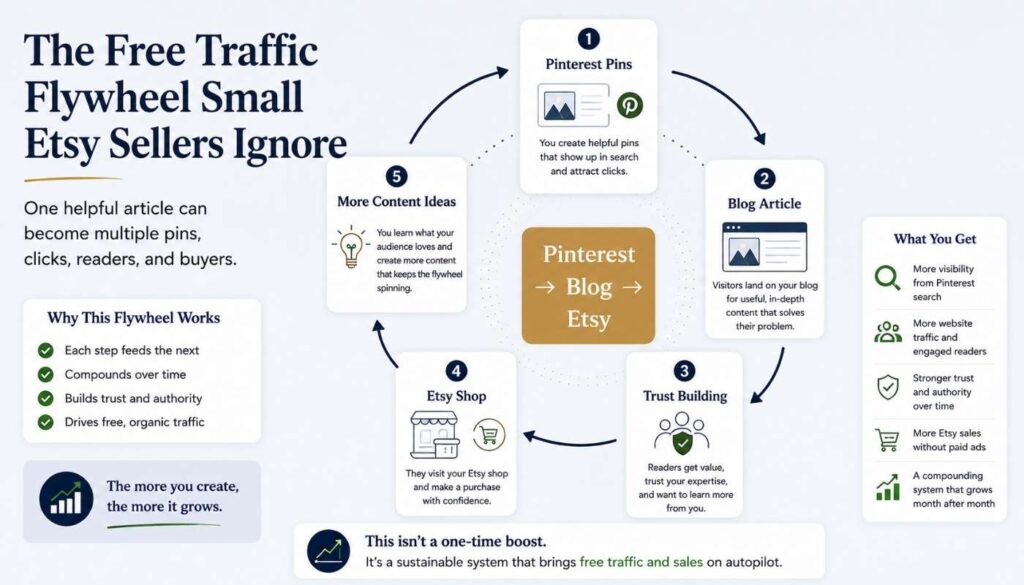
This is the core of everything I am doing. It is simple, but almost nobody in the Pinterest advice space explains it clearly.
Most Pinterest guides tell you to pin your Etsy listings directly. Create a pretty image of your product, link it to your Etsy listing, and hope for sales. That can work, but it is a weak strategy because it only captures buyers who are ready to purchase right now.
The stronger strategy is a three-step flywheel that captures people at every stage of the buying journey.
Step 1: Write a Blog Article That Solves a Real Problem
You write an article on your blog that is genuinely useful to the same audience who would buy your Etsy products. Not a sales pitch. Not a product description. A real piece of content that helps someone.
For example, I wrote an article about how to sell Notion templates on Etsy in 2026. This article targets people who want to create and sell digital products. Those same people are potential buyers of my finance templates and planners.
Another example: my research article on 20 premium ADHD Notion templates on Etsy targets people interested in the Notion template market. Some of them are buyers. Some are sellers. Both are valuable visitors.
Step 2: Create 4 to 6 Pins Per Article
For each blog article, I create multiple pins with different designs, different titles, and different keyword angles. All of them link back to the same article.
Why multiple pins? Because each pin targets a slightly different search query. One pin might say “How to Sell Notion Templates on Etsy.” Another might say, “Etsy Digital Product Beginner Guide 2026.” ” A third might say, ‘Start Your Etsy Template Shop This Week.” Same article, different doors into it.
I create my pins in Canva using their free Pinterest templates. Each pin takes about 5 to 10 minutes to make. The key elements are:
Key elements of a strong Pinterest pin
| 1 | Vertical format — 1000 x 1500 pixels, the 2:3 ratio Pinterest recommends for maximum distribution |
| 2 | Clear, readable text overlay — tells the reader exactly what they will get before they click |
| 3 | Clean background — does not compete with the text or distract from the message |
| 4 | Brand name or URL — small in the corner for recognition as your pins circulate over time |
Step 3: The Pin Drives Traffic to Your Blog, Your Blog Drives Traffic to Etsy
When someone finds your pin on Pinterest and clicks through, they land on your blog article. The article is genuinely helpful. It builds trust. And within the article, you naturally link to your Etsy listings, your other articles, and your products.
This is the flywheel:
Pinterest → Blog → Etsy
The blog sits in the middle and does the heavy lifting. It warms the visitor from “curious browser” to “potential buyer” before they ever see your Etsy shop. That is a much higher conversion path than sending cold Pinterest traffic directly to an Etsy listing.
It also creates a compounding effect. The blog article ranks on Google over time, bringing in search traffic. The pins keep circulating on Pinterest, bringing in visual search traffic. Both channels feed your Etsy shop with warm visitors who already trust you.
This is the same compounding logic I wrote about in why most people fail at passive income. The people who succeed build systems where each piece strengthens the others. The blog to Pinterest to Etsy flywheel is exactly that kind of system.
What Most Pinterest Guides Get Wrong
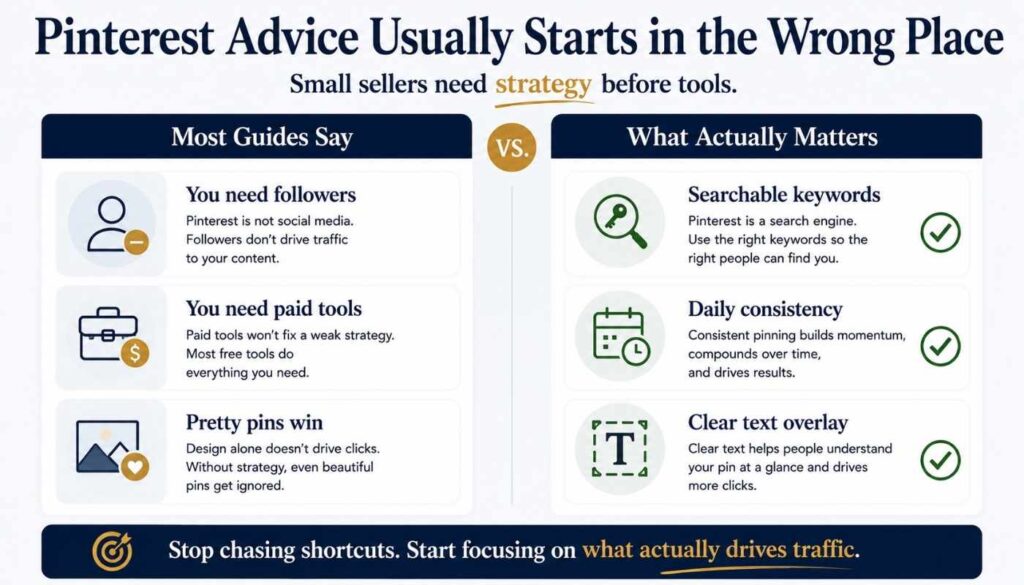
I read six of the top-ranking Pinterest guides before writing this. Here is what they all miss.
They Assume You Already Have an Audience
Almost every Pinterest guide starts with “optimize your profile” and “engage with your community.” That advice is useless for someone with zero followers and zero engagement. The real starting point is keyword research and consistent pinning, not community building. You build community as a result of good content, not as a prerequisite for it.
They Sell Tools Instead of Strategy
Most top-ranking Pinterest articles are written by companies selling Pinterest scheduling tools, analytics dashboards, or courses. Their advice is designed to make you feel like you need their product to succeed. You do not. I am 20 days in with 11,000 daily views, and I have not spent a single dollar on tools. I pin manually. I design in Canva for free. I use Pinterest’s built-in analytics to see what is working.
Tools like Tailwind or paid Canva subscriptions can help later when you are scaling. They are not necessary to start.
They Focus on Pin Design Over Pin Strategy
Beautiful pins do not drive traffic. Relevant pins drive traffic. I have seen my simplest, text-heavy pins outperform my most designed ones because the text clearly described what the reader would get. Pinterest users are searching for solutions, not admiring art. Your pin needs to answer their search query in one glance.
They Never Give Realistic Timelines
Every guide says “Pinterest takes time,” but none say how much time. Here is what I am seeing and what other small sellers report:
| Timeline | What to expect |
|---|---|
| Week 1 to 2 | Impressions start trickling in, almost zero clicks — this is normal, do not quit |
| Week 3 to 4 | Impressions grow noticeably, first clicks begin to appear |
| Month 2 to 3 | Consistent daily impressions, steady click growth across your pin library |
| Month 4 to 6 | Compounding effect kicks in — older pins start driving significant traffic |
| Month 6 and beyond | Pinterest becomes a reliable, largely passive traffic source for your shop |
I am at week 3. My impressions are growing. Clicks are just starting. This matches the pattern. Patience is not optional here.
How to Set Up Your Pinterest Boards for Maximum Reach
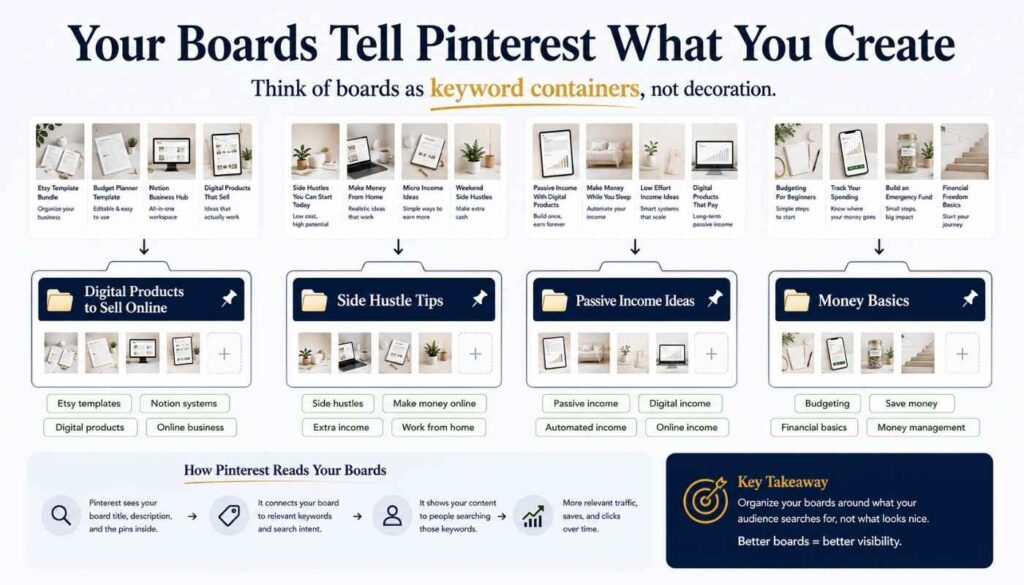
Your boards are not decoration. They are keyword buckets that tell Pinterest what your content is about.
When I first set up my Pinterest, I made the mistake of using creative board names that sounded good but meant nothing to Pinterest’s search engine. I recently renamed them to keyword-rich names that match my actual content categories.
Here is how I think about boards now:
How to set up Pinterest boards for maximum reach
| 1 | Each board should match a content category on your blog or a product category in your Etsy shop |
| 2 | The board name should contain words people actually search for — not creative names that sound good but mean nothing to the algorithm |
| 3 | The board description should be 2 to 3 sentences packed with natural keywords your ideal buyer would search |
| 4 | Every pin should go into the most relevant board so Pinterest’s algorithm understands what your content is about |
For a digital product seller on Etsy, your boards might look like:
| Board name example | Why it works |
|---|---|
| Digital Products to Sell Online | Notion Templates and Planners | Contains multiple searchable phrases that buyers and sellers both look for |
| Side Hustle Tips | Short, high volume keyword that attracts a broad audience looking to earn online |
| Passive Income Ideas | One of the most searched financial topics on Pinterest — captures aspirational buyers early |
| Money Basics | Budgeting, Saving and Investing Tips | Covers multiple finance sub-topics in one board, increasing the chance of ranking for each |
Each board becomes a container that trains Pinterest’s algorithm to understand what you create and who should see it.
The Pinning Routine That Takes 20 Minutes a Day
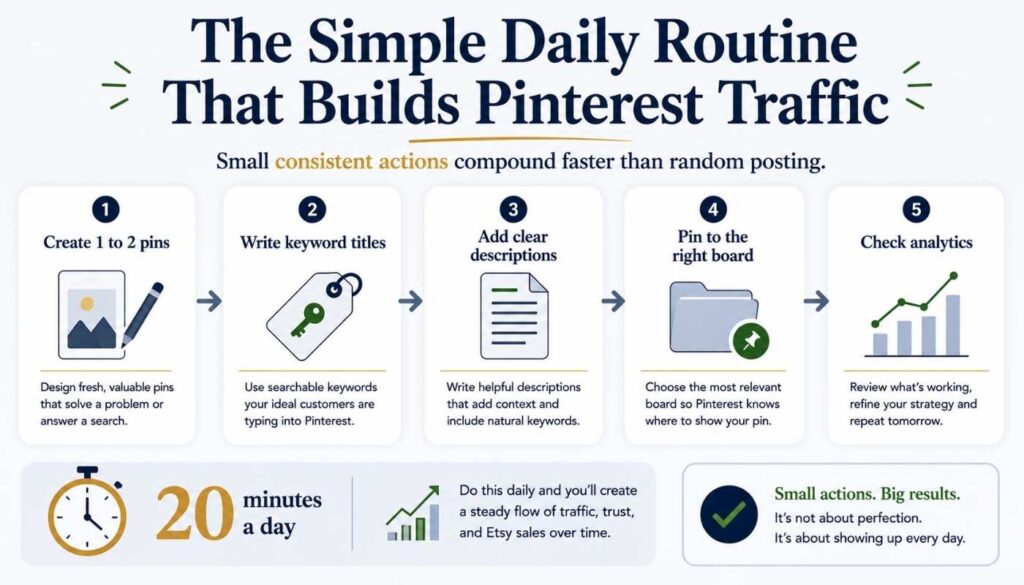
You do not need to spend hours on Pinterest. You need 20 focused minutes.
Here is my daily routine:
The 20-minute daily pinning routine
Total time: 20 minutes. Do this every day.
| 1 | Open Canva and create 1 to 2 new pins for an existing blog article | ~10 minutes |
| 2 | Write keyword-rich pin titles and descriptions | ~5 minutes |
| 3 | Pin them to the most relevant board | ~2 minutes |
| 4 | Repin 2 to 3 existing pins to secondary boards to keep them circulating | ~3 minutes |
That is it. 20 minutes. I do this every day. Some days I create more pins if I have published a new article. Some days I just repin older content to keep it circulating.
The key is consistency, not volume. Pinning 3 pins every day for 30 days is far more effective than pinning 90 pins in one day and then disappearing for a month. Pinterest rewards accounts that show consistent activity.
I know this from personal experience. My first attempt, 6 months ago, was the “post randomly and disappear” approach. It produced nothing. My current approach of daily, consistent pinning produced 11,000 daily views in under three weeks. Same platform. Same account. Completely different result.
Connecting Pinterest to Your Etsy Shop and Blog
The real power of Pinterest is not any single pin. It is the system that connects your content, your shop, and your traffic.
Every article on my blog naturally links to related articles and to my Etsy shop. When I wrote my guide on 7 surprisingly simple Notion templates people are quietly paying for, I linked to my Etsy shop and to my digital products strategy articles. When I wrote about how to build a digital products shop for passive income, I linked to specific product examples and related guides.
Each Pinterest pin drives traffic to one of these articles. The article then distributes that traffic across the entire site and into the Etsy shop. One visitor becomes multiple page views and a potential customer.
This is why the flywheel works. You are not just getting Pinterest clicks. You are building a connected system where every piece of content supports every other piece.
Common Mistakes I Made (And How to Avoid Them)
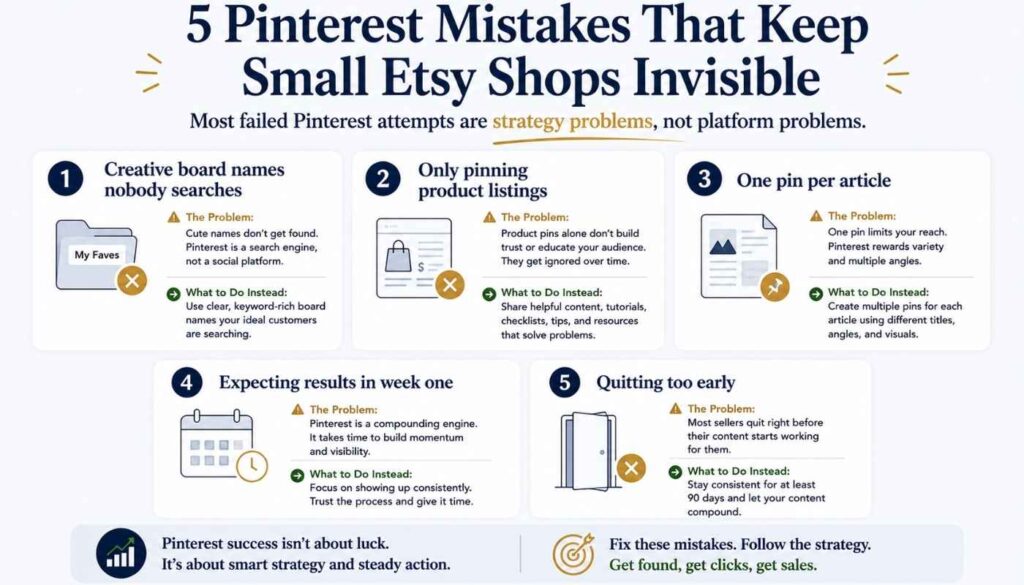
Mistake 1: Using Creative Board Names Nobody Searches For
I originally named my boards things like “Daily Pulse” and “Financial Logic.” Nobody searches for those terms on Pinterest. I renamed them to keyword-rich names, and my impressions improved noticeably within a week. Your board names should contain words your ideal buyer would actually type into Pinterest’s search bar.
Mistake 2: Only Pinning Product Listings
When I first started, I only pinned my Etsy product images. They got almost no traction. When I started pinning my blog articles instead, engagement jumped. Blog content gives Pinterest’s algorithm more to work with because articles have depth, keywords, and value that a product photo alone does not provide.
Mistake 3: Creating Only One Pin Per Article
I initially created one pin per blog post and thought I was done. Then I learned that creating 4 to 6 different pin designs for the same article dramatically increases reach because each pin can rank for different search terms. One article, multiple doors. This is one of the simplest changes that produced the biggest difference in my results.
Mistake 4: Expecting Results in the First Week
I checked my analytics obsessively for the first 5 days and saw almost nothing. I nearly gave up again. Then impressions started climbing in week 2 and have not stopped since. The first week is always quiet. That is normal. If you are in your first week right now and seeing nothing, keep going. The algorithm is still learning your content.
Mistake 5: Quitting Too Early the First Time
This is the most serious mistake on this list because I lived it. I created my Pinterest account 6 months ago, posted a handful of pins with no real strategy, saw zero results, and stopped. The account sat dead for months. I convinced myself that Pinterest did not work for small sellers.
When I came back 20 days ago with a real plan and committed to daily pinning with keyword-focused content, results started within two weeks. The platform had not changed. My approach had.
If you tried Pinterest before and quit, that does not mean Pinterest failed you. It probably means you did what I did: posted randomly without keywords, consistency, or a system. Come back with a plan. The platform rewards consistency over everything else.
Frequently Asked Questions
How many followers do you need on Pinterest to drive traffic to your Etsy shop?
You do not need any. I have 10 followers and roughly 11,000 daily views. Pinterest distributes content based on keyword relevance, not follower count. A new account with zero followers can start getting impressions within the first week if the pins target searchable keywords.
How many pins should I create per day?
Start with 2 to 5 pins per day. Consistency matters more than volume. Pinning a few pins every day trains Pinterest’s algorithm to see your account as active and worth distributing. Avoid bulk pinning 50 pins in one day and then going quiet for weeks.
Do I need Tailwind or other paid tools to succeed on Pinterest?
No. Paid scheduling tools can save time once you are scaling, but they are not necessary to start. I pin manually every day using free Canva templates and Pinterest’s built-in analytics. You can add tools later once you have proven the strategy works for your content.
Should I pin my Etsy listings directly or my blog articles?
Both, but prioritize blog articles. Blog content performs better on Pinterest because it provides more value, more keywords, and more reasons for Pinterest to distribute it. Pin your blog articles as the primary strategy and pin your Etsy listings as a secondary supplement.
How long before Pinterest starts driving real traffic to my Etsy shop?
Based on my experience and what other small sellers report, expect the first 2 to 3 weeks to be slow with mostly impressions and very few clicks. Clicks typically start growing in month 2. By month 4 to 6, Pinterest can become a consistent, reliable traffic source. The key is not stopping during the slow early weeks. I quit once during that slow period and lost 6 months. Do not repeat my mistake.
What makes a Pinterest pin perform well?
Clear, readable text that tells the viewer exactly what they will get. Vertical format at 1000 x 1500 pixels. A specific title that matches what people actually search for. Simple design that does not compete with the text. Pins that answer a question or solve a problem outperform pins that just look pretty.
Can I use Pinterest if I do not have a blog?
You can, but your results will be limited. Without a blog, you can only pin directly to your Etsy listings, which captures only ready-to-buy traffic. A blog lets you capture people earlier in their journey, build trust, and then guide them to your shop. If you do not have a blog yet, I wrote a guide on how to build a digital products shop for passive income that covers the full setup.
Final Thoughts
Pinterest is not a magic bullet. It will not turn a zero-traffic Etsy shop into a six-figure business overnight.
But it is the closest thing to a free, compounding traffic machine that exists for small digital product sellers in 2026. You create a pin, it enters Pinterest’s search engine, and it keeps working for months without any additional effort from you.
I am 20 days into my second attempt at this strategy. My first attempt failed because I posted randomly and quit when nothing happened. My second attempt is working because I showed up every day with a plan.
My numbers are small. Ten followers. Eleven thousand daily views. Zero dollars spent. But they are real, they are growing, and they prove one thing that every small Etsy seller needs to hear.
Pinterest does not reward the biggest accounts. It rewards the most consistent ones.
If you have an Etsy shop selling digital products and you are not on Pinterest yet, you are leaving free traffic on the table. Not next month’s traffic. Traffic that could start building this week.
Start with one blog article. Create 4 pins for it. Post them over the next few days. Watch what happens. Then do it again.
That is the whole strategy. It is not complicated. It is not expensive. It is just quiet, consistent work that compounds over time.
And in a world full of loud, expensive marketing advice, sometimes the quiet strategy is the one that actually works.
Leave a Reply