If you are trying to figure out how to start a side hustle with no money, you will usually run into two types of advice, and both of them are misleading.
The first says it is completely free. Just start a blog, post on Pinterest, open an Etsy shop, and watch the money appear. No mention of any cost at all.
The second says it is secretly expensive. You need premium tools, paid courses, ads, and a budget before you can earn a single dollar.
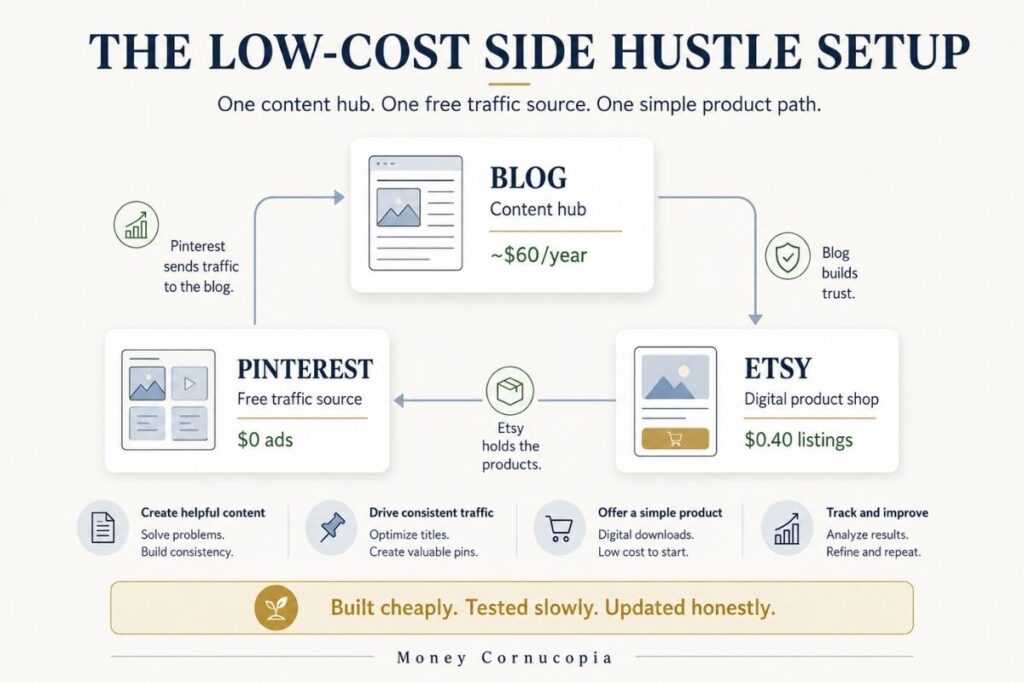
The truth, based on what I actually spent, sits in between. I started a blog, a Pinterest account, and an Etsy shop for roughly $60 in essential costs. That number is neither free nor expensive, and being honest about it matters more than any headline.
But before you get excited about the low number, here is the part most articles skip: starting cheap is not the same as earning quickly. I spent very little, my visibility has grown a lot, and I have still made $0 so far. This article is the honest breakdown of exactly what it costs to start, what I spent it on, what I deliberately skipped, and what actually happened.
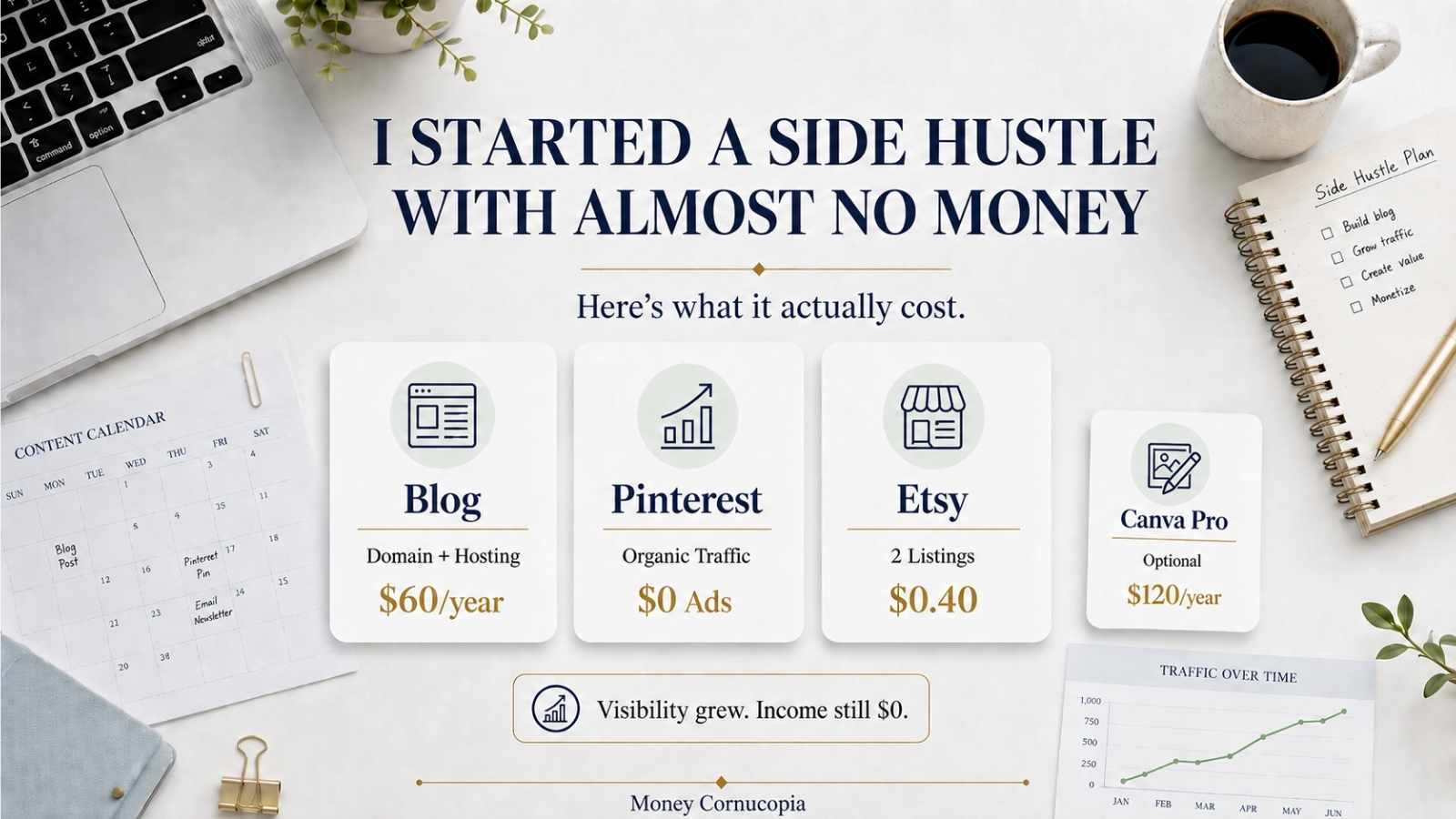
Quick cost summary: My essential startup cost was around $60 for the first year, roughly $20 for a domain and $40 for hosting. Pinterest cost $0, Etsy cost $0.40 for two listings, and Canva Pro was optional at around $120 per year.
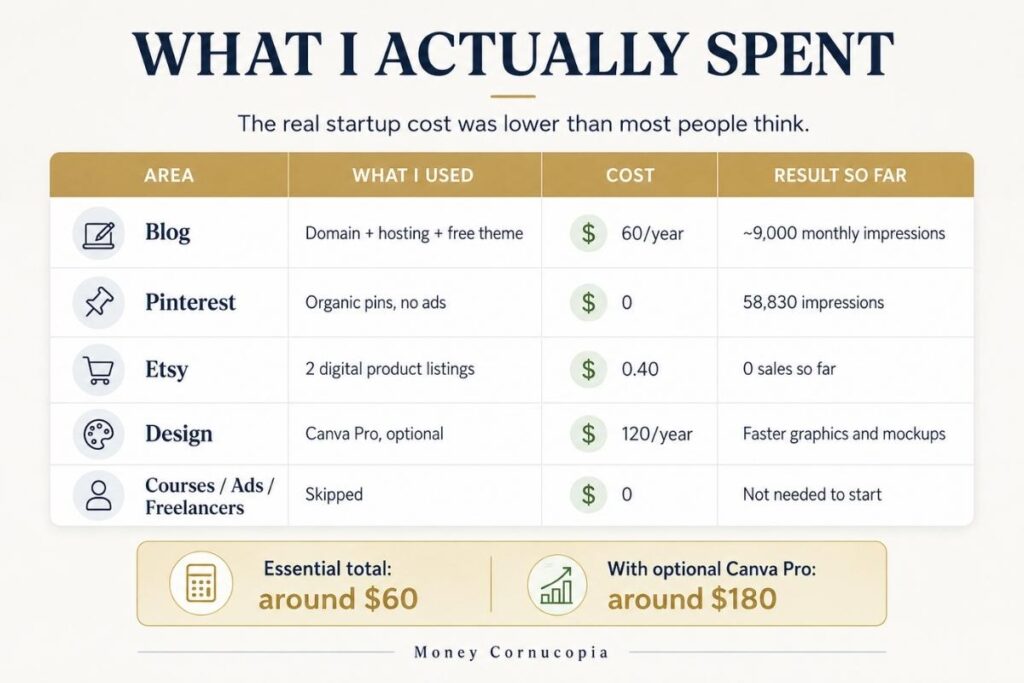
Table of Contents
First, What “No Money” Actually Means
When people search “how to start a side hustle with no money,” many are looking for fast cash today. Survey apps, gig work, something that pays this week.
That is not what this article is about, and I want to be upfront so you do not waste your time.
This is about starting a real online side hustle, a blog, Pinterest presence, and digital product shop, for almost no upfront money. These are assets that build slowly. They are not quick cash. If you need money this week, this is the wrong article for you, and I would rather tell you that now than have you read 2,000 words expecting something else.
It is worth knowing you are not alone in looking for a low-cost start. Penny Hoarder’s 2026 survey found that 53% of Americans with side hustles say they would struggle to cover essential expenses without that extra income, which is exactly why starting cheaply matters so much to so many people.
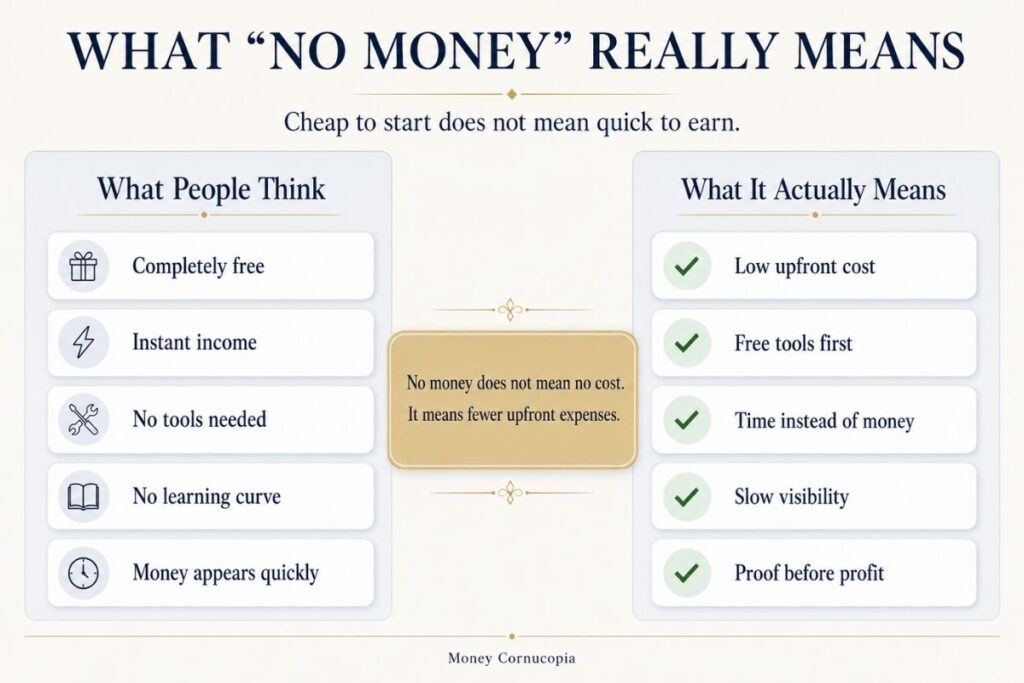
“No money” here means avoiding unnecessary upfront costs. It does not mean zero cost, zero time, or zero learning curve. It means you spend only where you genuinely have to, and you skip everything you can skip at the start.
What I Spent on the Blog
Essential cost: roughly $60 for the first year.
The blog was the only part that required real money to start, and even then, it was modest.
I paid around $20 for the domain name. This is the address of the website, the part people type to find you. Domains are a yearly cost, and most are inexpensive.
I paid around $40 for hosting. Hosting is the service that keeps your website online and accessible. This is also a recurring cost, but for a beginner blog, entry-level hosting is cheap and perfectly sufficient.
That is the entire essential cost of starting the blog: around $60 for the first year. No premium theme, no paid plugins, no developer. I used a free theme and free versions of the plugins I needed.
The content itself costs nothing but time. I wrote every article myself. I did not hire writers, buy content, or pay for any writing tools.
What I Spent on Pinterest
Cost: $0. No ad spend, ever.
Pinterest has been the most surprising part of this entire journey, and it cost me nothing.
I have spent zero dollars on Pinterest ads. Everything I have built there has been organic, meaning it came from consistent free pinning rather than paid promotion. The results have genuinely surprised me: I went from around 50 monthly impressions to 58,830 in about 5 to 6 weeks, with 723 saves, 61 outbound clicks to my blog, and just 16 followers.
I broke down exactly how that happened in how I grew Pinterest to tens of thousands of views without followers, but the relevant point for this article is simple: the single most effective traffic source I have cost me nothing but the time to create and schedule pins.
What I Spent on Etsy
Cost: $0.40 for two listings.
My Etsy shop has two digital product listings, a freelancer tax tracker and a budget planner. Etsy charges $0.20 per listing, so my total Etsy startup cost was 40 cents.
I recently changed my pricing on these from $5.99 to $9.99 after realizing that pricing too low was not building the trust I assumed it would. And to be completely honest, I have made zero sales so far.
I am including this because many people assume Etsy is a free flood of buyers waiting to discover your products. My honest result says otherwise. Listing something on Etsy costs almost nothing, but that does not mean it sells. The cost of entry is tiny. The cost of actually getting noticed and trusted is paid in time, not dollars. I dug into this gap more deeply in whether you can really make money selling PDFs, since my Etsy products are exactly that kind of digital file.
Optional Tool I Use: Canva Pro
Cost: around $120 per year. Helpful, but not required to start.
This is the one expense I want to be careful about, because I do not want to tell you that you need it when you do not.
I use Canva Pro to design my Pinterest pins, blog graphics, and Etsy mockups. It costs around $120 per year. The Pro templates, background remover, and resizing tools genuinely save me time and make my work look more professional.
But here is the honest truth: you do not need Canva Pro to start. The free version of Canva is genuinely capable, and a beginner can create perfectly good pins and graphics without paying anything. Canva Pro helps a lot once you are creating content daily, but it is an upgrade, not a requirement. If your budget is truly zero, start with free Canva and upgrade later only if the work justifies it. I broke down exactly when Pro becomes worth it in my honest Canva Free vs Pro breakdown.
So if you are counting strictly essential costs, my number is around $60. If you include Canva Pro, it is closer to $180 for the first year. Either way, it is far from the expensive setup many people imagine.
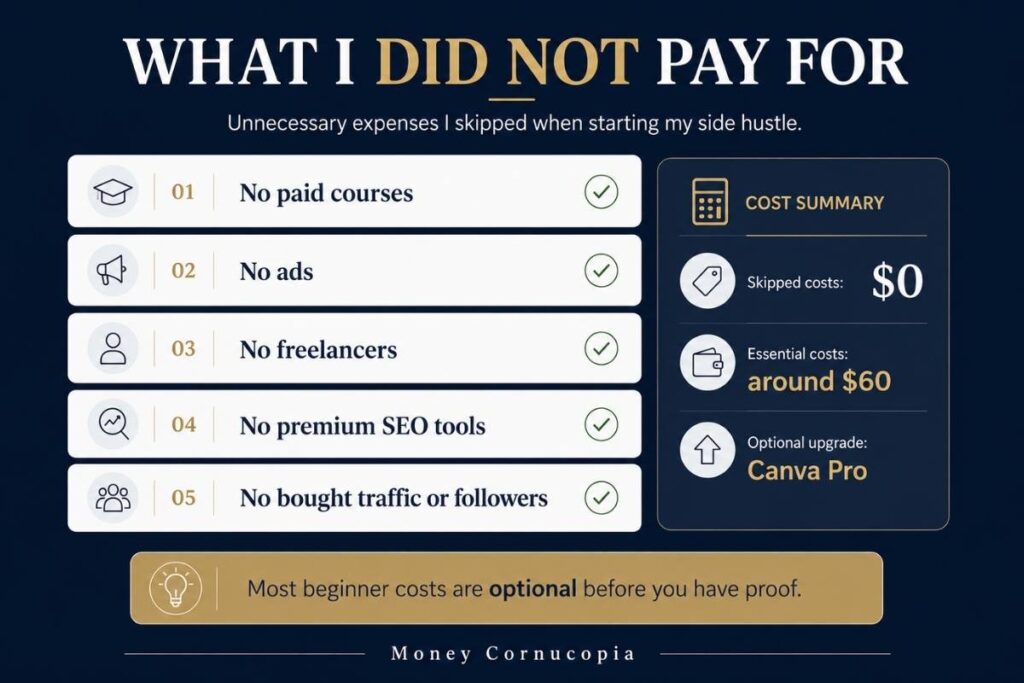
What I Did Not Spend Money On
This list matters as much as what I spent.
I did not buy any courses. No “make money on Pinterest” program, no Etsy masterclass, no blogging bootcamp. Everything I learned came from free articles, free videos, and trial and error.
I did not run any ads. Not on Pinterest, not on Google, not anywhere. All my traffic has been organic.
I did not hire anyone. No writers, no virtual assistants, no designers. I did every part myself.
I did not buy expensive software. No premium SEO tools, no paid automation stacks, no subscription pile. I used free tools wherever they existed.
I did not pay for traffic or followers. The 16 followers and 58,830 impressions on Pinterest were all earned, not bought.
The reason I am listing all of this is that these are exactly the costs that beginners are pushed toward constantly. Every one of them is optional at the start, and skipping all of them is part of how I kept my real cost near $60.
The Real Cost Was Not Money
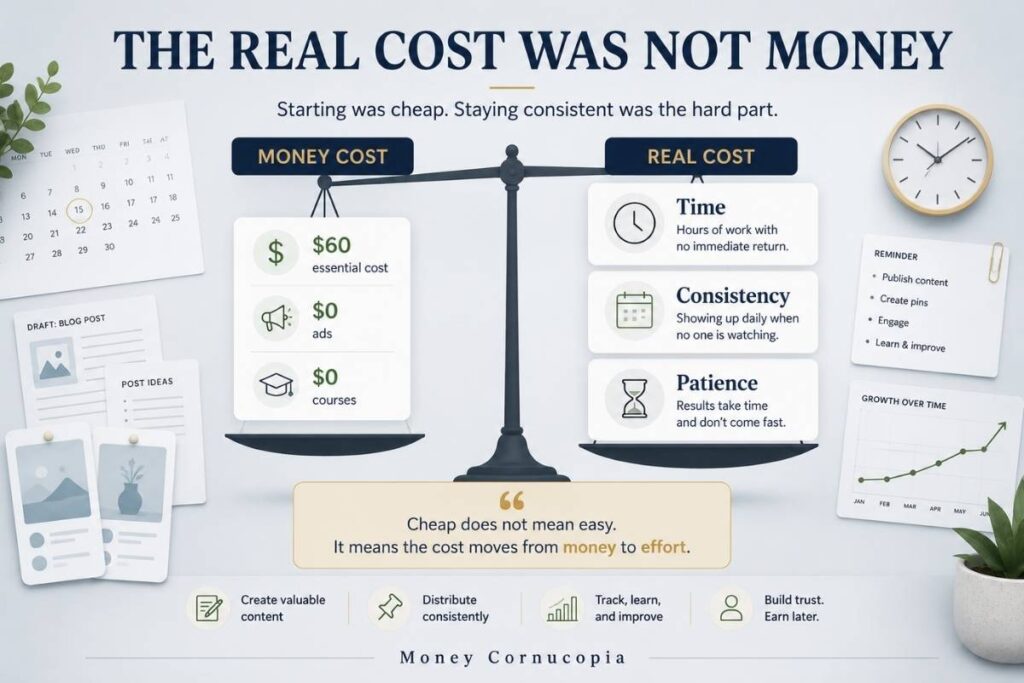
The expensive part of starting a side hustle was not the money. It was everything money cannot buy.
The real cost was time. Writing articles takes hours. Designing pins takes time every single day. Learning what works takes weeks of trying things that do not work first.
The real cost was consistency. Showing up every day to pin, to write, to adjust, even when nothing seemed to be happening. Especially when nothing seemed to be happening.
The real cost was patience. Waiting for Google to start trusting a new site. Waiting for Pinterest to start distributing my pins. Waiting through the long stretch where the numbers are technically growing, but the income is still zero.
I wrote about this stretch in detail in how long it actually takes to make money from a side hustle, because it is the part nobody warns you about. The money cost of starting is small. The psychological cost of waiting, while doubting whether any of it will work, is the real price of admission.
What I Would Do If I Were Starting Again With $0
If I had to begin again today with almost nothing, here is exactly how I would do it.
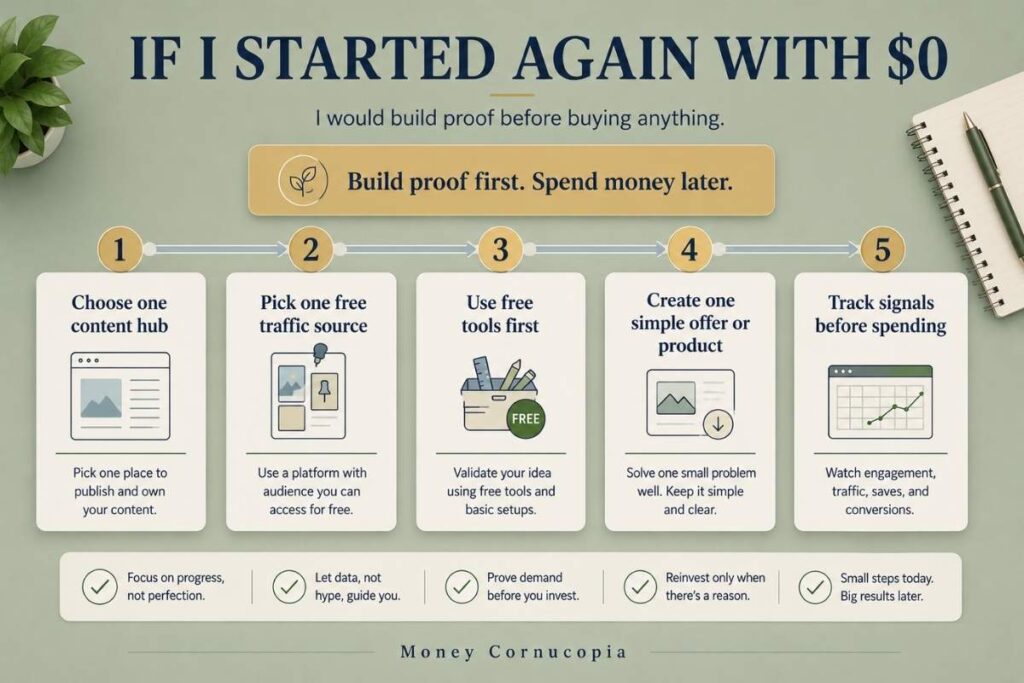
I would not start by buying tools, courses, or ads. I would start with one free traffic source, one simple content platform, and one offer or product, and I would use free tools until the work itself proved an upgrade was worth it.
The specific setup would be this. Start one content hub, a basic blog or even a free platform if a domain is out of budget. Pick one free traffic source and commit to it daily, which for me was Pinterest. Use free Canva for all graphics until you are creating enough volume that Pro pays for itself. Create one simple digital product or pick one affiliate path rather than spreading yourself across five. Track everything in a basic free spreadsheet so you can see which signals are growing. And run no ads at all until you have proof that people actually want what you are making.
The order matters. Most people spend money first and build proof later. I would build proof first and spend money only where the proof demanded it. Starting this way means your only real risk is your time, and time spent learning what works is never fully wasted, even if the first idea does not succeed.
So, Can You Start a Side Hustle With No Money?
Yes, you can start for almost nothing. No, that does not mean you will earn quickly.
Here is my honest answer after living it.
You can absolutely start a real online side hustle for very little money. Around $60 covers a domain and hosting. Pinterest is free. Etsy listings are cents. The free versions of most tools are good enough to begin. The “you need money to make money” idea is not true for getting started.
But starting is not the same as earning. The first goal of a cheap side hustle is not income. It is proof of visibility, evidence that real people are finding and engaging with what you make. My visibility has grown enormously. My income has not arrived yet.
This slow start is more normal than the hype suggests. According to Side Hustle Nation’s 2026 survey data, the median side hustle earns around $200 a month, and roughly half of side hustlers make under $100, which tells you that modest or slow early income is the norm, not the exception.
If you start expecting cheap to mean fast, you will quit in the first month when the money is not there. If you start understanding that cheap means slow but possible, you have a real chance.
The Honest Breakdown
| Area | What I used | Cost | Result so far |
|---|---|---|---|
| Blog | Domain, hosting, free theme | ~$60/year | ~9,000 monthly impressions, a handful of Google clicks |
| Organic pins, no ads | $0 | 58,830 impressions, 723 saves, 61 clicks | |
| Etsy | 2 digital product listings | $0.40 | 0 sales so far |
| Design | Canva Pro (optional) | ~$120/year | Faster, more professional pins and mockups |
| Courses, ads, tools, freelancers | None | $0 | Skipped entirely |
Essential total to start: around $60. With the optional Canva Pro: around $180 for the first year.
Frequently Asked Questions
Can you really start a side hustle with no money?
You can start a real online side hustle for very little money, though rarely literally zero. A blog needs a domain and hosting, which cost around $60 a year combined. Pinterest is free, and Etsy listings cost $0.20 each. Many tools have free versions. So while “completely free” is usually a myth, “very cheap” is genuinely achievable.
How much does it actually cost to start a side hustle?
In my case, the essential cost was around $60 for the first year, covering a domain and basic hosting. Adding optional tools like Canva Pro brought it closer to $180. The higher cost was not money but time and consistency over several months before seeing meaningful results.
What side hustle can I start with no money online?
The lowest-cost online side hustles are usually content-based or service-based: blogging, Pinterest traffic, freelance services, digital templates, affiliate content, or simple digital products. The cheapest option depends on whether you need fast income or are building long-term traffic. Service-based hustles tend to earn fastest, while content and product-based ones take longer but can compound over time.
What is the cheapest side hustle to start?
Service-based side hustles using skills you already have are often the cheapest because they require no inventory or upfront product cost. For digital asset side hustles like blogging, Pinterest, and digital products, the cost is low, but the timeline to income is longer. The cheapest option depends on whether you need money quickly or are building something over time.
Do you need to pay for tools to start a side hustle?
Not to start. Free versions of design tools like Canva, free blogging plugins, and free Pinterest scheduling are enough to begin. Paid tools like Canva Pro genuinely help once you are creating content daily, but they are upgrades rather than requirements. Starting with free tools and upgrading only when the work justifies it is a sensible approach.
How long before a cheap side hustle makes money?
Longer than most people expect. Low-cost digital side hustles like blogs, Pinterest, and Etsy shops build visibility before income. In my own case, I grew to tens of thousands of Pinterest impressions and thousands of blog impressions while still earning $0, because traffic and trust build before sales do. Several months of consistent effort is a realistic expectation before meaningful income.
Is Etsy free to start selling on?
Almost. Etsy charges $0.20 per listing, so listing a handful of products costs cents. However, listing something does not guarantee sales. The real challenge is visibility and trust, which take time to build, not money to buy.
Final Thoughts
Starting a side hustle with almost no money is genuinely possible. I did it for around $60 in essential costs, plus one optional tool, across a blog, a Pinterest account, and an Etsy shop.
But the cheap part was the easy part. The expensive part, the part that actually tests whether you will succeed, was the time, consistency, and patience required to keep going while the income stayed at zero.
If you are waiting until you have money to start, you may be waiting for a barrier that is smaller than you think. Sixty dollars and a willingness to show up consistently is genuinely enough to begin.
What it is not enough for is instant income. That part is still being built, on my side too. But you cannot build it at all until you start, and starting costs far less than most people believe.
I will update this article as the numbers change.
Leave a Reply