
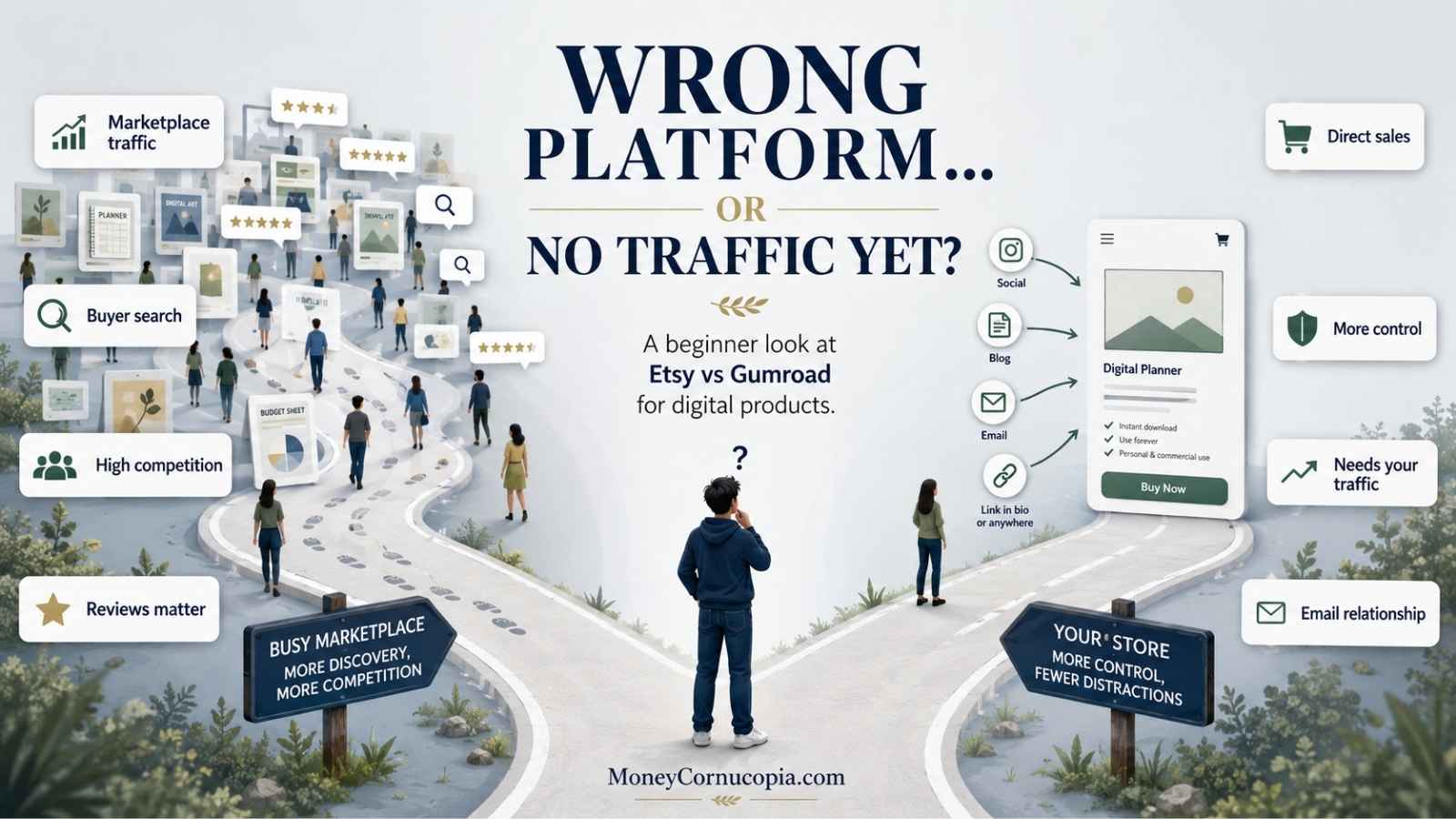
When you have been selling on Etsy for months with zero sales, a question eventually finds you.
“Am I on the wrong platform?”
I started asking it after weeks of watching my two listings sit untouched. I had fixed the mockups. I had researched the keywords. I had adjusted the pricing. I had studied successful shops and audited my own listings. Still nothing.
So I started researching Gumroad vs Etsy for digital products, not as a theory, but as someone genuinely wondering whether I had chosen the wrong platform. I spent several weeks understanding how both platforms work, what they charge, where their traffic comes from, and what kind of seller actually succeeds on each one.
What I found was not what I expected. And it completely changed how I think about platform choice for new digital product sellers.
Quick Summary: Gumroad vs Etsy for Digital Products
Etsy brings built-in marketplace traffic but puts you in direct competition with thousands of established sellers who have hundreds of reviews. Gumroad gives you more control and simplicity but requires you to bring every single buyer yourself.
For a complete beginner with no traffic source, Etsy is usually the better starting point because buyers are actively searching there. For a seller who already has blog traffic, Pinterest views, or a social audience, Gumroad can complement Etsy by converting warm traffic directly without marketplace fees or competition.
Neither platform solves the core problem for new sellers. That problem is visibility, and it cannot be solved by choosing the right platform alone.
Table of Contents
Why I Started Wondering If Gumroad Would Have Been Better
The thought process goes like this.
You list products on Etsy. Nothing sells. You look around and see other sellers with hundreds of sales on what looks like a similar product. You wonder if the issue is the platform, not the product or the listing.
Then someone mentions Gumroad. It sounds appealing. Lower fees. No competition from other sellers on the same page. Simple setup. Direct relationship with buyers. No Etsy algorithm deciding whether to show your listing.
It sounds like a cleaner, fairer version of selling online. So why is everyone not using it?
That was the question I needed to answer honestly.
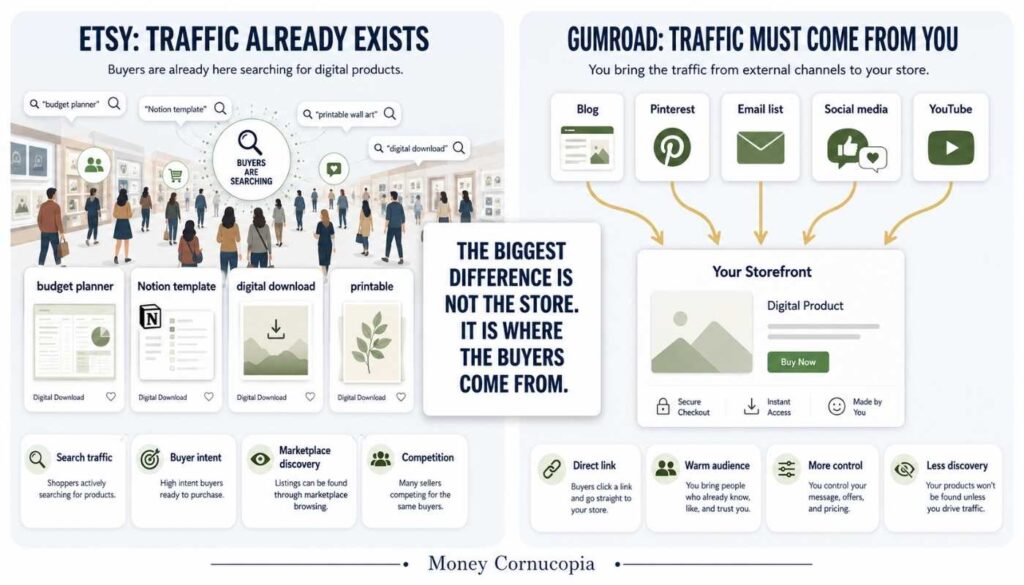
The Biggest Difference: Etsy Has Search Traffic. Gumroad Needs Traffic.
This single difference explains almost everything else about both platforms.
Etsy is a marketplace. It works like Amazon or eBay in the sense that buyers arrive on the platform already looking to buy something. They type “budget planner template” or “ADHD Notion system” into Etsy’s search bar and see results. Your listing can appear in those results and get discovered by a buyer who never heard of you before.
Etsy has a much larger marketplace discovery engine than Gumroad, which matters enormously for sellers who do not have their own audience yet. Buyers on Etsy are already in purchasing mode. They arrived with the intention of buying something.
Gumroad works completely differently. When you list a product on Gumroad, nobody automatically sees it. Gumroad has a Discovery feature where listed products can appear, but data from independent platform research consistently shows that a significant percentage of all Gumroad products generate zero revenue. Simply listing on Gumroad is not a traffic strategy. You need to bring buyers to your Gumroad page yourself, through social media, a blog, Pinterest, an email list, or paid advertising.
This is the honest reality most Gumroad comparisons skip. Gumroad does not have an Etsy-style search engine that surfaces your products to buyers who are actively looking. It is more like having your own shop window on a quiet street. Etsy is more like having a stall inside a busy market. The stall in the market has competition all around it. But at least people are walking past.
Gumroad vs Etsy Fees: The Real Numbers
Fees matter, but they tell a different story than most comparison articles suggest.
Here is the honest fee breakdown for both platforms:
| Fee type | Etsy | Gumroad |
|---|---|---|
| Listing fee | $0.20 per listing, renews every 4 months | None |
| Transaction fee | 6.5% of sale price | 10% + $0.50 per sale |
| Payment processing | Varies by country, often ~3% + $0.25 for US sellers | Included in the 10% |
| Discovery or offsite ads | 12 to 15% for sales via Etsy’s external ads | 30% if buyer comes through Gumroad Discover |
| Monthly fee | None | None |
At first glance, Gumroad looks cheaper for direct sales. And when you bring your own buyer directly to your Gumroad page, you pay roughly 10% plus $0.50. That is significantly better than layering Etsy’s listing fee, transaction fee, and payment processing together.
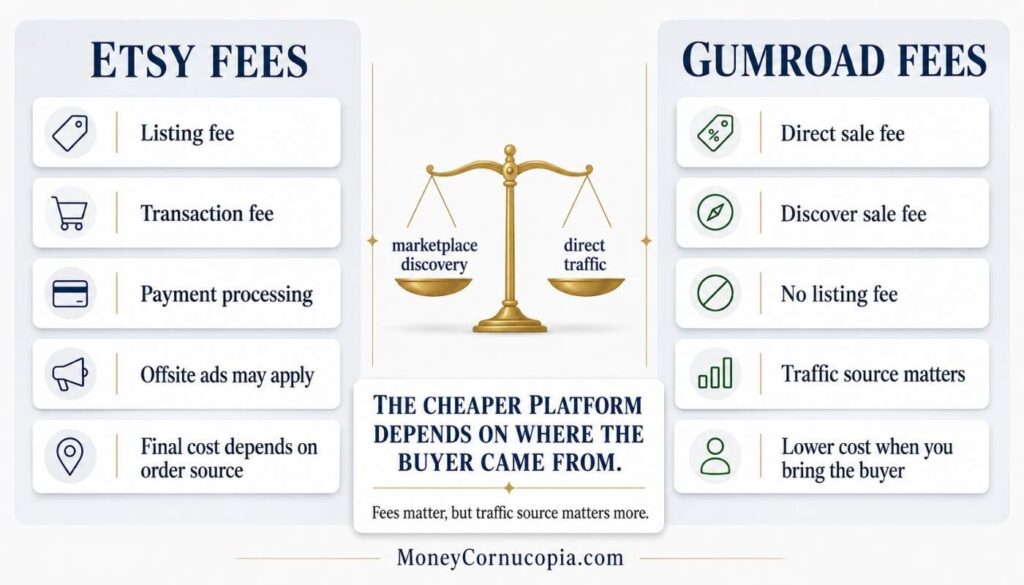
However, the real fee comparison depends entirely on where your buyers come from. For many sellers, Etsy’s total selling cost includes the listing fee, transaction fee, payment processing fee, and possible offsite ad fees, so the final percentage varies by order source and seller location. What is consistently true is that if you drive your own traffic to Gumroad directly, you keep more per sale. If a buyer finds you through Gumroad’s own Discovery feature, the 30% cut makes it comparable to or more expensive than Etsy.
The platform with better fees is whichever platform your buyers are actually coming from.
To see exactly how Etsy fees affect your profit on any specific price point, run your numbers through this free Etsy Digital Product Pricing Calculator and see what you actually keep after fees.
Which Platform Is Easier for Complete Beginners?
On pure convenience, Etsy wins. But convenience does not equal sales.
Both platforms are genuinely easy to set up. You can have a listing live on either platform within an hour. Neither requires technical knowledge or coding.
But Etsy has one specific advantage for beginners that Gumroad cannot match: buyers are already there looking for things to buy. You do not need to explain what Etsy is to a buyer. You do not need to convince someone to visit an unfamiliar platform. The transaction happens inside a marketplace they already trust and use.
Gumroad requires one extra step that beginners consistently underestimate. You need to find buyers and convince them to visit a page outside of any marketplace they already use. For a complete beginner with no social following, no blog traffic, and no email list, that extra step is enormous.
This is why switching from Etsy to Gumroad as a solution to zero sales almost never works. You bring the same zero-traffic problem to a platform that cannot help you with traffic at all.
The Real Reason You Might Have Zero Etsy Sales (And Why Gumroad Would Not Fix It)
This is the section I wish I had read before I started asking whether I should switch platforms.
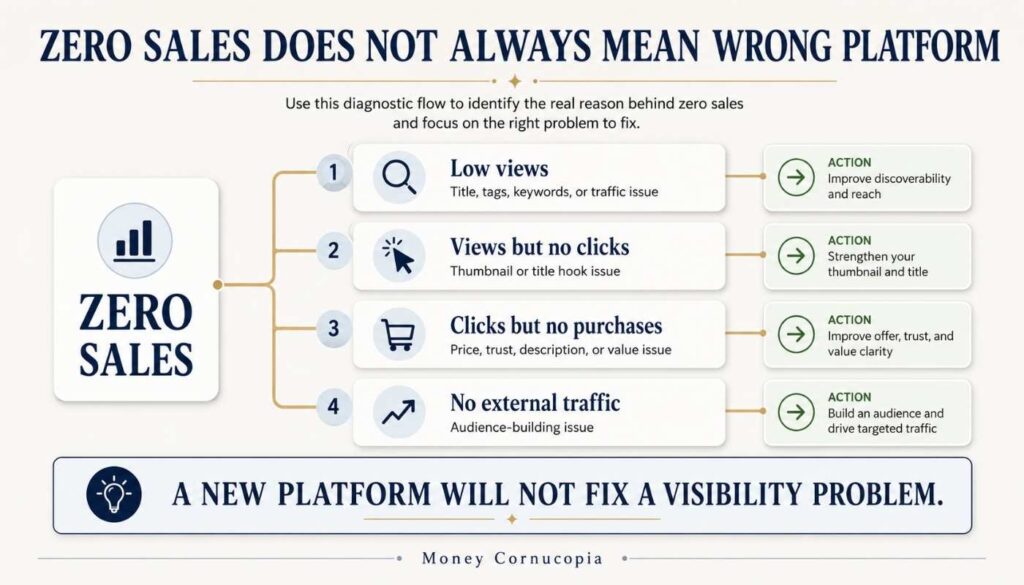
Zero Etsy sales can have several causes:
| Cause of zero sales | Why Gumroad would not fix it |
|---|---|
| Listing is not getting views | Your title, tags, or keywords are not matching what buyers search for. Gumroad has even less built-in search traffic than Etsy — the problem follows you |
| Listing gets views but no clicks | Your thumbnail is not compelling enough to earn a click. This is a listing presentation problem, not a platform problem |
| Listing gets clicks but no purchases | Pricing, trust signals, or description quality are the issue. These problems exist on any platform you move to |
| Shop has no external traffic | This is the one case where Gumroad could be comparable — but only if you already have a traffic source ready to direct to it |
In almost every case of zero Etsy sales, the problem is not Etsy. It is one of these four causes, all of which follow you to Gumroad.
I wrote about my own zero-sales journey and what I actually found when I studied successful shops in my Etsy listing audit. The short version: the platform was not the problem.
The Overwhelming Competition Problem on Etsy
Etsy’s traffic advantage comes with a significant cost: you are competing against everyone.
When you search “budget planner template” on Etsy, you see thousands of results. The listings at the top have 500 reviews, Star Seller badges, and years of conversion history telling Etsy’s algorithm to keep showing them. Your new listing with zero reviews starts at the back of a very long queue.
Etsy’s marketplace traffic does not automatically flow to new listings. Discovery depends heavily on category competition, listing optimization, and how well your title and tags match what buyers are actually searching for.
So the truth about Etsy’s traffic advantage is this: the traffic exists, but reaching it as a new seller requires time, optimization, external sources like Pinterest, and patience. It is not passive discovery. It is earned visibility in a competitive market.
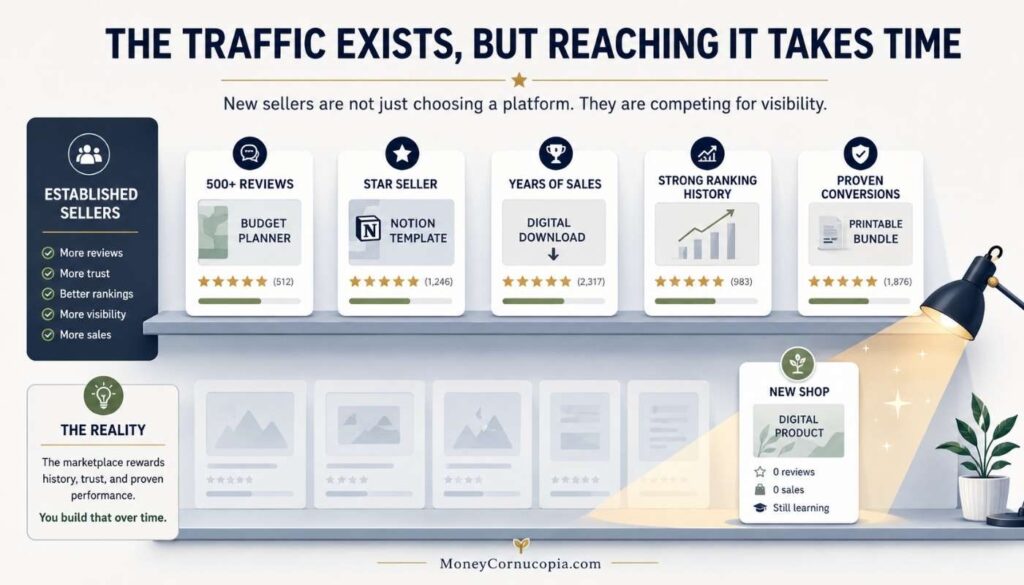
This is exactly why Pinterest has become the most important traffic strategy for new Etsy sellers. Pinterest bypasses Etsy’s internal competition by sending warm, interested buyers directly to your listing rather than making you compete for position in Etsy’s search results.
When Gumroad Makes More Sense Than Etsy
For certain sellers in certain situations, Gumroad is genuinely the better choice.
Gumroad makes more sense than Etsy when:
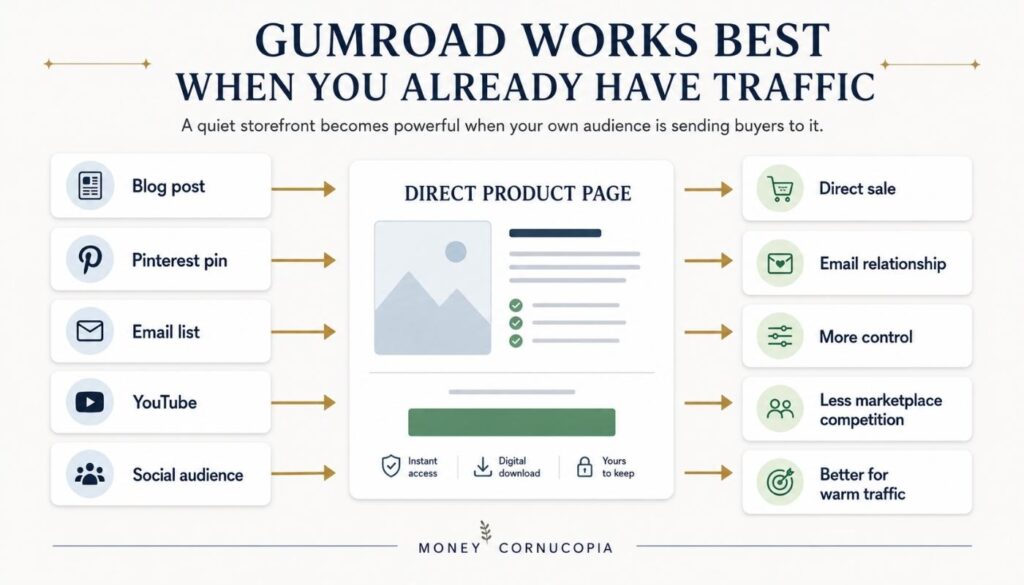
You already have your own traffic. A blog with growing readership, a Pinterest account sending regular outbound clicks, a YouTube channel, or an email list. If buyers are already coming to you through your own content, Gumroad lets you convert them at lower fees without Etsy’s competition.
You sell products that are not impulse-driven or visual. For low-ticket digital downloads like templates and printables, Etsy’s buyer intent and search volume can drive meaningful volume. For premium digital products like software, courses, or niche technical content, Gumroad’s pricing flexibility and direct buyer relationship tend to perform better.
You want to build a direct customer relationship. Etsy owns the customer relationship. A buyer who purchases from your Etsy shop is Etsy’s customer, not yours. Gumroad lets you collect email addresses and build a direct relationship with buyers for future sales.
You want to test pricing flexibility. Gumroad supports pay-what-you-want pricing, memberships, subscriptions, and bundles more naturally than Etsy. For creators experimenting with different pricing models, Gumroad offers more options.
When Etsy Makes More Sense Than Gumroad
For new sellers who have not yet built a traffic source, Etsy is still the smarter starting point.
If you have no blog, no Pinterest presence, no social following, and no email list, listing on Gumroad means you are marketing to nobody. Etsy, despite its competition, gives your products a chance to be found by buyers who are actively looking for what you sell.
For beginners selling visual, functional digital products like templates, planners, spreadsheets, and printables, Etsy’s marketplace is often the stronger starting point for two reasons:
Why Etsy is still the smarter starting point for new sellers
| 1 | Buyers on Etsy already trust the platform and expect to find digital downloads there — the purchase feels safe to them without any extra convincing |
| 2 | Etsy’s search gives you data — when you see which searches bring impressions to your listing, you learn what your audience is actually looking for, whether you later sell on Etsy, Gumroad, or your own website |
The Answer for Someone in My Exact Situation
I have a blog. I have Pinterest. I have zero Etsy sales. So what should I actually do?
After all the research, my honest answer is: use both, but understand what each one does for you.
Etsy remains my primary listing platform for now because it gives my products the possibility of marketplace discovery while I build my external traffic. Every view my listing gets, even without converting to a sale, is data about who is searching for what I sell.
Gumroad is the platform I will add next, specifically linked from my blog and Pinterest content. When someone reads my article about finance templates or digital products and wants to buy directly, a Gumroad link lets them do that without navigating Etsy’s marketplace. I keep more of the revenue, and I capture their email address for a direct relationship.
The two platforms serve different parts of the same business. Etsy handles marketplace discovery. Gumroad handles direct conversion from my own traffic.
This is how many successful digital product sellers eventually operate. They start on Etsy for discovery, build an audience through content and Pinterest, and gradually add Gumroad or their own storefront to handle direct sales from that audience at better margins.
The mistake is thinking you have to choose only one.
My Honest Verdict
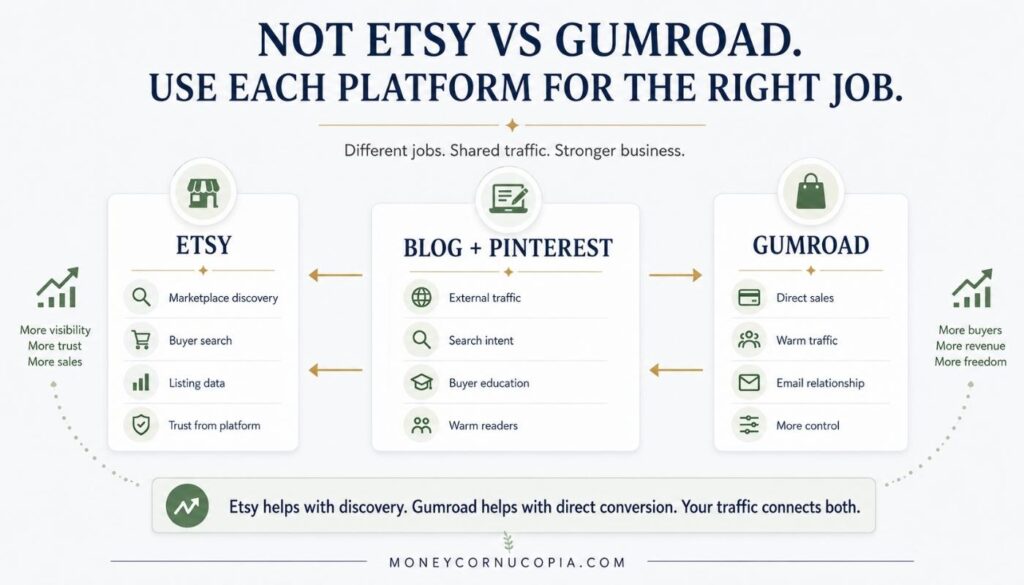
Start with Etsy if you need discovery. Add Gumroad when you have your own traffic. Do not switch platforms just because Etsy has not worked yet. Fix the visibility problem first. The platform is rarely the problem. The audience is.
Frequently Asked Questions
Is Gumroad or Etsy better for selling digital products?
It depends entirely on your traffic situation. Etsy is better for sellers who have no existing audience because it provides built-in marketplace search traffic. Gumroad is better for sellers who already have traffic from a blog, Pinterest, social media, or email list because it offers lower fees, direct customer relationships, and more control over the selling experience.
Why am I getting zero sales on Etsy for my digital products?
Zero Etsy sales in a new shop are usually caused by low listing visibility (title and tag problems), weak thumbnail presentation, insufficient external traffic, or no reviews, creating a trust gap. Switching to Gumroad will not fix any of these issues. Improving your listing quality, driving Pinterest traffic, and building patience for the first reviews to arrive are the higher-leverage actions.
Does Gumroad have built-in traffic like Etsy?
Gumroad has a Discovery feature, but it is not comparable to Etsy’s marketplace search traffic. Etsy has a significantly larger built-in buyer audience than Gumroad. Gumroad works best when you bring your own buyers through external traffic sources like a blog, Pinterest, or an email list.
What are the fees on Gumroad vs Etsy?
Gumroad charges 10% plus $0.50 per sale for direct sales and 30% for sales through their Discovery feature. Etsy charges a $0.20 listing fee, 6.5% transaction fee, and payment processing that varies by country, often around 3% plus $0.25 for US sellers, with optional offsite ad fees of 12 to 15%. For direct traffic you control, Gumroad is typically cheaper per sale.
Can I use both Gumroad and Etsy at the same time?
Yes, and many successful digital product sellers do exactly this. Etsy handles marketplace discovery for buyers who are searching within the platform. Gumroad handles direct sales from your blog, Pinterest, email list, or social media at lower fees and with direct customer relationship building. The two platforms serve different parts of the same business.
Which platform is better for Notion templates?
For beginners without an existing audience, Etsy is better because buyers specifically search for Notion templates there. As you build blog traffic and a Pinterest audience, adding Gumroad for direct sales makes strong sense. I covered what actually sells in the ADHD Notion template space on Etsy and the broader Notion template market in separate articles.
Final Thoughts: Would Gumroad Have Been Better?
The honest answer is no, not for where I started.
When I launched my Etsy shop, I had zero followers, zero blog traffic, and zero Pinterest presence. If I had launched on Gumroad instead, I would still have zero sales. Except I would also have zero marketplace impressions to learn from, zero chances of organic discovery, and zero data about which search terms connect buyers to products like mine.
Etsy was and remains the right starting point for someone in my position because even with zero sales, Etsy gives me something Gumroad cannot. It puts my product in front of buyers who are already looking.
But the question changed as I started building traffic.
Now that my Pinterest account is growing and my blog is earning Google impressions, Gumroad is starting to make sense as the next layer. Not as a replacement for Etsy. As a direct sales channel for the warm readers who arrive through my own content.
The creators making real income from digital products in 2026 are rarely using just one platform. They use Etsy for discovery, Gumroad or Payhip for direct sales, and Pinterest or a blog for the traffic that connects both.
That is the honest answer to the question I started with. Not Gumroad vs Etsy. Both, with clarity about what each one actually does for you.
Leave a Reply